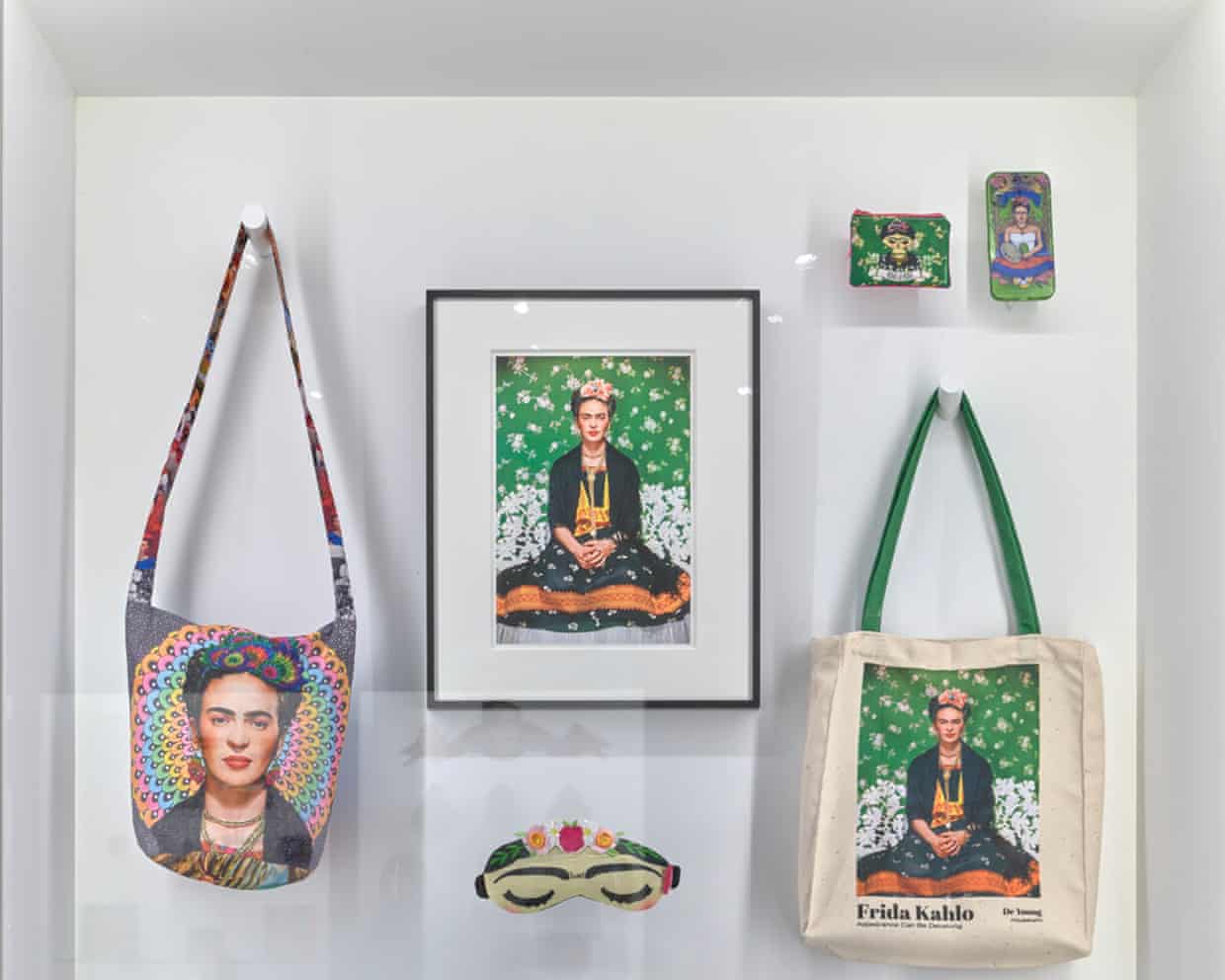
A display of Kahlo merch at a previous staging of the exhibition. Photograph: Museum of Fine Arts, Houston
Reports of the blockbuster exhibition’s death are premature as Tate’s Kahlo show breaks ticket record
Recent Van Gogh show was National Gallery’s most popular ever and British Museum gears up for arrival of Bayeux tapestry
Nadia Khomami Arts and culture correspondent
Fri 19 Jun 2026
When Tate Modern announced a major exhibition devoted to Frida Kahlo, few doubted it would be popular. The Mexican artist has become one of the most recognisable cultural figures in the world, with her image adorning everything from tote bags to T-shirts.
The Blue & Red Houses of Frida Kahlo & Leon Trotsky
Jeff Vonder Schmidt
17 September 2015
I’m very much in two worlds simultaneously right now. I’ve recently returned from an amazing week in Coyoacan with Gabriela Ortiz, following up with her and other friends in Mexico City on the success of our Los Angeles International New Music Festival this past July and planning next steps for the future. At the same time I’m also wrapping my head around my new post as artistic advisor to the Hanoi Philharmonic Orchestra and planning the first concerts of the Hanoi New Music Ensemble (probably its working title for now).
Bitch. Sauvage. Icon. Barbie doll: the grotesque exploitation of Frida Kahlo... and the artist behind the myths Valeria Luiselli Mon 11 Jun 2018
F
rida, the unapologetic bitch. Frida, the disabled artist. Frida, symbol of radical feminism. Frida, the victim of Diego. Frida, the chic, gender-fluid, beautiful and monstrous icon. Frida tote bags, Frida keychains, Frida T-shirts, And also, this year’s new Frida Barbie doll(no unibrow). Frida Kahlo has been subject to global scrutiny and commercial exploitation. She has been appropriated by curators, historians, artists, actors, activists, Mexican consulates, museums and Madonna.
Over the years, this avalanche has trivialised Kahlo’s work to fit a shallow “Fridolatry”. And, while some criticism has been able to counter the views that cast her as a naive, infantile, almost involuntary artist, most narratives have continued to position her as a geographically marginal painter: one more developing-world artist waiting to be “discovered”, one more voiceless subject waiting to be “translated”.
In 1938, Frida Kahlo painted Lo que el agua me dio (What the Water Gave Me), the painting perhaps responsible for launching her international career, but also her international mistranslation. In this self-portrait of sorts, we see Kahlo’s feet and calves inside a bathtub and above them, as if emanating from the steam, a collaged landscape: an erupting volcano out of which a skyscraper emerges; a dead bird resting on a tree; a strangled woman; a Tehuana dress dramatically spread out; a female couple resting on a floating cork. Kahlo was working on Lo que el agua me dio when the French surrealist André Breton arrived in Mexico for a visit. He was transfixed by it. He called Kahlo a “natural surrealist”, and in a brochure endorsing her New York debut at Julien Levy’s gallery in 1938, he wrote: “My surprise and joy were unbounded when I discovered, on my arrival in Mexico, that her work has blossomed forth, in her latest paintings, into pure surreality, despite the fact that it had been conceived without any prior knowledge whatsoever of the ideas motivating the activities of my friends and myself.”
Lo que el agua me dio
Though “natural surrealist” was a label that helped translate Kahlo’s paintings for European and American audiences, it was one that she always rejected. To be projected as a “surrealist” in Europe helped audiences to understand her work more immediately – more palatably. She was branded as authentically Mexican, with international flair. But to be seen as a “naturalsurrealist” also transformed her into a kind of sauvage: unconscious of her talent, unsuspecting of her mastery. After her debut, a Time magazine critic described her work as having “the daintiness of miniatures, the vivid reds and yellows of Mexican tradition and the playfully bloody fancy of an unsentimental child.”
Kahlo was hardly unsuspecting, hardly unconscious of what she was doing and who she was. She knew how to capitalise on the elements of her private life and cultural heritage, curate them carefully, and use them to build her public persona. She was a mestizo, born in Mexico City, who had adopted a traditional Zapotec-Tehuana “look”. Her father, the German-born Carl Wilhelm “Guillermo” Kahlo, was a well-known photographer, and the family lived in a neocolonial mansion in Coyoacán, the famous Casa Azul. Kahlo was very much aware of the complex politics of selfhood she was creating and manipulating. In a 1939 photograph taken during the opening of Kahlo’s first exhibition in Paris, she is posing in front of Lo que el agua me dio. She is wearing a Tehuana dress and her unibrow is underscored with black eyeliner: Frida representing Frida. (It is unclear which one is the artwork.)
The way Kahlo’s work and persona were read in Mexico was of course very different from the way they were translated into other cultural milieux. Just as Breton had attached the category “natural surrealist” to her art and framed her work in a discourse that she herself did not embrace, many others did the same with various aspects of her public and private life.
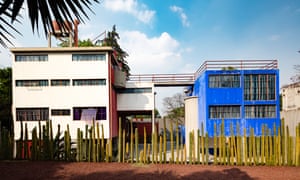
A post-revolutionary symbol of modernity: The casa-estudio designed for Rivera and Kahlo by Juan O’Gorman. Photograph: Pawel Toczynski/Getty Images
An interesting example of this is the house and studio in Mexico City where she and Diego Rivera lived and worked during some of their most productive years in the 1930s. It was designed by Juan O’Gorman, the young architect who was then pioneering the radical architectural changes that took place in post-revolutionary Mexico City.
Before the Mexican Revolution (1910-20), 19th-century neoclassical and colonial architecture dominated. French-influenced mansions across the city stood like lonely homages to a quickly decaying European noble class, and the family life of the Mexican bourgeoisie played out in the sumptuous and darkened stages of these interiors, with their heavy drapes and excessive ornamentation. But after the revolution new ideas about hygiene, ventilation, comfort, efficiency and simplicity made their way into the city. Houses, and with them daily life, were transformed radically and rapidly.
Attuned to the ideological and architectural changes taking place, the couple asked O’Gorman to design a studio and house for them. He created a space specifically for a couple of painters – at once separated and connected. The buildings were the first in Mexico designed for specific functional requirements: living, painting and showcasing work.
In 1933, a few years after Kahlo and Rivera married, they moved in. Rivera’s area was larger, with more work space. Kahlo’s was more “homely”, with a studio that could transform into a bedroom. A flight of stairs led from her studio to a rooftop, which was connected by a bridge to Rivera’s space. Beyond being a workplace, it became a space for the couple’s extramarital affairs: Rivera, with his models and secretaries; Kahlo, with certain talented and famous men, from the sculptor and designer Isamu Noguchi to Leon Trotsky. Perhaps without knowing it, O’Gorman designed a house whose function it was to allow an “open” relationship.
The house was an emblem of modernity and a kind of manifesto: a solitary example of a new functionalism in a city that was still trying to find a national architectural language that best suited its revolutionary programme. It did not encode traditional values or messages. It simply addressed the practical necessities of its dwellers, was materially efficient (primarily made of reinforced concrete), socially progressive and cheap.
With time, however, as neutral as the buildings may have been intended to be in their architecture, they ended up functioning as a site of Mexican cultural capital, especially one connected to indigenous Mexican craftsmanship. The couple were hosts to visitors who came to see their work and works-in-progress, as well as their collections of arts and crafts: Trotsky, Nelson Rockefeller, Pablo Neruda, John Dos Passos, Sergei Eisenstein, Breton.
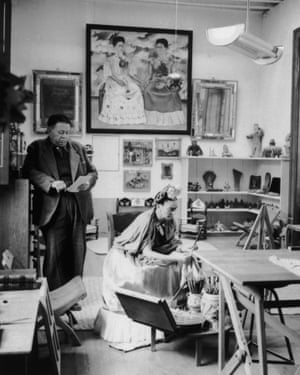
Diego Rivera and Frida Kahlo. Kahlo’s self-portrait, The Two Fridas (1939), hangs in the background. Photograph: Hulton Archive/Getty Images
O’Gorman gave Rivera and Kahlo a machine to live in, as Le Corbusier would have had it, but also a machine to translate in. Their home brought in foreignness as much as it served as a platform to project a particular idea of Mexico to the world. More than anything, it provided the stage for the power couple of Mexican modernity: cosmopolitan, sophisticated, well-connected and more Mexican than Mexico. The couple’s ultimate oeuvre was, of course, themselves. Kahlo and Rivera were, perhaps, Mexico’s first performance artists, and their casa-estudio was their very own gallery.
In 1934 the photographer Martin Munkacsi visited Mexico and copiously documented the house and studios. The pictures had been commissioned for Harper’s Bazaar, the New York-based fashion magazine which was directed at an upper-class female audience, mostly American but also French and British. In Harper’s July 1934 issue, a double-page spread titled “Colors of Mexico” displayed three of Munkacsi’s many photographs: one of Kahlo crossing the bridge from one house to the other; one of Rivera working in his studio; and one of Frida climbing the staircase to the roof. In the centre of the layout, there is a large photograph of the couple walking beside the cactus fence; a caption explains “Diego Rivera with Señora Freida [sic] Kahlo de Rivera before the cactus fence of their Mexico City home.”
The buildings were designed to embody a proletkult ideology, resembling a factory or industrial complex, with its visible water tanks, its exposed materials and raised supporting columns. The cacti fence surrounding the house, if seen in relation to it, added to the general industrial feeling. However, Harper’s chose the image that best decontextualised the cacti fence and thus presented it as a folkloric, decorative element. To the right of that central image appeared a series of photographs of barefooted Mexican peasants selling crafts and riding mules.
An accompanying piece written by Harry Block – a New York editor – describes his search for the perfect Mexican sandals: “All Mexico walks on huaraches (pronounced wahratchehs and meaning sandals) …” Juxtaposed with the portrait of Rivera and Kahlo – he, dressed like a European dandy, solid leather shoes included; she, wearing pointy black boots – Block’s ode to the huarache seems rather forced. The Harper’s piece is a perfect example of how Mexico was perpetuated in such stories as a marginal space, with glimpses of modernity a rare exception to the rule. The magazine shows an utterly foreign Mexico, but in a way that also makes it easier to capture and explain to foreign audiences through its associated cliches. It is a form of translation that simplifies the complex operations that took place in the Rivera-Kahlo home
A functionalist Mexican house that showcased post-revolutionary art? Impossible! Let’s just use the picture with the cacti.
This instance of colonising narratives in cultural translations was not the end but the beginning. In 2002, Harvey Weinstein’s company distributed the film Frida, starring Salma Hayek, asked for a more-sexy Kahlo – more nudity, less unibrow – and got away with it. In a 2016 concert stunt in Mexico, Madonna pulled a Frida lookalike from the audience, said she was “so excited” to finally meet Frida, and then handed her a banana as a token.
Last Halloween, my 21-year-old niece was dragged by her friend to a New York college party. She wasn’t wearing a costume, was not really in the mood. At some point, a trio of Wonder Women stumbled in: red knee-high boots, star print bikini-bottoms, strapless tops, gold headbands fastened around long blond hair.
One of the three wonders took a long swig from a bottle and almost fell back, suddenly noticing my niece, standing behind her. She turned round and looked straight into her face. She studied it up close. Like many women in my maternal family, my niece inherited a dark, robust unibrow. The Wonder Woman finally said: “Oh my god, it’s Frida Kahlo!”.
•Valeria Luiselli’s Tell Me How It Ends is published by 4th Estate. Frida Kahlo: Making Herself Up opens at the V&A, London SW7, on 16 June. vam.ac.uk.
Frida Kahlo, Paris, France letter to Nickolas Muray, New York, N.Y., 1939 Feb. 16
My adorable Nick. Mi Niño,
I am writing you on my bed in the American Hospital, yesterday it was the first day I didn’t have fever and they aloud me to eat a little, so I feel better. Two weeks ago I was so ill that they brought me here in an ambulance because I couldn’t even walk. You know that I don’t know why or how I got coli-bracilus on the kidneys thru the intestines, and I had such an inflamation and pain that I thought I was going to die. They took several eXrays of the kidneys and it seems that they are infected with those damn colibacilus. Now I am better and next monday I will be out of this rotten hospital. I can’t go to the hotel, because I would be all alone, so the wife of Marcel Duchamp invited me to stay with her for a week while I recover a little. Your telegram arrived this morning and I cried very much –of happiness, and because I miss you with all my heart and my blood. Your letter, my sweet, came yesterday, it is so beautiful, so tender, that I have no words to tell you what a joy it gave me. I adore you my love, believe me, like I never loved anyone-only Diego will be in my heart as close as you-always. I haven’t tell Diego a word about all this trouble of being ill – because he will worry so much – and I think in few days I will be allright again, so it isn’t worthwhile to alarm him.
Don’t you think so?
Besides this damn sickness I had the lousiest luck since I arrived. In first place the question of the exibition is all a damn mess. Until I came the paintings were still in the custum house, because the s. of a b. of Breton didn’t take the trouble to get them out. The photographs which you sent ages ago, he never received. So he says- the gallery was not arranged for the exibit at all and Breton has no gallery of his own long ago. So I had to wait days and days just like an idiot till I met Marcel Duchamp (a marvelous painter) who is the only one who has his feet on the earth, among all this bunch of coocoo lunatic son of bitches of the surrealists. He immediately got my paintings out and tried to find a gallery. Finally there was a gallery called “Pierre Colle” which accepted the damn exibition. Now Breton wants to exibit together with my paintings, 14 portraits of the XIX century (Mexicans) about 32 photographs of Alvarez Bravo, and lots of popular objects which he bought on the markets of Mexico – all this junk, can you beat that? For the 15th of March the gallery supose to be ready. But…. The 14 oils of the XIX Century must be restored and the damn restoration takes a whole month. I had to lend to Brenton 200 bucks (Dlls) for the restoration because he doesn’t have a penny. (I sent a cable to Diego telling him the situation and telling that I lended to Breton that money – he was furious, but now is done and I have nothing to do about it) I still have money to stay here till the beginning of March so I don’t have to worry so much.
Well, after things were more or less settled as I told you, few days ago Breton told me that the associated of Pierre Colle, an old bastard and son of a bitch, saw my paintings and found that only two were possible to be shown, because the rest are too “shocking” fir the public!! I could of kill that guy and eat it afterwards, but I am so sick and tired of the whole affair that I have decided to send everything to hell, scram from this rotten Paris before I get nuts myself. You have no idea the kind of bitches these people are. They make me vomit. They are so damn “intelectual” and rotten that I can’t stand them any more. It is really too much for my character- I rather sit and sell tortillas, than to have any thing to do with those “Artistic” bitches of Paris. They sit for hours on the “cafés” warming their precious behinds, and talk without stopping about “culture” “art” “revolution” and so on and so forth, thinking themselves the gods of the world, dreaming the most fantastic nonsense, and poisoning the air with theories and theories that never come true. Next morning they don’t have anything to eat in their house because none of themwork and they live as parasites of the bunch of rich bitches who admire their “genius” of “Artists”, Shit and only shit is what they are. I never seen Diego or you wasting their time on stupid gossip and “intelectual” discussions. That is why you are real men and not lousy “artists”- Gee weez! It was worthwhile to come here only to see why Europe is rottening, why all this people - good for nothing - are the cause of all the Hitlers and Mussolinis. I bet you my life I will hate this place and its people as long as I live. There is something so false and unreal about them that they: drive me nuts.
I am hoping to get well soon and scram from here. My ticket will last for a long time but I already have acommodations for the “Isle de France” on the 8 of March. I hope I can take this boat. In any case I won’t stay here longer than the 15th of March. To hell with the exhibition in London. To hell with everything concerning Breton and all this lousy place. I want to go back to you. I miss every movement of your being, your voice, your eyes, your hands, your beautiful mouth, your laugh so clear and honest. YOU. I love you my Nick. I am so happy to think I love you – to think you wait for me – you love me.
My darling give many kisses to Mam on my name, I never forget her. Kiss also Aria and Lea. For you my heart full of tenderness and caring. One special kiss on your neck your give my love to Mary Skear if you see her and to Ruzzy
Frida Kahlo’s Passionate Hand-Written Love Letters to Diego Rivera
by Maria Popova
“Only one mountain can know the core of another mountain.”
Mexican painter and reconstructionist Frida Kahlo is among the most remarkable figures of contemporary culture. At a young age, she contracted polio, which left her right leg underdeveloped — an imperfection she’d later come to disguise with her famous colorful skirts. A decade later, as one of only thirty-five female students at Mexico’s prestigious Preparatoria school, she was in a serious traffic accident, which resulted in multiple body fractures and internal lesions inflicted by an iron rod that had pierced her stomach and uterus. It took her three months in full-body cast to recover and though she eventually willed her way to walking again, she spent the rest of her life battling frequent relapses of extreme pain and enduring frequent hospital visits, including more than thirty operations. As a way of occupying herself while bedridden, Kahlo made her first strides in painting — then went on to become one of the most influential painters in modern art.
Two years after the accident, in 1927, she met the painter Diego Rivera, whose work she’d come to admire and who became her mentor. In 1929, despite the vocal protestations of Kahlo’s mother, Frida and Diego were wedded and one of art history’s most notoriously tumultuous marriages commenced. Both had multiple affairs, the most notable of which for bisexual Kahlo were with French singer, dancer, and actress Josephine Baker and Russian Marxist theorist Leon Trotsky. And yet her bond with Diego was one of transcendental passion and immense love.
Diego.
Truth is, so great, that I wouldn’t like to speak, or sleep, or listen, or love. To feel myself trapped, with no fear of blood, outside time and magic, within your own fear, and your great anguish, and within the very beating of your heart. All this madness, if I asked it of you, I know, in your silence, there would be only confusion. I ask you for violence, in the nonsense, and you, you give me grace, your light and your warmth. I’d like to paint you, but there are no colors, because there are so many, in my confusion, the tangible form of my great love.
I suffered two grave accidents in my life. The other accident is Diego.
She and the Mexican muralist Diego Rivera first met when she was 15, and a student at a college where Diego was commissioned to paint a mural. So badly behaved were Frida and her gang that the previous muralists had armed themselves with pistols to deal with the kids. After meeting again in 1928, they married the following year, and she yearned for a child with him. Although she became pregnant several times, she had two terminations for medical reasons and one miscarriage. Her pelvis, it seems, had been too badly damaged to support a baby. Her painting Henry Ford Hospital depicts the artist, naked and alone on blood-soaked sheets, surrounded by a barren landscape that echoes her own barrenness. “Never before,” said Diego, “has a woman put such agonized poetry on canvas.”



+(1).jpg)


