Showing posts with label Tomi Ungerer. Show all posts

Tuesday, February 12, 2019

Tomi Ungerer’s Triumphant Return

Tomi Ungerer’s Triumphant Return


By Robert Sullivan

February 4, 2015


Now that the illustrator Tomi Ungerer is back—and this was the feeling at the opening of the wonderful new exhibition “Tomi Ungerer: All in One,” up through March 22nd at the Drawing Center—it seems worth looking again at how he went away. Ungerer was sent away, really, his books banned, removed from libraries, and not reviewed in, for instance, the _Time_s, after he was deemed too offensive as an artist. It was a break that was not his fault, though he certainly didn’t help matters and still seems to blame himself for it, judging from his remembrances in the documentary “Far Out Isn’t Far Enough,” which came out in limited release in 2013 and is now available to stream. In the documentary, Ungerer remembers the break as having begun at an American Library Association conference in 1969. “You can really pinpoint exactly the moment that my multiple activities came out into the open,” he says. “It all happened in this one evening, at a children’s-book convention, and I had to say a few words.”

Monday, February 11, 2019

Children's Author Tomi Ungerer / Still Subversive After All These Years


Tomi Ungerer

Children's Author Tomi Ungerer: Still Subversive After All These Years

October 4, 2012 

Tomi ungerer finger pop
"I have the fullest respect for a piece of white paper which I then shall rape with my drawings and my writing."  from Far Out Isn't Far Enough
Outside librarian circles, the name Tomi Ungerer may not be very familiar. Children's librarians know him as  a writer of both fame and notoriety. I was lucky enough to get a ticket to Far Out Isn't Far Enough: The Tomi Ungerer Story which was screened recently at TIFF. It was easily the best film, out of many very good films, that I saw. In an inspired move, the director, Brad Bernstein, had Ungerer's drawings and posters animated which added enormously to the telling of his story.
Ungerer was born in Strasbourg, Alsace  in 1931. When the war came his mother was hauled in front of local Nazi officials for speaking French. French books were burned. After the war, Alsatians were banned from speaking their German-based dialect.  German books were burned. It's not hard to spot the point in time when his keen sense of the absurd was born.
He didn't start out as a children's author when he moved to New York in 1956, but gained quick success as a graphic artist and illustrator for Life, Esquire, Harper's Bazaar and The New York Times among others.  Often his work was political.Black and white power

Eventually, he was lured into writing children's books by  Ursula Nordstrom. Norstrom was responsible for discovering and nurturing several prominent writers, including Maurice Sendak, Margaret Wise Brown, E.B. White, Shel Silverstein and Charlotte Zolotow.  Ungerer's satirical humour, lack of sentimentality and renegade drawing style meant he was bound to stand out as an original.  In the film, his friend Maurice Sendak, says, "I'm a self-taught raving maniac, but not as crazy as Tomi. Or as great as Tomi."
There's something slightly dark about Tomi Ungerer's books. Hints of recent violence or violence soon to be perpetrated - sharp knives, battle-axes, faint spots of blood, a Reaper's scythe - pepper his illustrations, although you often have to look hard for them in the spectacularly chaotic crowd scenes he enjoys creating. I think this is part of their appeal to kids; it's a reward and a surprise for paying attention - a slightly perverse I Spy.  In this scene from The Beast of Monsieur Racine, a man has a rather painful-looking injury from the umbrella embedded in his head, and the gendarme beside him has lost a hand.
Beast of M Racine crowd
            
In another illustration, a hobo carries a severed foot in his bundle.  Is it a spare foot for someone used to walking the open road? And why are his eyes red?  There are no tears, so he hasn't been crying.  An adult might ask, is he drunk or stoned, perhaps?

               Beast of M Racine hobo Beast of M Racine scythe


              Beast of M Racine trunk


But, for all their darkness, the recurring theme in his books is this: something you thought was a bit scary and grotesque can often be quite beautiful and heroic.  The crime-fighting heroes of Crictor and Emile and Orlando the Brave Vulture are a snake, an octopus and a carrion eater.
The Three Robbers begins ominously:  "In the dark of the night they walked the roads, searching for victims."
                                Three robbers
                 
But the robbers turn out to be good guys who use their plunder to start an orphanage.
Despite his award-winning success as a children's book writer, Ungerer continued to illustrate for adults, too.  It was his 1970's collection of sado-masochistic erotica, Fornicon  that brought much criticism down on him (there's a copy in the Special Collections of the Toronto Reference Library). In the film he described attending a conference of the American Library Association and being verbally attacked by several children's librarians. Some of his books were banned. His popularity with publishers waned because of his erotic drawings.  He eventually left New York and didn't write another children's book for more than two decades. 
His life also has a Canadian connection. He and his wife lived in Gull Harbour, Nova Scotia for a few years, a time chronicled in the book he wrote and illustrated, Far Out Isn't Far Enough.  Although beautifully illustrated with local scenery and plant and animal life, it doesn't sound as if it was a particularly happy time for him. The book ends in carnage after a pack of dogs (joined by their own beloved Sacha) attacked the Ungerer's herd of sheep, killing several, and in a scene straight out of Far From the Madding Crowd, driving the rest over the edge of a cliff.   After that, they closed the farm down.
Now living in Ireland, Tomi Ungerer has, in recent years, experienced a renaissance of sorts, at least in Europe.  In 1998 he was awarded the Hans Christian Anderson Prize , the most prestigious international award for children's literature, and he became an Officer of the Legion d'Honneur in 2000.  He even has his own museum in Strasbourg which opened in 2007.  I believe through word of mouth, the documentary about his life  will reach an audience in North America, and Tomi Ungerer, once despised, ostracised and forgotten, will be rediscovered.  Until it comes to the theatre, rediscover the renegade Tomi Ungerer yourself by visiting the library.
Update: Far Out Isn't far Enough is the story of Tomi Ungerer's entire career, and as such, this trailer includes images from the above-mentioned collection of his erotic drawings, Fornicon.


Tomi Ungerer / Women


WOMEN
by Tomi Ungerer


Tomi Ungerer / Objectos


Tomi Ungerer

Objects


Tomi has been working with mixed media since the beginning of his career in the 1950’s.  Many of his exhibitions have included a 3D element including found objects, re-purposed farm implements and materials such as wood, rust and barbies.  Below is a very small selection of new works which were featured in the 2016 exhibition Incognito and were extensively photographed for the catalogue of the same name.  


Sunday, February 10, 2019

Tomi Ungerer is dead

Tomi Ungerer

Writer: Tomi Ungerer is dead


The French draftsman, cartoonist and children's book author Tomi Ungerer is dead. He died at the age of 87 in Ireland in his daughter's home, as several French media reported in unison.
Ungerer wrote and illustrated famous children's books like The Three Robbers and The Moonman .He also created sharp-tongued picture books for adults, also with poster art and erotic drawings he found recognition. He has published more than 140 books translated into 28 languages.
Ungerer was born in Strasbourg in 1931. Since 1976 he lived with his third wife in Ireland. 
"Not only was he a great artist, he embodied the complexity of Alsace, its dual culture, we envisioned it to be eternal, and now it's leaving us," said Alain Fontanel, first deputy mayor of Strasbourg, like the newspaper Les Dernières Nouvelles d'Alsace reported. In 2007 the "Center for Illustration - Tomi Ungerer" opened in Strasbourg. It was the first museum in France that honored a draftsman during his lifetime.

INTERNATIONAL NEWS


DE OTROS MUNDOS

RIMBAUD


Tomi Ungerer / A life in pictures

Tomi Ungerer

Great children's illustrators


Tomi Ungerer - a life in pictures

The writer and illustrator Tomi Ungerer has delighted generations of children since the publication of his first book in 1957, creating a rich series of fantastical fables which he says always carry a message


The Mellops Go Diving for Treasure(1957) Ungerer made his name with a series of books about an adventurous family of French pigs called the Mellops. Mr Mellop finds an intriguing letter in the attic, giving a set of co-ordinates for some lost treasure, and the family goes on a great adventure to find itPhotograph: Phaidon Press Limited

The Mellops Go Diving for Treasure(1957) After diving to retrieve the treasure from a sunken ship, the Mellops need help from a lovely merpig. Her charming music lulls to sleep a dangerous octopus who lives in the shipwreckPhotograph: Phaidon Press Limited

The Mellops Go Diving for Treasure(1957)Their boat wrecked and their raft lost, the pigs find themselves trapped on a desert island. In due course they are rescued, but not before they have learned a valuable lesson: 'riches are no good to people stranded on a desert island with nothing to buy'Photograph: Phaidon Press Limited

Monday, November 28, 2016

Awkward artist and freethinker Tomi Ungerer turns 85


TOMI UNGERER

Awkward artist and freethinker Tomi Ungerer turns 85

His work is multifaceted, humorous and edgy. Erotic fantasies and apocalyptic scenes are as much a part of his repertoire as peaceful children’s worlds. At 85, Tomi Ungerer is still asking philosophical questions.

HEIKE MUND
28 NOVEMBER 2016

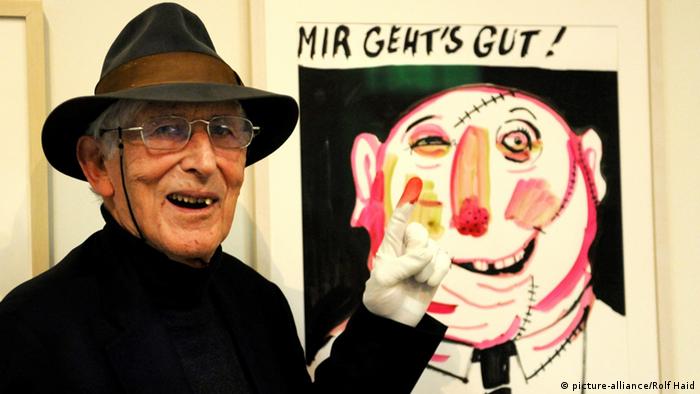
Tomi Ungerer (picture-alliance/Rolf Haid)
Tomi Ungerer, who is 85 on Monday, says he's lived five lives already.
Work is his life - the capturing of moments between people through sketches and drawings is his passion. His lines are extraordinarily precise, his drawings conversational. But Ungerer’s subversive humor is not for everyone.
Beyond his inexhaustible, precisely considered drawings, the artist’s passion is that of being a citizen of the world. He calls the French Alsace region his home, though he is well traveled, having hitchhiked to the North Pole, worked as a camel driver in the Sahara desert and boarded an Icelandic fishing cutter.
These experiences helped him get to know the world from the bottom up and influenced his work. For his controversial sketchbook, "The Guardian Angel of Hell," he moved in with a well-known dominatrix in Hamburg in order to study sado-masochistic practices.
Subversive world citizen
One of the few artists who appeals to both young and adult audiences, Ungerer has also enjoyed illustrating children's books throughout his career. Shortly before his 85th birthday, his latest was released under the title, "Why am I not you?" With his cartoons, Ungerer responds to the big philosophical questions that children are often concerned with. He has remained an attentive political observer of world affairs over time.
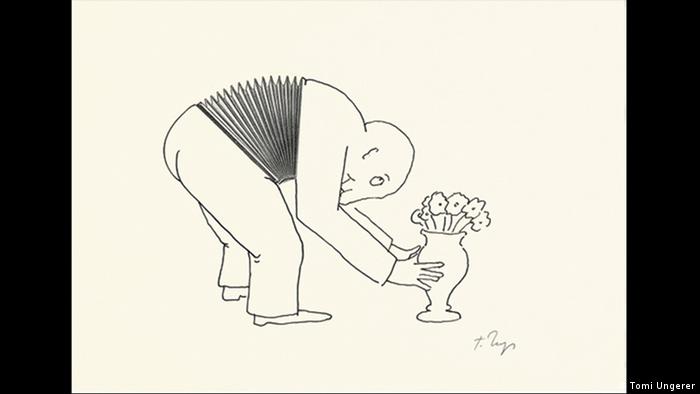
Sketch by Tomi Ungerer (Tomi Ungerer)
His most artistic major work to date was one that took over five years of intensive work: a collection of German folk music and songs for children over the age of three, "The Great Song Book," which is accompanied by his sketches. It portrays a utopia, an idyllic children's world, as he had recalled from his home in the Alsace.
Adventurous gap years
The famous illustrator was born as Jean Thomas Ungerer on November 28, 1931 in the Alsatian city of Strasbourg. His father, a historian and artist who manufactured clocks, died when Ungerer was still young. He was held back from playing with other children his age by his frightened mother, and used his time alone to draw.
As a young man, he made his way through the world, embarking on numerous adventurous journeys after he quit school shortly before his exams and taking on a job decorating shop windows. He later said that he was searching for something but wasn’t quite sure what that was.
In 1956, "Tomi" went to New York for the first time with just $60 in his pocket. He worked as an advertising illustrator and political cartoonist for various magazines, including "The New York Times," "Esquire" and "Life." The work was a great distinction for the otherwise unknown artist from Europe. His first children's book, "The Mellops Go Flying," was released in the US in 1957.
A bold career as illustrator
That same year, he met the Swiss publisher Daniel Keel, who signed him on under contract with his publishing house Diogenes. A bold and highly successful career took off. Books, exhibitions, prizes and honors piled up. In 1995, he was awarded France’s National Prize for Graphic Arts and in 2007, a museum dedicated to his work - Musée Tomi Ungerer - was opened in Strasbourg.
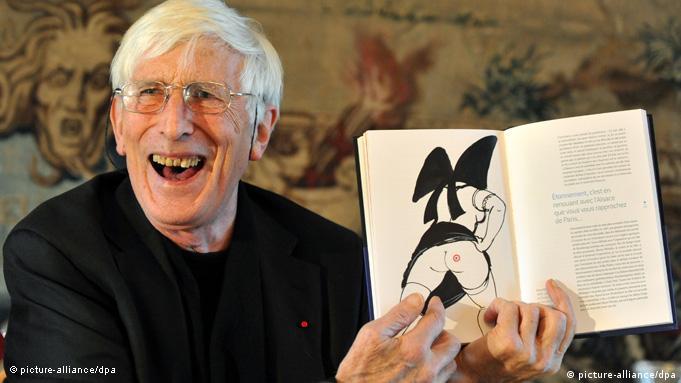
Tomi Ungerer holds up a book of his sketches (picture-alliance/dpa)
The artist and his controversial work at a press conference in Strasbourg on his 80th birthday
Fame didn’t sit well with the artist and he retreated into a self-chosen loneliness. He avoided big cities and lived for some time in rural Canada. Since 1976, he has resided in the Irish countryside. Yet he’s not an artist for whom the world remains foreign. Just the opposite. From his chosen home, he continues to voice opinions about political events and social inequalities in a globalized world. One of his drawings, for example, shows a dead American soldier with the caption, "What now?"
'Ideas are free…' is his life's motto
Ungerer's social engagements are enormous: He supports initiatives in the fight against AIDS, and for animal rights and the Red Cross. As a pacifist, peace activism is close to his heart. He experienced the brutality of military service as member of the Foreign Legion in the 1950s.
He remains an inveterate optimist and would like to jolt the world, to change things for the better. He published his autobiography in German in 1993 as "Die Gedanken sind frei - Meine Kindheit im Elsass" and under the title, "Tomi: A Childhood Under the Nazis" in English in 1998. In it, he discusses his life in the Alsace under Nazi occupation and talks about the difficult post-war years that really influenced him.
"Here today, gone tomorrow…" are the words sung by one of his characters. And that’s how he feels today. "I have my roots in the Alsace and take my leaves and my branches with me."
He says it cheerfully, with the hat of a deceased friend atop his own white hair, supporting himself on a cane and with a pale pink scarf wrapped around his neck. Tomi Ungerer has survived three heart attacks and a bout of cancer, yet his perspective remains as mischievous as ever.

Thursday, October 30, 2014

Tomi Ungerer / Waiting for Godot

Tomi Ungerer

Waiting for Godot 

Tomi Ungerer


Illustrator and author TOMI UNGERER was born on November 28, 1931 in Strasbourg, France, the capital of the Alsace region located on the west bank of the upper Rhine. The youngest of four children, Ungerer lost his father – an artist, engineer, and astronomical clockmaker – when he was three years old, and was raised by his mother and uncle. “I’ve always had the feeling,” Ungerer says, “that when he died, he passed me all his talents, just like that.”


And then came the war. The Nazis began to occupy Alsace in 1940, when Ungerer was just nine years old, and he was prohibited from speaking French and forced to learn German in three months. Because of his artistic talents, he was conscripted by the Wehrmacht as a young illustrator – his first assignment was to draw “a Jew.” He saw his first dead person when he was 10, his neighbor Mr. Hermann. A self-proclaimed paranoiac, Ungerer has never been able to get rid of his fear of the war. “Death,” he says, “is perhaps the subject I’ve used most in my drawings.”
In 1956 Ungerer went to New York, where he instantly became an award-winning children’s book author, graphic designer, and illustrator for newspapers and magazines, and a leading figure in the world of advertising. He also made some of the most imaginative erotic art and adult literature to date, for which he was interrogated by the FBI, banned in American libraries, and forced to flee, first to Nova Scotia, in 1972, then later to Ireland, where he’s lived with his wife, Yvonne, for the last 37 years.
The recipient of numerous prestigious awards, including a European prize for culture and a Hans Christian Andersen Award for children’s literature, Ungerer is also an officer of the Légion d’honneur and a Council of Europe goodwill ambassador for childhood and education. He’s published more than 150 books, many of which are finally being reprinted, and is the only living illustrator ever to have a museum dedicated to his life and work. For Tomi Ungerer, far out just isn’t far enough.
Good morning, Tomi. 
Good morning. I have to say that this morning I’m in a bit of a daze. Yesterday I had one of my days. I wrote all day for 12 hours and to keep on going I drank. I’m a bit fuzzy here, but I’ll just act according to my competence.
You’re a prolific writer, Tomi, which not many people know.
I love to write and I love words. It’s a three-language passion, because words bounce from one language to another and come back with another meaning. For me, a dictionary is like an alembic.
What’s that?
You know, what sorcerers used for distillation.


A device to distill magic.
Yes, exactly.
What are you writing now, Tomi?    
I always write in three languages. When I take notes I use one part of the page for English, one for French, and another for German, and it goes back and forth. I have a busy mind. The other day I was writing two short stories at the same time on two different sheets of paper.
In two different languages?
No, when I write a short story I normally stick to one language, unless there’s an equivalent that I can’t find right away.
Do you use each language for a different purposes?
That’s a very good question. I think I use English for humor, French for wit, and German for feelings. In a way it’s like the Three Faces of Eve.
Like multiple personalities.
That’s what I like.
French is very dry.
I like that too. In English there’s a profusion of synonyms. You have about five or ten words for one French word. I must say English is really ideal for playing around.
You can’t be as funny in French as you can in English.
That started after the renaissance when they cleaned up their act.


There’s an interesting book called The History of Shit, which talks about how the French language—l’Academie Française—was institutionalized the same time Paris set up its sewage system. 
I love Old French because it was still a free-for-all. Today it’s the precision—the absolute accuracy—that I like about French. It’s more a crystallization process. In German you can put any two words together. If I can’t think of a word right away I can make one up.
How do you manage to work in so many different mediums?
I can’t even figure it out—it’s nearly impossible. I’m like a bee going from one flower to another. I’ll be working on a sculpture and then I’ll have to write something down and then on to something else. I just have to live with it, right?
But you also have to get it out.
It’s much more difficult to break through when you’re in so many different things.
Let’s talk about mechanics. You use mechanical elements in your children’s books–in the Mellops series there is a machine that can distill petrol from grass.
I’m just very mechanical. A whole part of my life involves invention. I designed what I call the Wheel of Energy for the French EDF [Électricité de France] in 2010. It was designed for the Shanghai World Expo, and it’s basically a mechanical animation of erotic frogs. Because sex is basically mechanical, in motion and position.
How does the Wheel of Energy work?
You take two rafts and put a watermill between them and anchor it. It can work on rising and pulling tides, or you can put it on a river. It just generates energy, it’s mobile, and you can put it anywhere.
Speaking of motor coordination, your father was a watchmaker.
He was an artist and an astronomer, a humanist really. He built astronomical clocks—many public clocks in eastern France are Ungerer clocks. I have mechanical ghosts in my family. It’s really in my blood.
Your book Fornicon (1971) is about simulating sex with machines.
That’s right. I actually built some of these machines working with Barbie dolls. My other book Schutzengel der Hölle (1986), or “the guardian angels of hell,” is about dominatrices in Hamburg. It hasn’t been published in English, but it documents a form of specialized prostitution: the mechanics of fantasy, if you will. I lived in the bordello as a bystander, just recording its daily functions. I wrote the book but the drawings are also very thorough.


It’s a much more sociological work.
But on an extreme subject. They were wonderful women. Being a dominatrix is not a profession, it’s a vocation. It was first time in my life that someone told me they told me they vomited while reading a book. It’s really rough stuff. One dominatrix named Astrid had a customer who couldn’t come that often because he could only have an orgasm if he had his fingernail pulled out with a pair of pliers. No doctor or psychiatrist would do that. They were wonderful women!
Do you see it as a form of therapy?
These guys have an obsession, and where are they going to go with such an obsession? It’s better for them to have an outlet than kill a little girl or boy in the woods. I think bordellos have a function, though it was even hard for me to take some of it. As a matter of fact, Dr. Eberhard Schorsch (1935–1991), who was the head of the Deutsche Gesellschaft für Sexualforschung (German Society for Sex Research), told me it’s the most thorough and complete book ever published on the subject. You have to live there [in the brothel] to get this kind of material. The prostitutes have to trust you. There was another guy who could only have an orgasm if his tongue was nailed to a block of wood. The first line of my book is “Was ist normal?” It’s absolutely relative.

What was your first encounter with erotica?
When I was seven years old I found two girlie magazines behind my father’s books. It was the first time I was exposed to this kind of thing. When I looked at the pictures I realized that my father had gone over them with gouache.
He modified the photographs to match his pleasures?
My father didn’t like big-breasted women so he went over all the girls, retouching them to make them smaller. He was an aesthete. But I got into eroticism as an exorcism of my puritan upbringing. After my father died when I was three, I was raised Protestant by my uncle.
High expectations of moral behavior.
Morally I believe that everybody should be allowed to do whatever they want as long as they don’t hurt anybody else. Unless it’s sadomasochism and then it’s by mutual consent. What I always found fascinating in eroticism is that when you meet a woman you find out what her fantasies are. And according to her fantasies you just perform and you stage. And it’s a tremendous game. I knew a person who was aroused by medical examinations. So let’s play doctor!
What’s the difference between eroticism and pornography?
I’d say it’s the same difference between men and animals. Any animal can give you a lesson on how to do just plain sex, but eroticism is more an intellectual process, a distillation, a careful staging. It’s a way of putting into action your fantasies. It’s a long ritual. For me pornography is not erotic. I sometimes think it’s rather funny or even ridiculous.
Do you think that political satire and eroticism are connected?
They have always been very close together, not only political satire but social satire as well. When they celebrated the anniversary of the French Revolution in France, I made an erotic political satire. Napoleon Bonaparte started as a young general for the Republic, after the revolution, and where did he end up? As Napoleon the Emperor of the French. So I made a drawing of the Emperor taking Marianne, the French symbol, from behind. I was accused of depicting sodomy, but it’s not. You can take somebody from behind consensually.
How do you view humor in relation to fear?
I think humor is the best medicine against fear. Sometimes during the bombings in Alsace my whole family would just laugh away. My mother was fearless.  And just the other day, a woman came to visit me in the studio and she saw a skeleton I have there. She said, “About twenty-eight years ago I came to visit you—I was six years old—and I was terrified of the skeleton. You told me the skeleton was your mother and asked me to go shake hands with her.” She overcame her fear of the skeleton. Then I told her it was a joke, because otherwise it would be a lie.
When you moved to the States you were really misunderstood.
My whole life has been about proving reality with the absurd. I’m fascinated by the absurd. I cultivate it, I practice it. And one of the most absurd things I realized when I went to America was that in the land of blues and jazz there was racial segregation—and it was immediate outrage for me. I couldn’t understand the irony. The Americans came to fight Nazi Germany, the ultimate racist regime, and then I arrive in a country where racism prevails, especially in the era of McCarthyism.

How do you feel now going back to America?
America is really a land of contrast and contradiction, which explains all the hypocrisy. Let’s not forget though that there’s the United States of America and there’s New York, which is a completely different entity. I’ve never loved a city as much as I loved New York. Possibly Hamburg, but New York is unbelievable.
You were investigated by the FBI there.
I was kidnapped by the FBI, which was again so absurd! I even had the soles of my shoes opened up to see if there were secret messages. But after that I went back to America and New York two years ago. I was delighted. In New York—not outside of the city necessarily—there was racial harmony. To see that there’s one place where it’s possible made me very happy, because xenophobia is all over the world right now. I was born already as a child with a need and a love for peace.

032 C


DE OTROS MUNDOS

RIMBAUD