Showing posts with label Bulgarian writers. Show all posts

Friday, February 20, 2026

Georgi Gospodinov / ‘Jorge Luis Borges gave me an exhilarating sense of freedom’


Georgi Gospodinov


The 

Books

 0f my 

life


Georgi Gospodinov: ‘Jorge Luis Borges gave me an exhilarating sense of freedom’

The Bulgarian Booker winner on the letter he wrote to JD Salinger, the allure of Homer’s Odyssey and the magic of Thomas Mann


Georgi Gospodinov
Friday 20 Feb 2026


My earliest reading memory
I was taught to read quite early, at five or six, probably so that I would sit quietly and not be a nuisance to the adults. And it worked. Once I’d entered a book, I didn’t want to come out. I remember how Hans Christian Andersen’s The Little Match Girl turned my heart upside down. I was living with my grandmother at the time, and I cried under the blanket, terrified that one day she, too, would die.

My favourite book growing up
I read greedily and indiscriminately, picking books at random from my parents’ library. Thomas Mayne Reid’s adventure novels were favourites, especially The Headless Horseman. Jack London’s Martin Eden, too. Clearly, the idea of being both a hero and a writer appealed to me. Writers were not usually heroes. I also loved a textbook on criminology, which explained how to make invisible ink, what traces criminals leave behind, and so on – matters of extraordinary importance to any 10-year-old boy.

The author that changed me as a teenager
All novels that contained erotic scenes – because of the acute shortage of eroticism in the late socialist Bulgaria of the 1980s. Also around that time I discovered JD Salinger. I reread his stories obsessively, without being sure I understood everything. At 17, I decided to write him a letter, trying to provoke him into breaking his silence. Of course, I never sent it. Much later, that story found its way into my memoir, The Story Smuggler.

The writer who changed my mind
Jorge Luis Borges. When the first translations of his work appeared in Bulgaria, I was 21, shortly before the wall fell – a crucial moment. It was as if I suddenly understood what literature is capable of, and how there are no real borders between genres. I had an exhilarating sense of freedom, but also of a shared secret. Memory, erudition, heart, science and myth – all of it was there.

The book that made me want to be a writer
The poems of two tragic Bulgarian poets: Peyo Yavorov and Nikola Vaptsarov. I began writing poetry in secret. Later, I was found out.

The book I reread
Homer’s Odyssey. We probably mentioned it or read parts of it at school, and perhaps that was what put me off it for so long. After turning 40, I began to truly understand it – and to reread it, seeing it differently each time. The theme of the father increasingly drew me in, the bond between father and son. Then there’s the great theme of return – not only the return home but also to the past – and memory, the question of who remembers us unconditionally and recognises us, like the dog. In my last two novels I have been in dialogue with this book again and again.

The book I discovered later in life
Thomas Mann’s The Magic Mountain. It always stood out on my bookshelf, but for years I never reached for it. I imagined it would be very gloomy, heavy, full of endless reflection. When I read it in my late 40s it wasn’t love at first sight, but the story didn’t let me go. I love books I can converse with, even enter into Socratic arguments with. It was very important to me while I was writing Time Shelter. You think you write in solitude, but in truth you are in constant dialogue with other books and authors.

The book I am currently reading
The Books of Jacob by Olga Tokarczuk. A powerful novel that seems, like Borges’s maps, to try to contain the world – and time – at a scale of 1:1. A book for slow winter reading.

 Death and the Gardener by Georgi Gospodinov is published by W&N. 


THE GUARDIAN


Saturday, March 31, 2018

The ideas interview / Julia Kristeva


Julia Kristeva

The ideas interview: Julia Kristeva


Why is a great critic ashamed of being fashionable? 

By John Sutherland
Tue 14 Mar 2006


T
o her admirers, Julia Kristeva is one of the heroic band of French critics who injected "theory" into the sluggish Anglo-Saxon cultural bloodstream. To diehards on the other side, she is a prime exponent of impenetrable and unnecessary critical complexities. One colleague, to whom I mentioned her name replied with the single word "bonkers". Another suggested she should get a Nobel prize.

She is particularly associated with three concepts, which she now seems to wish to disown. Le semiotique is the idea that speech works as much through sub-verbal codes as by what is actually said. The real work of signification is done in the "cleavage between words and meanings". This fascination with the sub- or pre-verbal is something that, looking back, Kristeva now associates with the liturgy of the Orthodox Church: "All my childhood was bathed in this," she says.
The second of Kristeva's hallmark ideas is what she calls "abjection". Why, Kristeva inquires, are we fascinated by things that disgust and horrify us? As she put it in her essay on the subject: "There looms, within abjection, one of those violent, dark revolts of being, directed against a threat that seems to emanate from an exorbitant outside or inside, ejected beyond the scope of the possible, the tolerable, the thinkable. It lies there, quite close, but it cannot be assimilated. It beseeches, worries, and fascinates desire, which, nevertheless, does not let itself be seduced."
Most famously, Kristeva is associated with the concept of "intertextuality" - the idea that all literature is constantly in conversation with all other literature, undetachable, as a single unit, from the textual mass. Having patented these influential ideas, Kristeva is now acutely uneasy at being chained to her own thought, or confined within her own thinking. "I am very proud of the widespread use of my ideas," she says, "and at the same time very much ashamed because they have become so fashionable. Everybody thinks and talks about 'intertextuality', everybody thinks and talks about 'abjection'. The ideas become politically correct everywhere in the world and I hate it because I think when people repeat what you have done and said, they can no longer recognise you yourself. You are denied. It's a kind of decay of this moment when the idea burst out of your mind. Now the idea is consumerised."

Kristeva applies one term to her project - "synthetic". She likes to join things, mix them fluidly. It is, perhaps, something that links with her background. She came to France in 1965, aged 24, as a refugee from communist Bulgaria. She says she now thinks in French. But clearly, as her latest writing indicates, she still feels Bulgarian.
In recent years, restless as ever, Kristeva has utilised fiction as her principal mode of expression. Her latest detective novel, Murder in Byzantium, revisits the Greek Orthodox Christianity of her childhood and incorporates religious conspiracies and Thomas Harris-style serial killers. What does she see as the connection between Kristeva the critic and Kristeva the novelist? "There is a continuation", she replies. "As you know, I belong to the tendency, or school, in French philosophy which developed in the 60s, in which conceptual work is deeply involved with the personal and in which notions, or ideas, are sutured by style. There is a lot of imagination, rhetorical figures, subjective expressions and so on that that often bother the so-called Anglo-Saxon reader because they consider this French 'stuff' - theory - to be somehow indigestible."

Why is her latest novel so concerned with religion? Is she attracted by the Church? Or merely fascinated by it? "I am not a believer, I believe in words. There is only one resurrection for me - and that is in words. My novel is a kind of anti-Da Vinci Code. I'm not Catholic by background. My father was a very great believer, but in the Orthodox Church, in Bulgaria. As a young woman my Oedipus conflict was in a perpetual fight with that." She laughs. "Afterwards I tried to understand what Christianity is and my approach became more intellectual. On the one side, I'm very much interested in religion. On the other hand, I don't make any kind of spiritual - how shall I say - extrapolation or message. My idea is to link religion with politics and see how in both of them there were, and will be, a lot of crimes and human folly."
Why the detective novel format? "It is necessary to revisit the starting point of my writing detective stories. I date it as some months before the fall of the Berlin Wall in 1989, when my father was assassinated in a Bulgarian hospital. It was a very, very difficult experience for me. When I arrived, after he was dead, the family was not informed of the cause of his death.
We could make no inquiry as to who was the criminal who had done it. And finally he was, without our permission, cremated, which was wholly contrary to his religious belief. It was very, very difficult for me to recover from this grief - to mourn. In this situation the detective story imposed itself on me, without any voluntary act on my part."
Since then, Kristeva has written a string of detective novels. Is it an entirely separate exericise from the academic work?" No. This is why I made the point about the 60s, and the French theoretical 'stuff'. There have always been some personal implications in my essays. But now it's a jump because I think that writing novels is a sort of process I like to call transubstantiation. There is, as I see it, a very strong linkage between words and flesh in writing fiction. It's not merely a mental activity. The whole personality is in it. You have psychology, you have belief, you have love affairs, you have sexuality, you also have a connection to language. When I'm writing novels, I am making a voyage around, or into, myself. I do it also, of course, in my essays. But my essays are a defence of my self-voyaging. In the novel, I take all the risks of the traveller, or the explorer. And I get all the pleasures as well"


Friday, March 30, 2018

Julia Kristeva was communist secret agent, Bulgaria claims


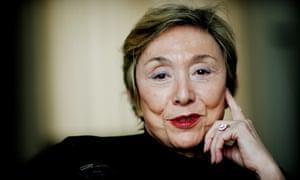
It was claimed thatJulia Kristeva worked for the communist-era secret services under the code name ‘Sabina’. Photograph: Graeme Robertson for the Guardian

Renowned psychoanalyst and philosopher alleged to have become collaborator in 1970s


Julia Kristeva was communist secret agent, Bulgaria claims

 Renowned psychoanalyst and philosopher alleged to have become collaborator in 1970s

Reuters in Sofia
Wed 28 Mar 2018


The renowned Bulgarian psychoanalyst and philosopher Julia Kristeva worked as an agent and collaborator with the Balkan country’s secret services during the communist era, a state commission has claimed.

Kristeva, 76, is the author of more than 30 books and worked alongside leading French intellectuals such as Jacques Derrida, Jacques Lacan and Roland Barthes.

The Bulgarian commission that identifies people who had worked for the communist-era secret services alleges that Kristeva, under the code name “Sabina”, had been a collaborator for the first department of the Committee for State Security. The department oversaw intelligence in the area of the arts and mass media.

It said she began working for the state security organisation in 1971. She had moved to Paris in 1965 on a French government scholarship. The document did not say how long she had worked for state security or whether she had received any payment.

Kristeva, who still lives in Paris, was not immediately available to comment on the matter.

In its heyday, Bulgaria’s state security, working closely with the Soviet KGB, operated a network of about 100,000 agents and informers. It was dissolved in 1989 following the collapse of the communist regime.

The issue of access to, and publication of, its files has continued to raise powerful emotions in Bulgaria during its difficult transition to democracy.

Foreign Policy magazine has ranked Kristev as one of the 100 greatest thinkers of the 20th century. As well as books on psychoanalysis and philosophy, she has written extensively on cultural and feminist issues and is also a novelist.

She is an emeritus professor at the Université Paris Diderot and a visiting professor at Columbia University in New York.