Showing posts with label Masterpieces of painting. Show all posts

Tuesday, May 18, 2021

Edvard Munch / The Scream III


Edvard Munch
THE SCREAM III


Edvard Munch / Scream II


Edvard Munch
SCREAM II


Edvard Munch / The Scream I

The Scream by Edvard Munch
THE SCREAM
by Edvard Munch


The Scream (Norwegian: Skrik) is the popular name given to each of four versions of a composition, created as both paintings and pastels, by the Expressionist artist Edvard Munch between 1893 and 1910. Der Schrei der Natur (The Scream of Nature) is the title Munch gave to these works, all of which show a figure with an agonized expression against a landscape with a tumultuous orange sky. Arthur Lubow has described The Scream as "an icon of modern art, a Mona Lisa for our time."

Wednesday, May 27, 2020

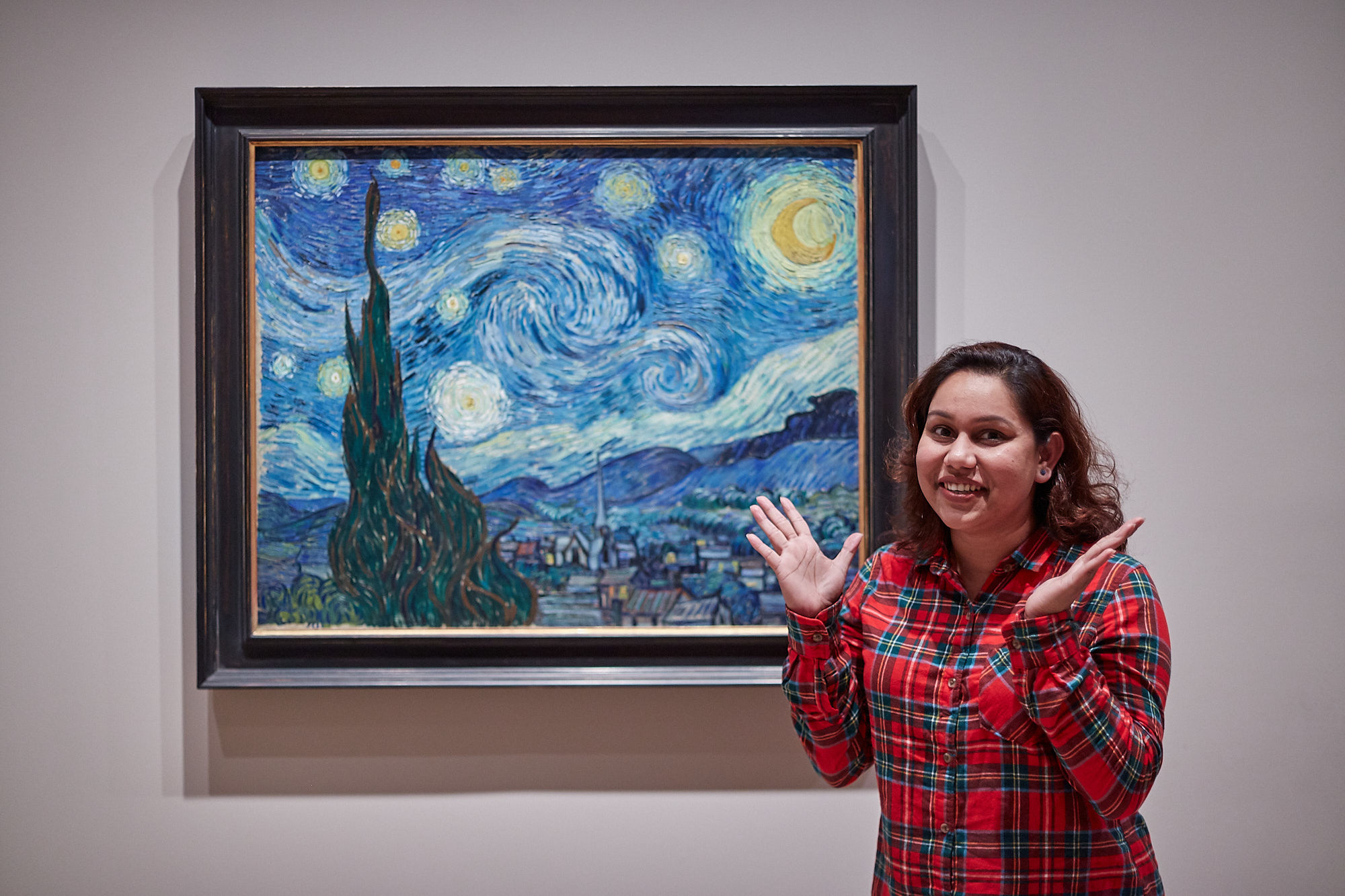
Masterpieces of painting / Vincent van Gogh / The Starry Night


The Starry Night, 1889
Vincent van Gogh

MASTERPIECES OF PAINTING
The Starry Night
by Vincent van Gogh

  • Alicja Zelazko
    • June 17, 2019

The oil-on-canvas painting is dominated by a night sky roiling with chromatic blue swirls, a glowing yellow crescent moon, and stars rendered as radiating orbs. One or two cypress trees, often described as flame-like, tower over the foreground to the left, their dark branches curling and swaying to the movement of the sky that they partly obscure. Amid all this animation, a structured village sits in the distance on the lower right of the canvas. Straight controlled lines make up the small cottages and the slender steeple of a church, which rises as a beacon against rolling blue hills. The glowing yellow squares of the houses suggest the welcoming lights of peaceful homes, creating a calm corner amid the painting’s turbulence.

Vincent van Gogh. The Starry Night. 1889 | MoMA

Van Gogh painted The Starry Night during his 12-month stay at the Saint-Paul-de-Mausole asylum near Saint-Rémy-de-Provence, France, several months after suffering a breakdown in which he severed a part of his own ear with a razor. While at the asylum, he painted during bursts of productivity that alternated with moods of despair. As an artist who preferred working from observation, van Gogh was limited to the subjects that surrounded him—his own likeness, views outside his studio window, and the surrounding countryside that he could visit with a chaperone.
Although van Gogh’s subjects were restricted, his style was not. He experimented with the depiction of various weather conditions and changing light, often painting the wheat fields nearby under a bright summer sun or dark storm clouds. Van Gogh was also particularly preoccupied by the challenges of painting a night landscape and wrote about it not only to his brother, Theo, but to a fellow painter, Émile Bernard, and to his sister, Willemien. In a letter addressed to the latter, he alleged that night was more colourful than day and that stars were more than simple white dots on black, instead appearing yellow, pink, or green. By the time van Gogh arrived at Saint-Rémy, he had already painted a few night scenes, including Starry Night (Rhône) (1888). In that work, stars appear in bursts of yellow against a blue-black sky and compete with both the glowing gas lamps below and their reflection in the Rhône River.

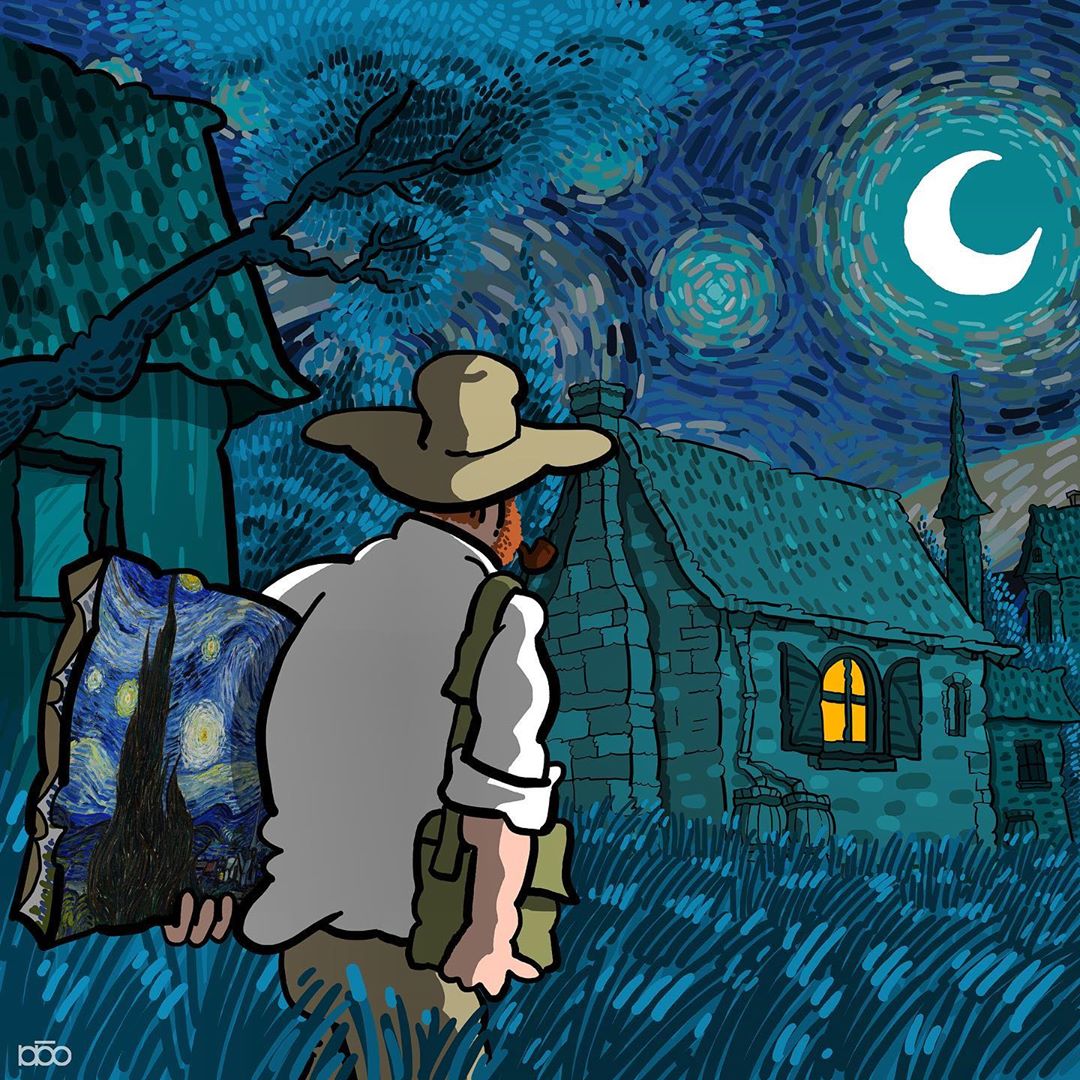
Coloridos webcómics celebran la vibrante vida de Vincent van Gogh
At the asylum, van Gogh observed the night sky from his barred bedroom window and wrote a letter to Theo describing a magnificent view of the morning star very early one morning in the summer of 1889. Because he was not allowed to paint in his bedroom, he painted the scene from memory or possibly drawings and used his imagination for the small village that did not actually exist. Employing the expressive style he had developed during his stay in Paris in 1886–88, he applied the paint directly from the tube onto the canvas, creating thick impasto and intense hues. Ambivalent about working from his imagination, van Gogh eventually regarded the finished Starry Night as a failure, and Theo frankly indicated that the painting favoured style over substance.
The painting was one of van Gogh’s late works, as he committed suicide the following year. His artistic career was brief, comprising only 10 years, but it was very productive. He left more than 800 paintings and 700 to 850 drawings to his brother. When the Museum of Modern Art (MoMA) in New York City purchased The Starry Night from a private collector in 1941, it was not well known, but it has since become one of van Gogh’s most famous, if not one of the most recognized, works in the art history canon.


Tuesday, September 11, 2018

Whistler’s Mother review / A painting that’s not what it seems


Whistler’s Mother review – a painting that’s not what it seems

A meticulous study of Anna Whistler, by Daniel E Sutherland and Georgia Toutziari, is a treasure trove of odd information
Kathryn Hughes
Saturday 12 May 2018


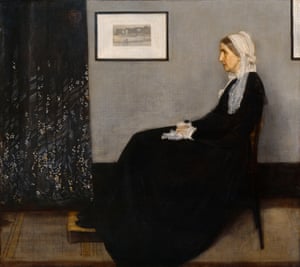
Arrangement in Grey and Black No 1, known as Whistler’s Mother.
 Arrangement in Grey and Black No 1, known as Whistler’s Mother. Photograph: Jean Schormans/RMN/National Gallery of Victoria

Over the last century and a half Whistler’s mother has been having a high old time. Perhaps 1934 was the giddiest year: Cole Porter name-checked her in “You’re the Top” while the US government put her on a postage stamp to celebrate Mother’s Day.

More recently the playwright Edward Bond turned her into the devil in a wheelchair in Grandma Faust, while in 1997 Rowan Atkinson gurned in front of her as Mr Bean. Whenever Whistler’s Mother (its official title isArrangement in Grey and Black No 1) tours the world, gallery crowds flock to stare at the elderly, seated figure staring enigmatically into the middle distance.Along with the Mona Lisa and Girl With a Pearl Earring, she has become an instantly quotable pin-up of popular art. Which is odd because “Whistler’s mother” doesn’t exist, not really. The fact that the woman in the picture was indeed the artist’s mother was not, at least for James McNeill Whistler, the point at all. The London-based American painter had no interest in doing family portraits – Anna Whistler was a stand-in for someone who hadn’t turned up – nor was he concerned with conjuring up “wisdom”, “age” or even “mothers” in general. As the picture’s real title suggests, what actually drove him was the technical challenge of modulating tones of black and grey in a way that made them legible in half-light.
He had done something similar nearly 10 years earlier in The White Girl when he’d painted his mistress Jo Hiffernan in a froth of white on more white. Now here was another aesthetic experiment, this time at the opposite end of the colour spectrum.
For a painter who said he wasn’t interested in mimetic portraiture, illustrative anecdote or symbolic signalling, it’s ironic that Whistler is now best remembered for a painting that appears to do all three. There’s something telling, too, in the fact that Anna Whistler herself never seemed to grasp that she was only there as a useful arrangement of shape and volume rather than as a subject who actually mattered.
When Whistler finished the picture and murmured “Oh Mother … it is beautiful,” it was his handiwork he was admiring, not her bone structure. And there’s no getting away from the odd fact that, while everyone agreed that the picture was the very spit of Anna, they quickly spotted one deliberate distortion. Instead of an accurate rendering of her neat little patrician slippers, Whistler had given his mother “sprawling, flat peasant feet”.


Photograph of Anna Whistler; she lived with ‘Jemie’ in London for nine years.
Pinterest
 Photograph of Anna Whistler; she lived with ‘Jemie’ in London for nine years.

Daniel E Sutherland and Georgia Toutziari are adamant that we shouldn’t try to read anything into this. Yet they proceed to offer such a treasure trove of odd information about Whistler mère et fils that it seems a dereliction of curiosity, duty even, not to probe further.
You can’t help noticing, for instance, how strangely the flesh-and-blood Anna was positioned in her adult son’s life, managing to be simultaneously at its centre and entirely to one side. Living around the corner from his studio in Chelsea, the American-born widow acted as “Jemie’s” amanuensis, agent, cheerleader and chief scold. She prepared lunch for visitors at his studio, nagged him to number his engravings in order to boost their market value, and told him to make friends with important people who might buy his work. She remained hugely proud of what she called “my painting”, claiming it not just as a portrait but as an emblem of the contribution she had made to her darling son’s career.
“He always confides in his mother,” Anna approvingly told her friends which, unsurprisingly, turns out to be the opposite of true. Whistler was instead careful to present his mother with a tightly edited version of his extremely rackety life. Whenever she met his disreputable male friends, they were instructed to be on their best behaviour. How else can one explain the fact that this deeply religious woman believed the boisterously drunk and gay Algernon Swinburne to be a delightful young man fit to be her honorary son?
And as for Hiffernan, Jemie’s Irish mistress, Anna seems to have thought that she was nothing more than his favourite model. When in 1870 the girl-mad Whistler had an illegitimate son by a local chambermaid, the news was kept from Anna, who sailed on oblivious, offering prayers and tracts to anyone she thought looked spiritually peaky.
While Sutherland and Toutziari are meticulous in rendering the busy life of Anna Whistler – she crossed the Atlantic 11 times as she followed her peripatetic husband and sons around the world – they remain uninterested in teasing out the emotional resonances of these constant dislocations. What we get instead is a respectful portrait of a woman who prided herself on her moral restraint and good breeding, yet whom, for some unaccountable reason, her son decided to paint with cumbersome feet that appear poised to step on other people’s toes.
• Whistler’s Mother: Portrait of an Extraordinary Life is published by Yale.


Saturday, February 15, 2014

Rino Stefano Tagliafierro / Master Paintings

rino stefano tagliafierro brings master paintings to life
Giuditta e Oloferne by caravaggio 
jan 24, 2014
Rino Stefano Tagliafierro 
Master Paintings


‘beauty’
video courtesy of rino stefano tagliafierro
rino stefano tagliafierro animates master paintings
‘sacrificio di isacco’ by caravaggio
rino stefano tagliafierro animates master paintings
‘dante and virgil in hell’ by william adolphe bouguereau
rino stefano tagliafierro animates master paintings
‘witches going to their sabbath’ by luis ricardo falero


Wednesday, March 27, 2013

Cohen buys Picasso

EXCLUSIVE: SAC’s Cohen buys $155M Picasso after settling trading probe
Steve Wynn put his elbow through this Pablo Picasso's ‘Le Rêve’
now owned by Steven A. Cohen

SAC’s Cohen buys $155M Picasso after settling trading probe

by Austin Smith
March 26, 2013
Steven A. Cohen
Steven A. Cohen
Steven A. Cohen, whose SAC Capital just settled two insider-trading lawsuits with the government for $616 million, has bought himself a gift — Picasso’s “Le Rêve” for $155 million, Page Six has exclusively learned.
Billionaire Cohen secretly bought the masterpiece from Vegas mogul Steve Wynn, who famously put his elbow through the 1932 painting of Picasso’s mistress, creating a six-inch tear.
The price is estimated to be the highest ever paid for an artwork by a US collector — and it’s even more impressive because Wynn had previously agreed to sell the masterpiece to Cohen for $139 million in 2006, but accidentally tore the painting the following day.
A source told Page Six, “Steve bought ‘Le Rêve’ as a gift to himself. This was supposed to be a top- secret sale because of the government investigation and settlement.”
It reaped a hefty profit for Wynn, who also got a $45 million insurance payout after he elbowed the painting while showing it off to friends including Nora Ephron at his Las Vegas office.
Wynn, who suffers from vision problems, agreed at the time to release Cohen from the sale and repair it. Now he has sold it to Cohen for $16 million more than the pre-damage price.
Another source told us, “Steve has wanted that painting for a long time. The timing of the sale is just a coincidence.”
In what officials are calling the largest-ever settlement of an insider-trading action, SAC Capital Advisors LP agreed March 15 to pay securities regulators more than $600 million to resolve a civil lawsuit related to improper trading.
Despite reports that Cohen, worth about $9.3 billion, was feeling the pinch after investors in SAC asked to withdraw $1.68 billion — sparking speculation he might sell his art — it seems he’s building his collection, which includes works by van Gogh, Manet, de Kooning, Cezanne, Warhol, Francis Bacon and Damien Hirst.
Cohen’s longtime spokesman Jonathan Gasthalter declined to comment, and reps for Wynn didn’t get back to us.


Thursday, June 28, 2012

Gustave Courbet / The Origin of the World


THE ORIGIN OF THE WORLD
(L'ORIGINE DU MONDE)
by Gustave Courbet

L’Origine du monde (The Origin of the World) is an oil-on-canvas painted by French artist Gustave Courbet in 1866. It is a close-up view of the genitals and abdomen of a naked woman, lying on a bed with legs spread. The framing of the nude body, with head, arms and lower legs outside of view, emphasizes the eroticism of the work.

Joanna Hiffernan
by James Whistler
Identity of the model


At the time Courbet was working on the painting his favourite model was a young woman,Joanna Hiffernan, also known as Jo. Her lover at the time was James Whistler, the American painter and friend of Courbet.
Courbet did another painting in 1866, La belle Irlandaise (Portrait of Jo), whose model was Joanna Hiffernan. During his whole career, Courbet did four portraits of Hiffernan. She was probably the model for L’Origine du monde, which might explain Courbet’s and Whistler's brutal separation a short while later. Whistler then returned to London. In spite of Hiffernan’s red hair contrasting with the darker pubic hair of L’Origine du monde, the hypothesis that Hiffernan was the model for it prevails.


File:La belle Irlandaise (Portrait of Jo).JPG
La belle irlandaise
Portrait of Jo
by Gustave Courbet

L’Origine du monde in the Musée d'Orsay.
Owners

The commission for L’Origine du monde is believed to have come from Khalil Bey, an Ottoman diplomat, former ambassador of the Ottoman Empire in Athens and Saint Petersburg who had just moved to Paris.Sainte-Beuve introduced him to Courbet and he ordered a painting to add to his personal collection of erotic pictures, which already included Le Bain turc (The Turkish Bath) from Ingres and another painting by Courbet, Les Dormeuses (The Sleepers), for which it is supposed that Hiffernan was one of the models.
After Khalil-Bey’s finances were ruined by gambling, the painting subsequently passed through a series of private collections. It was first bought during the sale of the Khalil-Bey collection in 1868, by antique dealer Antoine de la Narde. Edmond de Goncourt hit upon it in an antique shop in 1889, hidden behind a wooden pane decorated with the painting of a castle or a church in a snowy landscape. According to Robert Fernier, Hungarian collector BaronFerenc Hatvany bought it at the Bernheim-Jeune gallery in 1910 and took it with him to Budapest. Towards the end of the Second World War the painting was looted by Soviet troops but ransomed by Hatvany who, when he emigrated, was allowed to take only one art work with him, and he tookL'Origine to Paris.
In 1955 L’Origine du monde was sold at auction for 1.5 million francs. Its new owner was the psychoanalyst Jacques Lacan. Together with his wife, actress Sylvia Bataille, he installed it in their country house in Guitrancourt. Lacan asked André Masson, his stepbrother, to build a double bottom frame and draw another picture thereon. Masson painted a surrealist, allusive version of L’Origine du monde. The New York public had the opportunity to viewL’Origine du monde in 1988 during the Courbet Reconsidered show at the Brooklyn Museum; the painting was also included in the exhibition Gustave Courbet at the Metropolitan Museum of Art in 2008. After Lacan died in 1981, the French Minister of Economy and Finances agreed to settle the family’s inheritance tax bill through the transfer of the work (dation en lieu in French law) to the Musée d'Orsay, an act which was finalized in 1995.

Provocative work

During the 19th century, the display of the nude body underwent a revolution whose main activists were Courbet and Manet. Courbet rejected academic painting and its smooth, idealised nudes, but he also directly recriminated the hypocritical social conventions of the Second Empire, where eroticismand even pornography were acceptable in mythological or oneiric paintings.
Courbet later insisted he never lied in his paintings, and his realism pushed the limits of what was considered presentable. With L'Origine du monde he has made even more explicit the eroticism of Manet's Olympia. Maxime Du Camp, in a harsh tirade, reported his visit to the work’s purchaser, and his sight of a painting “giving realism’s last word”.
By the very nature of its realistic, graphic eroticism, the painting still has the power to shock and triggers censorship.

Influence

The explicitness of the picture may have served as an inspiration, albeit with a satirical twist, for Marcel Duchamp's last major work, Étant donnés (1946–1966), a construction also featuring the image of a woman lying on her back, legs spread apart.

L’Origine du monde in the Musée d'Orsay.

In February 1994, the novel Adorations perpétuelles (Perpetual Adorations) by Jacques Henric reproduced L’Origine du monde on its cover. Police visited several French bookshops to have them withdraw the book from their windows. A few proprietors, such as the Rome bookshop in Clermont-Ferrand, maintained the book, but others, such as Les Sandales d’Empédocle in Besançon, complied, and some voluntarily removed it. The author was saddened by these events: “A few years ago, bookshops were anti-establishment. When the Ministry of the Interior, in 1970, banned Pierre Guyotat’s book, Eden, Eden, Eden, bookshops had been places of resistance. Today, they anticipate censorship....”[citation needed]
On February 23, 2009, a similar situation happened in Braga, Portugal, when the police confiscated the book "Pornocratie" by Catherine Breillat, displayed in bookshops using L’Origine du monde as its cover. A great deal of controversy was sparked by the police action. The reason given was the need to maintain public order. Also, the book title incorrectly hinted at pornographic content. Portuguese law forbids public displays of pornography.
In February 2011, Facebook censored L'Origine du monde after it was posted by Copenhagen-based artist Frode Steinicke, to illustrate his comments about a television program aired on DR2. Following the incident, many other Facebook users defiantly changed their profile pictures to the Courbet painting in an act of solidarity with Steinicke. Facebook which originally disabled Steinicke's profile finally re-enabled it without the L'Origine du monde picture. As the case won media attention, Facebook deleted other pages about the painting.
In October 2011, again, a complaint was lodged against Facebook with the "tribunal de grande instance de Paris" (Paris court of general jurisdiction) by a French Facebook user after his profile was disabled for showing a picture of L'Origine du monde. The picture was a link to a television program aired on Arte about the history of the painting. As he got no answer to his emails to Facebook, he decided to lodge a complaint for "infringement of freedom of expression" and against the legality of Facebook's terms which define the courts located in Santa Clara County, California, as the exclusive place of jurisdiction for all litigating claims.
Although moral standards and resulting taboos regarding the artistic display of nudity have changed since Courbet, owing especially to photography and cinema, the painting remained provocative. Its arrival at the Musée d'Orsay caused high excitement.
The Serbian performance artist Tanja Ostojić parodied the work in her so-called "EU Panties" poster in 2005.
According to postcard sales L’Origine du monde is the second most popular painting in the Musée d’Orsay, after Renoir’s Bal du moulin de la Galette.
The image is also referenced as inspiring Catherine Breillat's filming of the female genitalia in her 2004 film Anatomie de l'enfer (Anatomy of Hell).
In 2010, British composer Tony Hymas composed "De l'origine du monde" a musical suite dedicated to the picture as well as relations between Courbet and La Commune de Paris, and based on texts by Courbet himself, Charles Baudelaire, Pierre Dupont and Christian Tarting. Illustrators such as Daniel Cacouault, Simon Goinard Phélipot, Rocco, Stéphane Courvoisier, Zou, Eloi valat, Jeanne Puchol, Benjamin Bouchet, Sylvie Fontaine, Chloé Cruchaudet, Stéphane Levallois, Nathalie Ferlut took part to this project published by nato record.

Source: Wikipedia