Showing posts with label Matt Blease. Show all posts

Friday, January 5, 2018

Uncommon Type: Some Stories by Tom Hanks / Digested read


Uncommon Type: Some Stories by Tom Hanks – digested read


‘After we came back from the moon, we all went home for some nice apple pie. Whoopety-doodah-day’

John Crace
Sun 22 Oct ‘17 00.00 BST


Illustration by Matt Blease


Three Exhausting Weeks
Anna and I were rummaging through some old typewriters in a secondhand store as a gift for MDash, a sub-Saharan immigrant who was about to become as American as Apple Pie.
“Hey, Gumpy,” she said. “Let’s go out on a date.”
Now let me tell you that Anna is a triathlete with the body of a triathlete, while I like to sit around doing not very much and thinking nice thoughts about how lovely everything in America can be.
On the first day together, she put her hand inside my pants. And I put my hands inside her pants. Things progressed pretty quickly after that. Whoopety-doodah-whoppety-day!
“You’re a nice guy, Gumpy,” she said. “But you have to shape up a bit. Pack a bag, you’re coming with me on a business trip to Fort Worth.”
After we had sex, I began to feel a bit unwell. “I think I’m getting a cold,” I said. Anna told me I needed to take some vitamins and release the toxins through my feet. I thought I’d take some ibuprofen.

I did get better eventually but on the 21st day of our relationship Anna said, “I don’t think this is going to work out.”
“Neither do I,” I replied.
But we stayed friends. Which was nice.
Christmas Eve, 1953
Virgil had walked up the garden path that was lined with snow. “Happy Christmas Eve, everyone,” he said. “Happy Christmas, Eve,” his family had replied. Once he had taken his coat off, Virgil got out his old typewriter and got his kids to write their letters to Santa before sending them off to bed. “Make sure you go to sleep or Santa won’t come,” he told them before settling down to wrap presents with his wife.

Just before bedtime, the phone rang. As it always did on Christmas Eve. “Hi, Bud,” he said. “Would you believe it’s 10 years since Christmas Eve, 1944?”
“Actually, it’s only nine years, Private Ryan.”
Bud and Virgil had landed on the Normandy beach at exactly the same time and had witnessed many of their comrades get killed. Which wasn’t nice. They had fought through France together until Christmas Eve 1944 when a shell had blown Virgil’s leg off. Bud had carried him to the medics. Which was nice.
“Are you sure you don’t want to visit?” Virgil asked. Bud declined. “We’ll speak again next year then.” Virgil hopped up the stairs and went to bed. It was great to be an American. Though he was sad about his fallen comrades who would be missing Christmas.
Our Town Today with Hank Fisek
So many rumours here today at da paper! Some people say the Tri-Cities Journal might go digital. But I much prefer typing my column on an old typewriter. Which is nice.
Alan Bean Plus Four
I can’t remember whose idea it was to go to the moon. Almost certainly not mine, as I am a bit dopey. It was probably Anna’s as she is the most driven woman I know. She is a triathlete with the body of a triathlete. MDash bought the food, I bought the capsule off an old woman for $100 – making sure I got a typewritten receipt – and we took off from Steve Wong’s back yard.
“Whoopety-doodah,” I yelled as we went into orbit.
“Whoopety-doodah-day,” everyone else yelled in response.
I had named the capsule Alan Bean after the lunar astronaut whom I had once met buying toothpaste in a branch of Walmart in downtown Oakland and we all felt very cosy as we went to the moon.
Anna checked the Lunar Trajectory app and said, “Time to press the button for lunar orbit, Gumpy.” Much to my surprise the dark side of the moon wasn’t dark at all. It was just that we never got to see it from Earth. The so-called dark side looked much the same as the bright side.
“We’ve all been to the moon in Alan Bean,” I said to the crew who picked us up in the Pacific.
“That’s nice,” they said.
Then we all took the bus home in time for some nice apple pie.

Go See Costas
Assan was pleased to have escaped communist oppression in Bulgaria. Even if he had had to flee the country on a boat without his typewriter. He had worked hard on the boat because he knew that’s what American people would expect of him.
After he had landed in New York, he had met a fellow refugee who told him a man called Costas would give him a job in his restaurant.
“Can I have a job, please?” Assan asked. “No,” said Costas.
The next day, Assan went back and asked again. Costas still said no. On the third day, Assan returned again.
“I suppose you still want a job,” said Costas.
“No, I just want a coffee.”

“Well, tough. You can have a job.”
Assan smiled. Persistence and hard work paid off in the Land of the Free and the Home of the Brave.
Our Town Today with Hank Fisek
I still like writing on my typewriter, even though I’ve been sacked.
Steve Wong is Perfect
Anna, who is a triathlete and has the body of a triathlete, MDash, Steve Wong, who worked in Home Depot, and I all went bowling. One thing I haven’t told you is that Steve Wong used to be a champion bowler.
That evening he threw 60 perfect strikes. A TV station got to hear about this and offered him $100,000 if he could throw another 60 perfect strikes.
“I don’t know about this,” he said. “I only like bowling for fun.”
Anna persuaded him the money could be useful so Steve Wong agreed. After throwing another 60 perfect strikes and collecting the check, Steve said it hadn’t been fun and he was only going to bowl for fun from now on.
“You haven’t mentioned a typewriter, Gumpy,” said Anna.
“Typewriter.”
Digested read, digested: Common Hype.


The Unexpected Truth About Animals by Lucy Cooke / Digested read


The Unexpected Truth About Animals by Lucy Cooke – digested read


‘Penguins? A bunch of pathological narcissists. Pandas? Addicted to three-way sex. Toads? Complete bastards’


John Crace
Sun 29 Oct ‘17 17.00 GMT

Illustration by Matt Blease


S
cientists have been misunderstanding animals for centuries. We viewthe animal kingdom through the prism of our own rather narrow existence. This has got to stop. It is driving many creatures into therapy. Bats are literally going bats. We need to open our minds – and let them tell their own stories.

Beaver My name is Beaver and I’m a beaver. If I hear one more story about how I like to chew off my own gonads and throw them at people, I’m going to shoot myself. My reproductive organs are just configured differently. I can’t help it if my balls smell so great that Givenchy use them in their perfumes. But do stop bigging up my achievements. Basically, we beavers are a bit thick. It’s pure luck we don’t get squashed by more trees. Play us the sound of running water and we’ll start building you a dam.
Sloth As president of the sloth appreciation society, I’ve spent many a thrilling hour watching sloths move, and I can confirm that their average cruising speed is a leisurely 0.3 kilometres an hour. But rather than thinking of sloths as slow, a characterisation imposed on them by French naturalist Le Comte de Buffon, we should see things from their point of view. Walking slowly and deliberately, like a tai chi master, enables them to silently sneak up on foliage unnoticed so they can pounce before it has a chance to escape. Also, why bother to walk any quicker when you only need to have one poo every eight days?


Frog They come in three sizes: small, medium and large. They are also among the fittest amphibians on the planet. Even when stuck at the bottom of Lake Titicaca, the Telmatobius culeus never misses a daily workout of 50 press-ups followed by three sets of 10 bench presses. What has mesmerised humans about the frog is its reproductive cycle. Aristotle was of the impression that frogs emerged spontaneously out of mud, but thanks to French scientist Réaumur, we now know that is not true. Réaumur attached a pair of underpants – fastened with braces to make sure they didn’t fall off – to a male frog then showed it lewd photographs of a female. Never confuse a frog with a toad. Toads are complete bastards.
Hippopotamus Since the days of the Roman empire, the hippo has been portrayed as a monstrous, fire-vomiting “river horse”. In fact, it is much more like a whale, apart from the fact that it has feet and doesn’t eat plankton. It was originally thought that the red liquid it expelled was blood, which led Pliny to advocate blood-letting as a medical cure, but research has now proved that it is in fact a sophisticated factor-50 suncream. Interesting fact: there are now cartels of coke-dealing hippos in Colombia after several broke out of Pablo Escobar’s zoo in the early 1990s.

Panda An endangered species, thanks to having targets on their eyes, pandas have undeservedly gained the reputation for being a bit shy and uptight about sex. Far from being retiring types who can have sex only with the lights off, pandas are among nature’s most enthusiastic shaggers. So much so that they can usuallyget aroused only if there is a threesome. Were Edinburgh zoo to get hold of another panda to spice things up for Tian Tian and Yang Guang, they might get the baby panda cub they so dearly want.
Penguin No animal has been more wilfully misrepresented. The thing you’ve got to remember about penguins is that they are a bunch of pathological narcissists. Stick David Attenborough in front of them, or sign them up for a March of the Penguins movie, and they’ll come over all cute and cuddly. Oh look at us! Aren’t we so noble because we band together against the cold? And no, I couldn’t possibly sleep with you because I’m already married. I’m monogamous, me. Take away the cameras, though, and it’s a scene of utter degradation. Worse than The Jeremy Kyle Show. Not only will you get penguins tripping one another up so they get eaten by whales, they will quite happily spend the afternoon lobbing stones at one another and shooting smack. And don’t get me started on sex! A penguin will quite literally shag anything. Male, female, children. Even a dead penguin. Disgusting. Take it from me. Penguins are evil.
Digested read, digested: We need to talk about Penguin.


Tuesday, January 2, 2018

War and Peace by Leo Tolstoy / Digested read


War and Peace by Leo Tolstoy – digested read


We’re going to speak Frussian, join the army, fall in love, fall out of love, get very cold, and then die


John Crace
Mon 11 Jan ‘16 08.20 GMT


I
t was July 1805, and all St Petersburg was concerned about the advance of Bonaparte. Though not so much as to cancel a soiree at which Pierre, a bastard by birth but not by nature, was to be introduced to Russian society.

“Pierre is not one of nous,” several guests observed. “Not only does he forget choses but he doesn’t speak Frussian. Et he drinks even plus que nous.”
Prince Andrew, a bastard by nature but not by birth, cleared his throat delicately. “As a member of the officer class, I have decided to join the army,” he declared.

“Leave your pregnant wife if you will, Pierre said, willingly accepting the mantle of fecklessness. “I shall eat, drink and copulate for Russia. That will be my duty for the glorious Motherland.”
“I shall join the hussars,” Nicholas declared, while his sister Natasha eyed up potential husbands. They might become rather scarce.
Pierre checked his fob watch. The pages were turning faster than he expected and his father had now died. “I seem to find myself the richest man in Russia.”
War proved more terrible than either Andrew or Nicholas has expected. Dreams as well as men got killed. “How I embrace death,” Andrew murmured as the battle of Austerlitz raged. “Pas so vite,” said Napoleon. “Permettez-moi de vous donner une main. Now I must wash my chubby little body.”
“I’m home,” said Andrew as his wife died in childbirth.


Pierre felt the burden of expectation and married Helene but, helas, she had a bit on the cote. The anguish was intolerable, but Pierre felt obliged not to kill his love rival in a duel and left St Petersburg for many years to ruminate on Freemasonry before deciding a knotted handkerchief was not for him. Instead, he chose to improve the lot of his serfs, who had up till now remained entirely invisible. “Harrumph,” he concluded at last. “I cannot improve their lot because they have never had it so good.” Tolstoy nodded approvingly, lifting his eyes momentarily from the handsome handmaiden beneath him.
“So, 500 roubles on the peace lasting,” said Nicholas, as Napoleon and the Tsar embraced in friendship, thereby losing the remains of the Rostov fortune.
Andrew observed Natasha longingly. “Marry me, please,” he begged. “Oh, I do love you ever so much, Nick,” Natasha replied, but my father is making me wait a year and I’m bound to have developed une grande passion for the inside of Anatole’s trousers by then.”
“I am distraught,” Andrew declared as Natasha fell dangerously ill.
It was now 1812 and Pierre was beside himself as the French approached Moscow. “‘I am deranged with symbolism and Helene has left me even though I left her first. I vow to kill Napoleon,” he said.
“Je ne peux pas believe que je have justperdu the battle of Borodino,” Napoleon squeaked, his shoe-lifts giving him gip. “The French had by lointhe best army.”
“But Russia had nature and spirituality on its side,” said Tolstoy while a chorus of Volga boatmen sang patriotic songs.
“Can you not faire quelque chose about the fumee in Moscow?” asked Napoleon. “Et quand will I receive the surrender?”
“Jamais,” Mother Russia replied. First scorched earth, then General Winter. War is hell.
Illustration by Matt Blease

Pierre hovered between madness and death as the French performed atrocities during their withdrawal from the icy embrace of Mother Russia.
“There is a nobility in being broke,” said Nicholas’s aunt. “So I am going to give you some more money.” “Oh, thank you,” Nicholas replied. “Now I can marry Mary. And maybe you and Andrew can make up now, Natasha?”
“I forgive you, Natasha,” said Andrew, before dropping dead.
“That’s handy,” said Pierre, appearing out of nowhere. “Maybe I can marry you instead.”
“Yes please,” Natasha whimpered. “I can give up my singing, we can have four children and I can become a right old drudge, because Leo thinks that submission is a woman’s natural state.”
Tolstoy bowed his head. He was tired. The novel was a difficult thing. Not that his book was a novel, of course. Though people would be bound to call it that. Fools all of them. We can only know we know nothing.
THE GUARDIAN


Sunday, December 31, 2017

The best children’s books of 2017


 Luscious ... one of Emily Sutton’s illustrations for Katherine Rundell’s One Christmas Wish.


The best children’s books of 2017


Whatever their age, kids will be engaged and inspired by this year’s diverse offerings


Illustration by Matt Blease


Imogen Russell Williams
Sat 2 Dec ‘17 07.30 GMT


Age 0-4

Katinka’s Tail by Judith Kerr
(HarperCollins)
From the beloved creator of Mog and The Tiger Who Came to Tea, this feline adventure – featuring the snow-white Katinka and her unusual tail – will enthral toddlers with its gentle, gold‑flecked domesticity.
Pick a Pine Tree by Patricia Toht
Illustrated by Jarvis (Walker)
Anticipation builds throughout this rhyming, ritual account of choosing and bedecking a tree. Everyone in the blocky, soft-glowing images is beaming, from people to pets to plump Santa ornaments; by the end of the book, readers will be, too.
Mopoke by Philip Bunting
(Scholastic)
In a series of splendid visual/verbal jokes, a mopoke (or southern boobook owl) is denied the peace he craves – until, refusing to be a snowpoke, a slowpoke or a glowpoke any longer, he takes to the wing, leaving Nopoke.


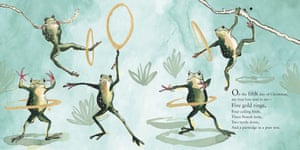
Frog lords ... The Twelve Days of Christmas, illustrated by Anna Wright. Photograph: Faber


Illustrated by Anna Wright (Faber)
Gorgeously gilded, darkly leafy and understatedly humorous, this richly textured version of a well-loved carol features frog lords a-leaping and woodpecker drummers, as well as partridges, pears and calling birds in ink, watercolour and collage.

Age 5-8


One Christmas Wish by Katherine Rundell
lllustrated by Emily Sutton (Bloomsbury)
Costa shortlistee Rundell’s first foray into younger fiction is a witty story of a lonely boy, four mischievous tree decorations and a wish on an unlikely star, complemented perfectly by Sutton’s intricate, luscious illustrations.
Fairy Tales by Hilary McKay
Illustrated by Sarah Gibb (Macmillan)
Via enthralling framing narratives, deft twists and thought-provoking details, McKay renews classic tales – including The Twelve Dancing Princesses and Rumpelstiltskin – in this sumptuous collection, enriched by Gibb’s evocative black-and-white line drawings.

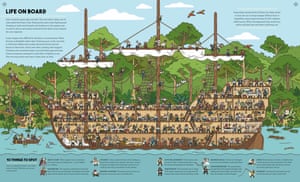
Colourful ... a Harry Bloom illustration for David Long’s Pirates Magnified. Photograph: PR

Pirates Magnified by David Long
Illustrated by Harry Bloom (Wide-Eyed)
An absorbing non-fiction variation on the search-and-find trend, this treasure chest of pirates’ lives, skills, ships and booty boasts a 3x magnifying glass (incorporated ingeniously into the cover), a rogues’ gallery and a pirate-slang glossary. Hoist the mizzen!
A is for Art by Paul Thurlby
(Hodder)
Amid a plethora of art-focused children’s non-fiction, Thurlby’s alphabetical guide – an introduction to the National Gallery and to many artists, techniques and movements – stands out for its demystifying enthusiasm, bold, cheerful design and inspiring sense of possibility.
The Story Orchestra: The Nutcracker by Jessica Courtney-Tickle
(Frances Lincoln)
Beautifully designed and vividly illustrated, this mouth-watering musical book contextualises excerpts of Tchaikovsky’s ballet music within a sugarplum-sweet retelling of the story.

Age 8-12


The World of Moominvalley by Philip Ardagh
Illustrated by Tove Jansson (Macmillan)
Bound in celestial blue and gold, featuring a foreword by Frank Cottrell-Boyceand Tove Jansson’s glorious illustrations throughout, Ardagh’s weighty, witty, carefully curated guide to the Moomins, their friends, their philosophies and their habitats – as well as the life of their mysterious creator – offers hours of browsing to aficionados young and old.
Illegal by Eoin Colfer and Andrew Donkin
Illustrated by Giovanni Rigano (Hodder)
Twelve-year-old Ebo’s journey from his village in north Africa, following in his siblings’ wake, brings him to a dangerous Mediterranean crossing in this arresting graphic novel. Full of contrasts – cold sea and scorching desert, small kindnesses and casual cruelty, hope and sorrow – it tells the stories behind the blunt headline statistics.

Harry Potter and the Prisoner of Azkaban by JK Rowling, illustrated by Jim Kay.


Illustrated by Jim Kay (Bloomsbury)
Harry’s third adventure at Hogwarts is reinvigorated by Jim Kay’s superb painterly images. From the crepuscular grandeur of the towering Knight Bus to the dappled, strokable feathers of Buckbeak the hippogriff, his work invests Rowling’s world with yet another layer of magic.


(Chicken House)
Amihan has lived all her life on the island of Culion, where many people have leprosy – including Ami’s mother. It is a place of joy, however, until harsh authority descends, parting families and uprooting children. Shortlisted for the Costa award, Milwood Hargrave’s second novel is original, poignant and saturated with a sense of wild nature.


Age 12+

The Book of Dust Vol 1: La Belle Sauvage by Philip Pullman

Pullman’s long-awaited return to the world of His Dark Materials is, at times, dark indeed. As Malcolm Polstead, 11-year-old landlord’s son, and Alice Parslow, 15-year-old potwasher, convey the baby Lyra Belacqua down a flooded river in Malcolm’s canoe, the threats in their wake are fierce and frightening (and Alice’s language, in particular, unparliamentary). To the reader immersed in it, whatever their age, it affords the enjoyment of watching a master storyteller at work.


Things a Bright Girl Can Do by Sally Nicholls
(Andersen)
Nicholls’ compelling narrative follows Evelyn, groomed for marriage over study; May, the free-thinking daughter of a Quaker; and Nell, the tough, capable mainstay of her poor family. All of them will fight for the right to vote, but, as the spectre of war grows ever closer, what will they sacrifice – and what will be taken from them? An unforgettable historical novel.


(Walker)
A standout debut, this US novel is the Black Lives Matter-inspired story of Starr Carter, whose friend Khalil is shot dead by a police officer as she watches – and whose divided life is jolted out of kilter in the fallout. Full of evocative detail and wry humour, with a charismatic narrator, it reads like a canonical text.


Satellite by Nick Lake
(Hodder)
Leo was born in space, living all his life on space station Moon 2 with fellow space-children Libra and Orion. Now, at 15, he is almost due to go to Earth for the first time, but more awaits him there than his grandfather’s ranch and the experiences he has been promising himself. Told in Leo’s abbreviated, allusive diction, this is extraordinary science fiction, as diverse and humane as Iain M Banks at his best.