Showing posts with label Yayoi Kusama. Show all posts

Sunday, January 19, 2025

Yayoi Kusama / ‘A letter from Georgia O’Keeffe gave me the courage to leave home’


Yayoi Kusama: ‘A letter from Georgia O’Keeffe gave me the courage to leave home’

This article is more than 8 years old

The artist on a miserable childhood, moving from Japan to the US, and pumpkins

Rosanna Greenstreet

Saturday 21 May 2016

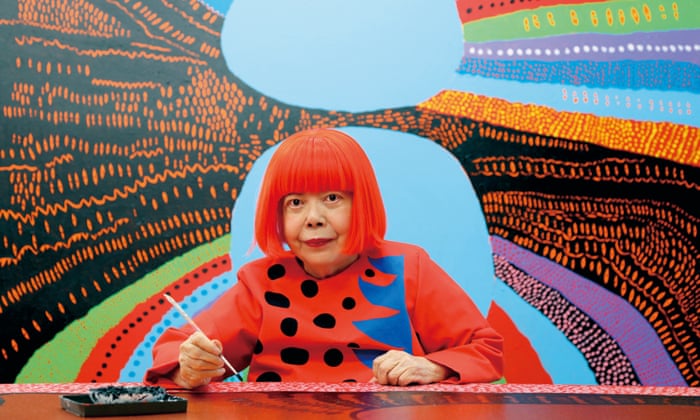
Born in Japan, Yayoi Kusama, 87, studied painting in Kyoto before moving to New York in 1957. She has staged polka-dot orgies and naked anti-tax protests; her work spans painting, drawing, sculpture and performance, as well as literature, fashion and product design. Her latest paintings, pumpkin sculptures and mirror rooms are showing at the Victoria Miro gallery in London from 25 May. Since 1977, she has lived voluntarily in a psychiatric hospital in Japan.

Friday, December 8, 2023

Top 25 News Photos of 2023


A Palestinian man mourns as civil-defense teams and residents search for people trapped under the debris of a demolished building following Israeli air strikes that hit the Al-Shati refugee camp, in Gaza City, Gaza, on October 24, 2023. In early October, Israel declared war on Hamas following the surprise attacks by Hamas militants on October 7 that left 1,200 people dead in Israel and more than 200 taken hostage. In the weeks since, more than 15,000 Palestinians have been killed in the subsequent hostilities, according to the Ministry of Health in Gaza, and more than 1 million have been displaced. 
Ali Jadallah / Anadolu / Getty

Top 25 News Photos of 2023

2023 en fotos


As the end of the year approaches, here is a look back at some of the major news events and moments of 2023. Hamas militants launched a surprise attack in southern Israel, followed by thousands of Israeli air strikes in Gaza; a suspected Chinese surveillance balloon was shot down over the U.S.; extreme weather events affected people around the world; a devastating earthquake struck parts of Turkey and Syria; and much more. Here, we present the top 25 news photos of 2023. 

Tuesday, July 4, 2023

Yayoi Kusama / You, Me and the Balloons review – a psychedelic pop-art garden of earthly delights


A spectacle of tentacles … Yayoi Kusama's installation You, Me and the Balloons. 
Photograph: Phil Noble


Yayoi Kusama: You, Me and the Balloons review – a psychedelic pop-art garden of earthly delights


Aviva Studios, Manchester
The 94-year-old Japanese trailblazer goes big – really big – with warehouse-filling inflatables of dolls, pumpkins and writhing tentacles instilling satisfaction and a stupid happiness

Clearly the architects didn’t get the message that Manchester’s new arts venue Factory International has been renamed, boringly, as Aviva Studios. Because despite the new moniker I can still picture its ultimate inspiration, Tony Wilson, regional TV reporter and founder of the city’s legendary Factory Records, standing on the raised viewing platform in its colossal space, the Warehouse, pretending to be Andy Warhol, looking down on tiny people dwarfed by multicoloured inflatable artworks, pleased that Manchester has finally turned into his fantasy version of Warhol’s New York.


Yayoi Kusama


The Warehouse is a monster of a room that seems to have been inspired by staring at the enigmatic covers of Factory Records LPs while listening to Joy Division. It is an enormous industrial cavern with giant steel doors and towering, shadowy dimensions that appears equally capable of hosting art, gigs or a club. Yayoi Kusama’s opening event You, Me and the Balloons has aspects of all three. The 94-year-old pink-haired artist appears on a screen chanting above a forest of luminous purple tentacles. In front of this loom a gargantuan orange pumpkin, a giant statue that resembles Kusama with a skirt made of fat fingers, yapping dogs and lurid clouds.

Wednesday, June 24, 2020

Yayoi Kusama / Infinity Mirror Rooms


TATE MODERN
EXHIBITION

YAYOI KUSAMA: INFINITY MIRROR ROOMS

UNTIL 9 MAY 2021
Step into infinite space

Tate presents a rare chance to experience two of Yayoi Kusama’s Infinity Mirror Rooms. These immersive installations will transport you into Kusama’s unique vision of endless reflections.

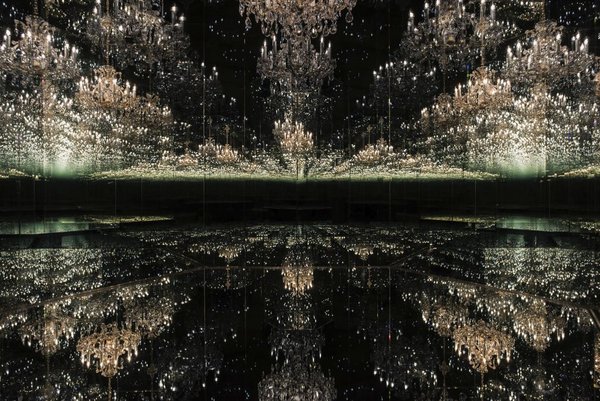
Infinity Mirrored Room – Filled with the Brilliance of Life is one of Kusama’s largest installations to date and was made for her 2012 retrospective at Tate Modern. It is shown alongside Chandelier of Grief, a room which creates the illusion of a boundless universe of rotating crystal chandeliers.

A small presentation of photographs – some on display for the first time – provides historical context for the global phenomenon that Kusama’s mirrored rooms have become today.

Born in 1929 in Matsumoto, Japan, Kusama came to attention for her happenings in 1960s New York and a wide-ranging artistic practice that has encompassed installation, painting, sculpture, fashion design and literary writing. Since the 1970s she has lived in Tokyo, where she continues to work prolifically and to international acclaim.

Yayoi Kusama: Infinity Mirror Rooms is presented in The George Economou Gallery

TATE


Wednesday, April 15, 2020

Yayoi Kusama's message to Covid-19 / 'Disappear from this earth'


‘A brief burst of light points to the future’ ... Yayoi Kusama in 2015. Photograph: Courtesy Ota Fine Arts, Victoria Miro, David Zwirner

Yayoi Kusama's message to Covid-19: 'Disappear from this earth'

The veteran Japanese avant-garde artist has issued a poem of defiance in the teeth of the ‘terrible monster’, the coronavirus pandemic

Mark Brown
Wednesday 15 April 2020
Yayoi Kusama, one of the world’s most popular living artists, has responded to the global coronavirus crisis with a message of defiance.
The reclusive 91-year-old, celebrated for her polka-dot artworks and installations, has written what she says is a message to the whole world.
It takes the form of a poem, in which Kusama says it is time “to fight and overcome our unhappiness” to “fight this terrible monster”.
Kusama has had hugely popular touring shows across the US and Europe in recent years, as well as large-scale solo shows in Mexico City, Rio de Janeiro, Seoul and Taiwan. In 2017, a five-storey museum dedicated to her work opened in Tokyo.


 Yayoi Kusama’s Road to Eternal Love and Hope, 2019. Photograph: Courtesy Ota Fine Arts, Victoria Miro, David Zwirner

Much of Kusama’s work is characterised by obsessiveness and a desire to escape psychological trauma. Open about her own mental-health issues, Kusama has lived voluntarily in a Japanese psychiatric institution since 1977.
This is the text of her message:

Today, with the world facing Covid-19, I feel the necessity to address it with this message:
A MESSAGE FROM YAYOI KUSAMA TO THE WHOLE WORLD


Though it glistens just out of reach, I continue to pray for hope to shine through
Its glimmer lighting our way
This long-awaited great cosmic glow

Now that we find ourselves on the dark side of the world
The gods will be there to strengthen the hope we have spread throughout the universe

For those left behind, each person’s story and that of their loved ones
It is time to seek a hymn of love for our souls
In the midst of this historic menace, a brief burst of light points to the future
Let us joyfully sing this song of a splendid future
Let’s go

Embraced in deep love and the efforts of people all over the world
Now is the time to overcome, to bring peace
We gathered for love and I hope to fulfil that desire
The time has come to fight and overcome our unhappiness

To Covid-19 that stands in our way
I say Disappear from this earth
We shall fight
We shall fight this terrible monster
Now is the time for people all over the world to stand up
My deep gratitude goes to all those who are already fighting.

Revolutionist of the world by the Art
THE GUARDIAN


Wednesday, November 5, 2014

Yayoi Kusama / Monograph

Yayoi Kusama / Louis Vuitton
Yayoi Kusama
BIOGRAPHY
MONOGRAPH

The origin of artworks by Yayoi Kusama is a hallucination which took place at a dining room: the red flower patterns on the tablecloth started to spread across the walls, the floor and on herself. The artist, born in 1929 in Japan, seized all techniques (sculpture, painting, film-making, photography, and writing) to transcribe this disorientation. In the 1950’s, she made a name for herself with the Infinity Nets, the monochrome networks composed of a miniscule unique element repeated to infinity. In 1958 Yayoi Kusama settled in New York where she mixed with the avant-garde world and exhibited alongside Claes Oldenburg, Andy Warhol and Donald Judd. In her installations, she recovered everyday objects of soft prominent forms, and carried out performances in symbolic areas of the city. Since her return to Japan in 1973, the artist who describes herself as obsessive resides in a psychiatric hospital and goes to her studio everyday to create. Yayoi Kusama became famous tardily from the late 1980s and she showcased prestigious exhibitions, in particular at the Venice Biennale, the MOMA in New York and the Maison de la Culture du Japon in Paris. The travelling retrospective which is dedicated to her today confirms her status as an indispensable figure of contemporary art.


Marking the collaboration between Louis Vuitton and Yayoi Kusama, this limited-edition monograph, with a cover exclusively designed for Louis Vuitton, presents an in-depth examination of the Japanese artist’s career and creative process. It features contributions from internationally renowned authors and curators, and includes many previously unpublished documents, photographs from the artist’s archives and reproductions of her original works.
Yayoi Kusama Monograph was edited by Louise Neri, published by Rizzoli NY in 2012. This exclusive edition is only available in Louis Vuitton stores for US$85.


Yayoi Kusama's sell-out line for Louis Vuitton


Kusama sculptures in the windows of Selfridges

Yayoi Kusama's sell-out line 

for Louis Vuitton

The Japanese artist's polka-dotted collection for Louis Vuitton has repeatedly sold out at Selfridges.

BIOGRAPHY

BY LISA ARMSTRONG | 07 SEPTEMBER 2012

The Louis Vuitton collaboration with Yayoi Kusama is, apparently, its most successful art union ever, which probably means it's the most successful art-fashion union of all time.
To celebrate the repeated sell-outs, Selfridges has winched a giant Yayoi into place above its front doors on Oxford Street, just in case customers missed the Kusama/Vuitton products in its 24 windows. As we can no longer rely on the late Robert Hughes to explain its success, I've toiled with two theories. Either the eternal repetitiveness of YK's trademark polka dots are a metaphor for the insatiable yearnings of the modern consumer, or it's all about Kusama's hair. It's not just the pumpkin colour (very 2012), but the precision bobbing. No one, from Anna Wintour to Victoria Beckham, has failed to assail the citadels of fashion with that cut.


FASHION


Yayoi Kusama / A Visual Exploration of the Mind


Yayoi Kusama

BIOGRAPHY
A Visual Exploration of the Mind
By Camille Okhio
Yayoi Kusama Self-Obliteration, 1967. Tate-Modern Retrospective.
Viewing my first Yayoi Kusama’s Infinity Net, was like experiencing the feeling of abruptly waking up from a dream in which one was falling towards something bottomless. Her work is dark, uncomfortable and indecipherable. In her autobiography, Kusama discusses her simultaneous fascination and disgust with all things pertaining to human sexuality. Her tortured relationship with the body and the mind is the root of her mental illness. Her discomfort has mounted so intensely over the years that it was enough of an impetus to commit herself to a psychiatric hospital in 1977.
Infinity Dots 2007 
Photography by Hal Reiff of Kusama reclining on Accumulation No. 2. 1966. Museum of Modern Art, New York.
Her fragmented perception of the world around her was not something developed in order to foster the artistic process, but rather a plague that has affected her since early childhood. Whether the viewer translates this as positive or negative, it is perhaps the reason why Kusama’s work has such emotional and conceptual depth. For the artist this was not just one element of her life, but its entirety. She writes in her autobiography: “One day, after gazing at a pattern of red flowers on the tablecloth, I looked up to see that the ceiling, the windows, and the columns seemed to be plastered with the same red floral pattern. I saw the entire room, my entire body, and the entire universe covered with red flowers, and in that instant my soul was obliterated and I was restored, returned to infinity, to eternal time and absolute space. This was not an illusion but reality itself.”
Yayoi-Kusama “Leaves”-1954.Tate-Modern Retrospective.
“Tree” 1952.
“Lemonade” 2000.
“Flowers”
The visual fruit of her mind’s unrest is her prolific collection of work. Yayoi Kusama’s paintings and sculpture have a way of creating an immersive sensory experience for the viewer. Her Accumulation worksand Compulsion Furniture make one feel as if they are under attack. They are all-encompassing, occupying every space in your mind, as they do in hers. Her work is a projection of her own consuming mental illness onto the viewer, so that we can truly see what she sees. Her work seeks out and identifies the fears of the individual, namely, lack of control. Perhaps the same lack of control Kusama experiences when her visions overcome her.
Yayoi Kusama.Accumulation 1963 – 64, New York.
Yayoi Kusama ,Compulsion Furniture, 1962-63/1993, Acrylic on canvas and mixed media
As a child, Kusama had auditory and visually extraordinary interactions with her inanimate surroundings. She speaks of a day during her childhood when the violets in the field surrounding her home spoke to her, using her name, until their calls became screams. These experiences were most likely promulgated by a fear of the people around her, later developing into a fear more specifically channeled at the sex organs of those around her and herself. The repetitive phallic imagery in much of her sculpture communicates the intense anxiety she associates with the sex act. When this anxiety is considered with the knowledge of the performance orgies Kusama organized in the 1960’s, Kusama’s focus becomes muddled. This shows the shifting quality of her work. It targets whatever anxiety is most oppressive at the point of creation.
“Sliver Shoes”
I see Kusama’s work as a response to what seems to her an oppressive world. The artistic process is her“search for truth.” This search is marked physically by her Infinity Net’s. Kusama’s Infinity Nets wave in and out of each other an innumerable amount of times. She constructs her compositions with no frame or pattern in mind, but draws purely upon the rhythm of her mind. The processes of a mind, especially one as troubled as Kusama’s, are something so intricate that it seems an impossibility that one could envision them without separating them. The aesthetic value of Kusama’s compositions is that she is able to represent every tangent of her mind simultaneously. The technical skill of her works is unquestionable. She does not once drop a line or a pattern.
Infinity Nets Yellow.
Viewing her canvases within a frame seems to obstruct them. Her paintings go on forever. They seem to strain against the frames they’re placed in, ready to burst farther into infinity. In her autobiography, Kusama describes her artistic process as a treatment for her mental illness. She would stay up days at a time, not necessarily as a matter of dedication, but from the need to release the forms that plagued her onto the canvas. Her work is in the purest form a projection. Her work is a visual manifestation of her anxieties, fears and repulsions. Her presentation of her own reality also reveals to us her vision of the duality of nature, at times both hostile and benign.
“Self – Portrait” Yayoi Kusama, 2009.
The works in which she quotes the natural form take on a predatory and aggressive tone. By claiming natural and human forms and slightly perverting them into more amorphous forms, Kusama’s work claims a space somewhere between dreams and nightmares. Kusama’s self-proclaimed effort is to reunite humanity more firmly with the unadulterated beauty of the natural world and the human mind. Two things which strangely enough are the root of Kusama’s psychological discomfort. She writes towards the end of her memoirs: “The arrogance of human beings, who have progressed so far through science and the mastery of machinery, has caused them to lose touch with the radiance of life and led to the impoverishment of the imagination.” Kusama’s work is both noble and extraordinary in its conception and execution. In a lifetime of oppressive mental illness, Kusama has identified and revealed true beauty, which is neither perfect nor wholesome, and has expressed that beauty with an elegance and honesty which indicates her masterful skill.
Yayoi Kusama.

Camille Okhio is a contributing writer for by such and such.