Showing posts with label Natalia Ginzburg. Show all posts

Tuesday, September 10, 2024

Natalia Ginzburg, the Last Woman Left on Earth


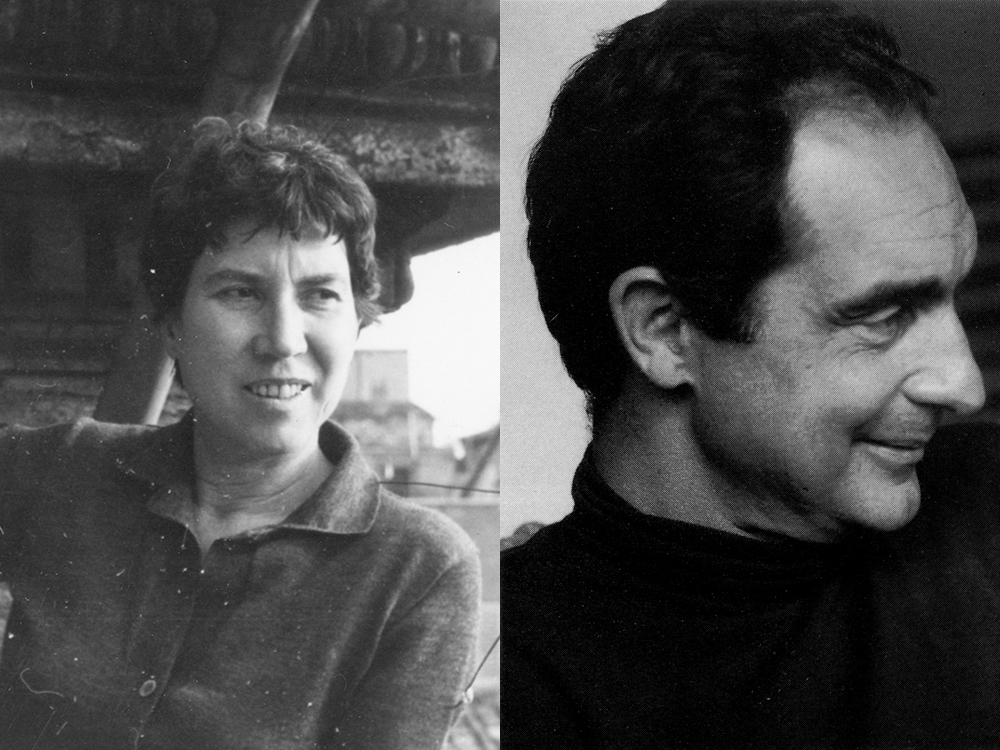
NATALIA GINZBURG AND ITALO CALVINO. GINZBURG PHOTO: COURTESY OF ARCHIVIO STORICO EINAUDI. CALVINO PHOTO: COURTESY OF THE AUTHOR’S ESTATE.


Natalia Ginzburg, the Last Woman Left on Earth

By 


On September 21, 1947, Italo Calvino—then the twenty-four-year-old book critic for Piemonte’s L’Unitá newspaper—published a review of Natalia Ginzburg’s second novel, The Dry Heart. The review, which is presented below in English for the first time, opens with this proposal: “Natalia Ginzburg is the last woman left on earth. The rest are all men—even the female forms that can be seen moving about belong, ultimately, to this man’s world.” For a moment, if you’re familiar with Calvino’s surreal masterpiece Invisible Cities, written twenty-five years later, you feel as if you’re teetering on the edge of one of that book’s bewildering scenes—all glimpse and symbol, hallucination posing as anthropology. But no, the young writer is merely trying to find the perfect words to describe the entirely singular aesthetic of a novelist who is vexingly (to him, it would seem) female. Calvino’s review stands in the Ginzburg archives as one of the most bizarre, yet also astute, as he pinpoints the way her made-up worlds are hyperrealistic voids, her characters both humane and remote, her Minimalism dependent on small mundane artifacts, her domesticity suffocating and vast. “It’s a shame we’ll never know Ginzburg’s reaction to this review,” the Ginzburg biographer Sandra Petrignani writes, “that positioned her in a new world of fiction, modern precisely because it is ancient.”

Wednesday, March 30, 2022

Foreign fields / Boyd Tonkin chooses his favourite shorter classics in translation

Georges Simenon


Foreign fields: Boyd Tonkin chooses his favourite shorter classics in translation

4 July 2020

If I had a rouble or a euro for every reader who fulfilled their lockdown promise to devour Dostoevsky, Tolstoy or Proust my bank account would hardly grow by a single penny. Duty, guilt and pride never made the pages turn more swiftly, whatever a book’s length. Almost all vows to catch up on doorstopper classics from the global canon will have failed to outlast the fallen blossoms. Yet you might more realistically blend discovery and delight by exploring some of the smaller miracles of great fiction in translation.

Tuesday, December 22, 2020

Reading women / Vivian Gornick on the Book That Made Her a Personal Essayist

Vivan Gornick


Vivian Gornick on the Book That Made Her a Personal Essayist


As told to Erica Schwiegershausen
September 6, 2017


In Reading Women, the Cut talks to women who interest us about the books by women that transformed the way they think.

The book that influenced me the most in my life as a writer is a small book of essays called The Little Virtues by the Italian writer Natalia Ginzburg. I was quite young, in my late 20s and early 30s, when I read that book, and it taught me who I was as a writer. In the book, there is an essay called “My Vocation.” It’s an account of how Ginzburg came to be a writer. What she’s writing towards, and you’re following right along with her, is the deepening perception of what a piece of writing is: that it has to come from the heart, from the spirit. And she discovers that she is not a fiction writer, but in fact a personal essayist. That’s what she called her vocation — meaning, This is the work I was born to do. She sees that only by being a person who is able to touch the deepest parts of her own self, as a writer, can she experience and practice generosity towards others.


I’ve read these essays over and over as the years have passed. The deepest lesson that I learned was that I was going to become a personal essayist, and that it was as an essayist that I would try to use myself, not to speak about myself, but to explore the world. When you feel that the writer is genuinely on a path of discovery, or self-discovery, the writing comes alive. Ginzburg is insisting that the essay can make you feel the wonderment of being alive as much as you could in a story or a poem. And she does that. It’s my hope that I sometimes do it, too. That’s the claim of the personal essay now, that it has the power to make emotional experience come alive. That’s what we read for, the emotional experience.

THE CUT