Showing posts with label Neil Gaiman. Show all posts

Wednesday, January 15, 2025

Neil Gaiman denies sexual assault allegations after multiple women come forward

Neil Gaiman


Neil Gaiman denies sexual assault allegations after multiple women come forward

Author publishes statement after New York Magazine investigation, saying: ‘I have never engaged in non-consensual sexual activity with anyone. Ever’


Sian Cain
Wednesday 15 January 2025


Neil Gaiman has denied all allegations against him after multiple women accused him of sexual misconduct in a New York Magazine article, writing in a lengthy statement: “I have never engaged in non-consensual sexual activity with anyone. Ever.”

Neil Gaiman screen adaptations halted after allegations of sexual misconduct


Neil Gaiman


Neil Gaiman screen adaptations halted after allegations of sexual misconduct

This article is more than 3 months old

Netflix’s Dead Boy Detectives has been cancelled and productions by Amazon and Disney have been put on hold amid reports about the Coraline author


Ella Creamer
Fri 13 Sep 2024 21.47 BST

Three screen adaptations of Neil Gaiman’s works have been cancelled or had their production paused amid reports accusing the author of Coraline and The Sandman of sexual misconduct.

Saturday, October 28, 2023

Gene Wolfe / In the Company of Wolves


Gene Wolfe

In the Company of Wolves

I became involved with the Chicago Literary Hall of Fame because I believe that Chicago has an important literary legacy deserving of attention. After two induction ceremonies where we celebrated historical writers, it was time to look at the contribution of writers living and working in Chicago.

Fuller Award designed by M.C. Matz and sculpted by Ron Swanson (Photo by 8 Eyes Photography)

After some discussion, it was unanimous, and we moved forward to create a new award, the Fuller, to honor a lifetime contribution to Chicago literature. 

Sunday, October 22, 2023

I Believe by Neil Gaiman

Neil Gaiman


I BELIEVE
by Neil Gaiman

I can believe things that are true and things that aren't true and I can believe things where nobody knows if they're true or not.

Writers, alcohol and kisses by Neil Gaiman


Neil Gaiman


Writers, alcohol and kisses
by Neil Gaiman


In my experience, writers tend to be really good at the inside of their own heads and imaginary people, and a lot less good at the stuff going on outside, which means that quite often if you flirt with us we will completely fail to notice, leaving everybody involved slightly uncomfortable and more than slightly unlaid.

So I would suggest that any attempted seduction of a writer would probably go a great deal easier for all parties if you sent them a cheerful note saying "YOU ARE INVITED TO A SEDUCTION: Please come to dinner on Friday Night, Wear the kind of clothes you would like to be seduced in."

And alcohol may help, too. Or kissing.
Many writers figure out that they're being seduced or flirted with if someone is actually kissing them.

Neil Gaiman / ‘In your 60s, any sex is good sex. It’s like: Oh my gosh, I can still do this thing’


Neil Gaiman


Neil Gaiman: ‘In your 60s, any sex is good sex. It’s like: Oh my gosh, I can still do this thing’


Rosanna Greenstreet
Saturday 21 October 2023

Born in Portchester, Hampshire, Neil Gaiman, 62, started out as a journalist. In the 1980s, he wrote the Sandman comic-book series, which became a multimillion-selling graphic novel, and was adapted for Netflix last year. His books Coraline and Stardust have become films, and Neverwhere, American Gods and Good Omens are TV series. His latest book, What You Need to Be Warm, which supports the work of UNHCR, is released on 26 October. Gaiman lives in Woodstock, New York.

Thursday, December 30, 2021

All Advice Is Bad


Margaret Atwood


All Advice Is Bad

The arbitrary brain feed of writerly legends who could easily be the faceless guy at the bar crying into his shoulder bag.
Blake Butler
June 19, 2012

Last year or so the Guardian rounded up a bunch of writers over the age of 60 or something and asked them to give advice to writers who use the internet, AKA college students. Some of them offered up some pretty dumb ideas, and even the ones that seemed reasonable to me were mostly just as arbitrary as the ones that clearly were the brain feed of someone who’s been too long in a game where even the legends could be the faceless guy beside you at the bar crying into his shoulder bag.

1. Elmore Leonard: “Never open a book with weather. If it's only to create atmosphere, and not a character's reaction to the weather, you don't want to go on too long. The reader is apt to leaf ahead looking for people.”

If you’re a pussy, this rule is true. Giving up some banal crap I can look out my window to find out isn’t that necessary, but there are plenty of ways to talk about what’s in the air without sounding like you’re setting up an Elmore Leonard novel. One of the most famous opening lines ever, Pynchon’s “A screaming comes across the sky,” isn’t regarding weather per se, but it’s just provocatively situated enough to make you think it could be. And our crime drama writer Leonard is OK with the weather as long as you’ve got a human telling about it? Isn’t that every sentence in every book? I’m sorry to break it to you, Elmore, but humans are the most transient pieces of weather on the earth.

2. Margaret Atwood: “You most likely need a thesaurus, a rudimentary grammar book, and a grip on reality.”

A grip on reality is the last thing I recommend if you are hoping to devote your life to sitting at a machine all day while other people work for actual money and then go home and spend time with their families while not still in the back of their mind doting on the fantasies they ejaculated that week at the desk. More likely you should have a willingness to completely dash any hope of being a normal person with a normal face, though it does indeed help not to be a total headcase motherfucker in the meantime, so perhaps find/replace “reality” with “death.” I don’t think you’ll find that replacement in your thesaurus, which is why they are mostly a waste of time.


3. Roddy Doyle: “Do be kind to yourself. Fill pages as quickly as possible; double space, or write on every second line. Regard every new page as a small triumph.”

I like writing in a frenzy as much as anyone, but to pat yourself on the back every time you’ve blathered the roughly 450 words it takes to fill one double-spaced page, which is essentially the length of a slightly-too-long email, is not only unnecessary, it’s pathetic. Look, no one cares what you do at your desk or how long it took you to get there, or how many words you snuck in today before going to the gym to burn off the beer you drank to feel better about having sat in one place all day again, or how long the manuscript you’re currently working on that should probably have half of itself deleted if you really want to be kind not to yourself or to the reader but the thing you’re making, which is the point in the first place, right? If you’re the kind of person that needs a new small triumph a few times an hour, take up playing billiards against toddlers. If you want to write, put down the mirror.

4. Richard Ford: “Don't read your reviews.”

If you’d read your reviews, Richard, you might have found enough self-guilt to do something new.

5. Jonathan Franzen:“You have to love before you can be relentless.”

Giancarlo DiTrapano and I already extensively covered our feelings on J-Franz, but I’m still cringing about this little nugget. Is that, like, make sure you squash your itch to watch old episodes of Friends before you sit down at the computer, otherwise you’ll just never quite be able to focus?

6. Esther Freud: “Editing is everything. Cut until you can cut no more. What is left often springs into life.”

I mean, yeah, you need to edit, but this sounds like you just put the printout in a magic hat and shake it around and out it comes all wise and ready for the National Book Awards. “Cut until you can cut no more” taken to its logical conclusion pretty much ends up with a blank page, which is maybe some advice that could be taken more regularly, for sure, though this thing about springing into life reminds me for some reason of the Smurfs. Why do so many grown ass-people sound like wise-beyond-their-years nine-year-olds?

7. Neil Gaiman: “Remember: when people tell you something's wrong or doesn't work for them, they are almost always right.”

No. Bad Neil. You are wrong.

8. David Hare: “Write only when you have something to say.”

Following this rule, every Facebook status update could be expanded into a novel. Your baby is six weeks along now? Well by all means, tell the world! Why stop at 50 words? I AM SO READY TO HEAR EVERYTHING THAT’S ON YOUR MIND. How about instead only write when you have absolutely nothing to say and aren’t even in your body so now it’s not you with all your shitty human want and wishing, and is instead something bigger than a person ostensibly writing out a Christmas list of narrative action on paper?

9. Hilary Mantel: “Are you serious about this? Then get an accountant.”

Barf on my dick, Hilary.

10. Michael Moorcock: “Introduce your main characters and themes in the first third of your novel…. Develop your themes and characters in your second third, the development. Resolve your themes, mysteries, and so on in the final third, the resolution.”

Hi, Reader, I’d like you to meet my character, Michael Moorcock, and my theme, Anti-Transcendent Definition of Impossible-to-Define Terminology in the Name of Pretending There Is Perfect Science to My Mythology When in Fact the Only Thing That’s True About Anything Is What It Actually By Its Own Admission Is, Which Doesn’t Mean Anything Because Storytelling Is Just a Bunch of Stories and Making Art Is Making Art and The Reason People Are Sick of Reading Mostly Is That So Many People Think They Have to Follow Anybody’s Shitty Rules Instead of Thinking of Their Own Rules With Their Blood Instead of Their Brains and Just Fucking Creating Something Else.

11. Annie Proulx: “Write slowly and by hand only about subjects that interest you.”

AKA never learn anything, never invent anything, never change speeds, never feel deleted, never scare yourself, never scare anyone. Sure. Sounds good. See you in the gardens.

12. Will Self: “Stop reading fiction–it's all lies anyway, and it doesn't have anything to tell you that you don't know already (assuming, that is, you've read a great deal of fiction in the past; if you haven't, you have no business whatsoever being a writer of fiction).”

I suggest you start with the work of Will Self.

13. Colm Tóibín: “Finish everything you start.”

Now, if you’ll excuse me, when I was six I wrote the first verse of a rap called “The Supersonic Dudes from 3003” and never got around to finishing and now I realize why I never sleep….

VICE


Wednesday, October 6, 2021

Our 2020 in Books / Sam Cohen

Joan Didion


Our 2020 in Books: Sam Cohen


As a globally unusual year comes to an end and we enter into 2021, we consider the reading that defined each of our 2020s. In this piece, writer Sam Cohen talks about reading as refuge in 2020.

“But really, I read in order not to be in life. Reading is better than life. Without reading, you’re stuck with life.”
— FRAN LEBOWITZ: BY THE BOOK — NEW YORK TIMES, 2017

 In order not to be in life has always been the appeal of reading. Reading is my primary refuge. When nothing feels safe, or certain, I pick up a book and instantly, I am in control. I am shrouded in secrecy — the only ones who know what will happen next are me and the author, the characters on the page. If difficulty is encountered, it is conquered. If grief is experienced, it is ended. If loss occurs, it is finite. And if it becomes too much, I can simply put the book down and walk away. Listen to music. Watch television. Sit and gaze into the sky. It isn’t real, and thus, it does not need to be carried with me.

Tuesday, October 27, 2020

Neil Gaiman / How To Read Gene Wolfe


How To Read Gene Wolf

by Neil Gaiman


The Wolfe & Gaiman Show

LOOK AT Gene: a genial smile (the one they named for him), pixie-twinkle in his eyes, a reassuring mustache. Listen to that chuckle. Do not be lulled. He holds all the cards: he has five aces in his hand, and several more up his sleeve.

I once read him an account of a baffling murder, committed ninety years ago. "Oh," he said, "well, that's obvious," and proceeded off-handedly to offer a simple and likely explanation for both the murder and the clues the police were at a loss to explain. He has an engineer's mind that takes things apart to see how they work and then puts them back together.

Monday, October 26, 2020

Neil Gaiman / Fortunately, the Milk / Review

Neil Gaiman


Fortunately, the Milk by Neil Gaiman – review


Gaiman's inventive tale of time travel relies on Chris Riddell's illustrations to flesh out the fun

  • Philip Ardagh
  • The Guardina, Saturday 14 September 2013
Fortunately, the MilkView larger picture
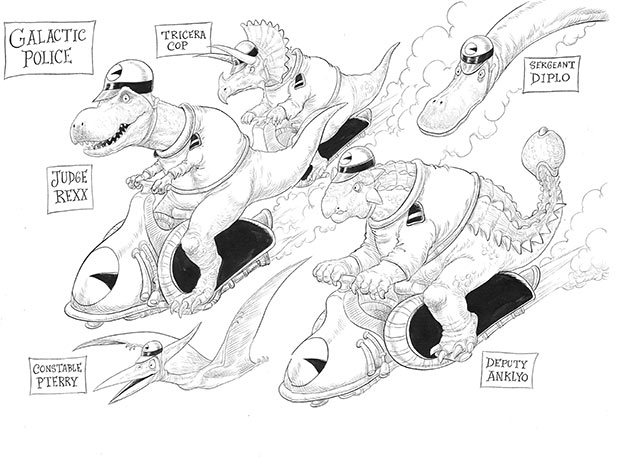
High comedy … a detail of Chris Riddell’s illustration of dinosaur galactic police on space bikes in Fortunately, the Milk. Click to enlarge
Neil Gaiman is a phenomenon. I'm not saying that's good. I'm not saying that's bad. I'm simply stating a fact. As @neilhimself he has more than 1.8 million followers on Twitter, with a cult following both online and in the flesh. A fellow author recently commented that when Gaiman talks, people clap. When he coughs, they laugh. He inspires loyalty like few others. There is, in effect, the cult of Gaiman.

Friday, October 9, 2020

Books that made me / Neil Gaiman / 'Narnia made me want to write, to do that magic trick'

Neil Gaiman: ‘Tristram Shandy is a novel I approve of and keep meaning to read. I just haven’t read it.’ Photograph: Tim Knox/The Guardian


Books

that 

made me  

Neil Gaiman: 'Narnia made me want to write, to do that magic trick'

The author on his friendship with Gene Wolfe, crying over Diana Wynne Jones and falling under the spell of CS Lewis 


Neil Gaiman

Friday 9 October 2020


The book I am currently reading
The Invention of Jane Harrison by Mary Beard. I’m fascinated by Hope Mirrlees, and her relationship with Jane Harrison was one of the ingredients of her life. They collaborated on a book of translated Russian tales, and Harrison’s theories seem integral both to Paris, Mirrlees’s modernist poem and to Lud-in-the-Mist. I’m loving watching Mary Beard deconstruct and re-examine ideas about what biography is in this short but brilliant book. Also Pandora’s Jar: Women in the Greek Myths by Natalie Haynes. I’m reading it slowly and with delight, an essay at a time, rejoicing in the easy erudition and the way she upends what I thought I knew and gives me something much more interesting in its place.

The book that changed my life

The Book of the New Sun by Gene Wolfe. It’s brilliant, much more brilliant than I knew when I read it for the first time. I would not be the writer I am without Wolfe’s friendship, or without taking his lesson that you should write to be reread with increased pleasure by a smart reader.

The book I wish I’d written

Lud-in-the-Mist by Hope Mirrlees. It’s the great English fantasy novel, about the prosaic land next to the wilderness of Faerie. It’s a history and a murder mystery, and it’s about family and dissatisfaction, and about fairy fruit, which, as with all good fantasy, stands both for itself and for poetry, and sexuality, and the things that leave us changed forever.

The last book that made me laugh
Round the Horne Scripts by Marty Feldman and Barry Took. Où sont les neiges d’antan, Mr Horne? That’s your actual philosophical French.

The book that influenced my writing

The Voyage of the Dawn Treader by CS Lewis. I read it when I was six, and fell in love with Narnia and with the magical story and most of all with the auctorial voice. Lewis seemed to be having a wonderful time writing, confiding in and treating the readers as if they were smart friends. It was the first time I was ever aware that there was a person behind the words. It made me want to write. It made me want to do that magic trick.

The last book that made me cry

Reading Diana Wynne Jones’s Dogsbody to my daughter Maddy, some 15 years ago. I got to the book’s end and we both had very wet faces.

The book I couldn’t finish
Titania Has a Mother by Caryl Brahms and SJ Simon. I love much of their work, so was thrilled recently to find a book of theirs I didn’t know about. And a fairytale book at that. Let’s just say it was of its time and hadn’t aged well.

The book I’m ashamed not to have read
Laurence Sterne’s Tristram Shandy. I’ve read extracts from it and loved them. It’s a novel I approve of and keep meaning to read. I just haven’t read it.

The book I give as a gift
A Humument by Tom Phillips. A Victorian novel, with pages painted over and into, messages and thoughts revealed and illuminated. It was always the book I gave people, hoping that even a few of them would read it and delight in it as I do.

The book I’d most like to be remembered for
You don’t get to choose. Probably, you don’t get to be remembered, either. But most of my favourite authors are now unfashionable and forgotten, and I’d be happy to join their company, if every now and again someone found one of my books in a dusty pile and took comfort in it.

My earliest reading memory
A book about a little mermaid looking for other mermaids, and the inside front cover art from a Noddy book.

My comfort read
Roger Zelazny’s Lord of Light feels like a place I can go where the people know me and will have to take me in, in a novel of people become gods.

 Pirate Stew by Neil Gaiman, illustrated by Chris Riddell, is published by Bloomsbury (£12.99).

THE GUARDIAN


THE BOOKS THAT MADE ME
2017
13 October 2017
Eimear McBride / ‘I can never finish Dickens – it’s sacrilege’
20 October 2017
Shami Chakrabarti / ‘Harry Potter offers a great metaphor for the war on terror’


Sunday, March 4, 2018

Neil Gaiman / A man who won't forget Ray Bradbury

Ray Bradbury


A man who won't forget Ray Bradbury


Fantasy writer Neil Gaiman remembers his friend Ray Bradbury who has died at the age of 91

Neil Gaiman
Wed 6 jun 2012


Y
esterday afternoon I was in a studio recording an audiobook version of a short story I had written for Ray Bradbury's 90th birthday. It's a monologue called The Man Who Forgot Ray Bradbury, and was a way of talking about the impact that Ray Bradbury had on me as a boy, and as an adult, and, as far as I could, about what he had done to the world. And I wrote it last year as a love letter and as a thank you and as a birthday present for an author who made me dream, taught me about words and what they could accomplish, and who never let me down as a reader or as a person as I grew up.

Last week, at dinner, a friend told me that when he was a boy of 11 or 12 he met Ray Bradbury. When Bradbury found out that he wanted to be a writer, he invited him to his office and spent half a day telling him the important stuff: if you want to be a writer, you have to write. Every day. Whether you feel like it or not. That you can't write one book and stop. That it's work, but the best kind of work. My friend grew up to be a writer, the kind who writes and supports himself through writing.
Ray Bradbury was the kind of person who would give half a day to a kid who wanted to be a writer when he grew up.
I encountered Ray Bradbury's stories as a boy. The first one I read was Homecoming, about a human child in a world of Addams Family-style monsters, who wanted to fit in. It was the first time anyone had ever written a story that spoke to me personally. There was a copy of The Silver Locusts (the UK title of The Martian Chronicles) knocking about my house. I read it, loved it, and bought all the Bradbury books I could from the travelling bookshop that set up once a term in my school. I learned about Poe from Bradbury. There was poetry in the short stories, and it didn't matter that I was missing so much as a boy: what I took from the stories was enough.
Some authors I read and loved as a boy disappointed me as I aged. Bradbury never did. His horror stories remained as chilling, his dark fantasies as darkly fantastic, his science fiction (he never cared about the science, only about the people, which was why the stories worked so well) as much of an exploration of the sense of wonder, as they had when I was a child.

He was a good writer, and he wrote well in many disciplines. He was one of the first science fiction writers to escape the "pulp" magazines and to be published in the "slicks". He wrote scripts for Hollywood films. Good films were made from his novels and stories. Long before I was a writer, Bradbury was one of the writers that other writers aspired to become. And none of them ever did.
A Ray Bradbury story meant something on its own – it told you nothing about what the story would be about, but it told you about atmosphere, about language, about some sort of magic escaping into the world. Death is a Lonely Business, his detective novel, is as much a Bradbury story as Something Wicked This Way Comes or Fahrenheit 451 or any of the horror, or science fiction, or magical realism, or realism you'll find in the short story collections. He was a genre on his own, and on his own terms. A young man from Waukegan, Illinois, who went to Los Angeles, educated himself in libraries, and wrote until he got good, then transcended genre and became a genre of one; often emulated, absolutely inimitable.


Ray Bradbury
by Richard Wyatt


I met him first when I was a young writer and he was in the UK for his 70th birthday celebrations, held at the Natural History Museum. We became friends in an odd, upside-down way, sitting beside each other at book-signings, at events. I would be there when Ray spoke in public over the years. Sometimes I'd introduce him to the audience. I was the master of ceremonies when Ray was given his grand master award, by the Science Fiction Writers of America: he told them about a child he had watched, teased by his friends for wanting to enter a toy shop because they said it was too young for him, and how much Ray had wanted to persuade the child to ignore his friends and play with the toys.
He'd speak about the practicalities of a writer's life ("You have to write!" he would tell people. "You have to write every day! I still write every day!") and about being a child inside (he said he had a photographic memory, going back to babyhood, and perhaps he did) about joy, about love.
He was kind, and gentle, with that midwestern niceness that's a positive thing rather than an absence of character. He was enthusiastic, and it seemed that that enthusiasm would keep him going forever. He genuinely liked people. He left the world a better place, and left better places in it: the red sands and canals of Mars, the midwestern Halloweens and small towns and dark carnivals. And he kept writing.
"Looking back over a lifetime, you see that love was the answer to everything," Ray said once, in an interview.
He gave people so many reasons to love him. And we did.