Wednesday, June 6, 2012

Alessia Cocca / La rose di Alfredo


ALESSIA COCCA
by Giovanni Cervi

Alessia‘s latest body of work will be on the walls of the Italian Cultural Institute in Berlin from June 7th at 19:00. Her latest body of work, Le rose di Alfredo (Alfredo’s roses), was inspired by the story of Alfredo “Alfredino” Rampi: the six-year Alfredino fell on 10 June 1981 in Vermicino near Rome, 36 meters deep in a well. Despite the several days of rescue efforts, the child could only be recovered dead. The powerful photographs of Alessia bring back her childhood memory of that episode, reinterpreted with powerful symbolism, so common in Alessia‘s work. 


Tuesday, June 5, 2012

Beautiful Women / Portraits

Beautiful Womens Portraits (12)

Beautiful Women

 Portraits

Monday, June 4, 2012

Felicia Simion / Beautiful Girls

Beautiful Girls (1)

Beautiful Girls

By Felicia Simion

Felicia Simion has collective above 2 million page views and numerous thousand followers with her flimsy portraits, frequently rest in the stunning Romanian landscape. Simion’s photos are generally obvious by their cold color palette and invitingly classic feel – a fashion that she has been constantly sanitization in post production above some years. Here I am presenting some really creative girls’ portraits by Felicia. She makes a common girl more beautiful by using her different style. Take a look inside this gallery and watch which girl picture is the best than others.
           If the examples below are anything to go by, this is certainly one young photographer to keep an eye on in the future. Be sure to check out Simion’s complete portfolio on her deviantART page, or at her website.


Beautiful Girls (2)
Beautiful Girls (3)
Beautiful Girls (4)
Beautiful Girls (5)
Beautiful Girls (6)
Beautiful Girls (7)
Beautiful Girls (8)
Beautiful Girls (9)
Beautiful Girls (10)
Beautiful Girls (11)
Beautiful Girls (12)
Beautiful Girls (13)
Beautiful Girls (14)
Beautiful Girls (15)
Beautiful Girls (16)
Beautiful Girls (17)
Beautiful Girls (18)
Beautiful Girls (19)
Beautiful Girls (20)

Sunday, June 3, 2012

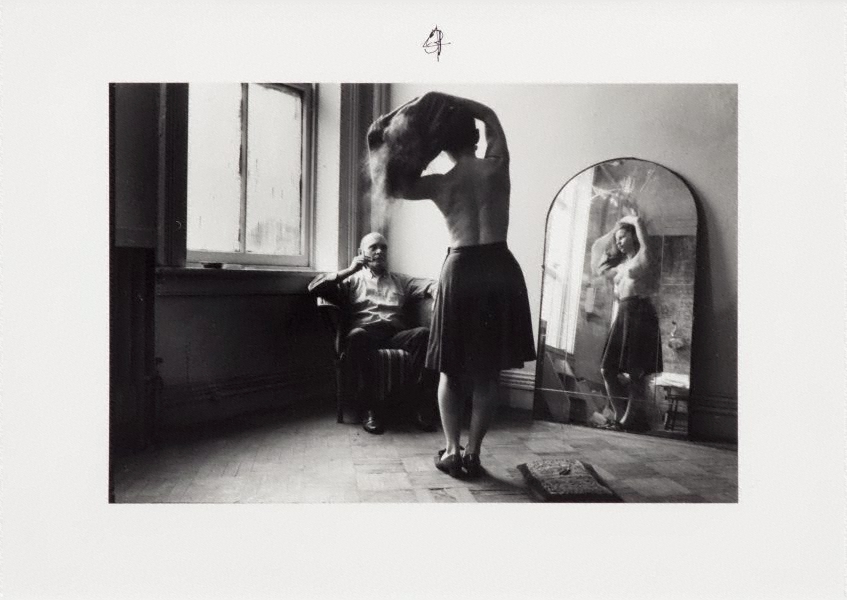
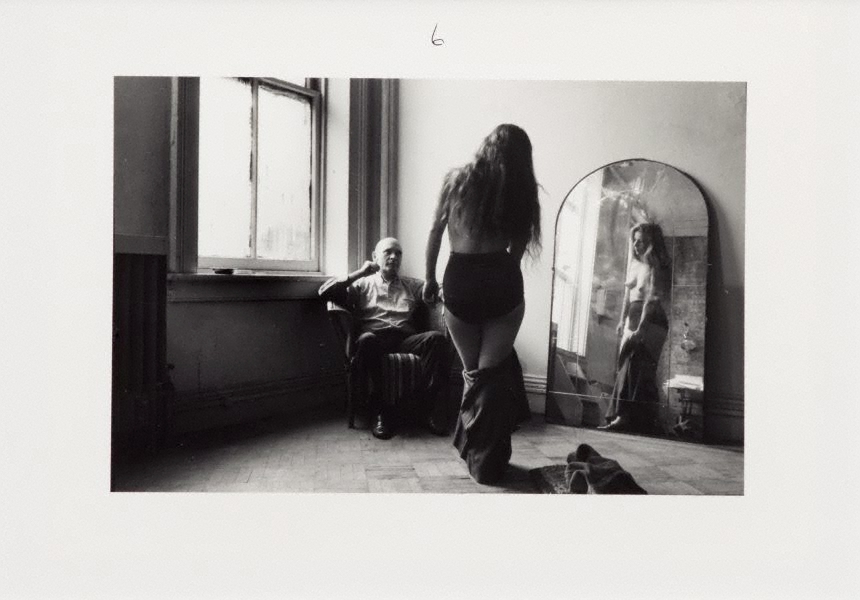
Duane Michals / For Balthus

An image of For Balthus


Duane Michals
FOR BALTHUS, 1969


Michals goes against the idea of photography as a direct record of reality and instead aims to represent intangibles such as dream, imagination, death, time, myth and spirit. He poses philosophical questions graphically following in the tradition of painters such as Magritte and de Chirico. Michals, self taught in photography, started to work freelance for 'Vogue' and other magazines in 1958. He began to photograph series in the 1960s, adding captions to further illustrate his ideas in the 1970s, believing that artistic expression is more important than the autonomy of the single photographic image.
   'The things that interest me were all invisible, metaphysical questions: life after death, the aura of sex - its atmosphere rather than the mechanics - these are things you never see on the street. So I had to invent and make these situations to express and explore these things.' Duane Michals, August 1985.


An image of For Balthus
(United States of America 1932– )
Title
For Balthus
Year
1969
Media
Photograph
Medium
nine gelatin silver photographs, vintage
Dimensions
9 photographs each: 8.4 x 12.8cm image; 12.1 x 17.9cm sheet
Signature & date
Signed l.r. sheet [i], ink "Duane Michals ...". Not dated.
Credit
Gift of Edron Pty Ltd - 1996 through the auspices of Alistair McAlpine
Accession number
1039.1996.a-i
Copyright
© Duane Michals. Courtesy Pace/MacGill Gallery, New York
An image of For Balthus


a

Saturday, June 2, 2012

Durga Chew-Bose / Carriage Ride


Mariel Hemingway
Carriage Ride
by DURGA CHEW-BOSE
Of Manhattan’s 96 minutes, 25 of them swap comedy for candor and the veneer of midlife fitfulness for a snowy and plainspoken 17-year-old Dalton girl named Tracy. While she only occupies a quarter of the film's runtime - thirteen scenes, one cry, one carriage ride, five toppings on her pie, two close-ups, and the line, "Let's do it some strange way that you've always wanted to do it" - Manhattan belongs to Mariel Hemingway.
From the moment we see her sitting at Elaine’s with her 42-year-old lover, Isaac (Woody Allen), and his married friends, Yale and Emily, Hemingway typifies teenage limbo: a discomfort with oneself that for a lucky few, can yield the most luminous glow. As Yale waxes about "the essence of art" with Isaac, and as Emily, on cue, rolls her eyes and apologizes, "We've had this argument for 20 years," Tracy smiles and accepts. Her age and inexperience might keep her on the periphery this time, but her silence and presence, and elbows resting keenly on the table, suggest considerable aplomb.

Friday, June 1, 2012

My hero / Homer by Madeline Miller

Homer
Illustration by Triunfo Arciniegas

My hero: Homer by Madeline Miller


'From the very first sentence - "Sing, O goddess, the destructive rage of Achilles" - I fell completely in love'

Madeline Miller
Friday 1 June 2012 22.55 BST


I
first encountered Homer when I was five years old and my mother would read the Iliad and the Greek myths to me as bedtime stories. From the very first sentence – "Sing, O goddess, the destructive rage of Achilles …" – I fell completely in love. I was enthralled by the larger-than-life gods, the epic adventures and most of all by the noble and deeply flawed heroes.

When I got to high school, I was fortunate enough to have a Latin teacher who offered to teach me ancient Greek. Being able to read Homer's words in the original was a life-changing experience. I had always loved his stories and characters, but in the original I was struck by the beauty of his language. It was so poetic and powerful and expansive. No matter how many times I studied it, I was always surprised and delighted by something new.


I continued to study classics through college, and came to realise that I wanted to participate in the stories not just as a reader but as a teller. I returned to the same characters that had always fascinated me – Achilles and his beloved, Patroclus. And once again Homer inspired and surprised me. His rich and fully imagined world generously gave me the scope for my own.

We still don't know if Homer was one person or many people, whether he was truly the blind bard of legend or someone more prosaic. What we do know is that when these poems were written they were intended not just for an elite audience, but for everyone. Homer's eye is all-encompassing; every facet of human life is welcome. His insight into human nature, into such universal experiences as love, loss and war, remain relevant today. Whoever created these gorgeous poems, I owe them a huge debt of gratitude. Almost 3,000 years later they are as fresh as they ever were.
•
 The Song of Achilles (Bloomsbury), Madeline Miller's first novel, has been awarded the 2012 Orange prize.


2009
001 My hero / Oscar Wilde by Michael Holroyd
002 My hero / Harley Granville-Barker by Richard Eyre
003 My hero / Edward Goldsmith by Zac Goldsmith
004 My hero / Fridtjof Nansen by Sara Wheeler 
005 My hero / Mother Mercedes Lawler IBVM by Antonia Fraser

007 My hero / Ernest Shepard by Richard Holmes
008 My hero / JG Ballard by Will Self
009 My hero / Alan Ross by William Boyd
010 My hero / Ben the labrador by John Banville

011 My hero / Vicent van Gogh by Margaret Drabble
012 My hero / Franz Marek by Eric Hobsbawm

2010

017 My hero / Jack Yeats by Colm Tóibín
018 My hero / Francisco Goya by Diana Athill
019 My hero / Max Stafford-Clark by Sebastian Barry
020 My hero / Arthur Holmes by Richard Fortey

036 My hero / Robert Lowell by Jonathan Raban
037 My hero / Beryl Bainbridge by Michael Holroyd
038 My hero / Charles Schulz by Jenny Colgan
039 My hero / Oliver Knussen by Adam Foulds
040 My hero / Annie Proulx by Alan Warner

041 My hero / David Lynch by Paul Murray
042 My hero / Edwin Morgan by Robert Crawford
043 My hero / Anne Lister by Emma Donoghue
044 My hero / Jane Helen Harrinson by Mary Beard
045 My hero / Edmund Burke by David Marquand
046 My hero / Shelagh Deleaney by Jeanette Winterson
047 My hero / Christopher Marlowe by Val McDermid
048 My hero / Gwen John by Anne Enright
049 My hero / Michael Mayne by Susan Hill
050 My hero / Stanley Spencer by Howard Jacobson

051 My hero / William Beveridge by Will Hutton
052 My hero / Jean McConville by Amanda Foreman
053 My hero / Alexander Pushkin by Elaine Feinstein
058 My hero / Cy Twombly by Edmund de Waal

2011
079 My hero / Gene Wolfe by Neil Gaiman
087 My hero / Alberto Moravia by John Burnside
096 My hero / Isaac Babel by AD Miller
097 Lucian Freud by Esi Edugyan
100 Thomas Tranströmer by Robin Robertson
102 My hero / David Hockney by Susan Hill

2012

190 My hero / Iris Murdoch by Charlotte Mendelson
194 My hero / René Descartes by James Kelman
199 My hero / Albert Camus by Geoff Dyer

2015
2016


Marco Bohr / Voyeurismo in the photographs of Hisaji Hara

Marco Bohr

Voyeurism in the photographs of Hisaji Hara


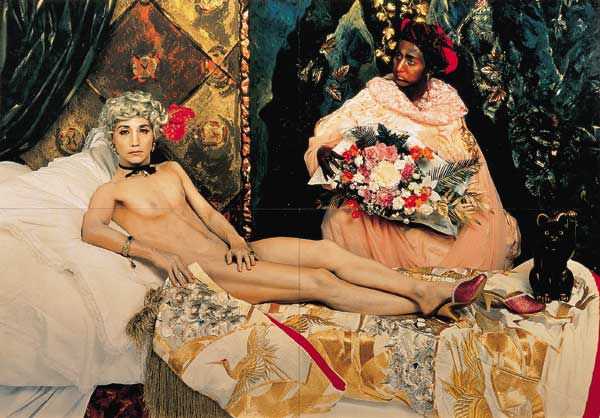
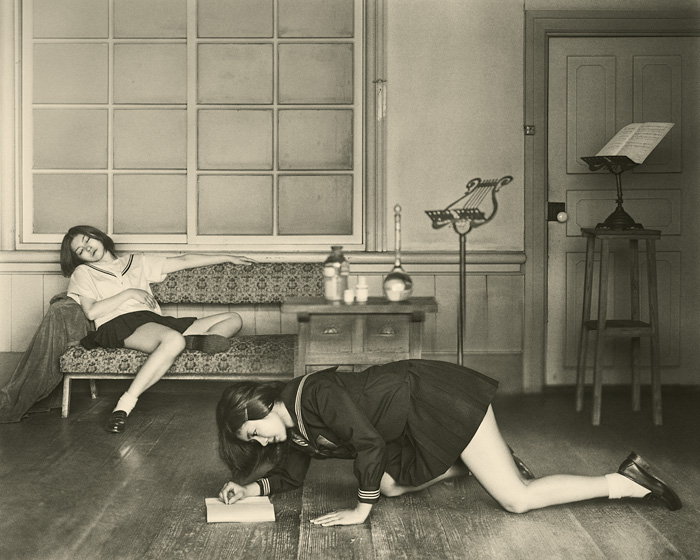
The provocative paintings of the French-Polish artist Balthus are the starting point for Japanese photographer Hisaji Hara’s visually arresting photographs currently on display at the Michael Hoppen Gallery. Like in Balthus’ work, the photographs are deeply voyeuristic, sexually suggestive, and fetishistic. As their titles indicate, the photographs are a study of’ well-known Balthus paintings that Hara generously appropriated from. Here, particularly in the context of Japanese photography, Hara appears to walk on well-trodden territory. In his acclaimed series Self-portrait as Art History, Yasumasa Morimura similarly appropriated iconic images from Western culture in his photographic montages. Rather than trying to match the original image as closely as possible however, Hara used Balthus’ work as a template, or a source, to produce photographs that are visually complex and culturally loaded in their own right.

Yasumasa Morimura, Futago, 1988
The re-occurring motif of the Japanese schoolgirl in Hara’s work is less a reference to Balthus’ preference for young girls in his paintings, but rather, it more likely refers to the fetishistic value ascribed to the schoolgirl (and her uniform) in the context of Japanese culture. While this fetish is historically located in Japan’s troubled transition to a modern nation-state, it is intriguing to note that Hara’s photographs, in spite of being produced within the last two years, purposefully look aged.
 
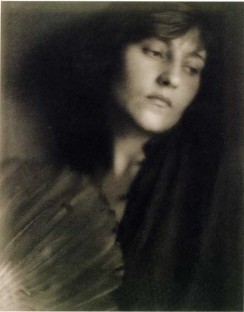
Hisaji Hara, A Study of the ‘Portrait of Therese’, 2009 and Margrethe Mather, Florence Deshon with Fan, 1921
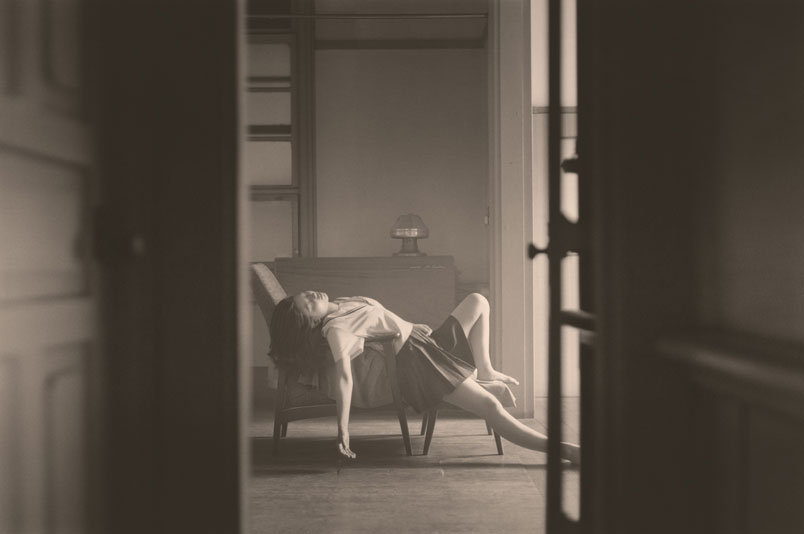
The vintage quality of the photograph is achieved in a number of ways. Firstly, the prints are black and white pigment prints which have a brown tinge to them. The location for Hara’s photographs too, a derelict privately run Japanese medical clinic from the 1940s and 1950s, creates the atmosphere of a bygone era. In addition to that, Hara’s portraits are produced with a large format camera, which inevitably has a more narrow depth of field and subjects fall out of focus more easily. The soft focus in Hara’s photographs immediately brings to mind Pictorialism – an aesthetic movement that dominated photography in the late 19th and early 20th century.
Hisaji Hara, A Study of ‘The Salon’, 2009
Apart from creating images that look purposefully aged, the optical devices applied by Hara also contribute to the voyeuristic dimension of his gaze. In A study of ‘The Salon’, Hara appears to change the focus of the camera, comparable to the cinematic technique of split-focussing, by using multiple exposures. Like the masculine gaze naturalized by the cinematic apparatus, Hara’s focus is highly selective, voyeuristic, even intrusive.
Hisaji Hara, A Study of ‘The Room’, 2009
Noritoshi Hirakawa, Angel in El Paso, Texas, undated
The apparent voyeurism is further emphasized by photographing his subjects from low vantage points, from a distance, or through open doors and windows. The door or window frame at the edge of some of Hara’s photograph are poignant references to the framing of the photograph: a process in which visual information is not only included, but also excluded. In other words, the door and window frames function as an allegory for the dialectical relationship between inclusion and exclusion so elemental to the act of photographing. Hara’s photographs are however less about the process of photography than they are about the process of looking. Here, Hara appears to tap into a lineage of photographers such as Kiyoshi Yoshiyuki or, more recently, Noritoshi Hirakawa, whose work deconstructs and problematizes the act of looking itself.
Hisaji Hara, A Study of ‘Because Cathy taught him what she learnt’, 2009
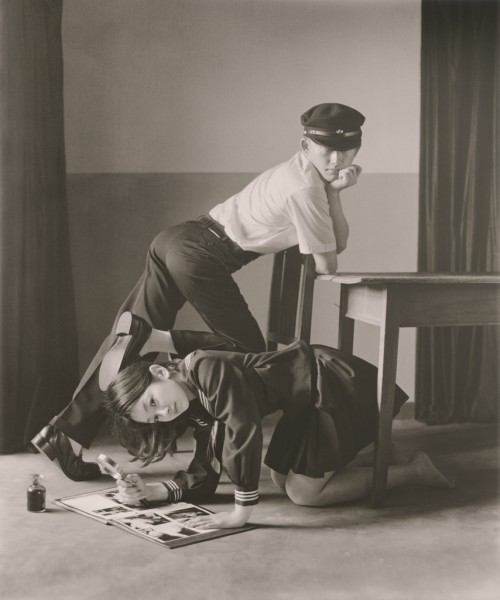
In A Study of ‘Because Cathy taught him what she learnt’, Hara thus sets out a complex scenario in which the apparent voyeuristic nature of the image comes to the fore: though his eyes are hidden by a hat, a young man can be seen looking at a girl kneeling on the floor. His downward gaze is emphasized by his body diagonally leaning forward on a chair. Hara meanwhile, the apparent stage master of this scenario, produces a photograph which is being looked at in context of the gallery. These multiple levels of looking are completed in the realization that the young woman – the clichéd object of the photographer’s gaze – is knowingly looking straight back at us.