Jhumpa Lahiri: ‘I am, in Italian, a tougher, freer writer’
The author’s new book, written in Italian and accompanied by English translation, is the result of an infatuation with Italy that began with her first visit in 1994. Here, the Pulitzer winner recounts her journey towards fluency, and answers our Q&A
My relationship with Italian takes place in exile, in a state of separation. Every language belongs to a specific place. It can migrate, it can spread. But usually it’s tied to a geographical territory, a country. Italian belongs mainly to Italy and I live on another continent, where one does not readily encounter it.
From writing about the Indian immigrant experience, Jhumpa Lahiri made a daring leap into writing in Italian, the language in which she has written her latest novel, Whereabouts, which she herself translated into English. Speaking on a video call from Princeton University, where she teaches creative writing, the Pulitzer winning writer spoke to Namita Devidayal about her book, diary writing, and loss You’ve always written so movingly about loss and grief. Right now, so many in India are confronting this. Do share your thoughts.
Writers think we have language at our disposal to make sense of things. But then there are these moments that defy any kind of articulation, and there is just the feeling, and there is the loss. And it is immense. It is terrifying. It is utterly blinding in its impact. I think all we can do is hold on to each other, hold on to what we have, and recognise that we have to endure. And the thing is it’s happening in India but it’s also happening all over the world because India is all over the world. When I was a child, a few of us were in households where India was very much in the heart but it wasn’t in the everyday consciousness. Now, all these decades later, India is not just in India; it is everywhere. And that’s been one of the things I have been trying to map in many of my works, certainly in my previous works.
A decade ago, the Pulitzer-winning author threw herself into mastering Italian. She talks about her love for Rome, translating Italy’s ‘finest living writer’ and rewriting her own work in English
Lisa Allardice
Saturday 1 May 2021
Jhumpa Lahiri’s third novel is the triumphant culmination of her 20-year love affair with Italian, an obsession that led her to move to Rome with her family almost 10 years ago. She renounced all reading in English and began to write only Italian. Published in Italy in 2018 as Dove mi trovo – “Where I find myself” or “Where am I?” – it is her first novel written in Italian. Now she has translated it into English under the title Whereabouts.
‘Geographical range’ … 2021 Booker prize longlistees (from left clockwise: Kazuo Ishiguro, Rachel Cusk, Richard Powers, Patricia Lockwood, Sunjeev Sahota and Nadifa Mohamed.
Booker prize reveals globe-spanning longlist of ‘engrossing stories’
This article is more than 3 months old
Kazuo Ishiguro makes cut alongside Rachel Cusk and Richard Powers, and novels from Sri Lanka and South Africa compete with choices from the US and UK
Alison Flood Tuesday 27 July 2021
Kazuo Ishiguro first won the Booker prize in 1989 for The Remains of the Day. Thirty-one years later, the British author has made the longlist for the £50,000 award with Klara and the Sun,his first novel since winning the Nobel prize in literature.
Ishiguro’s story of an AF, or “artificial friend”, which is bought as a companion for a 14-year-old girl, is one of 13 novels in the running for this year’s Booker, the most prestigious books prize in the UK. The author, who has been shortlisted three times, was praised by judges for his “haunting narrative voice – a genuinely innocent, ego-less perspective on the strange behaviour of humans obsessed and wounded by power, status and fear”.
“It’s not just a novel about a technological future,” said judge Rowan Williams, the writer and former archbishop of Canterbury. “It is a novel about power, the nature of personality, about freedom and about love.”
Ishiguro makes the cut alongside some heavyweight names, from Richard Powers, chosen for the yet-to-be-published Bewilderment, about a widowed astrobiologist trying to raise his nine-year-old son, to Rachel Cusk, longlisted for Second Place, in which a woman invites an artist to visit the remote coastal region where she lives.
Sally Rooney, who was nominated for the Booker for her 2018 novel Normal People, was overlooked by judges for her third novel, Beautiful World, Where Are You, which is out in September. Judges also failed to longlist Don DeLillo’s short novel The Silence.
“Most of us had one or two favoured novels that really struck us, but we couldn’t persuade the others, or sometimes there was a novel where we thought this was a really really good, thoroughly satisfying novel, but does it quite break the new ground or change the horizon in the way we hope a Booker winner would?” said Williams.
“When you think of what’s won the Booker over the years, you want something that puts down a slightly fresh marker … That’s not to say you look for novelty for its own sake. The other thing about a Booker winner is that it ought to be a book that people enjoy reading, call me old-fashioned if you like. You don’t want something that is so experimental as to be highly satisfying to the author and a few ultra-sophisticated critics. You do want something that will keep people turning the pages.”
Director of the Booker Prize Foundation Gaby Wood said that while recent Booker longlists have “drawn attention to various elements of novelty in the novel: experimentalism of form, work in unprecedented genres, debut authors”, this year’s list was “more notable for the engrossing stories within it, for the geographical range of its points of view and for its recognition of writers who have been working at an exceptionally high standard for many years”.
‘You want something that puts down a slightly fresh marker’: judge Rowan Williams, former archbishop of Canterbury Photograph: Tim Ireland/PA
The Booker’s globe-spanning lineup moves from Sri Lankan author Anuk Arudpragasam’s A Passage North, in which Krishan travels from Colombo to the war-torn Northern Province for a funeral, to the twice Booker-shortlisted author Damon Galgut’s The Promise. Set on a farm outside Pretoria, The Promise tells of a white South African family that has failed to keep a promise to the black woman who has worked for them her whole life.
Galgut is joined on the longlist by fellow South African author Karen Jennings, whose novel An Island, following an old lighthouse keeper who finds the unconscious body of a refugee on his beach, is published by small independent press Holland House Books.
The books world has long complained about the Booker’s decision to open its doors to American authors. This year, five British authors make the longlist, alongside four Americans. Ishiguro and the British-Canadian Cusk’s novels are joined by fellow Britons Francis Spufford’s Light Perpetual, which imagines a future for five children killed in the blitz, Sunjeev Sahota’s China Room, which weaves together the story of a young bride in rural 1929 Punjab with that of a young man in 1999, and British-Somali author Nadifa Mohamed’s The Fortune Men, in which suspicion falls on Mahmood Mattan for the murder of a shopkeeper in Cardiff’s Tiger Bay in 1952.
The Pulitzer-winning Powers, meanwhile, is joined by fellow Americans Patricia Lockwood, chosen for her buzzed-about debut No One is Talking About This, in which real life intrudes on the world of a woman known for her viral social media posts, Maggie Shipstead’s story of a female aviator who disappears in 1950 while attempting to fly around the world, Great Circle, and Nathan Harris’s first novel The Sweetness of Water, set at the end of the American civil war.
The longlist is completed by Canadian author Mary Lawson’s A Town Called Solace, set in Northern Ontario in 1972, when eight-year-old Clara’s sister Rose goes missing.
Williams and his fellow judges – chair Maya Jasanoff, the historian; writer and editor Horatia Harrod; actor Natascha McElhone; novelist and professor Chigozie Obioma – read 158 books to come up with their longlist of 13.
According to Jasanoff, the books are united by “their power to absorb the reader in an unusual story, and to do so in an artful, distinctive voice”.
“Many of them consider how people grapple with the past – whether personal experiences of grief or dislocation or the historical legacies of enslavement, apartheid and civil war. Many examine intimate relationships placed under stress, and through them meditate on ideas of freedom and obligation, or on what makes us human,” said Jasanoff. “It’s particularly resonant during the pandemic to note that all of these books have important things to say about the nature of community, from the tiny and secluded to the unmeasurable expanse of cyberspace.”
The shortlist of six books will be announced on 14 September, and the winner on 3 November.
Rachel Cusk’s singular novel stands out on wide-ranging Booker longlist
Second Place is both timeless and up-to-the minute, with big names Richard Powers and Kazuo Ishiguro among strong international finalists
Justine Jordan
Tuesday 27 July 2021
T
his is a longlist light on debuts and surprises, heavy on historical fiction, with an impressive geographical reach and an interest in the weight of the past. The biggest names look to the future, however: Kazuo Ishiguro’s Klara and the Sun shows us, through its narrator’s artificial eyes, a tired, fragile world in which inequality is ever-deepening and humans are at risk of becoming defunct. As ever, the Nobel laureate is exploring the messy mysteries of emotion, memory and what it is to be human: the book makes a fascinating companion piece to his 2005 novel Never Let Me Go. And it’s no surprise to see Richard Powers here, previously shortlisted for The Overstory; it’s not out until September, but Bewilderment, an investigation of climate grief and the prospect of life on other planets, told through the story of a father and his troubled son, will be a strong contender.
Elsewhere, recent political history and national trauma come to the fore. This is the third Booker listing for Damon Galgut; The Promise follows a white South African family in the decades before and after the end of apartheid, weighing broken promises on a national and individual level. Anuk Arudpragasam is a hugely promising young Sri Lankan author: in his second novel, A Passage North, a young man reflects on the horrors of the civil war. There’s a more fable-like treatment of political violence in one of the surprise inclusions, An Island; South African Karen Jennings’s small-press parable centres on an isolated lighthouse keeper who has suffered under colonialism and dictatorship in an unnamed African country. Debut novel The Sweetness of Water by Nathan Harris has been a smash in the US: a revisionist take on civil war history, with a sweeping treatment of forbidden gay love and the aftermath of slavery.
Set in the 50s, Nadifa Mohamed’s The Fortune Men is an important act of historical spotlighting, fictionalising a shameful episode in British history when a Somali sailor was wrongfully hanged for murder, while Sunjeev Sahota’s China Room connects a young man’s experience of deprivation and addiction in England at the turn of the millennium with rural poverty in India 70 years before. Only on his third novel, but already with a second Booker nomination, Sahota is a significant voice.
Francis Spufford’s Light Perpetual beautifully traces the inner lives of a group of working-class Londoners against postwar changes in British society. American Maggie Shipstead’s Great Circle, meanwhile, is a soaring crowd-pleaser of a historical novel: a century-spanning epic of early female aviation and adventure. Also much loved by readers is Mary Lawson’s A Town Called Solace, a tale of smalltown secrets and lies in 1970s Canada.
The past year has seen many sharp novels from younger female authors investigating how the internet influences minds, relationships and working lives, but the only example here is Patricia Lockwood’s virtuoso debut No One Is Talking About This: savagely funny on social media addiction and then truly tragic on family pain. Notable by its absence, however, is the year’s most anticipated novel: Sally Rooney’s Beautiful World, Where Are You, which is heavily embargoed until its September publication date but continues her exploration of modern love and purpose. It’s noteworthy, too, that though fiction is increasingly engaged with the urgent subject of global warming, on this longlist only Richard Powers explicitly tackles the climate crisis.
Perhaps the most singular book on the list is Rachel Cusk’s Second Place, which takes its inspiration from a historical source – a memoir detailing a woman’s painful encounter with DH Lawrence – to create a psychodrama that is both timeless and up-to-the-minute. Mercilessly anatomising privilege, creativity and ambition, male-female relationships and lockdowns Covid-driven and emotional, Cusk is brutally funny and honest about shame, ego and our sense of self. The novel is truly one of a kind.
While rolling a fifty-gallon drum of water from the canal to his potato garden, Bob Turk heard the roar, glanced up into the haze of the midafternoon Martian sky and saw the great blue interplan ship.
In the excitement he waved. And then he read the words painted on the side of the ship and his joy became alloyed with care. Because this great pitted hull, now lowering itself to a rear-end landing, was a carny ship, come to this region of the fourth planet to transact business.
Dick’s premises are undeniably perfect as-is, instantly intriguing and in tune with our daydreams and pet theories about what the future might hold.
by Jessie Guy-Ryan
One night, I stumbled upon an online quotations database and searched for quotes from Philip K. Dick, as you do when you are slightly drunk and in a good mood and just suddenly thinking of a favorite author. I found, among others, a quote from Do Androids Dream of Electric Sheep? (famously adapted as Blade Runner) and posted it to my Tumblr.
The stinging, gelatinous blobs could take over the world’s oceans.
By Rebecca Giggs
January / February 2018
In my mid-20s, I spent three months living in Broome, a coastal township in Western Australia famous for its moonrises, pink beaches, and pearl farms. Each morning during what is known locally as “the buildup” (the hot, muggy weeks heralding the wet season), I would stuff a towel in a bag and trudge out to where the red pindan soil—distinctive to the Kimberley region—marbles powdery dunes, longing to dunk my body in the postcard sea. Often, I could go no farther than the water’s edge. Signs pitched by lifeguards along the beach showed a stick figure lashed by a mass of tentacles: Irukandji jellyfish.
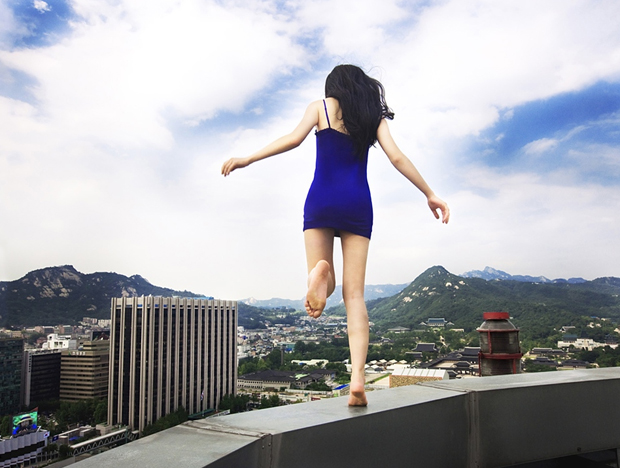
Korean photographer says vertiginous shots speak to the future of our cities - if you're acrophobic look away now
The South Korean photographer Ahn Jun has got to know a skyscraper or two over the past few years. She has spent some time in New York, studying at Parsons art and design school, and she's now in Seoul at Hongik University, taking a Ph.D in photography. Indeed, she's so comfortable with tower blocks that she's taken to climbing to the tops of them just to photograph herself standing on the buildings' outermost edges. As she is at great pains to point out the photos are not digitally composed which, if you are at all acrophobic, might make you feel a little uneasy.
Christophe Guye Galerie is pleased to announce the solo exhibition of Jun Ahn (*1981, South Korea). The exhibition presents a comprehensive overview of “Self-Portrait“, Jun Ahn’s most prominent series.
Jun Ahn, Self-Portrait (Seoul), 2009
The self-portrait has become de rigueur among female photographers since Cindy Sherman and Francesca Woodman made their now canonical works of the 1970s. Nikki Lee revived the genre in the late 90s with her studies of subcultures as self-portraits, and now the self-portrait has become almost a rite of passage among female photographers, who have been creating increasingly daring and specific versions of the genre. Jun Ahn’s suicidal self-portraits are a particularly unsettling, but captivating, addition to that tradition. They are paradoxical, conveying both the sense of the agency of a goddess or superwoman and the vulnerability and innocence of a wounded girl.
Luca Curci talks with Diana Cheren Nygren during Venice International Art Fair 2021, at Palazzo Albrizzi-Capello.
Diana Cheren Nygren is a fine art photographer from Boston, Massachusetts. Her work explores the visual character of place defined through physical environment, color, light and weather, its implications for our experience of the world, and what place reveals about the culture around it. Her photographs address serious social questions through a blend of documentary practice, invention, and humor. Diana was trained as an art historian with a focus on modern and contemporary art, and the relationship of artistic production to its socio-political context. Her emphasis on careful composition in her photographic work, as well as her subject matter, reflects this training. Her work as a photographer is the culmination of a life-long investment in the power of art and visual culture to shape and influence social change.
On the shores of Kamilo Point, in Hawaii, geologists have identified a new kind of stone. A sediment of recent history, the agglutinated rock displays milky-blue flecks, iotas of dull green, and fibrous orange twists. It is known, because of its unique properties, as “plastiglomerate.” That the name grinds together two familiar-sounding words is a clue to the stone’s qualities as an amalgam. What we are talking about is a rock veined not with metal or quartz, but with plastic. Plastiglomerate forms where polymer flotsam (trash, washed up on the tide line in this instance) is subject to high heat and melts, wrapping together particulate such as shell grit or sand. It then solidifies as it cools. Or, if liquefied plastic drips into hairline fissures in basalt or other porous minerals, what is left behind—a rock crazed with ersatz colors—can also be deemed plastiglomerate. Campfires are one source of that high heat. Plastiglomerate may also emerge along the scorched trail of a wildfire, or it might be cauterized into the ground by lava. It almost certainly appears in places where people burn their rubbish. Call it the birthstone of the age of unintended consequences.
What pioneering new research has revealed about the forest
By Rebecca GiggsThis article was published online on June 17, 2021. Above all else in the plant kingdom, trees make good trellises for our self-regarding thoughts. Robert Frost knew this when he wrote “Two roads diverged in a yellow wood.” A woodland is the right spot to yield to reflection. Though the life of a tree has little in common with the life of a person, we are accustomed to approaching trees on personal, even introspective, terms. As trunk is a synonym for torso, as branch can be interchangeable with limb, trees of great variety (especially the old ones) give body to human concerns.
It was late evening when K. arrived. The village lay under deep snow. There was no sign of the Castle hill, fog and darkness surrounded it, not even the faintest gleam of light suggested the large Castle. K. stood a long time on the wooden bridge that leads from the main road to the village, gazing upward into the seeming emptiness.
The Castle, allegoricalnovel by Franz Kafka, published posthumously in German as Das Schloss in 1926.
The setting of the novel is a village dominated by a castle. Time seems to have stopped in this wintry landscape, and nearly all the scenes occur in the dark. K., the otherwise nameless protagonist, arrives at the village claiming to be a land surveyor appointed by the castle authorities. His claim is rejected by the village officials, and the novel recounts K.’s efforts to gain recognition from an elusive authority. Arthur and Jeremiah introduce themselves to K. as his assistants but provide comic relief rather than genuine help. Klamm, a castle superior who is widely respected by the villagers, proves utterly inaccessible. K. aggressively challenges both the petty, arrogant officials and the villagers who accept their authority. All his stratagems fail. He makes love to the barmaid Frieda, a former mistress of Klamm. They plan to marry, but she leaves him when she discovers that he is merely using her
The Castle is an unfinished novel—as Max Brod, Kafka’s literary executor, observed, Kafka intended that K. should die exhausted by his futile efforts to gain access to and acceptance from the elusive, local authorities but that on his deathbed his character was finally to receive a permit to stay in the village—and it stands as testament to the Kafka’s achievements that its unfinished state is in no way detrimental to its effectiveness. It seems somehow proper the story has no ending, that the events recounted seemingly form part of an infinite series of occurrences, of which only a small segment has found its way onto the pages of a novel.
Regarded by many as the finest, and funniest, comic novel of the twentieth century, Lucky Jim remains as trenchant, withering, and eloquently misanthropic as when it first scandalized readers in 1954. This is the story of Jim Dixon, a hapless lecturer in medieval history at a provincial university who knows better than most that “there was no end to the ways in which nice things are nicer than nasty ones.” Kingsley Amis’s scabrous debut leads the reader through a gallery of emphatically English bores, cranks, frauds, and neurotics with whom Dixon must contend in one way or another in order to hold on to his cushy academic perch and win the girl of his fancy.
'The Magus': A Thrilling, Chilling Guilty Pleasure
Nick Dybek
April 30, 20126:36 AM ET
The sinister face sneering from the cover is reason enough to keep John Fowles' The Magus tucked discreetly away. Then there's the 600 or so pages inside, which are filled with pretentious riffs on psychoanalysis, metaphysics, fascism and the occult.
Places you’d be desperate to avoid in real life provide a magnetic lure in books by authors from Dickens to Du Maurier and even Richard Adams
Xan Brooks
Wed 26 April 2017
M
y novel, The Clocks in This House All Tell Different Times, tells the tale of a girl who travels through a dark forest and arrives at a big house. The forest is bad but the house is arguably worse – a false sanctuary inhabited by decadent aristocrats; boozy and boisterous, on the brink of turning nasty.
At some point when writing the story, I realised I was naively blundering into a long and noble tradition of books about terrible houses, much as I’ve naively blundered into many awkward, unfamiliar houses down the years. Maybe I love these places in fiction because I hate and fear them in real life.
Below is a list of good books that fetch up at bad houses. These houses are variously frightening, unsettling or funny – but they all tap into the mounting panic and inadequacy that we (or possibly just me) feel on arriving at an unfamiliar place and realising within seconds that we don’t fit in, that we will never fit in, and that the best that can be hoped for is to avoid some awful faux pas. These are the houses where the flush doesn’t work and the doorknob comes off in your hand and where you say the wrong thing and the host decides that, on balance, he hates you.
Apologies to Sartre, but I think he had it slightly wrong. Hell is not other people; it is other people’s houses.
Rebecca is the name of the first Mrs de Winter, dead in a boating accident but still haunting the wings of lavish Manderley, on the Cornish coast. The house remains much as she left it. Her housekeeper Mrs Danvers remains stubbornly in situ, like an emissary from the spirit world. The second Mrs de Winter knows she can never measure up. It is all she can do to totter out in one piece.
At the start of her peerless 1959 novel, Jackson dispatches a quartet of thrill-seekers to conduct a paranormal experiment at a remote American mansion. Hill House, we are told, is “vile” and “diseased”. The trouble is that the woman who tells us is shy, reclusive Eleanor, who may not be altogether sound and stable herself. In this way, Jackson suggests that the scariest houses are a kind of Rorschach blot, or even a blank canvas. We bring the horror with us and sit it beside us on the couch.
In 1922, suffering from tuberculosis, Kafka sat down to write the story of K, a land surveyor desperate to gain access to a forbidding castle in order to clear up a bureaucratic error. Reports suggest that Kafka planned to have his hero eventually die in the nearby village, with his case still ongoing and his legal status in limbo – except that the author never made it that far. His death ensures that the mystery of The Castle remains forever unresolved.
Aickman was an eminently respectable Englishman (chairman of the London Opera Society, co-founder of the Inland Waterways Association) who wrote scary fiction on the side. The Hospice might just be the most purely unnerving short story I’ve ever encountered, despite (or because of) the sense that I’m not entirely sure whether anything truly terrible happens. It’s about a travelling salesman, Maybury, who stops for the night at a mysterious house that may be a hotel, or a hospital, or some kind of purgatory. Inside, the guests sleep two to a room because they hate to be alone. At mealtimes, they wolf down mountainous portions while fettered by their ankles to the table. At one point, in the night, there may have been a murder. But the rooms are too dark and the thermostat’s turned too high and besides, it’s impolite to ask awkward questions. Just eat your food; get some rest.
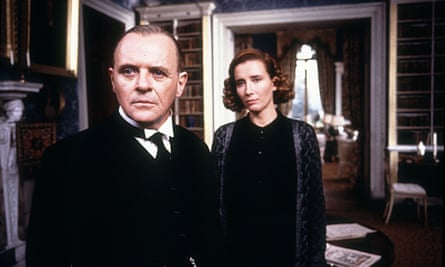
Ishiguro is the master of the dramatic side-eye, a writer who affects to position himself at one remove from the plot’s centre, quietly attending to the place settings and all but daring us to look elsewhere. The Remains of the Day, then, is the memoir of a dutiful butler (Stevens) at lavish Darlington Hall. But it is also (at heart, really) the tale of a passion that threatens to pop his starched collar and of a faithless, would-be quisling aristocracy in the runup to the second world war. Stevens clearly feels that certain doors are off limits. Ishiguro, very gently, invites us to prise them open.
Starched … Anthony Hopkins and Emma Thompson in the 1993 film version of The Remains of the Day. Photograph: Allstar/Columbia Pictures
How does one begin to navigate Danielewski’s literary hall of mirrors, let alone explain the damn thing? Ostensibly, it’s about the Navidson family, who return home to discover that their Virginia house has mutated. It’s bigger inside than out. A hallway appears out of nowhere; the spiral staircase seems without end. And audaciously, in the meantime, the book’s mutating too. Danielewski throws in references to illusory films and essays. His footnotes sprout footnotes and these lead us down the wormhole. One day I have to reread it, but the very prospect makes me nervous.
Before anyone cries foul, my defence is that a) a burrow is basically a house for rabbits and b) that the evergreen Watership Down is a book that views the world at rabbit-eye level. Oh, and c) that the rabbits in Cowslip’s warren are the most peculiarly human of beasts. Creepily so – a group of pampered, indolent aesthetes who are permitted to lounge about like minor royals so long as they turn a blind eye when the farmer wants fresh meat. Adams’s vagabond heroes initially view the warren as a place of sanctuary. But it’s a horrible place, a terrible house, where the residents sleepwalk towards the snares.
Dickens’s novel peaks early, with Pip’s visits to spooky Satis House (apparently named after a real mansion in Rochester, Kent). This is the home of Miss Havisham, still wrapped in her wedding dress, who keeps an uneaten tiered cake mouldering on the table and ensures all the clock hands point to twenty-to-nine. Dickens, of course, wrote great ghost stories in his time. But I don’t think he ever conjured a phantom quite as tragic and creepy as this.
Stumble upon this novel at an impressionable age and the experience is like walking into the middle of a firework display; dazzling and colourful and a little scary, too. Fowles rustles up a gripping tale of seduction and betrayal as cocky Nicholas Urfe falls under the spell of a puckish Greek recluse. The island estate is a laboratory, which leaves Nicholas Urfe as the rat. In playing tricks on his hero, Fowles plays beautiful tricks on us, too.
For anyone who has ever misjudged a mood, wrecked a dinner party or generally disgraced themselves in polite society, there is always Lucky Jim, one of the flat-out funniest books ever written. This hits a comedic crescendo at the home of Professor Welch and his horrific son Bertrand, where the guests are dragooned into madrigal singalongs. The first time I read this – aged 18, on a train – I wound up laughing so violently that I first knocked my drink to the floor and then pitched head-first into the aisle when trying to retrieve it. A case of idiotic real life imitating great art.