or years, Hilary Mantel was one of literature’s best-kept secrets, unknown to all but a devoted yet limited following. Then along came Wolf Hall. “Maybe this book will win one of the prizes that have been withheld so far,” ventured its Guardian reviewer when it was published in 2009, in what was to prove one of the understatements of the millennium. It won both the Man Booker prize and the US’s National Book Critics Circle award, selling more than 1m copies on each side of the Atlantic, and going on to colonise theatre and TV.
The second volume in the trilogy, 2011’s Bring Up the Bodies, kept the bandwagon rolling so fast and furiously that, eight years later, breathless excitement greeted the appearance of a mysterious billboard in Leicester Square in May, the first hint that the third volume was imminent. (The Mirror and the Light is out in 2020.) Mantel is phlegmatic, saying: “Some readers congratulate me on beginning a career in my 50s. I’m glad, of course, if I can offer anyone midlife encouragement. But I began writing at 22, wrote for 12 years before I published anything, and broke through in my mid-30s. I’ve had plenty of time to brace myself for success.”
Hilary Mantel
She traces the idea of writing about Thomas Cromwell, arch manipulator of the Tudor court, back to history lessons at a Cheshire convent school in which she first learned about Henry VIII’s dissolution of the monasteries. “It seemed to me like a very good idea, and I thought I’d like to meet the man behind it.” She had already ventured into historical fiction with A Place of Greater Safety, about the French Revolution. But did she have qualms about taking on the Tudor heritage industry? “Nothing but qualms,” she says. “Think of those miles of shelves stacked with novels about Henry’s wives. But I didn’t suppose I was going to write one of those.”
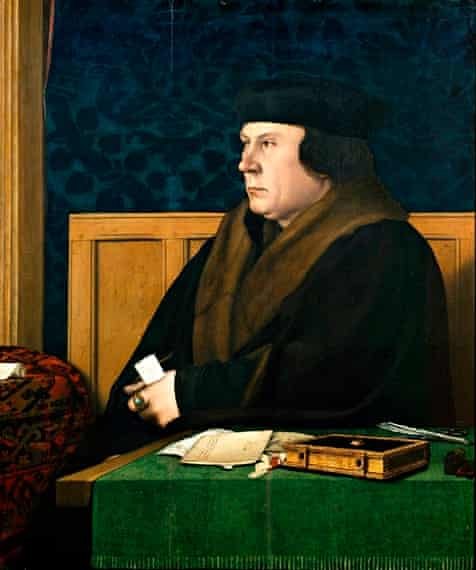
Until she took him on, Cromwell was best known as the corpulent, grim-faced bureaucrat in a famous Holbein portrait. “His story hadn’t been well served by biographers or fiction writers. He was under-imagined. And when you stand where he stands, what you see defamiliarises itself,” says Mantel. “He was the man who conquers the system from within.”
Portrait of Thomas Cromwell by Hans Holbein the Younger (1497-1543). Photograph: Fine Art/Corbis via Getty Images
Her “defamiliarisation” of the period drew criticism from some historians, in particular her refusal to go along with the sanctification of Sir Thomas More. But her response is characteristically brisk: “History is a process, not a locked box with a collection of facts inside,” she says. “The past and present are always in dialogue – there can hardly be history without revisionism. Most historians acknowledge More as a complex and conflicted human being, with debits and credits to his name. My portrait, unlike a historian’s, cannot be balanced or neutral. It comes from the imagined point of view of Cromwell, who is grievously and inextricably involved with him day by day. The same is true for my other characters; they are as I believe Cromwell sees them.”
How does she feel about finishing the trilogy after spending so long in Cromwell’s shadow? “We’ve been on a long walk, but we’re not parting company yet,” she says. A second television series has been announced, and a third stage play is likely. “Each medium offers new opportunities for the story, which is never used up, never completely told. Working on the theatre version was a fresh start in a new field, and maybe helped sharpen up my scene-building skills as a novelist. It persuaded me that however complex your material, you can unfold it with clarity and energy.”
‘I’ve had plenty of time to brace myself for success’ … Hilary Mantel.
Photograph: Richard Ansett/BBC
Part of the fascination of any bestseller is why this particular work should have so captivated the popular imagination. One answer is that Cromwell’s journey from childhood poverty to great power and finally to execution (set to occur in The Mirror and the Light) holds a distressed glass up to our own times. Mantel is wary of direct comparisons: “I wouldn’t be happy to write the kind of moralising, manipulative fiction that forces correspondences between past and present.” But she knows that “the same questions preoccupy us: how to live, how to govern, how to mediate between the world as we find it and the world we would like to see. The resonances change day by day. As events evolve, fiction evolves too, in the minds of readers as well as writers. It doesn’t stay fixed on the page, constant to one meaning.”
So what can Cromwell’s story teach the politicians of today? “Be careful. You are no longer beheaded for your failures, but the Tower of London is still standing.”
The author, who has died at the age of seventy, saw little distinction between the living and the dead.
By Larissa MacFarquhar
September 24, 2022
One of the finest writers in English ever to live, Hilary Mantel, has died. If Britain were as grateful for her as it ought to be, there would be another funeral next week, as magnificent as the one for the Queen this week, though it would be attended by different people because Mantel could be rude about royalty. There are not many writers who, like prophets, seize, melt down, and reshape the archetypal stories of their people.
Detail of portrait of Thomas Cromwell, 1532-33, by Hans Holbein the Younger.
Thomas Cromwell review – new biography of the hero of Wolf Hall
Henry VIII's faithful servant will always remain mysterious, but Tracy Borman's study makes clear his achievements, both admirable and despicable
Diarmaid MacCulloch Wed 3 Sep 2014 11.05 BST
T
homas Cromwell's ghost must be blessing Hilary Mantel for her two novels so far, and one more to come, restoring him to a life by turns engaging and intimidating. Equally, the theatre versions of Wolf Hall and Bring Up the Bodies have been triumphs, enriching Mantel's artistry with Ben Miles's extraordinary performance as Cromwell. Each play puts Miles on stage for nearly three hours, and he exhibits as much energy as the original Tudor statesman did in 10 years of public service to Henry VIII. It's a marvellous re-creation of an all-seeing polymath: he is witty, reflective, affectionate and calculatingly brutal, always visible to the audience, if not to his fellow players.
When a journalist contacted me recently to talk about the 30th anniversary of Virago Modern Classics, my first reaction was shock, says Hilary Mantel
Hilary Mantel Sat 24 May 2008 00.13 BST
W
hen a journalist contacted me recently to talk about the 30th anniversary of Virago Modern Classics, my first reaction was shock. Thirty years? Where had the time gone? When those lovely, green-spined books began to appear, I wasn't aware of them because I was living in Botswana, a country which, though peaceful and democratic, does not, when I look back, seem to me to bear much resemblance to the country depicted in the novels of Alexander McCall Smith. Botswana, which is a huge country, had then one tarred road of about 70km; elsewhere there were tracks, of various degrees of bumpiness, and what were called cut lines - that's to say, there was only a road for a truck if you got out and hacked one.
The Catcher in the Rye, Nine Stories, Franny and Zooey, Raise High the Roof Beam, Carpenters and Seymour – an Introduction
by J.D. Salinger. Little, Brown, 1072 pp., $100, November 2018, 978 0 316 45071 3
When I think of J.D. Salinger now – not the books but the man – the thing I find hardest to understand is the moment when, in his early thirties, he began to hide his face. In 1952 he hired the photographer Antony Di Gesu to take a series of portraits. With his prominent nose, jaw and cheekbones he looks as ruggedly confident as a prizefighter – in early life he was a handsome man. But it wasn’t an easy shoot: Di Gesu had to work to get him to loosen up. Salinger liked the pictures but insisted Di Gesu show them to no one else, saying that he wanted them for his mother and girlfriend. The first printings of The Catcher in the Rye in 1951 came with an author photo taking up the entire rear panel of the dustjacket: Salinger’s expression is amused, generous, even sweet; the chances are good that he picked the portrait out himself from a set taken by the photographer Lotte Jacobi the previous year. But when the time came for later printings, with copies flying off the shelves, he insisted that the photo be pulled: from that moment on, none of his books appeared with an author photo. Twenty years later he tried to persuade his lover at the time, Joyce Maynard, to allow no author photo on her own first book. ‘A writer’s face,’ he said, ‘should never be known.’
It’s no secret that J.D. Salinger was attracted to a certain “type” of woman: young, innocent, and sexually inexperienced. Even though these relationships tended to raise eyebrows from disapproving onlookers, Salinger’s intentions were arguably pure. He never wanted to hurt or take advantage of these women; he was, as I see it, simply looking for companionship. Salinger wasn’t the slighted bit interested in having sex with the women he pursued. His desires were, rather, focused on one thing: the innocence of his female companions. Salinger had succumbed to his own disease— the “Catcher In the Rye complex.” His biggest wish was to find a young girl to love, protect, and live out the rest of his life with. Salinger went through a myriad of women in search of his perfect match, struggling to find a woman who could meet his high standards. While Salinger was waiting to discover his young lover, he crafted stories filled with older men who lusted over them— an outlet that allowed him to fulfill some of the desires that he could not realize in his own life. His writing, however, was not enough to quench his thirst, and Salinger continued to search for this illusory innocent throughout his adult life.
Actress Michelle Williams arrives at the 2012 Independent Spirit Awards clutching a 'Catcher in the Rye' accessory. (Photo by Frazer Harrison
JD Salinger’s Pursuit of Teen Girls Gets Renewed Attention After ‘Allen v. Farrow’
Rae Alexandra
April 2, 2021
Yesterday, Vanity Fair published a compelling essay by prolific author Joyce Maynard. In it, she drew a parallel between Woody Allen and J.D. Salinger, saying both men harbored obsessions with very young women. Maynard was inspired to write the piece after watching recent HBO documentary series, Allen v. Farrow. But her motivation was born from the fact that, when she was a teenager, she had a relationship with the then-53-year-old Salinger.
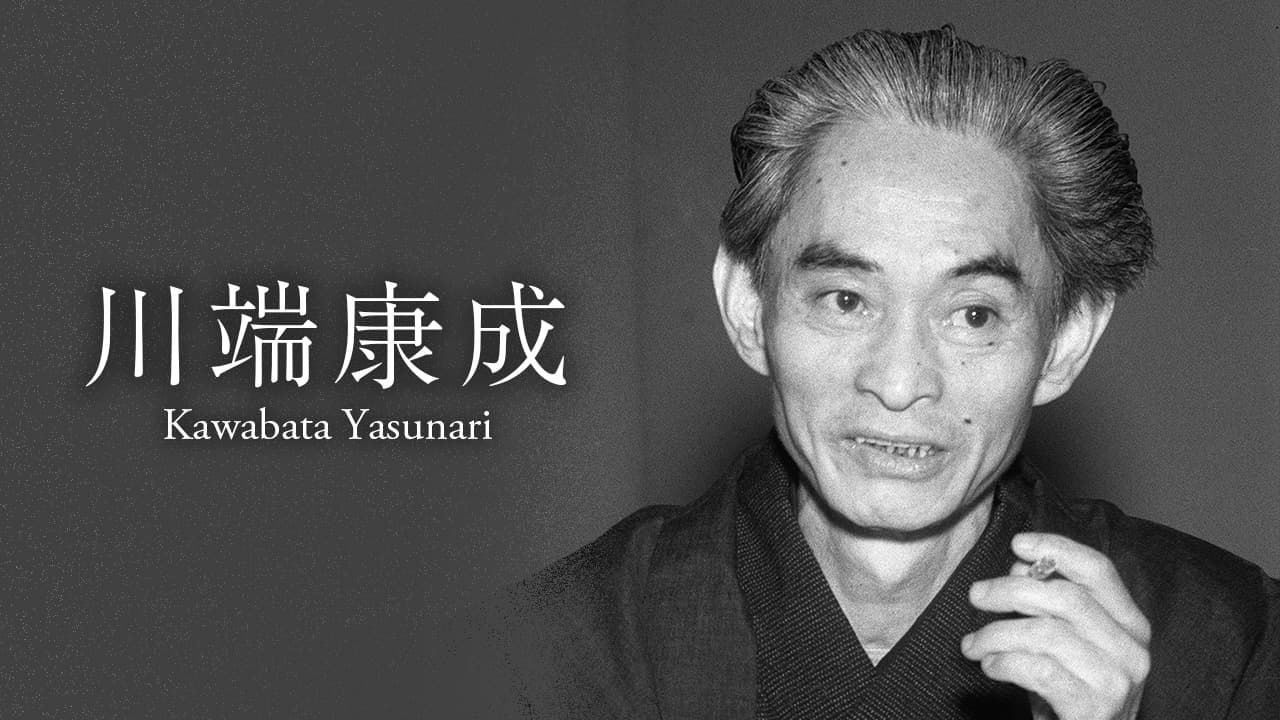
Kawabata Yasunari won the 1968 Nobel Prize in Literature for works written with narrative mastery and sensibility. Academic Taniguchi Sachiyo explores the connections between art and Kawabata’s literary world.
What sparks the idea for a literary work? How is this transformed through the creative process into the text itself? While there may be many different answers to these questions, in some cases, inspiration comes from an encounter with a painting.
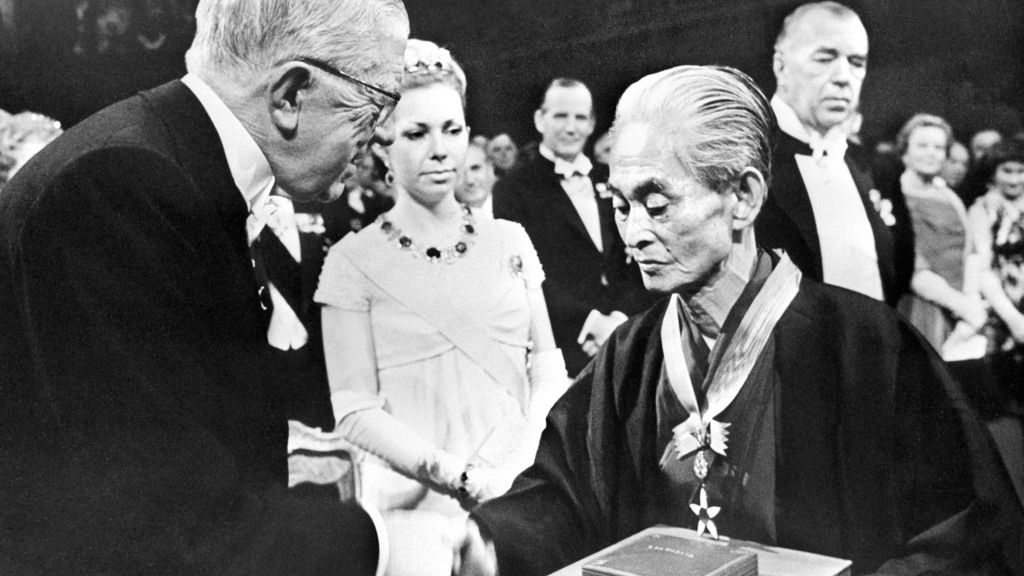
Kawabata Yasunari received the Nobel Prize in Literature in 1968. In the lecture he gave at the award ceremony on December 12 that year, he surfaced the connections between his own writing and Japan’s traditional culture, including especially the tea ceremony.
The Limitless Possibilities of a Literature Beyond Borders: A Conversation with Tawada Yōko
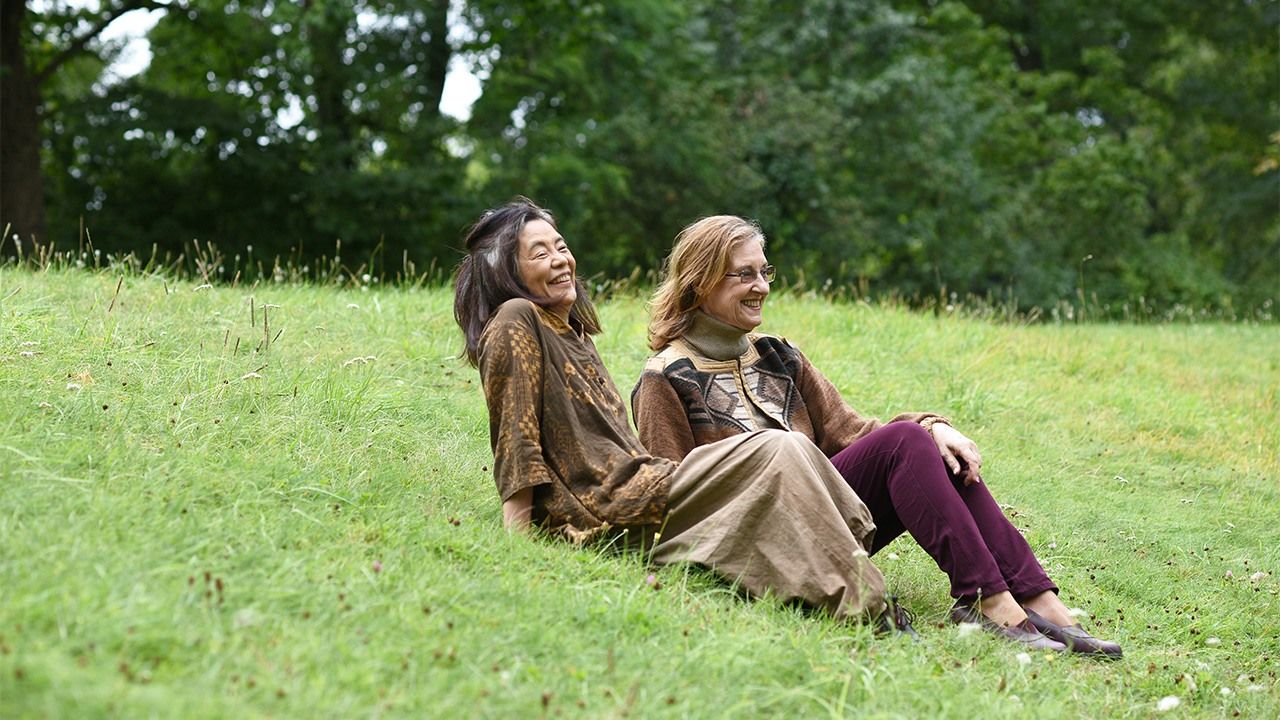
Tawada Yōko’s many accolades include the prestigious Kleist Prize, awarded to an outstanding work of literature written in German. Irmela Hijiya-Kirschnereit is one of Germany’s leading scholars of Japan, who has received the Gottfried Wilhelm Leibniz-Prize, Germany’s most prestigious academic award, for her scholarship on Japanese literature. The two met in Berlin for a wide-ranging discussion that covered adventures real and imaginary, translation, gender, and the future of the human race.
Tawada Yōko, a Japanese writer who lives in Germany and writes in both Japanese and German, has become one of the world’s leading literary voices, winning Germany’s Kleist Prize in 2016 and an American National Book Award in 2018.
Tights, 2011. Silver gelatin print Photo by Daido Moriyama
Daido Moriyama
A WOMAN IN TIGHTS
This picture was taken in 1986, and what you see is what you get. The shoot was quite natural: I asked my girlfriend to make an occasional pose, but didn't particularly direct her. I tend not to have feelings or thoughts while I work: I am completely immersed in the visual world of the subject.
DAIDO MORIYAMA EXHIBITION AT THE STEVEN KASHER GALLERY
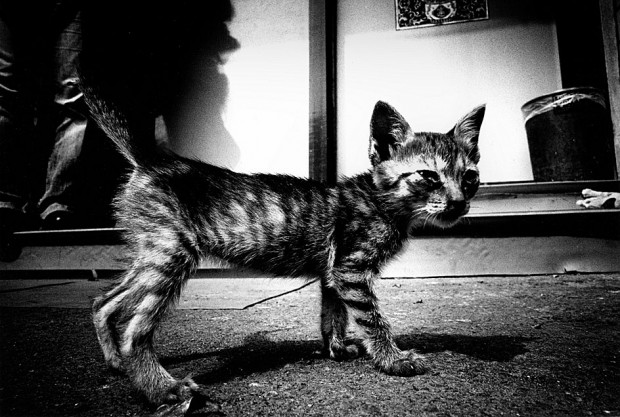
☛ Steven Kasher Gallery: “Record No. 18”, Taipei, 2010, gelatin silver, printed 2013, 16 x 22 in (40.6 x 55.9 cm).
Japanese photographer Daido Moriyama took this picture nearly 40 years after he shot one of his most famous portrait, that of a stray dog in Misawa (in january of 1971). In both case, the picture was created at the animal’s level, instead of adopting a high-angle shot (i.e. looking down on the animals). The young cat also seems to testify of a strong thematic continuity in Moriyama’s work.
Tate’s current ‘blockbuster’ brings together the works of William Klein and Daido Moriyama, exploring modern urban life in New York and Tokyo from 1950s to the present day. The exhibition seeks to demonstrate the visual affinity between their urgent, blurred and grainy styles of photography and also their shared desire to convey street life and political protest, from anti-war demonstrations and gay pride marches to the effects of globalisation and urban deprivation.
Moriyama Daidō wanders the streets like a stray dog, taking snapshots that leave vivid impressions on viewers. He is mentioned with the likes of Araki Nobuyoshi as one of Japan’s contemporary master photographers.Exhibits by modern Japanese photographers have become common at art museums and galleries in all parts of the world since the 1990s. Moriyama Daidō stands alongside Araki Nobuyoshias one of the most popular artists featured in these shows. Recent years have seen a number of large-scale Moriyama exhibitions, including a two-man exhibition with William Klein at the Tate Modern in London in 2012 and a one-man show, “Daidō Tokyo,” at the Fondation Cartier pour l’art contemporain in Paris.
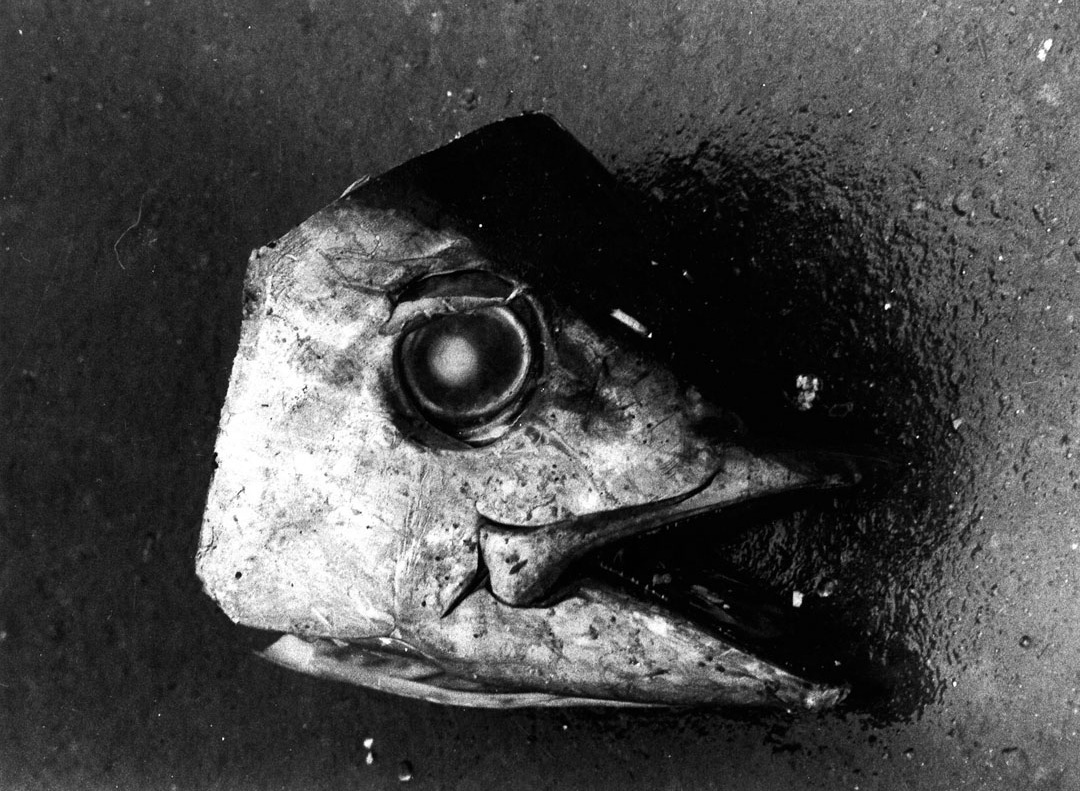
This image is also reproduced in the catalog assembled on behalf of the Fondation Cartier pour l’art contemporain: Daido Moriyama, photographs by Daido Moriyama, text by Nobuyoshi Araki and Daido Moriyama, London: Thames & Hudson 2003, p. 34. The hi-res reproduction shown above was scanned from this book where the head is shown facing down. I did however kept the orientation shown over at the Tepper Takayama Fine Arts website, with the head facing right.
From the essay “Dealing with a stray dog” by Akira Hasegawa comes a first-hand account, by Daido Moriyama himself, of how this photo was taken:
The photograph first appeared as a single image within the series Nanika he no Tabi (En Route to Something) in the March 1971 issue of Asahi Camera. As Moriyama himself recalls, “right after New Year 1971, I took a picture of a stray dog in Misawa up north in Aomori where there was a US military base. I was heading out in the morning with my camera in hand and took one step out of the hotel, when right there in front of me was this stray dog wandering around sunning himself. Just like that I pointed my lens at the stray dog and clicked the shutter a few times; later on, his moment in the light was printed as a full spread for a photo magazine series I was doing at the time”. As simple as that. Yet, now that same photograph “catches the eye of photography fans and somehow remains a favourite in Japan and around the world. It’s become a print that wanders around between museums and galleries and private collectors” (from an Asahi Shimbun newspaper essay by Moriyama). A turn of events the young photographer could never have imagined. (the essay “Dealing with a stray dog” is published in the book The World through My Eyes by Daido Moriyama, Milano: Skira, 2010, p. 17)