Saturday, February 23, 2019

Kristen Stewart / Hollywood's Rebel Belle

Hollywood’s Rebel Belle


Kristen Stewart doesn’t want to be packaged—she wants to live. As the 22-year-old actress blazes on-screen in Snow White & the Huntsman—with an adaptation of Jack Kerouac’s On the Road coming soon and the Twilight finale on the horizon—Ingrid Sischy hears about Stewart’s explosive first meeting with her Twilight-saga co-star Robert Pattinson, her passion for Kerouac’s Beat bible, and her definition of true girl power.

By Ingrid Sischy
Photograph by Mario Testino
I
shambled after as usual as I’ve been doing all my life after people that interest me, because the only people that interest me are the mad ones, the ones who are mad to live, mad to talk, desirous of everything at the same time, the ones that never yearn or say a commonplace thing . . . but burn, burn, burn like roman candles across the night.

—From the original manuscript of On the Road,
by Jack Kerouac.

Ghost Ships, Murders, Bird Attacks / Stories To Keep You Awake


Don't Look Now

Ghost Ships, Murders, 

Bird Attacks: 

Stories To Keep 

You Awake

Ethan Rutherford is the author of The Peripatetic Coffin and Other Stories.
I'd seen the movies before reading the stories — Nicolas Roeg's masterful version of "Don't Look Now" featuring Donald Sutherland and Julie Christie; and Alfred Hitchcock's strangely flat-footed and clunky version of "The Birds" — so I thought I knew what to expect from Daphne du Maurier's fiction. I was, in fact, a little bored by the prospect of reading these stories, since I'd already seen the movies, but one day a friend insisted, loaned me her copy of Don't Look Now and just said: Trust me. I sat down while it was still light out, didn't move from the chair until dark and have had a hard time sleeping ever since.
What I love and admire about the stories collected here — and all of them are great, but I will confess to loving "Don't Look Now" and "The Birds," the two stories that open the collection, more than the rest — is that they are eventful, by which I mean: Things happen. I had been on a streak of reading collections packed with stories that hinged on small misunderstandings, or featured passive characters typing emails to one another and being sad about their inability to express themselves. There is nothing wrong with stories like this, at their best you could say this sort of story is Chekhov 2.0, but at the time I was frustrated with my own writing. In my stories, nothing much seemed to happen; I was lucky if my character was able to, say, move a couch into his bedroom. It was depressing for everyone.


And then: that long day and this book. The stories collected in Don't Look Now feature U-boats and ghost ships; murderers and femme fatales; love on the rocks; episodes of clairvoyance and psychic shock; and, of course, birds attacking humans. "Nothing's been the same since. Nor ever will be," says the narrator of "Kiss Me Again, Stranger" — and that is what you come to these stories for: each features characters who endure the strange and the extreme, and who are forever changed by the events that befall them.
Do some of these stories telegraph their endings? Do a few of them read like genre exercises? Sure, a few of them do. But the first two alone are worth the price of admission. "Don't Look Now" is a strange and intimate masterpiece: a perfect distillation of the confusion and desire that attend grief, which, as the story progresses, adventures forward through the winding streets of Venice with the logic of nightmare. And then there's "The Birds," set on the desolate coast of Cornwall following World War II, which opens with a white cloud of gulls rising and falling in the trough of the seas "like a mighty fleet at anchor, waiting on the tide" — well, you know the story, or think you do. The movie is hammy and corny, but the story — both a precursor to the zombie scenarios so familiar these days and an early herald of the sort of environmental cataclysm we find ourselves on the verge of now — is absolutely terrifying. These stories open the book, and neither, once you turn the first page, lets you go.
All the stories in Don't Look Now are, in their own way, refusals of comfort —they do not end well for the characters — but we, as readers, knew that would be the case going in. This is du Maurier, after all. The pleasure in reading this book lies in being plunged into situations that are so fraught with tension that you begin to look for a release, which, when it does come, is never from the anticipated direction. They are strange stories; they are surprising. "Are you in distress?" comes the hail from a ghost ship in "Escort." The answer, as a reader, is surely: yes. But would you have it any other way?

Friday, February 22, 2019

The Doors of Perception / What did Huxley see in mescaline?


Reading group

The Doors of Perception: What did Huxley see in mescaline?


Given his damaged sight, the book's emphasis on the visual is all the more piquant, complicating the question of how much its visions reveal

Sam Jordison
Thu 26 January 2012

D
isconcertingly, given the detailed discussions of art and the visual world in The Doors Of Perception, Aldous Huxley was almost blind. Or, at least, some people said he was. Like much else in Huxley's life, the state of his vision was a source of considerable controversy and speculation.

The known facts are these: in 1911, while this scion of one of the UK's foremost intellectual families was studying at Eton, he suffered from a very unpleasant illness called keratatis, which left him blind for several years. Huxley's vision recovered enough for him to study at Oxford, with the aid of thick glasses and a magnifying glass, but further deteriorated over the next 20 or so years.
It's in 1939 that things become murky. Desperate for help, Huxley was persuaded to pursue the Bates Method, a controversial theory (now largely debunked) suggesting, among other things, that glasses shouldn't be worn, natural sunlight could be beneficial and a series of exercises and techniques could help improve vision. He claimed impressive results: "Within a couple of months I was reading without spectacles and, what was better still, without strain and fatigue … At the present time, my vision, though very far from normal, is about twice as good as it used to be when I wore spectacles."


That quote comes from The Art Of Seeing, the book he published about his experiences with The Bates Method in 1942. Reviews, were mixed at best. The British Medical Journal review declared: "For the simple neurotic who has abundance of time to play with, Huxley's antics of palming, shifting, flashing, and the rest are probably as good treatment as any other system of Yogi or Couéism. To these the book may be of value. It is hardly possible that it will impress anyone endowed with common sense and a critical faculty."

In the same article the author suggested that Huxley's vision may actually have improved naturally with time as some conditions move in cycles. Others, meanwhile, doubted that he could see much at all. Wikipedia cites a Saturday Review column from Bennett Cerfpublished in 1952, just two years before The Doors Of Perception, describes Huxley speaking at a Hollywood banquet, wearing no glasses and seemingly reading from his notes with ease: "Then suddenly he faltered — and the disturbing truth became obvious. He wasn't reading his address at all. He had learned it by heart. To refresh his memory he brought the paper closer and closer to his eyes. When it was only an inch or so away he still couldn't read it, and had to fish for a magnifying glass in his pocket to make the typing visible to him. It was an agonising moment."
In Huxley's defence, he always admitted he still needed a magnifying glass, but whichever way you look at all these arguments, they add an edge to the writer's enthusiastic artistic criticism in The Doors Of Perception. Was he protesting too much? Alternatively, was his delight and concern for the visual world all the more heightened because he had fought so hard to retain his sight – and knew what it means to lose it. Given that The Art Of Seeing had aroused such anger and doubt, was he perhaps using the Doors Of Perception as a way to answer his critics? Is it possible that Huxley's subconscious was operating in ways he didn't care to acknowledge?
Well, maybe. But now I'm in the realm of speculation. Just before I leave, one more conjecture: Huxley wouldn't be entirely delighted at the suggestion the book is somehow about his eye trouble. For him, it was all about mescaline. The message was the drug and its astonishing potential. It marked (forgive me) the high point in a lifelong obsession.
As anyone familiar with Brave New World will know, Huxley's most famous novel also shows the influence of drugs. The citizens of the future are nearly all hopped up on Soma, a powerful hallucinogen that allows "a holiday" from reality, imparts a tremendous feeling of well-being, softens up the mind and poisons the body. In the climactic scene in the book, when John the Savage rebels against Fordist society, his anger is concentrated on Soma, which has come to symbolise all that is rotten in this future-state.
It's fascinating to re-read this earlier book in the light of The Doors Of Perception – especially since, in it, Huxley frequently suggests that Soma is very similar to mescaline in its effects. Back in the 1930s, he even described mescaline as a worse poison than Soma, rendering poor Linda vomitous and even dumber than usual.
Clearly, in the 22 years between the publication of the two books Huxley revised his opinions about the drug. By the time he finally sampled mescaline he was convinced it would offer him insight rather than the distraction from reality offered by Soma. As The Doors Of Perception demonstrates the drug exceeded his expectations. Huxley was to remain a dedicated psychonaut for the rest of his life.
On Christmas Eve 1955, he took his first dose of LSD, an experience he was to repeat often and he claimed allowed him to plumb even greater depths than mescaline. The literary culmination of this self-medication can be seen in Island, the 1962 novel, which can be viewed as an answer to Brave New World. It describes a utopia rather than a dystopia, and this time around drugs perform an entirely beneficial function, providing serenity and understanding. They are as the book puts it, "medicine".
Ironically, Pala, Huxley's utopia sounds even worse than the alternative future Huxley describes in Brave New World. The Palanese are crashing bores. They are the kind of people who (in one of the most inadvertently hilarious passages I've read) think it's OK to rewrite the climax of Oedipus Rex with a lecture from some Palanese children, who inform the luckless mother-lover that he is being "silly" and ought to follow their philosophy rather than tear his eyes out … But never mind that. Although it is awful in many regards, Island still holds the charm of Huxley's cultured prose and fertile mind. The knowledge that he wrote the book shortly after his first wife died from cancer and he himself had received a terminal diagnosis also adds real poignancy to the book's many passages about coping with disease. One of his ideas is that tripping may ease the passage into that good night – advice he famously took on 22 November 1963 when he asked his wife second wife Laura Huxley to give him LSD. "Light and free you let go, darling; forward and up," she whispered to him as he drifted away. "You are going forward and up; you are going toward the light."
We'll never know how Huxley's final trip went, but we do know that his psychedelic experiments had a remarkable afterlife. (Psychedelic, incidentally, was a word Huxley helped coin along with Humphry Osmond. Huxley can lay considerable claim to kick-starting the 1960s revolution in the head. It wasn't just the fact that The Doors Of Perception was so influential. He was also personally instrumental in introducing luminaries like Allen Ginsberg and Timothy Leary to the possibilities of psychedelic experimentation (as described in the early pages of Martin Lee and Bruce Shlain's Acid Dreams, the definitive story of the way LSD swept through America in the 1960s – thanks to the many contributors Reading group who recommended that).
It's safe to say that Huxley changed the world. Without him there might have been no turn on, tune in, drop out, no Merry Pranksters, no Sergeant Pepper, no Fear and Loathing in Las Vegas, no Focus.
I scoffed when I read JG Ballard's introduction to my edition of The Doors Of Perception and he said that the book was "even more prophetic" than Brave New World (and also, incidentally, that Brave New World is more prophetic than Orwell's 1984). As this Reading group month draws to a close, I can see that – as usual – Ballard was quite right. The book didn't just point the way to the future (or one potential version of it), it changed it. The big question now is whether it has opened any doors for you? Has Huxley changed your view of mescaline and/or reality? And are you tempted to follow in his footsteps?


The Shipping News / Proulx's Newfoundland


 A still from the film of The Shipping News

READING GROUP

The Shipping News: Proulx's Newfoundland

The extremity of the location is one of the most memorable aspects of the novel. But how recognisable is it? 
SAM JORDISON
THU 22 DECEMBER 2011
No one who has read The Shipping News will be surprised to learn that Annie Proulx found Newfoundland inspiring.
"Within 10 minutes of landing on the rock I knew that this was a tremendously important place for me," she once told an interviewer. "The more I saw the more I loved. I knew I wanted to write something about this place. And it's hard to explain – because it's not a loveable place. It's very harsh, the weather is cruel, you can hardly drive for a mile without having a moose get in your way… "
Equally importantly, she also explained that her story could only have happened in a place "where people are kind". Quoyle was trampled on everywhere apart from Newfoundland. When he got there, he was able to have a shot at happiness.

Kevin Spacey as Quoyle and Judi Dench as Agnis in the film version of The Shipping News
Judging from the comments under the first few Reading Group articles about the book, however, not all Newfoundland residents feel quite so fondly of Proulx as she does about them.

"I live in Newfoundland and have spent some time up on the coast whose environment and people she 'describes' and I can tell you that book is a bunch of malarky from page one," frankthefist wrote. "But one detail in particular made me angry. She has people put a Bible in an outhouse to use for toilet paper. Those people are particularly religious and tidy. The idea that they would use a Bible to wipe their arses with is too insulting to pass. The whole book is full of bullshit 'observations' that make a Newfoundlander's skin crawl. Typical Yank making it up to seem more real."
Ouch!
"I'm also from Newfoundland" Millieb added, "and I agree with frankthefist. There might be much to admire about the book, but the culture it describes isn't one that I recognise at all (and I grew up spending a fair amount of time visiting relatives and family friends who lived not that far from the part of the coast she's describing). Proulx is an evocative stylist, but the book is more of an imaginative fantasia on Newfoundland than any sort of accurate representation of it – not, of course, that that's necessarily a bad thing. And while I have eaten flipper pie (wouldn't recommend it), the only place I've ever come across mention of a squid burger is in this novel."
I'm disappointed about the non-existence of squid burgers, but I don't have many objections to Proulx's depiction of the place itself. Surely it's Proulx's right to write fiction? As plenty of other people below the line pointed out, the fact that The Shipping News isn't entirely accurate shouldn't be seen to detract from Proulx's achievement.
"As others have said, she draws you in so powerfully that you become part of these places and lives – however 'other' they are from your own experiences – so that they resonate in your imagination afterwards," wrote Soixante10.
I would agree with that. It's now more than a fortnight since I put the book down – and I've read a lot since – but my quiet moments are still often filled with thoughts of fog rolling in, windswept coastlines and how strange it would be to have a moose get in the way of my car. Even if Proulx's depiction isn't strictly accurate, it is inspiring - as the Guardian's own Alison Flood can testify. "I love The Shipping News so much that we went on our honeymoon to Newfoundland," she wrote, "and it is every bit as gorgeous as Proulx makes it sound".
Sadly, constraints of time and budget have prevented me from being able to visit the place myself. Besides, I've learned there are few flights from the UK to Newfoundland outside May to October. Newfoundland, it's safe to say, is out on a limb. It contains the easternmost city in the American continent (St John's) and is so far removed from most of the rest of the world that it has its own timezone (Newfoundland Standard Timezone, a fiercely inconvenient three and a half hours behind GMT). It is also regularly visited by icebergs from May to July – and even if you can't see them for yourself, you can follow them on Twitter.
While I haven't yet visited, I have at least spoken to a few people on the island and while none of them are prepared to admit to the existence of squid burgers, they have all confirmed that other aspects of the book are true. Most notably, that there's an awful lot of rough weather and fog. Erin Skinner from Newfoundland and Labrador Tourism (the main source of the splendid photos in the gallery that accompanies this articlefdafdfasdfsdad) told me that she's seen days where warm sunshine has given way to snow, hail and rain in quick succession. She also attests that there are parts of Newfoundland where "everybody knows your name" and that there are a great many "thriving" community newspapers. L'Anse Aux Meadows, the isolated northerly part of Newfoundland that roughly corresponds to the area described in the novel, is served by The Northern Pen. I'd advise any fan of The Shipping News to give it a read. When I clicked on it, joyfully, the lead article contained a picture of a grounded boat and notes about a storm. (Sample line: "He's confused not only to how his home of 17 years survived last Thursday night's violent wind storm but also what to do with the bridge considering it is no longer attached to his house instead it lays upside down about 15 metres away.") Other pleasures included a piece about snowmobiles, and one about iceberg surveillance.
Quoyle would be in his element. So too, I'm beginning to think, would I. I haven't even mentioned the fact that Newfoundland is also reputed to offer some of the world's best whale-watching opportunities and it's stunningly beautiful. There's even a thriving literary scene, with a literary festival in a national park in August – and if that sounds a little too hectic, there are a number of writing residencies available on a retreat on the isolated Fogo island. I fondly await having an excuse to see it for myself…


Daphne du Maurier / Don't Look Now / The 'middlebrow' question


Daphne du Maurier in 1944. Photograph: Hans Wild


READING GROUP

on't Look Now: The 'middlebrow' question

How far does Du Maurier's work rise above the limitations of effective genre writing? And does it matter if it's only entertainment?

Sam Jordison
Friday 14 October 2011


I
n 1938, the distinguished author VS Pritchett wrote in the Christian Science Monitor that Rebecca would be "here today, gone tomorrow". I think by now, that it's safe to say that he was wrong.

Yet while Daphne du Maurier's books have proved durable, they still haven't the reputation of those by contemporaries like Anthony Powell, Evelyn Waugh, or even VS Pritchett. She spent a great deal of her life denying that she was a romantic novelist - often in the face of concerted marketing from her publisher – but the stigma still remains.
Perhaps there's some justification. I know that before I read Rebecca I always thought of Du Maurier as a slightly more sophisticated Barbara Cartland. After I read Rebecca, I continued to think pretty much the same thing – only with the qualification that being an upmarket Barbara Cartland is all right with me. Du Maurier is nearly always entertaining, can write with real urgency, has an intriguing darker side and provides good insights into human nature – as well as plenty of stuff about galloping hooves, brooding men and women in impressive dresses.
But of course, that doesn't really do justice to the full range of her talents. She has plenty to offer above and beyond the bodice. As is well shown in stories like the subject of this month's book club, Don't Look Now, and her violent, pessimistic masterpiece The Birds, Du Maurier could be a daring and original writer, unafraid to stare into some of the most troubling parts of the human psyche.
So where does she stand?
On our opening post for this month's Reading Group, zibibbo raised the question of whether Du Maurier "might be worth taking seriously beyond her talent for cooking up macabre plots." The answer to that, according to most people posting here has been a resounding "yes". Complimentary comments have included: "she is one of the masters of having a location become a character in her work"; "it's wonderfully written"; "I find it really haunting" and "impressive".
But there have been qualifications. In a series of posts, Jericho999 wrote:
"The writing was sometimes poor and flabby - lots of 'she nodded her head up and down', that sort of thing. Also, it simply didn't create the sense of deep unease that you find in, say, Henry James's Turn Of The Screw. It doesn't play with perception in the same way.
"That sort of lack of care in the finished sentence happens again and again in Du Maurier - it's particularly glaring in Jamaica Inn. Don't get me wrong, I like her writing; I've read most of her stuff. But she's not first order. Somerset Maugham called his own output "the very top rank of the second rate", and I think the same could probably be said for Du Maurier."
Du Maurier, it seems, is middlebrow. Or possibly not, because as Jericho999 also suggests:
"I hate the word 'middle brow'. It's used by snobs to belittle other people's reading tastes! l love a Jilly Cooper as much as I love a Hemingway, in the right setting – but obviously, I wouldn't say that she's as good or adept a writer. That's kind of what I mean by Du Maurier. And I sometimes think that claims are made for her which aren't quite… accurate."
It's hard to argue with Jericho999. Middlebrow is an unfortunate term. And while I love reading Du Maurier, I can also say that her writing lacks something. It's very effective, and vivid, but aside from a few delicious lines ("Last night I dreamed I went to Manderley again"), it isn't exactly quotable. It can be flabby. And it can be (as anyone who has read Frenchman's Creek will know) overwrought.
So where do we place Du Maurier? Is she good enough to hold her own against Papa? Has she been underestimated or overrated? Or do such questions even matter so long as we continue – in defiance of VS Pritchett – to enjoy her stories?
Over to you.

Thursday, February 21, 2019

The latest celebrity to star in Mario Testino’s beautiful towel series is…

Imaan Hamaam


The latest celebrity to star in Mario Testino’s beautiful towel series is…


Marie Claire
May 25, 2016


Imaan Hammam is the latest star to pose nude with just a towel, as part of legendary photographer Mario Testino's towel series.

Imaan Hammam joins previous models, Bella Thorne and Kristen Stewart who also participated in the series.

The beautiful photo series has seen a number of famed celebrities, from Naomi Campbell to Anna Wintour, pose in nothing but a towel for the lens.

Anna Wintour joins Mario Testino's 'Towel Series'


ANNA WINTOR
Photo by Mario Testino


Anna Wintour joins Mario Testino's 'Towel Series'

Post-shower hair wound up in a towel comes pretty low on our list of ideal photo opps – let’s be honest, it’s not the best look for most of us. Unless you’re a world-class supermodel or actress and your lensman is Mario Testino, that is.

The Peruvian photographer, who most recently captured the christening of Princess Charlotte, started a trend when he snapped his “muse” Kate Moss wearing nothing but a white waffle bathrobe and towel turban back in November 2013 and shared the off-the-cuff moment, taken on the set of Moss’s Stuart Weitzman campaign, on Instagram.

Kate Upton followed two weeks later in a similarly unpolished shot and so Testino’s ‘Towel Series’ was born, becoming more and more refined each time – no more grainy phone snaps, instead artful shots that wouldn’t look out of place on the cover of Vogue.

Tops models and actresses alike have participated – Gisele Bündchen, Keira Knightley, Cara Delevingne, Sienna Miller and Naomi Campbell are just a few – and now Anna Wintour herself has become a part of the series.

Of course, her infamous bob is left loose, making her the first participant to not actually wear a towel in the ‘Towel Series’ – but we doubt Testino was keen to labour the point too much...


Wednesday, February 20, 2019

Giovanni’s Room shows the fearful side of dauntless James Baldwin


READING GROUP

Giovanni’s Room shows the fearful side of dauntless James Baldwin

A love story ever on the brink of ‘self-contempt’, the novel shows the private terrors that beset the fearless public campaigner

Sam Jordison
Tue 19 Feb 2019
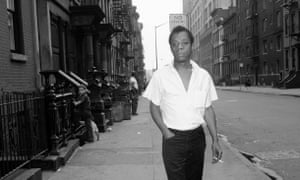
A mind in turmoil … James Baldwin in New York in 1963.
Photograph: Dave Pickoff/AP
Today James Baldwin is most frequently encountered as a “trailblazer of the civil rights movement”; a magnificent prophet who declared that “ignorance, allied with power, is the most ferocious enemy justice can have”.
His contemporary relevance is so obvious it hardly needs to be stated – although it’s always good to be reminded. To watch him in the recent documentary I Am Not Your Negro is exhilarating, showing just what an unstoppable moral and intellectual force he was. It’s not just that it’s hard to disagree with him; it’s impossible to argue with him. Representatives of the old order charge towards his machine-gun rhetoric like sword-waving cavalrymen and they are mown down.
He was politely devastating when Professor Paul Weiss tried to tell him on the Dick Cavett TV chatshow that he shouldn’t be so concerned about “colour”, when his life has been threatened, and his friends have been killed, precisely because of colour. Meanwhile, the footage of Baldwin shredding the rightwing commentator William F Buckley at the Cambridge Union is one of the most impressive rhetorical performances of the modern age. “It is a terrible thing for an entire people to surrender to the notion that one ninth of its population is beneath them,” he said toward the end of his speech. “Until the moment comes when we, the Americans, are able to accept the fact that my ancestors are both black and white, that on that continent we are trying to forge a new identity, that we need each other, that I am not a ward of America, I am not an object of missionary charity, I am one of the people who built the country – until this moment comes there is scarcely any hope for the American dream.” At his conclusion, the room erupted in a standing ovation. Baldwin’s words were forged in injustice and tragedy, making his delivery all the more remarkable. It feels impossible to imagine anyone who could ever take him on.
But there was one person capable of defeating James Baldwin – and that was James Baldwin. In Giovanni’s Room, he goes to war with himself and loses.

On the one hand, the novel feels as if it is striving to be a regular love story, describing something natural and joyous. Two young and beautiful people meet in a bar in Paris. There is an immediate spark. “We connected the instant that we met,” says the narrator. They enjoy talking together and the narrator feels “shy”. They flirt. They drink. They stay up too late and walk across the Seine in the early morning, have breakfast, make love, move in together. There is tenderness and affection. They make each other laugh. One of them declares, “I have only just found out that I want to live.”
But there are obstacles. Because the two lovers are both men and “people have dirty words for – for this situation”. David, the narrator, begins to feel his life is “occurring beneath the sea”. His love is “a cavern in which I would be tortured until madness came, in which I would lose my manhood”. The thing that brings him joy also brings him terror and mortification. “I was ashamed,” he says of his first same sex encounter. “The very bed in its sweet disorder, testified to vileness.”

David also regards most other gay men with horror, comparing a boy who goes out at night in makeup and earrings to “monkeys eating their own excrement” and bitterly scorns older men he sees chasing youth. This is contempt is made worse still because it is also “self-contempt”.
This blend of beauty and disgust makes for a destabilising reading experience. Everything up and down. One minute we’ll be appreciating the beauty of Parisian rooftops, “their myriad stacks very beautiful and vari-coloured under the pearly sky”; the next, we’re down on pavements “slick with leavings, mainly cast off rotten leaves, flowers, fruit and vegetables which had met with disaster natural and slow, or abrupt”.
We are witnessing a mind in turmoil, tangled and contradictory. This novel is unquestionably powerful and sad. But it can also feel tortured. David should not be mistaken for Baldwin, but it’s hard to separate the author entirely from his pain and moral uncertainty. After all, he chose Walt Whitman for the epigraph: “I am the man, I suffered, I was there.”
But that’s not to say that this doubting 1956 novel should be completely separated from the rhetorician, who spoke with such clarity and assurance at the Cambridge Union in 1965. Because there, Baldwin spoke as a man who knew what it was to be hesitant, vulnerable and defeated – and was all the more effective as a result. He contained multitudes.