Saturday, September 11, 2004

Sweet like chocolate / Willy Wonka and the Chocolate Factory


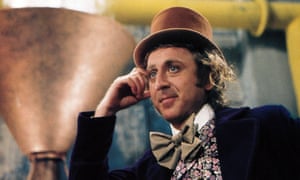
Gene Wilder as Willy Wonka in the 1971 film.
 Gene Wilder as Willy Wonka in the 1971 film. Photograph: Allstar/Warner Bros.


Adaptation of the week

Sweet like chocolate: Willy Wonka and the Chocolate Factory

Andrew Pulver
Saturday 11 September 2004
Author: Roald Dahl (1916-1990) began his prolific writing career after being invalided out of the RAF during the second world war, and being posted to the US. His first book, The Gremlins (1943), became a Disney film. In 1960 he moved back to England, and started writing in earnest, with James and the Giant Peach (1961) becoming his first significant success. Charlie and the Chocolate Factory - inspired, so he said, by being used as a test consumer by the nearby Cadbury’s factory while at school in Repton – was published first in the US in 1964. A string of successful children’s books followed, including Fantastic Mr Fox (1970), Danny: The Champion of the World (1975), The BFG (1982), The Witches (1983) and Matilda (1988). He died of leukemia in 1990.
Story: Dahl’s children’s fantasy tale is set in an un-named town that’s recognisably English (and still suffering the after-effects of war and rationing). Poverty-stricken child Charlie Bucket is one of five winners of a competition to visit the chocolate factory run by the mysterious Wonka. The factory tour introduces them to a string of bizarre confectioneries (Everlasting Gobstoppers etc) as well as the Oompa-Loompas – the pygmy-sized workforce. But the fairy tale becomes a cautionary one as Charlie’s fellow competition winners are consigned to humiliation for indulging in Dahl’s pet hates - eating too much, chewing gum, being grasping, and watching TV. Charlie is then handed ownership of the factory by Wonka as the “winner”.
The film-makers: Mel Stuart (b 1928) was originally a TV documentarist, and was told about the book by his 11-year-old daughter. The $1.8m budget was raised from Quaker Oats, who were planning to market a chocolate bar around its release. Dahl wanted Spike Milligan to play Wonka, but he was considered too much of a risk for the US market. Gene Wilder, hitherto best known for his role in Mel Brooks’s The Producers (1968), was cast instead, opposite a group of unknown child actors. Anthony Newley and Leslie Bricusse wrote the songs.


How book and film compare: The film is first and foremost a children’s musical, with catchy tunes such as The Candy Man Can and Oompa Loompa. Though the setting remains physically similar, the film is considerably more transatlantic than the book, with most of the principal cast being American. (Augustus Gloop, the glutton, is German; Veruca Salt, the spoilt kid, is English.) The film added two significant plot elements: the sinister figure of Slugworth, who tries to persuade each child to tell him the secret of Everlasting Gobstoppers; and Wonka’s threat to expel Charlie along with the other children after he samples the Fizzy Lifting Drinks. The film transforms Dahl’s story into a classic of pop-art kitsch, with costumes, design and lettering all contributing to an extravagantly imagined work. But the author was vocal about his unhappiness with Stuart’s changes.
Inspirations and influences: The success of previous children’s musicals like Oliver! (1968) and Chitty Chitty Bang Bang (1968) - on which Dahl had worked - meant that a market for this movie appeared assured. But it failed at the box office, and it wasn’t until the advent of video in the early 1980s that its bizarre stylings were rediscovered. Director Tim Burton was particularly affected: he is currently directing a remake of this film, having produced an animated adaptation of another Dahl book, James and the Giant Peach, in 1996.


Sunday, September 5, 2004

'An Evening of Long Goodbyes' / This Man Is an Island


'An Evening of Long Goodbyes': This Man Is an Island


By Stephen Amidon
September 5, 2004

AN EVENING OF LONG GOODBYES By Paul Murray. 424 pp. Random House. $24.95.

The economic boom that has transformed the long-stagnant Irish economy into one of the world's most productive is not without its detractors. The Celtic Tiger (as this upswing is grandiosely known) might be good news for tech entrepreneurs and real estate brokers, but the prospect of lattes by the Liffey and cellphone towers on Ben Bulben is driving many traditional Irishmen to distraction.

Charles Hythloday, the bibulous, buttonholing narrator of Paul Murray's first novel, "An Evening of Long Goodbyes," is just such a malcontent. Marooned in Amaurot, his family's seaside manor outside of Dublin, this 24-year-old gentleman of leisure casts a cold eye on the encroaching modern world. For Charles, even the briefest sortie into the "encircling suburbs" can prove a descent into hell. "The shopping center frightened me, the alien, prefabricated meanness of it: the cut-rate hair salon, the boutiques of bleak pastel frocks, the newsagent's whose staff were in a state of perpetual regression." Far better to stay at home, draining his recently deceased father's wine collection, feeding his pet peacocks and doting on his beloved sister, Bel, a would-be actress with a turbulent emotional history. He sees himself as living by the Renaissance code of sprezzatura, which dictates that every action (or, in Charles's case, inaction) must be carried out with effortless grace. Attention should be paid to beauty rather than results. "Thus, if one were to work at, say, law, one should raise it to the level of an art; if one were to laze, then one must laze beautifully."

It is, of course, an idyll doomed to failure. If there is anything the modern world disdains more than grace, it is a lack of results. Charles's nemeses are legion, and they all seem intent on driving him from Amaurot. First and foremost is Frank, the loutish "architectural salvage" specialist currently wooing Bel. There are also the Bosnian refugees squatting in the Folly, an extravagant but useless edifice that Charles is having built on the estate's grounds, as well as Charles's alcoholic mother, who returns unexpectedly from the upscale institution where she has been drying out. Rounding off this roster of tormentors is Harry, the social realist playwright who wants Bel to star in his latest work, "Ramp," a sublimely po-faced drama about the disabled.

These early scenes, in which Charles tries in vain to protect the sanctity of his ancestral home, are the novel's best. As long as he stays at Amaurot, "An Evening of Long Goodbyes" succeeds as a spirited howl against so-called progress. Once Murray casts his hero out into the world, however, the narrator begins to lose his voice. Charles's long, improbable residency with Frank in a Dublin slum lacks the sparkle of the Amaurot sequences, as does his servitude in a "bread factory" in the Cherry Orchard industrial park. (Murray has a rookie's weakness for literary allusion -- the telephone company that threatens to buy out Amaurot from the dithering, Hamlet-esque Charles and his Ophelia-like sister is named Telsinor). Since there is no doubt that Charles's foray into modern Ireland will turn out to be a disaster, his encounters with Dublin's drug lords and yuppie go-getters soon feel redundant. Murray also tends to rely on crude, knockabout humor to move his narrative along. The result is a novel whose 400-plus pages begin to weigh on the reader not long after the midpoint. Only when Charles straggles home, considerably worse for wear, does the author regain his deft touch.


If plotting is a difficulty for Murray, prose style most certainly is not. He writes with the cunning and confidence of a seasoned pro. Memorable images are frequently conjured, such as when Charles's father, a famous inventor of cosmetics, tries to mask the ravages of his fatal illness with his art: "And so the makeup was caked on with trembling fingers, layer upon layer; he lay in the half darkness like a sad, syphilitic Pierrot, his gaunt cheeks stained concavely with rouge." Charles's lacerating, hilarious voice proves as effective a weapon against creeping globalism as any smoke bomb or human blockade. The arriviste house hunters who are snatching up

the land around Amaurot are dismissed as "new people: pale and crepuscular from days and nights holed up in their towers of cuboid offices, crawling down the narrow, winding roads in BMW's or hulking Jeeps, scouting for property like toothless anemic sharks." Charles's caustic snobbery, which Bel calls his "feudal outlook," is oddly endearing, especially when it comes up against characters like Gemma from "Sirius Recruitment, Ireland's leading premium specialist in I.T., multimedia and e-business solutions NOW," whom a penniless, job-seeking Charles unwisely visits in a "slightly foxed" dinner jacket and "gaudy" waistcoat.

While Charles proves an acute commentator on the outside world, he is considerably less reliable about his inner landscape, opening a further comic dimension for the reader to savor. His project to save Amaurot as a haven "unlike the shifting, unstable world outside" is clearly doomed, especially once the chairman of Telsinor announces his plans to transform it into a corporate "Center for the Arts." Charles's relationship with his sister is even more deeply self-deceptive -- though he thinks he is simply protecting her from unsuitable suitors, he is clearly in love with her, an incestuous obsession that took root during their languid, cloistered childhood. The novel achieves an unexpected poignancy as it becomes clear that Charles's paralytic attachment to the past has as much to do with this impossible love for the fragile Bel as it does for ancient Ireland.

The story's key moment comes when its hero, quite literally, goes to the dogs. Before returning home for his final showdown with Amaurot's interlopers, Charles visits a greyhound racetrack in a desperate attempt to raise money. Championing a clapped-out old hound with the unlikely name of An Evening of Long Goodbyes, he manages to come up a winner, even after his dog is savaged by a brute called Celtic Tiger. At this moment of triumph, Charles is visited by the ghost of W. B. Yeats, who compliments him on his sprezzatura, then quotes Oscar Wilde, another Irishman who would have little time for the brave new nation around them: "In a good democracy, every man should be an aristocrat." It is a risky scene, but Murray's gamble pays off, placing his alienated narrator squarely in his nation's best traditions. In a contest between the aristocratic Charles and the egalitarian representatives of new Ireland, I suspect that many readers will be inclined to give Charles their votes.

Stephen Amidon's novels include "The New City" and "Thirst." His new novel, "Human Capital," will be published in October.


THE NEW YORK TIMES

Monday, August 16, 2004

Summer readings / Henning Mankell


SUMMER READINGS
Faro Island, The Baltic

By Henning Mankell

Sunday 15 August 2004 01.10 BST

I have always been on the move like a Scandinavian nomad in an unknown tribe, doing serious writing wherever I happened to be. When I was very young, I remember once living clandestinely in an empty apartment in Stockholm. There were no lamps in the flat. The only light I could find was when I opened the oven. Fine by me. I used the oven as a table, put my typewriter there and had all the light I needed.
Everything is possible. I still remember in 1992, writing The White Lioness in Maputo, east Africa. I lived in a small room where I was surrounded by other small rooms, and - I counted them - seven radios, playing loudly, but tuned into different music stations. It happened that I, maybe once a week, lost my temper and asked them if they at least not could choose one programme to listen to. Everyone was very understanding; they turned off the radios completely for 15 minutes and then it started all over again.

I loved my neighbours. And I wrote the novel. So I think I can write almost anywhere. I can never excuse myself for failing in my work by blaming the room, wherever or whatever it may be.

But perhaps this is not completely true. There is an exception to this rule. There is a sacred spot somewhere in the world. I spend time in this sacred spot and I must admit that I sometimes long to go there. On the other hand, I am always afraid to lose my independence. I can not fall in love too much with that little house.
North of the island of Gotland, this very rare and magic island in the Baltic, some 35 minutes' flying time from Stockholm, there is another island, even smaller. Its name is Fårö - meaning Sheep Island, and it is separated from Gotland by a firth where there is a ferry. This island has a magical landscape - it could be Ireland, the Hebrides or even the bush in north-eastern South Africa. All by itself on the eastern rocky beach is a small wooden cabin. It was originally built in the 1930s by a man who used to hunt during the winter season. Today, I can occasionally use it to live and work in. The cabin is situated some 30 metres from the sea. When the wind is strong, the salty waves almost reach the windows.

In this cabin, there is a kind of emptiness that is strange, rather impossible to explain. When I enter, I have a feeling that someone has just left, even though the house may have been abandoned for months. I am not talking about 'ghosts'; it is more the feeling that this cabin is breathing. But what is really magical about this cabin is that the mostly fictional characters I write about seem to like the cabin as much as I do. In just a couple of days, they fill the room with their voices. They share my bed, my food and they walk with me on the beach.
It took me some years to realise that this cabin is good when I have something really difficult to write. The house is a masterly servant. So I am happy that this cabin exists. And that I occasionally can use it. Among all the various rooms where I write, this little cabin is the centre that does not move, that is always there.
By the way, the owner of the cabin is Ingmar Bergman, who happens to be my father-in-law. As far as I know, he has never done any writing there.
· Henning Mankell's prize-winning Inspector Wallander thrillers consistently top European bestseller lists


Sunday, August 15, 2004

Summer readings / AS Byatt

Summer readings

Cevennes, France

by As Byatt

Sunday 15 August 2004 01.10 BST

What I need to write well is a combination of heat, light and solitude. My first experience of southern heat and light was when I was au pair to a French family in a vineyard on the hot plain near Nîmes. We now spend our summers in a tiny house in the Cévennes, not far from Nîmes, but in very different country. There is ridge after ridge of craggy mountain hillside, all densely wooded with oaks and chestnuts up to the bare stony mountaintops, where the flocks of sheep spend the summers.
The mountains were eaten bare by the sheep before the 18th century and the trees are the work of one imaginative man called Fabre, who replanted huge areas of mountainside. I like it here because the sheep and the uplands remind me of the Yorkshire moors, the magical landscape of my childhood holidays. But this is on a grander scale and it is mostly very hot and bright.

Our house is on the edge of a village. We have two bedrooms and a living room - the house is the converted carriage shed of the house opposite. When we came, it was infested up to its upper balcony with a dense jungle of brambles, nightshade and bryony. It had been empty for 11 years. We cleared the land with machetes and, after much soul-searching, cut down a 100-year-old mulberry and built a pool and a terrace in front of our door.
The terrace looks down on to our own patch of rough hillside, going down steeply to a river which moves fast and has been known to rise five metres. I sit on the terrace and write, in a kind of bowl of bright blue light, staring at the edges of the mountains, which are never the same for half an hour - sometimes vague and misty, sometimes bright green and gold trees, and at night a black silhouette against the stars, the crest of a line of conifers, the knife-edge of a ridge like a lizard's back.
I've become a creature of routine, here in the sun. I get up early, walk to buy the bread, in the grey morning, take a walk round the hillside for an hour, climbing up under trees, passing a collection of goats and geese, saying good morning to the same six or seven people. You can think writing out on foot, the rhythm is good for thinking. Then I sit at a metal table in the weather, and write furiously - longhand - until I need to stop for lunch. I have a large number of stones and a monstrous fossil which I carry out ceremoniously to hold the papers down.

The weather here is extreme whatever it is doing. If it is hot and still, you can see the heat shimmer. But there are sudden tempests of wind, which rattle in from nowhere, and pages fly up and over the edge of the terrace and whirl away in the river. I get more patient as I get older. Bad weather here is unworkable in. The storms bang in one's head, and all electric things - computer, telephone, television - have to be turned off.
We had a summer hailstorm so violent once that huge pieces of ice came down an air vent and mashed up the Collected Letters of Arthur Henry Hallam which I'd borrowed from the London Library. There is nothing to do in bad weather but endure. I sit on my bed and read Terry Pratchett and watch the trees bend and hurl themselves about.
In the afternoons, I sleep, and then I swim, and then I read, and then I walk down to the local auberge and eat dinner in a courtyard under great trees (cedars, palms, a lime.) In our early days here, we used to shop for delicious food in the local market and make meals to eat by candlelight. Now I've got it down to essentials - I've not got so long left to write books in - and I never cook. Salad and sheep's cheese and melon for lunch. Delicious mussels and omelette aux cèpes and poulet aux ecrevisses cooked by a good friend in the evening - and I can go on working over dinner. I carry a bag of books down with me and read German with a dictionary before the food arrives and then useful research books with the meal. I have my own bottle and drink a glass or two with my dinner.
I've got the solitude right too. No house parties, no visitors. We do have another small house at the other end of the village where the family can stay and cook and play table tennis and go for walks and come up the river to swim in the pool. My main problem is people feeling sorry for me when neither my husband nor my family are here. They come in and invite me to social gatherings, and I stare wildly at them with my head full of uninterruptable strings of words I must remember, and ideas I must keep hold of, and stammer that I like being alone, I need to be alone. But they don't quite believe me. They think I must be sad when I am fiercely happier than I have ever been.
· AS Byatt is the author of many novels. Possession won the Booker Prize in 1990


Tuesday, August 10, 2004

Digital Fortress by Dan Brown / Digest read


Digital Fortress by Dan Brown

This article is more than 19 years old
Mon 9 Aug 2004 12.41 BST

Tankado died with the three good fingers of his shrivelled hand pointing heavenward.

Susan Fletcher was woken by the phone. It was David. "I've got to postpone," he said. "Something's come up." The phone rang again. It was Strathmore, deputy head of the NSA. "Something's come up," he said. "Come in."

Few people have heard of the NSA. Fewer still have heard of TRANSLTR, the world's most powerful computer, buried deep underground in NSA headquarters. It can decipher any code.

"It's bad, Susan," he said. "Our ex-employee Tankado has created an algorithmal code TRANSLTR can't decipher. He has a partner called NDAKOTA who has the pass code. That's where you come in. I need you to trace his untraceable email address."


David was having a bad day. He hadn't told Susan that Strathmore had sent him to Spain to get the code from Tankado's ring. Now Tankado was dead, the businessman and the prostitute who had taken the ring were dead, the American punk who had bought the ring off the prostitute was dead, and the assassin was after him. Worse still, the ring was a red herring: there was no code.

Greg Hales entered the NSA inner sanctum. Susan thought he might be NDAKOTA. "It's not right we should be able to spy on ordinary Americans," he said.

"TRANSLTR has already saved America from two terrorist attacks," she replied.

"Then how come we couldn't stop 9/11?"

"Because this book was published in the US in 1998 and it's only getting an outing in the UK to cash in on The Da Vinci Code."

Susan's superfast decryption programme suggested Tankado and NDAKOTA had the same email. Of course, she thought, they're anagrams of one another. She looked up to see Greg Hales kill a security officer.

Strathmore was starting to panic. He would have to tell Susan. "It's not an algorithmal code," he said. "It's a worm. I was trying to add a mutation that would allow us to read every secret in the world. But I've failed and now all America's secrets are going to be available online unless we get this code."

Susan and Strathmore cornered Hales. "It's Strathmore," yelled Hales. "He killed the security officer." But no one believed him and he died a nasty death.

Strathmore loved Susan. He had no regrets about telling the assassin to kill David.

Susan read Strathmore's pager. David was dead and Strathmore was bad. He died a horrible death, too. She called the NSA head. "We've got two minutes to save the world," she said. "The code must be a prime number." She stared at images of Tankado's three fingers.

"Saved with only seconds to spare," said the NSA head.

The phone rang. It was David. "I'm alive. Marry me."


Friday, July 30, 2004

The Guardian profile / Woody Allen / "Comedy just pokes at problems, rarely confronts them squarely"

Woody Allen


The Guardian profile: Woody Allen

"Comedy just pokes at problems, rarely confronts them squarely"

If ever a film-maker represented a city, the Brooklyn boy Woody Allen represented New York. Now he's working in London. Can he achieve one more surprise and confound the legions of critics who are begging him to leave the stage for good?

Xan Brooks
Friday 30 July 2004

T
he 1979 film Manhattan opens with a breathless Woody Allen voiceover: "He was as tough and romantic as the city he loved. Behind his black-rimmed glasses was the coiled sexual power of a jungle cat ... New York was his town, and it always would be." Cue a crash of Gershwin on the soundtrack, a blaze of fireworks over the Central Park skyline, and a rash of romantic misadventures on the Upper East Side.

So far, so predictable. Through a 34-film career, Woody Allen has invariably cast the city as his chief supporting star. New York was his town. One assumed it always would be. And yet the director can currently be found at Ealing studios in west London, shooting a British romantic comedy with British money and a cast of homegrown talent.
Allen's London visit can be seen as the latest in a series of increasingly desperate manoeuvres to safeguard an ailing career. Ever since Orion Pictures folded in 1991, he has found himself shuttled nervously between studios, from Columbia Tri-Star to Sweetland Films (a consortium of foreign investors) to DreamWorks to Fox, as the box office shrank, the audience dwindled and distribution grew spotty.Despite their modest budgets, many of his recent films (Sweet and Lowdown, Hollywood Ending, Curse of the Jade Scorpion) have struggled to break even.
The latest production (snappily billed as "Woody Allen's Summer Project") comes bankrolled to the tune of £9m (peanuts in Hollywood terms, but a substantial sum for a British film). David Thompson, the head of BBC Films, admits that he is taking a gamble. "What we're doing is backing a hunch that the combination of Woody Allen and the UK might be a real treat," he says. "If you're going to take a punt on anything, it might as well be someone with the track record of Woody Allen."
Certainly Allen has earned his place in the pantheon of film-makers. Born Allen Konigsberg to a working-class Brooklyn family, he wrote gags for Bob Hope and Sid Caesar before becoming a standup on the 1960s comedy circuit, where he would fumble with his glasses, gulp in faux-terror and deliver devastating one-liners with a boxer's timing.
Shifting into movies, he pioneered a new brand of romantic comedy, installing himself as an emblematic urban everyman; the nerd who gets the girl (and then usually loses her). He pursued a flighty Diane Keaton in the Oscar-winning Annie Hall, romanced a teenage Mariel Hemingway in Manhattan, and fell foul of the Mob in 1984's Broadway Danny Rose.
The melancholic Hannah and Her Sisters was galvanised by his turn as a hypochondriac TV producer, while in 1989's peerless Crimes and Misdemeanours he played a luckless documentary maker who laments that "the last time I was inside a woman was when I visited the Statue of Liberty".Throughout his 1970s and 80s heyday, Allen's patented blend of borscht-belt comedy, psychoanalysis and the tenets of the European art film was an intoxicating brew.
These days it seems to have lost its fizz. Critics say his films have grown complacent and overfamiliar, while a certain peevish quality has percolated his comic worldview. His public image, too, has taken a battering. Over the past decade Allen's films have sometimes played a distant second fiddle to the cacophonous noises off, be they from a protracted legal battle with his former producer and longtime friend Jean Doumanian, his messy break-up with Mia Farrow, or his eventual marriage to the actor's adopted daughter, Soon-Yi Previn.
Anything Else, on general release from today, is widely viewed as another below-par effort. In the US (where it the was released a year ago) reviews ranged from the exasperated to the desolate.
According to the Village Voice, Anything Else plays as "an infinitely running spool of Allenian repetitions that could serve as entertainment in a relatively mild circle of the Inferno". For Moira MacDonald of the Seattle Times, "the title seemed like a taunt. Is there anything else, Woody? Please?" Over at the New York Times, Elvis Mitchell claimed that the man once hailed as the voice of his generation was now "increasingly out of touch with contemporary America".Nick James, the editor of Sight and Sound magazine, would second that. "The last few films have been pretty disastrous," he says. "All the things we've come to expect just aren't there any more. The quality of the scripts is not as good. The comic timing is very rusty. My gut feeling is that he no longer has anyone around him who can be critical. In a way it's a King Lear moment. He's become so venerated and isolated by celebrity that he no longer connects with an audience. Perhaps it's a case of finding some new collaborators - or considering the dreaded word, retirement."
For his part, David Thompson is hoping that a change of scene will do him good. "I think that everyone is hungry to see him do something in a different key or colour palette. He has a singular voice, and a consistent vision of the world and how people relate. What's interesting is to see how that works with British characters, who are perhaps less prone to psychoanalysis, less up their own navels and more buttoned-up. So I can't wait to see his approach to that buttoned-up British way of life."
Uncharitable types, however, might suggest that BBC Films has snapped up a director who's past his prime - like buying up an ageing Premiership footballer and then shipping them overseas.
"Yes, they might say that," Thompson concedes. "To be fair, a lot of people were quite critical of Robert Altman when he came to the UK to make Gosford Park. But in the end it seemed that the fresh territory inspired him."
And in any case, insists Nick James: "Woody Allen was never a Premiership footballer. He was always an indie, art-house person. No one ever made a Woody Allen picture to make lots of money. They do it to say, 'I made a Woody Allen picture.' There's still a residual prestige that comes with the name."
For the time being, at least, Allen can take comfort from the fact that there is no shortage of actors still clamouring to work with him, often for a cut-price fee. The current Ealing production casts star-du-jour Scarlett Johansson among its British players. Other recent outings have found room for the likes of Charlize Theron, Will Ferrell and Leonardo DiCaprio.
The rising British star Chiwetel Ejiofor recently completed work on the latest Allen film, Melinda and Melinda (currently in post-production). A long-term fan of the director's work, he did not hesitate when offered the role.
"He's such a forceful character that you just want to be around him," Ejiofor says. "And collaborating with him leads to a much freer process, because everyone understands what a Woody Allen film is, so to a certain degree you just play on that. It creates an environment that's so much more fun than other film sets."
In Ejiofor's view, "Woody Allen is quite different from his public image. Having grown up with his films, I was expecting this nervous, neurotic guy who's constantly twitching. But instead he's a very shrewd and intelligent man who has a twin persona that he puts in his films. Woody Allen knows exactly what he wants. It's always been his particular strength to push the independent ideal as far as it will go, and he gets away with it because his writing is so extraordinary. He's the living proof that talent will out."
Woody Allen will be 69 next birthday. If he were to bow out tomorrow, his reputation would be assured and his detractors silenced, and we could all sit back and revere him from a distance.
Yet Allen seems ready to confound us. At an age when most film-makers have already been shunted into enforced retirement, his workrate (two pictures a year) remains as fierce as ever. He never revisits his films once he's finished editing, and is forever moving on - the jungle cat in the black-rimmed glasses racing hard against the ticking clock.
Posterity has no attraction for Woody Allen. "I don't like the idea of living on in the silver screen," he once told an interviewer. "I'd rather live on in my apartment."
Born Allen Stewart Konigsberg, December 1 1935, Brooklyn, New York
Education Midwood High School, Brooklyn; New York University (one semester)
Family Married Harlene Rosen, 1956 (divorced 1962); Louise Lasser, 1964 (divorced 1969); Soon Yi-Previn, 1997. One adopted son, three adopted daughters, one son by Mia Farrow
Career Scriptwriter and gag-writer and standup comedian,1953-64; had his debut as a writer and actor in What's New Pussycat?, 1965
Plays and films include Don't Drink the Water, 1966; Annie Hall, 1977; Manhattan, 1979; Hannah and her Sisters, 1986; New York Stories, 1989; Husbands and Wives, 1992; Manhattan Murder Mystery, Deconstructing Harry, 1997; Small Time Crooks, 2000
On comedy "Comedy just pokes at problems, rarely confronts them squarely. Drama is like a plate of meat and potatoes; comedy is rather the dessert, a bit like meringue."


Friday, July 23, 2004

The Guardian profile / Joss Stone

Joss Stone

The Guardian profile: Joss Stone

With her astonishingly mature, emotive black soul voice the Devon teenager is an R&B sensation in the US and a talent that knocks 'reality-pop' for six. But would a Mercury music prize for cover versions add to the respect she's won?

Carolina Sullivan
Friday 23 July 2004

J
oscelyn Stoker, as her parents know her, made a minor bit of history this week, as both the youngest person ever nominated for the Mercury music prize and the first nominated for an album of cover versions. Therein lies the source of a debate that has divided critics since Stoker - who took Joss Stone as a stage name in her early teens - was launched last year by Virgin Records.

Her album, The Soul Sessions, crept into the chart in January and has hung around the Top 10 ever since, selling 670,000 copies in the UK and a further 1.7m worldwide. This is the sort of result underperforming Britrockers rarely achieve. But Stone is considered by some to have cheated a bit by falling back on covers; in her case, on covers of obscure old soul tunes.
Covers are deemed the lazy woman's way out, almost karaoke. "[Her nomination] detracts a bit from others on the list who spent a long time writing their album," says the journalist Hattie Collins, who wrote a story about the singer for Blues & Soul magazine. But because Stone is a trifling 17 years old (and, by happenstance, a photogenic little pixie) she has also had many springing to her defence.So for every reviewer who griped that Stone was just retreading old tunes by the Isley Brothers et al, another maintained that The Soul Sessions was a startling, almost-great, debut. The Mercury judges, for instance, excused its lack of original material, describing it as "a remarkable showcase of classic soul power".
The secret of her success - and this is where opinion is unanimous - is a voice that should not belong to a white, Devonian teenager (from Ashill, near Tiverton). Stone has somehow been endowed with the pipes of a black American 25 years her senior.
"When I found out she was white, I said, 'I can't believe it'. She was totally amazing," says "Shabs", the head of Relentless Records, the Virgin subsidiary that sells her CDs. "I've never worked with someone I've believed in so much." As his other star act is his old friends, the trouble-magnet rappers So Solid Crew, this is saying something.Stone's deeply emotional style, which compelled Shabs to drive to Devon the day after he heard an early demo, has elicited comparisons with Patti LaBelle, Mavis Staples, and even, rather overheatedly, Aretha Franklin.
On which subject Collins, who writes about British urban culture, sounds a slight cautionary note: "She is amazing, but it's premature to be comparing her to Aretha. Mary J Blige gets that, and she's been around 10 years. Maybe in 30-odd years ... "
Premature or not, Stone is currently seen as an antidote to the poison of reality-pop, which has devalued the singles chart and discredited the music industry. The only young British singer with a similarly incongruous sound is fellow Mercury nominee Amy Winehouse (William Hill's odds are Winehouse 6-1, Stone 10-1). But although Winehouse is arguably more accomplished, writing her own material, Stone has attracted more media attention.
Her camera-friendly blonde freshness has something to do with it, but she has also benefited from something looks can't buy: the respect of the black American music scene. Across the Atlantic, Stone has been welcomed as an R&B sensation. Her album, recorded in Miami and New York, was produced by the veteran belter Betty Wright, and features guests such as Angie Stone and Timmy Thomas. Wright introduced her to Stevie Wonder, who was generous in his praise ("I didn't know what to say," admits Stone, offstage the archetypal, ineloquent teenager).
Style-setting magazines such as Vibe embraced her. The upshot is that she was known in America first, and by the time Virgin was ready to launch The Soul Sessions here, the label had a fantastic back-story on which to build.
The girl from "the English village of Devon", as the Philadelphia Inquirer put it, got a US recording deal, with EMI, before a British deal. This is notable because the US music business customarily looks askance at UK acts, who have a reputation, not undeserved, for being snide and uncooperative. The handful of young Brits who have been successful in the US, such as Dido and Coldplay, are those who have not been imposingly English in their dealings with Americans.
So imagine the delight of EMI America's Steve Greenberg when he came across the 14-year-old Stone via a video of her performance on a 1999 British TV show entitled Junior Star for a Night, her sole flirtation with pop cheesiness. Here was a talent young enough to be malleable - she wouldn't be pulling the typically Brit stunts of refusing to record "idents" for Midwestern radio stations, or of being narky to Des Moines record retailers - but sophisticated enough potentially to compete with heavyweights such as Beyoncé and Mariah Carey. He signed her when she was barely 15.
Shabs says of her place in soul music: "Her being white has made it harder to break her. It's very similar to Eminem doing what he's doing."
But Collins says: "I've been asked, are they putting more money into marketing because she's white? There does seem to be an awful lot of push behind her. Beverley Knight said recently that when she started, nobody was interested if you were black."
But Stone's age appears to be a greater sticking point. Can someone so recently a schoolgirl (she got three GCSEs last summer) really convey the cavernous pain of songs such as those in her opening album track, The Choking Kind? She does feel patronised by the doubters. She told the Guardian writer Alexis Petridis last autumn: "How old do you have to be to hurt? I think some people have forgotten what it's like to be a teenager."
Collins agrees: "You don't have to have experience to sing with heart. Whether or not she's had her heart broken, it sounds like she has. She might have gone out with some boy who wasn't nice to her." In fact, Stone's 22-year-old boyfriend is a Devon lad who worries that his constantly travelling girlfriend will run off with Justin Timberlake.But Q magazine's deputy editor, Gareth Grundy, who has just commissioned a lengthy Stone feature, sees her age as a positive advantage. "With the voice she has, her youth doubles the 'wow' factor. And she's done smart things like cover the White Stripes [whose Fell in Love with a Boy recently became her first hit single]. Who knows what kind of records she'll be making at 25?"
His enthusiasm is shared by Matt Mason, the editor of the urban culture magazine RWD, who ranks her as "an important artist on this scene".
"She crosses boundaries and is really inspired by old soul, but because she's so young she appeals [also] to young people. She could well be up for a Mobo [the black music awards, held in October], which would cause an outcry, but it's clearly music of black origin."
Stone herself claims she was barely aware of the singularity of her voice while she was growing up. "I don't think of myself as a great singer at all," she's said. "I only ever sang for fun, so I can't quite work out how I got here."
Her route to success involved Junior Star for a Night, which she entered "for a laugh" when she was 12. Her version of Aretha's Natural Woman so impressed the judges she won. ("God knows why, because I thought I was really shit.")
She attracted a bit of industry interest at the time, but life went on as normal for the Stoker family. Her father was, and is, a fruit preserver, and her mother, Wendy, who is now her manager, let holiday cottages. Joscelyn, who hated school, knew only that she would not mind singing professionally, but she suffered from a severe lack of confidence. Even now, on stage, she blushes, squirms and almost apologises for her presence.
After Greenberg's sighting of the Junior Star footage two years later, and his signing her up - after a five-minute audition - it became clear that Stone would not be staying on at school for long.
Although it feels as if she has only been around for five minutes, she's already preparing for the release of her second album, Mind, Body & Soul, in September. An advance press release makes a point of announcing that she has co-written nearly the entire thing.
To further ramp up her credibility, co-writers have been revealed as the venerated Motown producer Lamont Dozier and Portishead's ghostly frontwoman, Beth Gibbons.
Success has been nearly instant, as it often is in the Pop Idol era. The difference, however, is that those around Stone expect her to be a leading light of British pop when the Michelle McManuses of the world have become a mere footnote in the Guinness Book of Hit Singles.
Life stages
Born Joscelyn Eve Stoker, April 11 1987, Dover, Kent. Brought up in Ashill, Devon, where her family still live
Education Uffculme comprehensive school, near Cullumpton
Career
· In 2001, aged 14, auditioned for the BBC talent show Star for a Night which she eventually won singing On The Radio by Donna Summer
· After being spotted by two London producers she was signed by New York record label S-Curve, run by Steve Greenburg, in 2002
· Toured the United States to rave reviews in 2003, aged just 16. Sang in Canada and at venues in New York, Chicago, Los Angeles and San Diego
· Released debut album, The Soul Sessions, in January this year, and appeared at Glastonbury this summer
Stone on chart music "It's got so image conscious and boring, I didn't want to go down the usual pop route - because it's not me"

THE GUARDIAN


FICCIONES
FOTOS

DE OTROS MUNDOS

DANTE