Anthony Browne's studio.
Photograph by Eamonn McCabe
Writers' rooms: Anthoy Browne
Illustrators' rooms: Anthony Browne
Saturday 13 June 2009 00.01 BST
This is my wonderfully light-filled studio, the conservatory at the back of my house in Kent. It's where I do all my illustration work - the words can come to me anywhere. I work fairly normal office hours, starting at 9.30am and usually finishing late afternoon/early evening. Although I have two good Anglepoise lights, I much prefer to work by daylight.
The painted papier mâché Frida Kahlo was made by my daughter, Ellen, and the portrait of me was made by Ellen and my son Joe to celebrate my 50th birthday. They, like me, have been influenced by the colours and images of Mexico. The Willy acrobat on the window-sill was given to me by a young fan in Colombia. The stuffed toy of Willy with a hand-knitted sweater was made by an old, beautiful Indian woman also in Bogotá. The calendar with the image of a rose was painted by my girlfriend, Hanne, a children's illustrator who lives in wonderful Copenhagen, and the cushion with the chimpanzee's face is from an exhibition of my work in Venezuela.
Most of the day I work standing up, as I once read somewhere that it's the best position for the back. The laptop I use mostly to play music as I work - an eclectic mixture of jazz, classical and pop. I'm impressed by the way some illustrators develop their images on computers, but it's too late for me to start and I'm still in love with paper and paint and pencils.
The artwork on the desk is from my next book, Me and You, a reworking of the story of Goldilocks and the Three Bears. I always thought that Goldilocks got a rough deal in the original and I'm trying to redress the balance. How do we know that she was a greedy, selfish little girl? Perhaps there was a reason for her to enter the bears' house? I'm trying to tell the story from two different points of view: the baby bear's story shown in warm, reassuring coloured pencils, and Goldilock's harsher existence painted like a graphic novel, in sepia tones.
Exclusive: Final fragments of Giuseppe Tomasi di Lampedusa
Published here, from a new collection, is ‘The Turret’ by the acclaimed author of ‘The Leopard’
Giuseppe Tomasi di Lampedusa, the author of The Leopard, one of the most poignant and enduringly popular novels of the 20th century, left only a few other pieces of fiction when he died in 1957 at the age of 60. A new book, published by Alma Classics in a new translation by Stephen Parkin, collects Lampedusa’s extant shorter fiction and provides a glimpse into the writer’s workshop and the background to the composition of his masterpiece. It also includes the previously unpublished fragment “The Turret”, which we reproduce here.
Portrait of the Author as a Historian: Giuseppe Tomasi di Lampedusa
Witnessing the slow decline of his native Sicily, the last Prince of Lampedusa saw both blame and possible salvation in the island’s unique location and history, writes Alexander Lee.
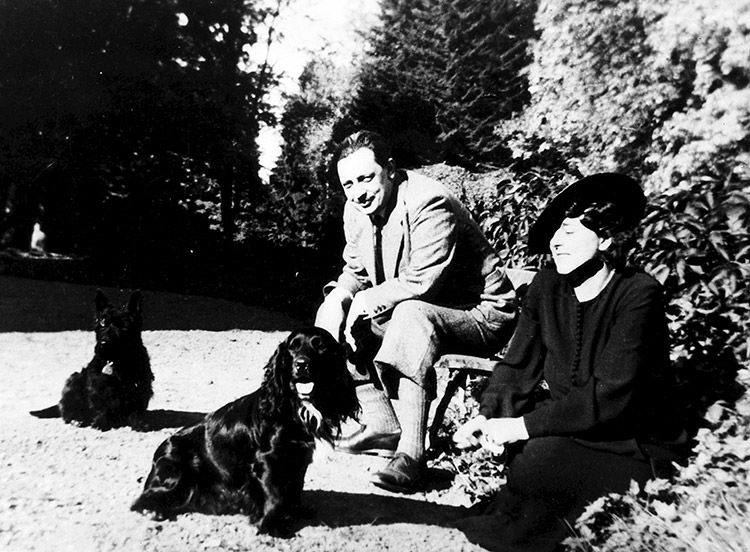
Giuseppe Tomasi di Lampedusa and his wife, Licy, 1940Whenever Giuseppe Tomasi di Lampedusa thought of the Sicily of his youth, it was always of ‘nature’s Sicily’. Though he had been born into aristocratic privilege and could recall many great events – such as the assassination of Umberto I (July 29th, 1900) and a visit from the ex-Empress Eugénie of France – his earliest memories were coloured by the magic of the Sicilian landscape. Even in the last months of his life he, like the characters in ‘Lighea’ (1956-7), would close his eyes, and recall
the scent of the rosemary in the Nèbrodi mountains, the taste of Melilli honey, the wavering harvest seen from Etna on a windy day … the gusts of perfume poured by the citrus groves onto Palermo at sunset … [and] the enchantment of … summer nights in sight of the Gulf of Castellammare, when the stars sparkle on the sleeping sea.
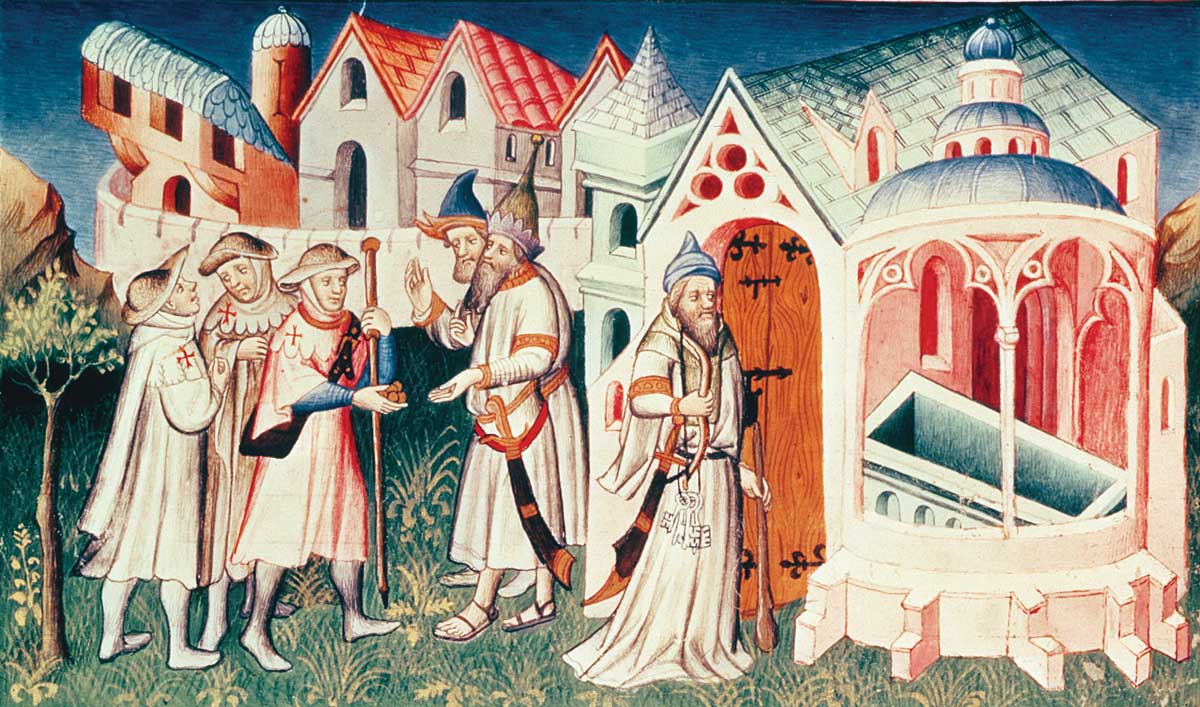
What do we miss when we describe a pilgrimage simply as travel to a destination – to Rome, or to Jerusalem? What makes a location worthy of pilgrimage? Medieval travellers explained: Chaucer’s pilgrims headed for Canterbury, ‘to seek the holy blissful martyr’, Thomas Becket. Bernhard von Breydenbach, a German clergyman who published a hefty pilgrimage account in 1486, summarised his trip to Sinai as ‘to the praiseworthy virgin and martyr St Katherine’. Though dead, these saints were as available for visiting as anyone living and, at the same time, their bones marked these places as holy. This is even starker in Katherine’s case: in life, she had no connection with Sinai. In death, her relics give it a distinct meaning, transcending even its biblical significance. Relics and medieval pilgrimage are thus intrinsically connected – but relics are much more than just holy bones and pilgrims’ relationships with them could be complicated.
Portrait of the Author as a Historian: Naguib Mahfouz
The ideas of a French philosopher provided the great Egyptian novelist with a way of assessing the good and the bad in his nation’s past.
Alexander Lee History Today Volume 67 Issue
1 January 2017
Throughout his life, Naguib Mahfouz felt caught between the timelessness of Egypt’s ancient past and the turbulence of its recent history. Even as a boy, he had felt it. Growing up in a devout Muslim household in one of Cairo’s oldest quarters, his childhood had been shaped by the unchanging obligations of faith and overshadowed by the legacy of the past. When he was not studying the Koran, he was playing in the streets of al-Gamaliya, not far from Saladin’s Citadel, or visiting the pyramids with his mother. But, though it was easy to believe that he was insulated from time’s flux, he could see that Egypt was changing around him. Over the preceding 40 years it had embarked on a process of rapid social and economic modernisation. Industrial development was spurred on by foreign investment, new roads and railways were constructed, educational reforms were implemented and scientific rationalism was exalted. Political changes were in the air, too. Though Egypt was notionally a British protectorate, liberal nationalism was on the rise and, before Mahfouz had turned eight, calls for independence had spilled over into violent revolution.
The 1988 Nobel prize-winner put modern Arabic literature on the map, says Robert McCrum
Robert McCrum Sunday 3 September 2006
IN THIS SEASON of literary prizes, it is good to reflect that without the Nobel Prize, the great Egyptian writer Naguib Mahfouz (1911-2006) might have remained unknown outside the Arab world. Even in his native city of Cairo, he was always cult reading. Named after the physician who delivered him on
What might it mean to “produce the novel of one’s generation”, (Paris Review) as Charlotte El Shabrawy proposes Naguib Mahfouz did with The Cairo Trilogy, a three thousand page book about Cairo life between the wars? By extension, we might wish to ask what it means to be a writer of one’s nation? It is to this latter question we want especially to attend as we will look at both the work and the social context to understand the significance of Mafhouz, a writer of immense importance not only in the context of Egyptian literature but modern Arab literature too – so much so that to say he produced the book of his generation can almost seem more like understatement rather than hyperbole. A question worth asking within this one is of a writer’s immense importance in relation to the people, with the public they are not only writing for but somehow speaking for also. The best a writer from the UK, the US, France or Italy can expect is that they have written the book of their generation, as Fitzgerald may well have done with The Great Gatsby, as Moravia may have done with The Time of Indifference, as Michel Houellebecq may have managed with Atomised or even Martin Amis with Money. We do not judge the quality of the books; we aim to say no more than that there will be little opportunity for the writer to hold such a significant place as the writer of their nation because of so many competing figures. Along with Fitzgerald, there was Hemingway and Faulkner, as well as Sherwood Anderson, John Dos Passos and Sinclair Lewis. Moravia’s contemporaries would include Italo Calvino, Primo Levi, Giorgio Bassani and Cesare Pavese; Amis’s Ian McEwan, Alisdair Gray, James Kelman, Salman Rushdie, Angela Carter and Kazuo Ishiguro. Enough listing of names, however. Our point is merely to say that an Egyptian writer has the advantage of making a name for him or herself in an uncrowded field as a writer from the US etc. cannot. This would, of course, be based on the assumption that the writer wants to make a name for themselves and, perhaps alas, many do. As Rushdie says, “my friend Martin Amis has a wonderful phrase: ‘What you hope to do is leave behind a shelf of books.’ You want to be able to walk into a bookstore and say, ‘From here to here, it’s me.’” Rushdie also reckons The “world is drowning in books; even if you read a great masterpiece every day, you’d never be able to read all the ones that exist already. So if you want to add a book to that mountain, it had better be necessary.” Rushdie is here offering more than a couple of egoistic remarks (Harvard Business Review), but he is also implicitly indicating as a British writer (albeit with an Indian background) he is writing in this crowded market. He would appear to be speaking for himself and trying to reach others. Mahfouz, however, is perhaps an example of the reverse: someone who is writing for others but trying to find himself. Rushdie writes to produce literature out of what is already abundantly there; Mahfouz in creating literature gives both a voice to the people and generates a literature out of that voice.
EMILIA CLARKE | PUT A RECORD ON, WATCH THE WORLD GROW
Jenny Cusak
May 10, 2019
“When I watch telly or a movie, it’s escapism. I just want to not think about my fucking life for a minute. I want to sit there, and be transported,” says Emilia Clarke, the 32-year-old English actor at the epicenter of one of the biggest, highest grossing, most culturally significant and revered shows on the planet: Game of Thrones.
Elsa Peretti has long, elegant bones, cropped dark hair and what she describes as khaki‐colored eyes. At 11 o'clock one recent morning, she was wearing Halston's long red cashmere dress and cardigan. Curled up on the sofa in the living room of her friend, Joe Eula, she applied eye make‐up as she talked, getting ready to go out to a business meeting.
Vargas Llosa at home in Madrid.Credit...Christopher Anderson/Magnum, for The New York Times
Mario Vargas Llosa
The Elder
Statesman
of Latin American Literature —
and a Writer
of Our Moment
Mario Vargas Llosa isn’t a household name among American readers. But at 81, he remains a literary and political colossus across the Spanish-speaking world, and his novels have never felt more relevant.
Shall we sit outside?” Mario Vargas Llosa asked me, gesturing through the library’s floor-to-ceiling windows at the brilliant September afternoon. The only Peruvian ever to have won a Nobel Prize, Vargas Llosa now lives in an eight-bedroom mansion on the fringes of Madrid, in the neighborhood known as Puerta de Hierro. When I arrived, a butler in a white jacket led me through the enormous two-story foyer, across gleaming black and white tiles, into a library lined with dark wood bookcases. A crystal ashtray sat next to silver dishes of chocolate and cigarettes. This imposing casona seemed like a fitting residence for the last living giant of a golden age of Latin American literature, a man who may well be the most politically important novelist of our time, but the house does not belong to Vargas Llosa. Over the library’s fireplace hung a portrait of its owner, Isabel Preysler, in a red dress.
Mario Vargas Llosa Illustration by Fernando Vicente
Keiko Fujimori would be ‘lesser of two evils’ as Peru president, says Nobel prize author
Novelist Mario Vargas Llosa says Fujimori’s opponent Pedro Castillo would undermine democracy
Sam Jones in Madrid
Sunday 18 April 2021
The Nobel prize-winning Peruvian author Mario Vargas Llosa has called on his compatriots to support Keiko Fujimori’s bid to become president, despite once running against her now jailed and disgraced father, Alberto, and spending years savaging the dynasty for its corrosive effects on Peru and its politics.
Vargas Llosa said the rightwing Fujimori – who faces Pedro Castillo, a far-left but socially conservative union leader and teacher in June’s presidential runoff – was “the lesser of two evils”. Castillo won 19.1% of the vote in last week’s first round, while Fujimori took 13.4%.
Writing in Spain’s El País newspaper, the novelist said Castillo would undermine democracy, ruin Peru’s economy and leave the country “with all the characteristics of a communist society”.
Faced with such an “abyss”, Vargas Llosa added, “Peruvians should vote for Keiko Fujimori because she represents the lesser of two evils and, if she’s in power, there are more possibilities of saving our democracy”.
Peru’s presidential candidate Keiko Fujimori speaks at a meeting in Lima. Photograph: Sebastian Castaneda/Reuters
But the writer, who was beaten by the then little-known Alberto Fujimori in Peru’s 1990 election, said Keiko Fujimori would have to promise to respect freedom of expression, obey presidential term limits, and rule out a pardon for her father’s former spy chief, Vladimiro Montesinos.
Keiko Fujimori has already said that, if elected, she intends to pardon her father, whose 10 years in office were mired in widespread corruption. She has twice lost presidential elections in 2011 and 2016.
Until now, Vargas Llosa had been a vehement critic of the Fujimoris. In 2010, he said Keiko Fujimori would be “a catastrophe for the country”, adding: “If the daughter of the dictator who has been jailed for being a criminal and a thief could possibly become the president of Peru, I will be one of the Peruvians who will strive to try to stop that happening using every possible legal means.”
The author, who has chronicled the uses and abuses of power in a career spanning seven decades, won the Nobel prize for literature in 2010. The committee said he had been recognised “for his trenchant images of the individual’s resistance, revolt and defeat”.
At the time, Vargas Llosa, who has Spanish citizenship and lives in Madrid, said he had always considered himself too liberal to stand a chance of winning the Nobel prize.
Saville made her name with giant paintings of fleshy, flawed bodies. She talks about being bankrolled by Charles Saatchi, how having children is changing her art – and the joy of late-night vacuuming
Emine Saner Monday 25 April 2016
I
t’s funny to think of Jenny Saville in her studio at 1am, music blaring, with vacuum cleaner in hand as she approaches one of her canvases and starts sucking great lines through her work. That it should be a Henry vacuum, the shamelessly anthropomorphised device, makes it even better: as he approaches Saville’s giant works, ready to wreak destruction, his expression will be one of eternal cheerfulness.
The seminal tale of Iannone's advocacy for sexual liberation.
“As much as Love and Eros have defined my work since its beginnings, so too has censorship or its shadow, accompanied it,” recalls Dorothy Iannone in her introduction to this facsimile publication of her legendary “The Story of Bern, [or] Showing Colors.”