 |
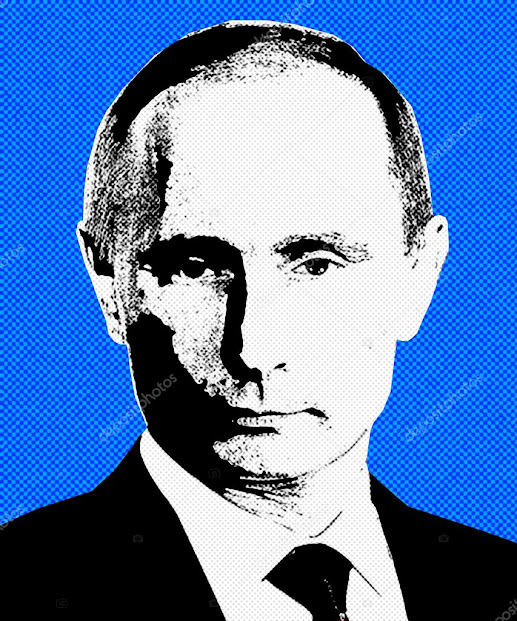
| Vladimir Putin |
The Accidental Autocrat
Vladimir Putin is not a democrat. Nor is he a czar like Alexander III, a paranoid like Stalin, or a religious nationalist like Dostoyevsky. But he is a little of all these—which is just what Russians seem to want
By Paul StarobinMarch 2005Like many Russians, Vladimir Vladimirovich Putin is a late riser. Sometimes he doesn't roll out of bed until 11:00 A.M. Russia's president lives with his wife, Lyudmila, and two teenage daughters, Maria and Katerina, about twenty-five miles west of the center of Moscow, at Novo Ogarevo, a country estate dotted with white birch and pine trees that was built in the late nineteenth century for a son of Czar Alexander II. The neighborhood is now a haven for wealthy Russians, who have constructed opulent and often tasteless dachas. Trim and fit for his fifty-two years, Putin usually starts his mornings with a vigorous workout in the compound's small indoor pool. (The butterfly stroke is a favorite.) The grounds contain stables, a recently restored Orthodox church, a vegetable plot, and a helipad, and Putin sometimes spends the day working at Novo Ogarevo, receiving visitors there rather than at the Kremlin. In any case, he seldom leaves for the office much before noon.
On days that he does go to the office, Putin speeds across the Moscow River in the back seat of his armored Mercedes Pullman and then cruises down the Novy Arbat, a garish boulevard bordered by neon-lit casinos, sushi bars, and ugly Soviet-era high-rise office buildings. Putin's motorcade deposits him inside the Kremlin walls, near his office in the Old Senate, a mustard-colored neoclassical building commissioned by Catherine the Great in the 1770s. Lenin made his headquarters here after the 1917 Revolution, when the Bolsheviks moved the capital to Moscow from imperial St. Petersburg.
Putin's office, in the northwest corner of the second floor, affords a view of Red Square. The office is spare and impersonal, with a somewhat antiquated feel. It has a clunky television and a bank of several dozen phones with heavy handsets—direct lines to the offices of Putin's Kremlin aides and other senior officials. Down the corridor, in a remodeled set of rooms that once contained Stalin's living quarters, is a small candlelit Orthodox chapel with icon paintings on the walls. Putin's immediate predecessor, Boris Yeltsin, had the chapel built but rarely entered it (according to what Putin told one visitor); Putin, in contrast, goes there very often. His private dining room, also on the second floor, contains a collection of bottles of Spanish red wine, one of his favorites. He likes to wash down his appetizers—what the Russians call zakuski, which are often the tastiest part of a meal—with a couple of shots of vodka, and to end his repast with a cognac from Dagestan, a province in Russia's troubled northern Caucasus. (Yeltsin's popularity, and Russia's image, suffered from his occasional displays of public drunkenness; Putin benefits from a reputation for sobriety and takes care to imbibe modestly in public.) He sometimes has dinner at the Kremlin, but more often heads back to Novo Ogarevo, where his work continues. Sipping cups of tea, Putin frequently works past midnight. An aide told me that "VVP," as his staff members sometimes refer to him, never hits the sack before 2:00 A.M.
The Russians have a saying: "Tyajela ti shapka manomakha"—"The crown of the czar is very heavy." On September 1 of last year a group of heavily armed men and women seized a middle school in Beslan, a railway-junction town in North Ossetia, a northern Caucasian province. They herded twelve hundred hostages, most of them children, into the gymnasium and wired it with explosives. The hostage-takers were Islamic militants; the operation was apparently organized by Shamil Basayev, a warlord whom Putin has likened to Osama bin Laden and who is leading a decade-old insurgency in the Caucasian republic of Chechnya and seeking to widen the rebellion to surrounding, largely Muslim provinces. (North Ossetia, an exception in the region, is predominantly Orthodox Christian.) The insurgents boasted of having made their way to the school by bribing the police at checkpoints along their route. "All your officials are mendacious and corrupt," one hostage recalls being told. Russian special forces surrounded the school. After a fifty-two-hour standoff a bomb exploded in the gym, perhaps accidentally, precipitating an hours-long firefight that killed some 330 of the hostages and wounded about 700.
On the day after the bloodbath Putin addressed the nation on television from the Kremlin. He seemed stripped raw; the brief clip I caught on the news was painful to watch. "It is a difficult and bitter task for me to speak," he began. "During these last few days each one of us suffered immensely." The thrust of his message was shame and embarrassment that Russians, "living in conditions formed after the disintegration of a huge, great country," had failed to pay enough attention to their defenses. "We demonstrated weakness, and the weak are beaten." His face was drained of color. I wondered if he was in shock.
But he soon rallied, unveiling in the days that followed a series of measures designed, he said, "to put right the system of power and management in the country." One measure was to end the popular election of regional governors and have the Kremlin appoint them instead, subject to confirmation by regional legislatures. In the West a chorus of critics decried a retreat to Russia's authoritarian past. Such criticism, though a bit sanctimonious, is reasonably well grounded: in the years since an ailing Yeltsin appointed him Russia's president, on December 31, 1999, Putin has in numerous ways tried to reassert Kremlin control over the country. (Voters ratified Yeltsin's choice in a March 2000 election, and elected Putin to a second four-year term in March of 2004.) But the West's concerns nevertheless struck me as out of touch with the anxieties and priorities of ordinary Russians. I lived and worked in Russia from 1999 to 2003, as the Moscow bureau chief of BusinessWeek, and most of the Russians I met (with the exception of those in the liberal intelligentsia) were supportive of the general direction of Putin's leadership. In fact, the majority of the criticism I heard came from people who felt that he was not authoritarian enough.
Putin is a difficult character study. An ex-KGB colonel, he is at times deliberately indistinct. And his secretive and tight-knit court tends to operate according to the old Russian village principle of "Iz izby soru ne vynesi"—literally, "Do not carry rubbish out of the hut." In the emerging school of Putinology, theories abound as to what makes him tick. Many analysts emphasize his intelligence training and his Soviet-era background. Alexander Rahr, the author of a biography of Putin calling him "the German in the Kremlin," sees him instead in the context of his KGB posting in Dresden and his affinity for German culture (he speaks German fluently). Others see a somewhat ambivalent Putin, split—as Russians often are—between an outward-facing Western orientation and an inward-looking Slavophilic one. The boisterous, red-faced Yeltsin—that bear of a man—more naturally fit the Western idea of a Russian leader. But Putin is as much a product of the Russian environment and heritage as Yeltsin was. In fact, Putin's Russianness, in the broadest sense, is the key to his character; in certain respects his rule is re-enacting distinctive Russian political traditions.
Understanding Putin requires exploring three core aspects of his political and personal character: the fighter, the Chekist, and the believer. These roughly correspond to Putin's instincts, his professional training and methods, and his religious and patriotic convictions. The parts may seem not to fit, but that is often the case with Russia's rulers. (After all, Stalin, the "Red Czar," was trained in a Georgian seminary.) Putin is best understood not as a divided character but as an integrated if complicated one: the Russian in the Kremlin.
In First Person (2000), a collection of interviews with and about him, Vladimir Putin mentions being beaten by stronger children in his rough-and-tumble neighborhood in Leningrad. It's not clear whether he was generally the instigator of the combat or responding to taunts and insults he felt should not go unchallenged. In any case, he resolved to fortify himself. "As soon as it became clear that my pugnacious nature was not going to keep me king of the courtyard or schoolgrounds," he said, "I decided to go into boxing." After getting his nose broken, he took up sambo, a Soviet combination of judo and wrestling, and finally settled on judo. He devoted himself to rigorous workouts and became a black belt and a city-wide champion. He fought like a "snow leopard," his coach once said, "determined to win at any cost."
The wonder is that he even made it into childhood. Two older brothers had died of illnesses, one in infancy and the other at age five. When Vladimir was born, on October 7, 1952, his mother was forty-one, and her prenatal health had no doubt been poor. A decade earlier, during the Nazi siege of Leningrad, there were mass deaths from starvation; "Mama herself was half dead," Putin recalls in First Person. His father, recuperating in a hospital from severe leg wounds caused by German shrapnel, gave her his food. After the war "Papa" went to work as a laborer at a train-car factory. He was given a room in a fifth-floor communal walk-up at 12 Baskov Lane, where Putin grew up, about a twenty-minute stroll from Nevsky Prospekt, the city's main thoroughfare. There were "hordes of rats" in the front entryway, which the young Putin chased with sticks. Once, he cornered one—only to have it rush at him. Frightened, Putin slammed the door shut "in its nose."
I recently came across an intriguing hypothesis about Putin's survival skills. Brenda L. Connors, a senior fellow in the strategic-research department of the Naval War College, in Newport, Rhode Island, is both a former State Department protocol and political-affairs officer and a onetime soloist with the Erick Hawkins Dance Company. Her field of study is a distinctive one: she is a certified "movement analyst." Because of her experience greeting Mikhail Gorbachev and other global figures and her study of modern dance, Connors became intrigued by how body movement—everything from a particular way of walking to hand gestures and facial expressions—constitutes a language for conveying not only emotion but also leadership styles and behavioral patterns. From close analysis of physical traits, captured on tape and examined with the help of experts in medicine, psychology, anthropology, and other fields, she has developed character profiles of a number of world leaders. Her work may sound esoteric, but it is endorsed by, among others, Andrew Marshall, the legendary director of "net assessment" in the Pentagon, and Leon Aron, a leading Russia specialist at the American Enterprise Institute, in Washington, and the author of an acclaimed biography of Yeltsin.
I paid a visit to Connors at her Newport office not long ago. We had chatted on the phone about her work on Putin—in particular about her detection of a striking irregularity in his gait—and I was eager to see her tapes and to hear more. After a tour of her lab we watched a tape she had made of Putin, compiled mostly from Russian television footage. The tape rolled to a shot of Putin at his first inauguration, in the spring of 2000, at the Andrei Hall of the Great Kremlin Palace. "Here's the picture," she said, as we watched Putin enter the hall and stride down a long red carpet. I saw what she meant only when she slowed the tape—and when she did, I was taken aback. Putin's left arm and leg were moving in an easy, natural rhythm. But his right arm, bent at the elbow, moved in a stiff way, as if jerked by the shoulder, and the right leg dragged, without absorbing his full weight. When she replayed the segment at normal speed, it was easy to pick up on the impediment, and then I had no trouble spotting it in other segments. All the momentum and energy in Putin's gait comes from the left side; it is as if the right side is just along for the ride. Even the right side of his torso seems frozen. When he is holding a pen, his right hand appears to have only an awkward, tenuous grasp on it.
Connors has shown footage of Putin's walk to a range of experts, including A. Thomas Pezzella, a cardiac-thoracic surgeon based in St. Louis; two orthopedic surgeons and a physical therapist at the naval hospital in Newport; and Bonnie Bainbridge Cohen, the founder of the School for Body-Mind Centering, in Amherst, Massachusetts, who is certified as something called a neurodevelopmental therapist. They offer a variety of conjectures: Putin could have had a stroke, perhaps suffered in utero; he may be afflicted with, as Pezzella speculates, an Erb's palsy, caused by a forceps tugging on his right shoulder at birth; he could have had polio as a child (polio was epidemic in Europe and western Russia after World War II). The stroke theory is consistent with what appears to be the loss of neural sensation in the fingers of his right hand. (Videotape of Putin at judo matches shows him using his fist, rather than a splayed hand, to push himself up off the mat.) Based on what she has seen and on her consultation with other experts, Connors doubts that Putin ever crawled as an infant; he seems to lack what is called contra-lateral movement and instead tends to move in a head-to-tail pattern, like a fish or a reptile.
Connors believes that Putin's infirmities "created a strong will that he survive and an impetus to balance and strengthen the body." She continues, "When we are unable to do something, really hard work becomes the way." His prowess at judo astonishes her: "He is like that ice skater who had a club foot and became an Olympic skater." Although her research sounds clinical, Connors empathizes with her subject. "It is really poignant to watch him on tape," she says of Putin. "This is a deep, old, profound loss that he has learned to cope with, magnificently." When I heard this, it was impossible for me not to think of another frail child possessed of a fierce will who turned to rigorous physical exercise and pugilism and grew up to be a head of state: Theodore Roosevelt.
Some of Connors's analytical ventures seem unconvincing. She suggests, for example, that Putin's instinct to make himself whole is mirrored in his imperative to keep Russia from breaking up—but any Russian leader would feel a similar sense of duty. The notion that Putin displays reptilian qualities, however, is not as odd as it may sound; even though ontogeny may not exactly recapitulate phylogeny, modern biology does recognize links between embryonic development and the evolutionary sequences. A characteristic of reptiles, Connors says, is that "they patrol their borders, and if an alien enters, lunge reflexively." That is as good a description of Putin's behavior in response to militants in the northern Caucasus as any political analyst has offered.
As the Chechen conflict illustrates, Putin is a ferocious, even pitiless fighter. One need not put stock in Connors's research to see that life does seem to have taught Putin that "the weak are beaten." Post-Soviet Russia's first Chechen war began in 1994, when Yeltsin invaded Chechnya to thwart a drive for sovereignty led by a radical separatist, Dzhokhar Dudayev. After nearly two years of savage fighting, and the assassination of Dudayev, a truce was reached and Russian forces withdrew. But the peace was tenuous. In August of 1999 Basayev, a guerrilla leader in the first war whose cause had taken on an increasingly Islamic cast, led an invasion of neighboring Dagestan with a force of Muslim soldiers that included Dagestani Wahhabis and fighters from Central Asia and the Middle East. Basayev's avowed goal was to create a united Chechen-Dagestani Islamic state.
Days after the invasion Yeltsin appointed Putin prime minister—and in so doing made him heir apparent to the presidency. At the time, Putin was serving as the head of the Federal Security Services, the successor agency to the KGB. Yeltsin was chronically sick and seldom had more than a few good working hours a day. Thus the Chechnya situation was in Putin's hands. Under his leadership Russian forces drove the insurgents out of Dagestan and back into Chechnya. In September, Moscow and several other Russian cities were racked by a wave of apartment bombings—apparently the work of Islamic terrorists, although no one claimed responsibility. An unnerved Russian public behind him, Putin responded with a brutal invasion of Chechnya. Using underworld slang to describe his intentions toward the guerrillas, he promised "mochit' v sortire"—to wipe them out (or, in the literal rendition of the slang, to "make wet" or "make bloody") in the toilet. Chechnya's capital, Grozny, was destroyed by Russian bombers. By the beginning of 2002 Russian forces had control of most of the territory (an area about the size of New Jersey) except for the insurgents' hideouts in mountainous areas, from which they could (and still can) launch small-scale attacks. When I visited Grozny in the fall of 2002, I found a mostly deserted city still in ruins.
Putin's judo training taught him to control his emotions, but when he is angry his outbursts can be not only crude but breathtakingly acerbic. At a press conference in Brussels in November of 2002 a reporter from Le Monde asked him about the use of anti-personnel landmines in Chechnya. When that drew an angry retort from Putin, the reporter followed up with an even more pointed question: "Don't you think that in trying to eradicate terrorism you're going to eradicate the civilian population in Chechnya?" Putin's reply: "If you want to become an Islamic radical and have a circumcision, I invite you to Moscow, because we are a multi-talented country and have specialists there. I recommend that you have the operation done in such a way that nothing else will grow there."
With the evolution of the Chechen conflict into what is essentially a blood feud, Putin is quite right to take it personally. The insurgents have posted a $20 million bounty on his head, and a likely goal is the kidnapping of his teenage daughters. The Russian Orthodox and Islamic cultures are both patriarchal. As a man, and as Russia's symbolic father, Putin is supposed to protect women and children. His tormentors were triumphant when he acknowledged that he had "suffered immensely" from the Beslan ordeal. They had pierced his shield and made him seem womanish. "Putin screamed like a stuck pig," Basayev crowed in a statement posted on a Web site.
Critics in Russia and in the West argue that Putin's harsh policies—not least the indiscriminate destruction of Grozny—invite terrorist retribution against Russian innocents. But he does not see things that way—and even his critics must acknowledge that he has bottled up the Chechen rebellion and the broader territorial aspirations of Basayev's band. Nor is his skepticism about a negotiated settlement unreasonable—Basayev, after all, used the truce agreed to by Yeltsin in 1996 to reorganize and launch a fresh assault. Shortly after the Beslan incident Putin met with a group of Russia watchers from the United States and Europe at Novo Ogarevo. Among them was Alexander Rahr, the Putin biographer. I asked Rahr to describe the president's mindset after Beslan. "Very combative," Rahr said. "He is like a sportsman … He is in the stage of recovering, of building strength, of building muscles, of focusing on the enemy."
In 1932 James Abbe, an American photographer, went to Moscow and managed to talk his way into a rare photo session with Stalin. "My years in the cinema had taught me that eyes are at least 75 percent of any portrait," Abbe later wrote. Stalin, Abbe found, made an extraordinary impression: "As soon as I saw the whites of his eyes I recognized that Stalin has the surgical ability to remove a man's thoughts from his head and sort them out on the table."
Putin, too, has the kind of eyes that give those who meet his gaze the unsettling feeling of being seen through (his are a metallic blue, Stalin's were a feline yellow). Putin's KGB colleagues were struck by "eyes that 'don't let you lie,'" according to a dossier prepared by a Moscow political researcher. In studying Putin on tape Connors has been impressed by both the intensity of his gaze and his listening skills—she calls him "an evaluator extraordinaire." These are strong assets for a Chekist—one who served in a Soviet security agency. (The first Soviet security agency was the Cheka, an acronym for Chrezvychainaya Komissiya, or All-Russian Extraordinary Commission.)
The notion of joining the KGB began as a boyhood dream. Putin was under the influence, he told the compilers of First Person, of spy novels and movies: "What amazed me most of all was how one man's effort could achieve what whole armies could not. One spy could decide the fate of thousands of people." In ninth grade he went to the office of the KGB directorate in Leningrad and declared his interest in a job. He was told that the KGB didn't take people who came in on their own initiative, and that he needed some higher civilian education, such as law school. "From that moment on," Putin said, "I began to prepare for the law faculty of Leningrad University." In his fourth year at the school he was invited to join "the agencies." After graduation, in 1975, he embarked on a sixteen-year career with the KGB, mostly in the foreign-intelligence section. He left the security service after the botched 1991 coup, led by KGB hardliners, that tried to preserve the Soviet Union. The plotters had a "noble" intention, he would later say, but their method was wrong.
Putin the Chekist is a model of cool calculation, elusiveness, and calibratedtactics. He wears casual cynicism like an old cloak—insisting, for example, on his fealty to freedom of the press while re-establishing Kremlin control over the nation's television networks, which during the Yeltsin years were taken over by billionaire oligarchs with their own political agendas. His Chekist mentality seems to reveal less an active antipathy toward democracy than an impatience with its inherent untidiness.
One of the happier results of Putin's vocational schooling is an attention to organization and detail. Rabbi Beryl Lazar, a leader of the Russian Jewish community, told me a tale of his efficiency-mindedness. A few years ago, at a regular meeting with Putin in the Kremlin, Lazar brought up the difficulty faced by a young Moscow woman who had removed an anti-Semitic sign from a roadside, only to trigger a rigged explosive that severely burned and nearly blinded her. The woman was getting hassled by her neighbors, Lazar told Putin, and wished to relocate to an apartment in another neighborhood. Lazar wasn't sure that Putin was paying close attention. He left Putin's office but was stopped downstairs at a guard's station and told to go back. An aide said Putin had rung up Moscow's mayor, Yuri Luzhkov, to talk about the apartment, and that Luzhkov was waiting to meet with Lazar. It may be that Putin handles such tasks himself because he lacks confidence that they will otherwise get done. "He gets extremely frustrated with the incompetence of the state," the rabbi told me.
One would expect a fellow of Putin's trade to be suspicious, and indeed, even those kindly disposed toward him say that he can be excessively mistrustful. Perhaps only half a dozen people have his full confidence, and nearly all of them he has known for years. That group is something like a clan; the Moscow political analyst Olga Kryshtanovskaya told me that Putin has in effect re-created a Soviet-style politburo. But even in his lair, among team members, Putin tends to withhold. In meetings he "never commits himself," one Moscow insider who has observed Putin in private group settings told me. His two closest Kremlin aides are ex-KGB. One, Igor Sechin, a squeaky-voiced veteran of the Soviet Union's campaign to aid Communist proxies in Angola, guards Putin's paper flow, among other duties. The other, Viktor Ivanov, a veteran of the failed Afghanistan venture in the 1980s, has a portfolio that includes vetting government appointments and advising on Chechnya policy. Both are known for their animus toward Western-style Russian liberals, with whom Putin himself has been intermittently friendly. Many Kremlin watchers believe that Putin's smartest aide is Vladislav Surkov, the one person in the inner circle whom Putin didn't know before becoming president. Surkov, who handles political operations and relations with the Duma, is half Chechen but second to none in his hard line on Chechnya issues.
Perhaps the best illustration of Putin's repertoire of Chekist skills can be seen in his dealings with the oligarchs, who infiltrated Yeltsin's Kremlin, made fortunes in rigged privatization auctions, and seemed to regard the state as their private preserve. On joining the Kremlin staff in 1996 Putin worked among the oligarchs and their protectors in the Kremlin—a group, including one of Yeltsin's daughters, known as the Family. He could never have moved up the ladder, and surely not to the position of prime minister, without the Family's blessing, and indeed, he came to be accepted as one of them. So when he got the nod as president, they figured all would be business as usual. "He won't try to arrest or screw the oligarchs," Mikhail Fridman, a billionaire with oil and banking interests, told me at the time.
But as soon became clear, Putin viewed the oligarchs much the way ordinary Russians did: as gangsters with an insidious grip on the levers of political power. He proceeded to break their hold, using every pressure point possible. His first target was Vladimir Gusinsky, a media baron who had helped bankroll Yeltsin's 1996 election and whose financial empire had debts guaranteed by a state-controlled company. Gusinsky was arrested and jailed on charges of embezzling state property. He signed away his business interests in return for being allowed to go into exile in the West. Putin's next target, the flamboyant Boris Berezovsky, who had served in Yeltsin's administration and actively assisted in Putin's rise, fled the country rather than face a likely embezzlement charge.
After the departures of Berezovsky and Gusinsky, Putin and the oligarchs established an unwritten pact: the remaining magnates could keep their fortunes and their freedom as long as they stayed out of the political arena. But the oil baron Mikhail Khodorkovsky tested Putin by declaring his intention of bankrolling opposition political parties. Putin sent a warning shot: the arrest of one of Khodorkovsky's partners. But Khodorkovsky persisted, and in the pre-dawn hours one fall morning in 2003 he was apprehended in his private airplane, which was on a refueling stop in Siberia. He is jailed in Moscow, while his trial for fraud and tax evasion drags on. Khodorkovsky's company, Yukos, which tax authorities slapped with billions of dollars in claims, is being broken up, with the most valuable pieces turned over to a state-owned company. The Chekists play to win.
In the West the Khodorkovsky affair sparked indignation over Putin's manipulation of law-enforcement bodies and the courts. But in Russia, although nobody believes that Putin is observing the rule of law, most ordinary citizens and members of the political elite (again, aside from liberals) support his maneuvers. "Misha violated the rules he agreed to before," Mikhail Margelov, a former KGB official who is now a member of the Duma, says of Khodorkovsky. (The liberal political leader and banker Boris Nemtsov characterizes Putin as typically Russian in his adherence to po ponyatiyam—"underground agreements"—rather than law.) Even many expatriate Western investors in Russia are behind Putin. William Browder, a former Wall Street investment banker who manages Hermitage Capital, a Moscow-based investment fund, frames the matter this way: "We have two choices. We can have the rule of the mafia or an authoritarian president." However rough his methods, Putin's tenure has been accompanied by steady economic growth and the creation of an entrepreneurial middle class in Moscow, St. Petersburg, and other large cities.
There is not so much an emerging rule of law in Russia as an emerging rule of Putin. Thus one abiding question is whether Putin can resist the bounty at his feet. Cynicism is pervasive: the general feeling is that it would take a Herculean effort on Putin's part not to grab some choice morsels. "The jury is out" on whether Putin is driven principally by patriotic or selfish motives, a well-informed U.S. official told me recently. I find that Russians tend to think Putin may be both selfish and patriotic, on the logic that it is okay for a leader to take a cut for himself as long as the first, best cut goes to the country. Putin has certainly upgraded himself sartorially, but nobody has detected any lavish displays of wealth. His salary is about 150,000 rubles—or $5,000—a month.
The Sretensky Monastery, a twenty-minute walk north from the Kremlin on Bolshaya Lubyanka street, was founded in 1397 on sacred national soil: the spot where Muscovites had met a delegation of Orthodox priests from the Russian city of Vladimir, who had brought with them an icon to save Moscow from the infidel warrior Tamerlane. Legend has it that at that very moment Tamerlane had a vision of the Holy Mother, who ordered him to spare Moscow. He fled. In 1925 the monastery was commandeered by Chekists, who razed churches, massacred believers, and built a dormitory for officers. In 1995 the Sretensky Monastery was reopened; these days it is thriving, with a new bell tower, a renovated chapel, a busy bookstore, a memorial to the martyred victims of the Cheka, and a seminary. On a drizzly Wednesday morning I strolled through the gates and past a garden of ferns and red roses, and knocked on the door of Father Tikhon, the monastery's abbot and Putin's personal confessor.
Father Tikhon would not confirm this relationship; church rules don't allow him to say whether a babushka is confessing to him, never mind Russia's president. But the person confessing is free to acknowledge the tie, and the Kremlin did so on the president's behalf. Putin, who was secretly baptized by his mother (she didn't want his father to know), met Father Tikhon well before becoming president, according to the Kremlin. They now get together wherever and whenever Putin wishes. For the Russian Orthodox, the confession is an elaborate, intimate institution; the obligation is very much on the side of the confessing party, and there is great reverence for the confessor. "One must consult him on all matters, receive him lovingly, and bow to him," says Domostroi, a sixteenth-century manual that offers directions for daily life based on Orthodox principles.
I approached my meeting with Father Tikhon with curiosity but also a bit of apprehension. From what I had been able to glean, he has a reputation for being an opportunistic church politician; he has close connections not only to Putin but also to other powerful government officials who have backgrounds in the KGB. He is also reported to hold crudely nationalistic views. In the summer of 1998 the British writer Victoria Clark interviewed him for her book Why Angels Fall, about Orthodoxy in Eastern Europe and Russia. Clark's book describes Father Tikhon as a "sharp-eyed, wiry young monk with a straggling flame-red beard," and quotes him as asserting that the gulags were set up by Jews.
When I met Father Tikhon, now approaching fifty, his beard had turned from flame-red to rust-brown, but he still looked slim and youthful. He wore a black frock and a crucifix on a chain that hung down to his abdomen; his long hair was tied neatly in a ponytail. We sat close together at a round wooden table on which he deposited two cell phones. Against my expectations, I found him disarming and easy to talk to.
I tried to draw him out about Putin by suggesting that the leader of Russia had a spiritual role to play. He gave me a quizzical look and asked what I meant. The leader's job, I replied, is not simply to defend the state, the territory of Russia, but to be a kind of custodian for the idea of Russia and a protector of the national soul. That last thought brought forth a stream of words. "You feel it exactly right," Father Tikhon told me. "The importance of the first person [he used the phrase 'pervoye litso,' which translates as 'first face' or 'first image'] is overwhelming, much more important than in America." And this, he went on, can be for good or ill. Under Czar Alexander III—"a very strong czar" who famously said that Russia had no allies but its army and navy—Russia was formidable, on a par with the European powers. Lenin, in contrast, "was a man of no principles, a monster, [who] turned Russia into a monster." As for Yeltsin, he was frivolous, "not sober," and during his tenure Russia became wobbly and threatened to break into pieces.
So what, I asked, is Putin's image and example for Russia? "Work," Father Tikhon began. "Work is part and parcel of his personality." Putin sets a "very important" moral example "for all of us, and for Russia in general," Father Tikhon said, by being the first true Christian head of state since the last czar, Nicholas II. (Orthodox leaders view Yeltsin as an atheist, his occasional appearances in church notwithstanding.) And Putin, he continued, stands for national strength: he knows, like Alexander III, that Russia can count only on itself. "Russia has no allies but its weakened army and weakened navy," Father Tikhon said with a wan smile. He praised Putin for taking a necessary stand against Islamic extremism in the northern Caucasus, and suggested that Western society—"weak and decadent," especially in Europe—is not up to the challenge presented by an "aggressive" Islamic culture bent on "world domination."
Just about the only time he bridled in the course of our two-hour talk was when I said that many in the West were coming to view Putin as a traitor to the cause of democracy in Russia. I cited Putin's decision to have regional governors appointed by the Kremlin. "It is a step forward, it is progress," Father Tikhon responded with vehemence. "We should distinguish between two things, democracy and chaos … These governors are like czars—their power is overwhelming, and with the level of corruption in society, many governors abuse their power." (Many Russians would second this point.) "I am surprised by Western leaders who viewed Yeltsin as a bulwark of democracy and demand going back to his time." He offered an analogy: just as a diver cannot be brought too quickly out of the depths, Russia must gradually adapt to a new form of society.
I had heard from several sources that Putin's inner circle generally views Orthodox belief as a positive attribute for members of the government. I asked Father Tikhon specifically about a Gogolesque tale I had heard regarding Viktor Ivanov, Putin's trusted Kremlin aide who vets candidates for appointments to the federal ministries. Someone had told me, I said, that one such candidate was brought to Ivanov in the Kremlin, who asked him his view of the Orthodox Church. The fellow said he had a favorable opinion. If that's so, Ivanov replied, then would he mind being baptized? The fellow said he was willing. Ivanov thereupon called Father Tikhon, got in a car with the candidate, and motored off to have the man baptized. I put it to Father Tikhon: a true story? He offered an enigmatic smile. "Not only members of the government are going through baptism, but a great many others," he replied, adding that adult-size baptismal fonts had become common in churches.
Before I left, I asked Father Tikhon whether he really believed that the Jews had set up the gulag camps. "Everyone set them up," he replied. "But if we look objectively at historical facts, we can see that in the leadership of the gulags were a lot of Jews. After the Revolution the role of Jews in Russia was very special. No one can deny it."
Why would Putin be willing to associate himself, at risk to his reputation, with someone who holds such views? It is sometimes said in Moscow that Putin harbors animosity toward Muslims—but not that he is an anti-Semite. Beryl Lazar notes that Russia under Putin has opened its doors to thousands of Jews who left for Israel during Soviet times but are now petitioning to return.
I'm convinced that Putin's religious convictions are genuine. I know strict Orthodox observers who have minutely studied his behavior in church, where his body language could betray him as ill-informed or a casual believer, and he passes their test. As for the vision of Russia that Father Tikhon sketches, a return to what might be called Patriotic Orthodoxy (like the philosophy that guided Russia in pre-revolutionary times), I don't think that is where Putin started out when he took over as president, but I do think it is where he is headed. The notion of a Chekist's coming of age in a culture of enforced atheism and then turning to Orthodoxy as a pillar of his rule is not as odd as it may sound. According to the memoirs of the KGB officer Filipp Bobkov, during Putin's time in the KGB there was a wide-ranging internal discussion "about how destructive the nihilist attitude toward religion was for the country."
I suspect Putin recognizes that Soviet ideology has little appeal to Russians, other than to a dying class of pensioners. But he seems to believe that Patriotic Orthodoxy, which—like Soviet ideology—is compatible with a highly centralized state and a strongman ruler, can take root and help morally regenerate the nation. There is also a psychological compatibility: the basic tenet of Patriotic Orthodoxy—that only Russia can help Russia—is akin to his personal conviction that strength comes from within, that he can count only on himself.
Putin is trying to increase his prestige by repairing a fracture in the Orthodox Church that occurred eight decades ago, when a group of anti-Soviet exiles established their own wing, the Orthodox Church Abroad. Putin and Father Tikhon have met with leaders of this group in New York, and a deal is pending that would reunite the church under the umbrella of the Moscow patriarchate, which already ministers to believers in former Soviet republics such as Latvia and Ukraine. This would be a historic triumph for Putin in his ambition to be seen as a consolidator of the Russian nation. Meanwhile, he is jettisoning some of Russia's Soviet baggage in favor of old-Russia symbols. In place of the national holiday that honored the October 1917 Revolution he has established a "Day of National Unity" on the anniversary of a seventeenth-century uprising led by a Moscow prince against Polish invaders who were trying to force Roman Catholicism on Russians.
Father Tikhon told me that Russia is in the throes of a religious revival. Perhaps so. In Moscow last summer crowds in a mile-long line waited for more than three hours to enter the Church of Christ the Savior, near Red Square, to view an especially revered Orthodox icon, the Virgin of Tikhvin, which had been returned after six decades of safekeeping in the United States. For many Russians who came of age in the Soviet period, a turn to Orthodoxy is unlikely; the youth of Russia, however, are another story. A pro-Putin youth group organized by the Kremlin, Idushie Vmeste ("Moving Together"), represents a kind of model for how Patriotic Orthodoxy aims to renew Russia. The group is against abortion (Russia has one of the highest rates in the world) and informs recruits about the Orthodox tradition of having large families. Members help at orphanages and hand out small crosses on street corners. The group's recommended-reading list steers clear of edgy post-Soviet writers and instead features reliable old masters such as Pasternak and Chekhov. I dropped in on the group's Moscow headquarters on a visit last spring, and had a pleasant chat with the chief librarian, twenty-year-old Irina Shevalkina. "The Russian national idea is Orthodox, and it is very beautiful," she told me.
The liberal newsweekly Itogi, in a recent interview with Valentina Matvienko, a Putin ally who is the governor of St. Petersburg, asked whether it wouldn't be better for Russia to have a parliamentary republic, headed by a prime minister and with no president. "No, this doesn't fit us," Matvienko replied. "We are not ready for such an experiment. The Russian mentality needs a baron, a czar, a president … In one word, a boss." When I read that comment, I thought of Stalin, who once said very much the same thing: "The people need a czar whom they can worship and for whom they can live and work."
The idea that a "wild" Russia can be tamed only by a strongman may be a myth, but it is a resonant one, arising in part from Orthodox teaching but also from the "times of trouble" that have periodically plagued this vast land over the centuries. Putin filled a vacuum created by the abrupt Soviet collapse. It could easily have been someone else—he might, in this sense, be called the Accidental Autocrat. No matter: the liberal intelligentsia has come to despise him. "Nothing could be worse than Putin," Anna Politkovskaya, an award-winning Russian investigative journalist, recently told The Independent of London. But surely the complaint is as much about Russia as about Putin. For more than two hundred years Russian liberals have been driven to exasperation by Russia's failure to become a second edition of, say, France. And in post-Soviet Russia the liberals have failed to marshal broad popular support for their agenda. Liberalism has become indelibly identified with the trauma and economic crime of the Yeltsin years. The liberal leader Irina Khakamada told me that the following for "decentralized power" and other Western-style liberal policies is no more than 10 or 15 percent of the population. Liberalism's "brief spring" is over, she said.
There are, in any case, possibilities "worse than Putin"—further toward the chauvinistic, authoritarian extreme. Competition comes, for instance, from the Rodina ("Motherland") Party, which was created by the Kremlin to siphon votes away from the Communists but has become a mini-monster in its own right. I paid a visit to one of the party's ideologues, Mikhail Delyagin, a thirty-six-year-old economist. He criticized Putin as a "bourgeois person" who spends too much time on downhill-skiing vacations in Austria. In contrast there was Stalin, "who had Spartan tastes, who wore cheap, inexpensive clothes and darned socks." Still more noxious is the writer Eduard Limonov, who heads the National Bolshevik Party and holds up Slobodan Milosevic as a model leader.
In any event, there is probably little the West can do to persuade Putin to change his course. "Each country looks for the most effective way to organize state power," he said in a November interview on Russian television before leaving for Santiago, where global leaders were gathering for the Asia-Pacific Economic Cooperation summit. In a tête-à-têe on the sidelines of the summit President George W. Bush raised concerns about a concentration of power in the Kremlin. Putin responded with a history lesson on the complexities of political development in Russia. To be a Russian, or at least to be a proud, historically attuned Russian like Putin, is to feel both a certain suspicion of and a certain resentment toward the West. The suspicion, a legacy of the Cold War that is reinforced by Putin's Chekist and Orthodox mindsets, is that the West (especially America) aims to keep Russia weak. Putin's clumsy intervention in Ukraine's presidential election late last year, on behalf of a pro-Russian candidate, stemmed in part from a belief that the United States and Europe were trying to pull toward their side a country traditionally under Russian economic and political influence. His outlook may strike Westerners as paranoid—but consider the perspective from Moscow. Since the end of the Cold War three former Soviet republics (Latvia, Lithuania, and Estonia) have joined NATO, and the United States has put military bases in two others (Uzbekistan and Kyrgyzstan). Ukraine itself is a future candidate for NATO. "Putin perceives that the West is ganging up on him," Michael McFaul, a veteran Russia watcher at the Washington office of the Hoover Institution, told me.
Russia's traditional resentment of the West is more intense and complicated, because it is mixed with envy of higher living standards. As the Russians see things, they turned back Napoleon and turned back Hitler, too, after absorbing his most savage blows—and now they are battling it out on the front lines of the war against Islamic barbarism. And yet the West, Russians observe, persists in instructing them on how to behave. Russia's long-standing sense of unappreciated sacrifice puts a chip on its shoulder but is also, in an odd fashion, a source of patriotic pride. Fate, the Russians tend to think, has dealt them history's heavy work. "Oh, don't speak to me of Austria," the salon hostess Anna Pavlovna says at the outset of War and Peace, with Napoleon on the march through Italy. "Russia alone must save Europe."
Russia's constitution limits a president to two four-year terms of office. A much debated question in Moscow is whether Putin will depart at the end of his second term, in March of 2008, or seek to extend his reign through a change in the constitution or some other expedient. Insider opinion is split. Some think he will leave on schedule, with a hand-off to a designated successor, who will face the voters in an election in which the state-run media are all on one side. The public in general, somewhat apathetically, is neither clamoring for him to stay nor bellowing at him to leave. That could change to Putin's detriment if perceptions of corruption in his regime mount, or if the pro-Western "Orange Revolution" in Ukraine gives hope to what has up to now been a weak opposition movement in Russia.
Putin himself, cryptic as ever, is keeping all options open. I asked Brenda Connors, at the Naval War College, for her prediction. If the task-minded Putin thinks his work is not done, she told me, he might try to extend his rule. But she also believes that he is bound to discover that the exercise of the will, which has brought him so far, pays diminishing returns. That sounds right to me. Russia tends to be cruel to its would-be masters. Its abiding harshness creates tough and determined types like Putin, but the country nearly always thwarts them in the end.
The writer is a contributing editor to National Journal and the author of After America: Narratives for the Next Global Age.
THE ATLANTIC


%2B(1).jpg)


