
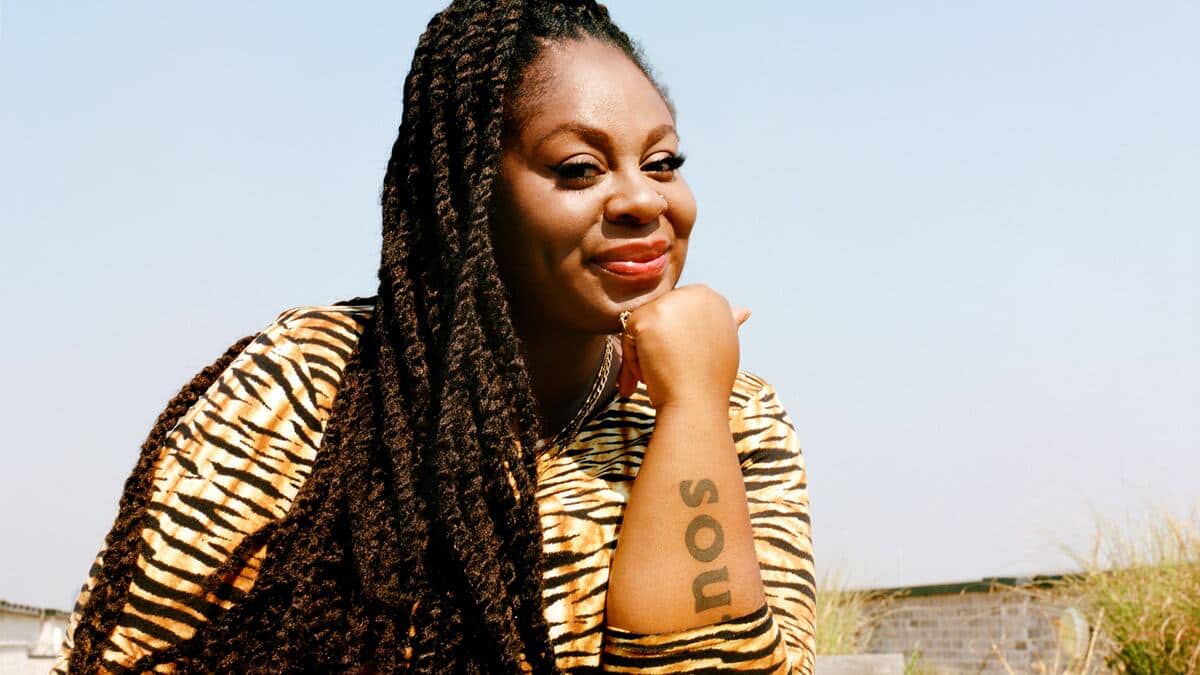
 Candice Carty-Williams
INTERVIEW
Candice Carty-Williams: ‘People feel very attached to Queenie’
One of the questions Candice Carty-Williams has spent the past few years batting away is whether she is Queenie. It is perhaps inevitable: her bestselling debut novel followed Queenie Jenkins, a twentysomething south London journalist navigating heartbreak, racism, terrible men and an escalating sense that her life was slipping beyond her control. Like Carty-Williams, Queenie is south London-born, Black and works in media.
It is a slightly predictable question, and one I avoid asking when we meet at her bright pink office in Peckham. But sitting opposite the 36-year-old, I can’t help but understand why it persists. Much like her most famous creation, she is instantly likable: warm, quick-witted and completely devoid of the self-seriousness that can sometimes come with literary success. She is disarmingly casual – her hair is wrapped up and under-eye patches are busy depuffing her face.
“I find Queenie quite annoying actually,” Carty-Williams laughs, putting to bed the allegations before I get the chance to ask. “I think a lot of people do. But I quite like that.”
It has been seven years since Queenie exploded on to the British publishing scene. Released in 2019, the novel arrived carrying the tagline “the Black Bridget Jones” – a phrase coined by Carty-Williams herself. At the time, she was working in marketing at a publishing house and understood better than most how difficult it could be to make a novel by a Black woman cut through.
It worked beyond anyone’s wildest expectations. Queenie became a phenomenon: it sold more than half a million copies, won book of the year at the British book awards in 2020 – making Carty-Williams the first Black writer ever to win – and was adapted for television by Channel 4.
If there is any secret to its success, Carty-Williams thinks it lies in relatability. “I think she’s just a drama queen,” she says. “And people are very interested in that.”
Nine years after first signing her book deal, Carty-Williams is returning to Queenie with a sequel. The new novel revisits its heroine in her early 30s, older and supposedly wiser, though still very much capable of detonating her own life. She is trapped in a situationship with a noncommittal guy she refers to as “TFL man”, so named because he is one of the tube network’s “fiiiine” employees, while also trying to rekindle things with Frank, the love of her life. The familiar ensemble of friends – “the Corgis” – also return. At work, she is investigating Black maternal healthcare, only to discover troubling information about her own fertility.
Queenie is not polished, noble or aspirational. She makes bad choices repeatedly, has terrible sex, and sends regrettable messages
For a long time, Carty-Williams resisted writing a sequel. “When I first signed my book deal in 2017, my editor said, ‘We’ll do a two-book deal for you,’” she tells me. “But I didn’t want to do a sequel right away, because I think people would expect it. My editor told me I should flex a little bit and try something else.”
Instead, she wrote People Person, her 2022 novel about a sprawling family of half-siblings and their wayward Jamaican patriarch. “That was fun,” she says. “But I did rewrite it twice because I’m not very good at landing on things.”
Returning to Queenie only made sense for Carty-Williams if she could find a story that “blows her life up again”. But, she says, because “a lot of Black women read her, I had to be careful about what I’m putting her through, because I’m putting them through it too. People feel very attached to her. So I was like, ‘Let’s come back when she’s in her 30s.’”
One of the triumphs of Queenie was that it refused a politics of Black exceptionalism. Queenie is not polished, nor noble or aspirational. She makes bad choices repeatedly, has terrible sex, and sends regrettable messages. She is self-sabotaging and self-involved. Readers either adore her or cannot stand her. The same traits are true of Queenie 2.0, and Carty-Williams seems delighted by both reactions.
“I like having fun with my readers,” she says. “And I don’t want to write boring people – you’re alone writing a novel for years. You need to entertain yourself.
“No one has it all together,” she continues. “I don’t, and I’m 36. I’m OK to go on the journey with her.”
The book also tackles motherhood and Black maternal healthcare head on. Interestingly, while Queenie longs for motherhood, Carty-Williams increasingly suspects she does not want children herself. “I think in my 20s I assumed I would,” she says. Laughing, she adds: “Now? I just don’t think I can be bothered.”
Marriage, similarly, while a north star for Queenie, holds little appeal. “It would feel like a trap,” she says insouciantly. “I like being a singular person.”
The themes in the book were partly sparked by Carty-Williams’s own experiences undergoing fertility testing after a time of prolonged stress during which she had her period for weeks. Everything was fine, she says, but the doctors immediately began discussing IVF and egg freezing. “And I was like: whoa, whoa, whoa. I don’t even know if I want children.”
Researching Black maternal healthcare for the novel proved both shocking and infuriating. She mentions the campaign group Five X More, named after the 2019 statistic that Black women in the UK were five times more likely to die during pregnancy, childbirth or the postnatal period than white women (the gap has narrowed since then, but there is still a nearly threefold disparity).
In the course of her investigation, Queenie encounters a Black woman who is told she is “big and strong” and can “handle the pain”, even as she is losing a worrying amount of blood; another whose midwife attributes a difficult labour to her “African pelvis”; and a third who is denied pain relief because there is supposedly no gas and air available on the ward, despite watching other women receive it.
“When Queenie’s researching in the book, that’s basically my research,” Carty-Williams says. “I put it in almost verbatim because I was so astounded. There’s basically no training around women of different backgrounds,” she continues. “A lot of this stuff is avoidable.”
Carty-Williams grew up in south London, her childhood defined by constant movement. “We were just renting and in council houses constantly,” she tells me. “I’ve lived in, like, 20 houses.”
Her mother is of Jamaican–Indian heritage, while her Jamaican father arrived in Britain at 16 and worked as a taxi driver. He met her mother when he picked her up from shifts as a hospital receptionist. It later emerged he already had three children with a different woman. Books were few and far between at home. “But I lived in the school library,” she says. “I’d read, like, a book a day.” Her mother, who is dyslexic and dyspraxic, stopped reading aloud to her when she was very young. “Then I just took over,” she says. “I became obsessed.”
Writing, however, did not initially feel like a viable future. “I wanted to do English literature at university, but teachers told me I wouldn’t get the grades,” she says. “They suggested media studies instead.” In the end she achieved two As and a B. “They predicted me three Cs,” she says. “I was in all the lower sets because I talked too much. Apparently, I had behavioural issues. A lot of it was that I was just bored.”
After getting in touch with a friend of a friend who worked in publishing, she secured an internship at a Brixton publisher, and eventually a role in the marketing department at 4th Estate. It was there, in her early 20s, that she first began to understand the shape of the industry – and to notice what was missing.
“I was, like: there isn’t anything written by anyone like me,” she says. That frustration would eventually become the 4thWrite prize, a scheme for unpublished Black, Asian and minority ethnic writers run in collaboration with the Guardian. “The prize is one of my babies,” she says. “Everyone was really receptive to it. But I also recognised things weren’t moving fast enough,” she continues. “So I was, like: OK, I’ll just write the book myself.”


No comments:
Post a Comment