Thursday, July 26, 2012

Brad Leithauser / Cheever's Art of the Devastating Phrase


John Cheever

CHEEVER’S ART OF THE DEVASTATING PHRASE
Posted by Brad Leithauser
The New Yorker, May 31, 2012

cheever-hundred.jpg
Photograph: Bettmann/Corbis.
Had he lived, John Cheever would have turned a hundred this week. A lifelong admirer of his work, I find myself again returning to one of my least favorite Cheever stories, “Boy in Rome.” Delivered through the unconvincing voice of a teen-age American boy living with his vapid expatriate mother in a Roman villa, it unfolds an overlong yarn of a wastrel writer, a bogus princess named Tavola-Calda (or “Hot Table”—an Italian term for cafeteria or diner), and the bungled smuggling of a Renaissance painting. Still, I don’t think I’ve ever read a story by Cheever that failed to offer authentic rewards, large or small, and a paragraph toward the close of “Boy in Rome” haunts me.
The paragraph is a modest island, surrounded on either side by a sea of white space and wholly contained within the gently curving shores of a pair of parentheses. “But I am not a boy in Rome,” it begins. A new voice has circumspectly, wistfully intruded on the young man’s narration. The speaker identifies himself as “a grown man in the old prison and river town of Ossining, swatting hornets on this autumn afternoon with a rolled-up newspaper.” This is no authorial surrogate; this is John Cheever, stepping off the page to introduce himself.
This literary device may sound potentially tiresome—some self-conscious preening, a bit of postmodern flummery. But those who love Cheever’s fiction will recognize here a familiar, defining trait: he was forever emerging from two dimensions into three, from the rectangle of the page into the cubic complexities of actual life. Time and again, an unexpected “I” surfaces in his stories, as the perspective forcibly shifts to accommodate the presence of a sly and witty observer. He was restless, and felt the page confined him. As that parenthetical insertion of himself into “Boy in Rome” suggests, he was impatient with plot. In his stories, the trappings of narrative tend to fall away, and in “Boy in Rome” we’re left with some artfully turned self-inquiries: “Why, never having received from my parents anything but affection and understanding, should I invent a grotesque old man, a foreign grave, and a foolish mother? What is the incurable loneliness that makes me want to pose as a fatherless child in a cold wind…?”
Cheever relished the creation of chaos—especially the placing of keenly idiosyncratic characters into situations of ramifying turmoil—but his denouements tended to be startlingly abrupt, especially in some of his best-known stories (“The Housebreaker of Shady Hill,” “The Angel of the Bridge,” “The Country Husband”). He was temperamentally far better suited to presenting problems than to portraying solutions—one of many reasons why his short fiction is more gratifying than his novels, where the larger form often requires that consequences be responsibly, painstakingly chronicled.
The more you read Cheever, the more you feel his best work is often less about plot than about language—about poetry in the broadest sense. You feel, too, the vivid immediacy, and the turbulent, benign influence of a number of authors—particularly Hemingway, Fitzgerald, Flaubert, and James. All four were masterly stylists, and at the end of the day Cheever’s prime accomplishment may be stylistic: the construction of something readily identifiable as a Cheever paragraph, a Cheever sentence, even a Cheever phrase.
He achieved a style that was surpassingly nuanced and nimble, and devoted it mostly to the happy marrying of lyrical and absurd comical effects. His style was a complex amalgam—a blending of heterogeneous attitudes, a rapid shifting (sometimes too rapid) of viewpoint and diction. His vocabulary was surpassingly resourceful. Of all the wonderful American short-story writers of the twentieth century, Cheever strikes me as the most dependable supplier of unlikely, often unflashy, and yet devastatingly apt word choices. Here are a few examples (italics my own) of his embedding into a sentence a word or phrase that any poet might envy: “a gentle and excursive mountain shower”; “I have cheerfully praised the evening sky hanging beyond the disheveled and expatriated palm trees on Doheny Boulevard”; “where one heard in the sounds of a summer rain the prehistoric promises of love, peacefulness, and beauty”; “her countenance was long, vacant, and weakly lighted”; “[The dog] was as black as coal, with a long, alert, intelligent, rakehell face”; “There is something universal about being stood up in a city restaurant between one and two—a spiritual no-man’s-land, whose blasted trees, entrenchments and ratholes we all share, disarmed by the gullibility of our hearts.” Many of his best effects are quiet and slow to emerge. In what may be his greatest story, “The Swimmer,” the protagonist, Neddy Merrill, contemplates a neighbor in swim trunks who has undergone extensive abdominal surgery: “Gone was his navel, and what, Neddy thought, would the roving hand, bed-checking one’s gifts at 3 A.M., make of a belly with no navel, no link to birth, this breach in the succession.” It’s a sufficiently spooky moment that a reader may not readily appreciate how strange and wonderful a verb-choice is “bed-checking,” how unexpected and ravagingly sad is “gifts.”
A proper study of Cheever’s style could fill a book, but for now I’ll limit myself to two further traits. Cheever loved to pair adjectives in productive and surprising ways. He was especially fond of constructions in which at least one term, and sometimes both, carried a danger of high-flown orotundity: “the irresistible and titanic voice of life itself”; “an inestimable and wayward passion”; “something preposterous and ascendant”; “an air of adamant and fetid sweetness”; “stubborn and irreducible proof of man’s determination to excel”; “some marvelous and obdurate part of myself.” We learn that one character’s “sense of these aspects of privacy was scrupulous and immutable” and that another’s “imagination remained resilient and fertile.” The high-flown adjective pair was for Cheever what the incongruous adjective triplet (“orange, bland, ambassadorial”) was to Robert Lowell: an opportunity to record a legible signature in an extremely confined space. You come upon a sentence like this—“The world lies before us like a bewildering and stupendous dream”—and sense that these cadences, this particular lovely note of vaunting applause, had to come from Cheever’s hand.
Still more Cheeveresque, if possible, is his use of the phrase “one of those.” When I first began to read him, in high school in the Midwest in the early seventies, I found the phrase an off-putting tic. When a character informed me that he met his wife “at one of those big cotillions at the Waldorf,” I bristled: why assume your reader knows anything of the Waldorf? Cheever seemed to be constantly presuming his readers were East Coast sophisticates—probably with ancestral ties to the Mayflower crew. It took me a while to see that this assumption of a sort of clubby exclusivity was, as so often the case with Cheever, a kind of delicate, straight-faced joke: “one of those large cars that cabinet ministers enjoy in socialist countries”; “one of those flat, cheap cakes with candles that are ordered to celebrate the retirement of the building maintenance assistant”; “one of those Italian restaurants that remind us all of how truly new is our settlement on this continent”; “one of those small, old Italians who always wear their hats tipped forward over their brows as if they were, even in the rain, enduring the glare of an equinoctial sun”; “one of those trains that move slowly across the face of New Jersey, bringing back to the city hundreds of people, like the victims of an immense and strenuous picnic.” One story begins, “It was one of those midsummer Sundays when everyone sits around saying, ‘I drank too much last night,’” and another begins, “It was one of those rainy late afternoons when the toy department of Woolworth’s on Fifth Avenue is full of women who appear to have been taken in adultery….”
Cheever liked to pose as a scion of an old New England élite, though he lacked both the family lineage (his father was a failed shoe salesman) and the privileged education (he never attended college) to support the role convincingly. The posturing may have fulfilled fantasies of a wordless, unimpeachable social acceptability, but by and large Cheever regarded with a level head his minor vanities and self-humoring mendacities. You rarely feel in Cheever, as you do in his contemporary and fellow New Yorker fiction stalwart John O’Hara, that a raw hunger for admission into an idealized upper class distorts his ability to treat his well-heeled characters with the calm skepticism they deserve. Cheever liked to play at being a Cabot or a Lowell—a Boston Brahmin—but this charade was delivered with a wink, much as he’s winking when inviting us, by way of a “one of those,” into a privileged world of shared values and experiences.
In all of Cheever’s writing, the most exorbitant use of the phrase must be the opening of “The Brigadier and the Golf Widow,” the title story of his fifth collection: “I would not want to be one of those writers who begin each morning by exclaiming, ‘O Gogol, O Chekhov, O Thackeray and Dickens, what would you have made of a bomb shelter ornamented with four plaster-of-Paris ducks, a birdbath, and three composition gnomes with long beards and red mobcabs?’” One of those writers? In the history of the world, only one writer has ever opened a story quite like that. The opening sentence says, in effect, “I would not want to be one of those writers like John Cheever”—even as his antic artistic zeal, his sparkling-eyed glee in the gambol of his wit, reflects off of every word.


Wednesday, July 25, 2012

John Cheever / Master of the short story


John Cheever: Master of the short story

John Cheever, the American writer called 'the Chekhov of the suburbs', was born 100 years ago today.

American writer John Cheever was born on 27 May 1912 and died on June 18, 1982
Image 1 of 4
American writer John Cheever was born on 27 May 1912 and died on June 18, 1982 


John Cheever's centenary is being celebrated in America today with the publication of a new edition of his collected stories.
Cheever, who was born on May 27th in Quincy, Massachusetts, was one of the greatest short story writers of the 20th century and was described by Elmore Leonard as "the Chekhov of the suburbs."
Cheever was the son of a failed shoe salesman - the writer's mother ran a "cluttered gift shop" - and he understood the ambition and inferiority complexes of post-war American life. He could be funny about the "crushing boredom" of life in the suburbs with the "stupid, depressed and uncreative" people who populated their tidy houses but he was more than just an angry critic of torpid rural life. As his contemporary John Updike put it: "John Cheever was often labelled as a writer about suburbia; but many people have written about suburbia. Only Cheever was able to make an archetypal place out of it."
Cheever deftly captured seething middle-class envy and his observations are as relevant as ever. In his story The Housebreaker of Shady Hill, for example, a man eaten up with jealousy about his ostentatious neighbours sneaks at night into the bedroom of a sleeping couple and steals cash from the husband’s wallet.


He was a great fabulist in his tales, too, including the haunting The Swimmer (made into a film in 1966 starring Burt Lancaster) with its deft opening. "It was one of those midsummer Sundays when everyone sits around saying, 'I drank too much last night.'"
Booze was a theme of his work and his life. His brother Fred was a drinker and Cheever himself became an alcoholic. He called himself a "solitary drunkard", easing his insecurities about his work, and the panic attacks that sometimes came, with copious amounts of gin, which he described morosely as "the only way out". "There is a terrible sameness to the euphoria of alcohol," he once wrote.
He nearly drank himself to death but pulled himself together with a stint at Manhattan’s Smither’s Alcoholism Treatment and Training Centre. After getting himself sober, he completed a brilliant novel calledFalconer, about his time teaching in Sing Sing prison.
Cheever also lived a secret life. He was bisexual and, while married to Mary and raising his children, had numerous flings with men and women. Years after his death on 18th June 1982, at the age of 70, he was featured in an episode of Seinfeld in which George Costanza inadvertently reveals a girlfriend's father's homosexual affair with Cheever. Incidentally, the character Don Draper in Mad Men, a Cheever-type man, lives in Ossining, where the author lived for so long.
His male characters often harbour secrets that eat away at them, and Cheever projected on to them the futility of trying to seem happy while suppressing unhappiness.
One of his most original stories was The Enormous Radio, a satire about Jim and Irene Westcott, who lived in a 12th floor apartment in New York. Cheever wrote sardonically of a couple who "went to the theatre on an average of 10.3 times a year" and whose crackling old radio suddenly and mysteriously allows Irene to eavesdrop on her neighbours. "She overheard demonstrations of indigestion, carnal love, abysmal vanity, faith and despair." Cheever slowly and clinically reveals that the Westcott's are as corrupt as the lives they have invaded.
Blake Bailey wrote a brilliant biography of Cheever - all about his difficult, sometimes embittered relationship with his wife, and his complicated love for his children Ben, Susan and Federico. Although there were bouts of self-pity, there was also great humour and self-deprecation. Cheever called himself "a fat slob enjoying an extraordinary run of luck". His novels - Falconer, Bullet Park and The Wapshot series - are all good yet Cheever believed his own tales of the "deterioration of the middle-aged businessman" did not stand up against the "big, wild, rowdy" world of his friend Saul Bellow's novels.
The recipient of the National Medal for Literature from the American Academy of Arts and Letters was too hard on himself. Many of his short stories are magnificent as he sought to "make sense" of his own life and failings while yearning for "a life of impossible simplicity". And while he could pull apart lives and reveal the nastiness at their core, he was also a man of great humanity, as his letter and journals make clear. My favourite entry from his journals is the following, written after a walk near his home in Northern Westchester:
"Someone had written something in the fresh snow. Who could it have been - the milkman, a boy, some stranger? And what would he have written - an obscenity, a calumny? What the stranger had written was: Hello World!"
Happy centenary John Cheever, from the Surrey suburbs. It's time for a gin and tonic.


Tuesday, July 24, 2012

John Cheever / The Swimmer / Burt Lancaster


Burt Lancaster in
THE SWIMMER 
by John Cheever


The Swimmer: movie based on a book published in 1964 by John Cheever. 

Plot: Neddy Merrill (Lancaster) in his comfortable life decides on one summer day to get home via the pools of the county. His energy is at first high at the beginning of the journey. Friends run into him and wish him well on the swim. The interesting part is mid-way through Neddy's trip of the swimming experience things take an odd turn. An entire swimming trip takes one day but things are starting to seem unclear and blury on the aspect of time itself, is it really just a day? We see when Neddy starts the swimming trip it is mid-summer then nearing the end it is fall. Even more odd by the time Neddy gets home has even more time slipped by.....you will have to see if it is just in one's imagination or reality! A very good and underated film of Burt Lancaster's.


The Swimmer (1968) Columbia Pictures
Directed By: Frank Perry
Starring: Burt Lancaster, Janet Landgard, Marge Champion & Kim Hunter

Burt Lancaster hits the screen with a bolt of personal drama as "The Swimmer"


Read also
THE SWIMMER by JOHN CHEEVER


Monday, July 23, 2012

John Cheever / The Swimmer


John Cheever

It was one of those midsummer Sundays when everyone sits around saying, "I dranktoo much last night." You might have heard it whispered by the parishioners leaving church, heard it from the lips of the priest himself, struggling with his cassock in thevestiarium, heard it from the golf links and the tennis courts, heard it from the wildlife preserve where the leader of the Audubon group was suffering from a terrible hangover. "I drank too much," said Donald Westerhazy. "We all drank too much," said Lucinda Merrill. "It must have been the wine," said Helen Westerhazy. "I drank too much of that claret."

   This was at the edge of the Westerhazys' pool. The pool, fed by an artesian well with a high iron content, was a pale shade of green. It was a fine day. In the west there was a massive stand of cumulus cloud so like a city seen from a distance—from the bow of an approaching ship—that it might have had a name. Lisbon. Hackensack. The sun was hot. Neddy Merrill sat by the green water, one hand in it, one around a glass of gin. He was a slender man—he seemed to have the especial slenderness of youth—and while he was far from young he had slid down his banister that morning and given the bronze backside of Aphrodite on the hall table a smack, as he jogged toward the smell of coffee in his dining room. He might have been compared to a summer's day, particularly the last hours of one, and while he lacked a tennis racket or a sail bag the impression was definitely one of youth, sport, and clement weather. He had been swimming and now he was breathing deeply, stertorously as if he could gulp into his lungs the components of that moment, the heat of the sun, the intenseness of his pleasure. It all seemed to flow into his chest. His own house stood in Bullet Park, eight miles to the south, where his four beautiful daughters would have had their lunch and might be playing tennis. Then it occurred to him that by taking a dogleg to the southwest he could reach his home by water.

His life was not confining and the delight he took in this observation could not be explained by its suggestion of escape. He seemed to see, with a cartographer's eye, that string of swimming pools, that quasi-subterranean stream that curved across the county. He had made a discovery, a contribution to modern geography; he would name the stream Lucinda after his wife. He was not a practical joker nor was he a fool but he was determinedly original and had a vague and modest idea of himself as a legendary figure. The day was beautiful and it seemed to him that a long swim might enlarge and celebrate its beauty.

He took off a sweater that was hung over his shoulders and dove in. He had an inexplicable contempt for men who did not hurl themselves into pools. He swam a choppy crawl, breathing either with every stroke or every fourth stroke and counting somewhere well in the back of his mind the one-two one-two of a flutter kick. It was not a serviceable stroke for long distances but the domestication of swimming had saddled the sport with some customs and in his part of the world a crawl was customary. To be embraced and sustained by the light green water was less a pleasure, it seemed, than the resumption of a natural condition, and he would have liked to swim without trunks, but this was not possible, considering his project. He hoisted himself up on the far curb—he never used the ladder—and started across the lawn. When Lucinda asked where he was going he said he was going to swim home.

The only maps and charts he had to go by were remembered or imaginary but these were clear enough. First there were the Grahams, the Hammers, the Lears, the Howlands, and the Crosscups. He would cross Ditmar Street to the Bunkers and come, after a short portage, to the Levys, the Welchers, and the public pool in Lancaster. Then there were the Hallorans, the Sachses, the Biswangers, Shirley Adams, the Gilmartins, and the Clydes. The day was lovely, and that he lived in a world so generously supplied with water seemed like a clemency, a beneficence. His heart was high and he ran across the grass. Making his way home by an uncommon route gave him the feeling that he was a pilgrim, an explorer, a man with a destiny, and he knew that he would find friends all along the way; friends would line the banks of the Lucinda River.

He went through a hedge that separated the Westerhazys' land from the Grahams', walked under some flowering apple trees, passed the shed that housed their pump and filter, and came out at the Grahams' pool. "Why, Neddy," Mrs. Graham said, "what a marvelous surprise. I've been trying to get you on the phone all morning. Here, let me get you a drink." He saw then, like any explorer, that the hospitable customs and traditions of the natives would have to be handled with diplomacy if he was ever going to reach his destination. He did not want to mystify or seem rude to the Grahams nor did he have the time to linger there. He swam the length of their pool and joined them in the sun and was rescued, a few minutes later, by the arrival of two carloads of friends from Connecticut. During the uproarious reunions he was able to slip away. He went down by the front of the Grahams' house, stepped over a thorny hedge, and crossed a vacant lot to the Hammers'. Mrs. Hammer, looking up from her roses, saw him swim by although she wasn't quite sure who it was. The Lears heard him splashing past the open windows of their living room. The Howlands and the Crosscups were away. After leaving the Howlands' he crossed Ditmar Street and started for the Bunkers', where he could hear, even at that distance, the noise of a party.

The water refracted the sound of voices and laughter and seemed to suspend it in midair. The Bunkers' pool was on a rise and he climbed some stairs to a terrace where twenty-five or thirty men and women were drinking. The only person in the water was Rusty Towers, who floated there on a rubber raft. Oh, how bonny and lush were the banks of the Lucinda River! Prosperous men and women gathered by the sapphire-colored waters while caterer's men in white coats passed them cold gin. Overhead a red de Haviland trainer was circling around and around and around in the sky with something like the glee of a child in a swing. Ned felt a passing affection for the scene, a tenderness for the gathering, as if it was something he might touch. In the distance he heard thunder. As soon as Enid Bunker saw him she began to scream: "Oh, look who's here! What a marvelous surprise! When Lucinda said that you couldn't come I thought I'd die." She made her way to him through the crowd, and when they had finished kissing she led him to the bar, a progress that was slowed by the fact that he stopped to kiss eight or ten other women and shake the hands of as many men. A smiling bartender he had seen at a hundred parties gave him a gin and tonic and he stood by the bar for a moment, anxious not to get stuck in any conversation that would delay his voyage. When he seemed about to be surrounded he dove in and swam close to the side to avoid colliding with Rusty's raft. At the far end of the pool he bypassed the Tomlinsons with a broad smile and jogged up the garden path. The gravel cut his feet but this was the only unpleasantness. The party was confined to the pool, and as he went toward the house he heard the brilliant, watery sound of voices fade, heard the noise of a radio from the Bunkers' kitchen, where someone was listening to a ball game. Sunday afternoon. He made his way through the parked cars and down the grassy border of their driveway to Alewives Lane. He did not want to be seen on the road in his bathing trunks but there was no traffic and he made the short distance to the Levys' driveway, marked with a PRIVATE PROPERTY sign and a green tube for The New York Times. All the doors and windows of the big house were open but there were no signs of life; not even a dog barked. He went around the side of the house to the pool and saw that the Levys had only recently left. Glasses and bottles and dishes of nuts were on a table at the deep end, where there was a bathhouse or gazebo, hung with Japanese lanterns. After swimming the pool he got himself a glass and poured a drink. It was his fourth or fifth drink and he had swum nearly half the length of the Lucinda River. He felt tired, clean, and pleased at that moment to be alone; pleased with everything.
  
 It would storm. The stand of cumulus cloud—that city—had risen and darkened, and while he sat there he heard the percussiveness of thunder again. The de Haviland trainer was still circling overhead and it seemed to Ned that he could almost hear the pilot laugh with pleasure in the afternoon; but when there was another peal of thunder he took off for home. A train whistle blew and he wondered what time it had gotten to be. Four? Five? He thought of the provincial station at that hour, where a waiter, his tuxedo concealed by a raincoat, a dwarf with some flowers wrapped in newspaper, and a woman who had been crying would be waiting for the local. It was suddenly growing dark; it was that moment when the pin-headed birds seem to organize their song into some acute and knowledgeable recognition of the storm's approach. Then there was a fine noise of rushing water from the crown of an oak at his back, as if a spigot there had been turned. Then the noise of fountains came from the crowns of all the tall trees. Why did he love storms, what was the meaning of his excitement when the door sprang open and the rain wind fled rudely up the stairs, why had the simple task, of shutting the windows of an old house seemed fitting and urgent, why did the first watery notes of a storm wind have for him the unmistakable sound of good news, cheer, glad tidings? Then there was an explosion, a smell of cordite, and rain lashed the Japanese lanterns that Mrs. Levy had bought in Kyoto the year before last, or was it the year before that?

   He stayed in the Levys' gazebo until the storm had passed. The rain had cooled the air and he shivered. The force of the wind had stripped a maple of its red and yellow leaves and scattered them over the grass and the water. Since it was midsummer the tree must be blighted, and yet he felt a peculiar sadness at this sign of autumn. He braced his shoulders, emptied his glass, and started for the Welchers' pool. This meant crossing the Lindleys' riding ring and he was surprised to find it overgrown with grass and all the jumps dismantled. He wondered if the Lindleys had sold their horses or gone away for the summer and put them out to board. He seemed to remember having heard something about the Lindleys and their horses but the memory was unclear. On he went, barefoot through the wet grass, to the Welchers', where he found their pool was dry.

   This breach in his chain of water disappointed him absurdly, and he felt like some explorer who seeks a torrential headwater and finds a dead stream. He was disappointed and mystified. It was common enough to go away for the summer but no one ever drained his pool. The Welchers had definitely gone away. The pool furniture was folded, stacked, and covered with a tarpaulin. The bathhouse was locked. All the windows of the house were shut, and when he went around to the driveway in front he saw a FOR SALE sign nailed to a tree. When had he last heard from the Welchers—when, that is, had he and Lucinda last regretted an invitation to dine with them? It seemed only a week or so ago. Was his memory failing or had he so disciplined it in the repression of unpleasant facts that he had damaged his sense of the truth? Then in the distance he heard the sound of a tennis game. This cheered him, cleared away all his apprehensions and let him regard the overcast sky and the cold air with indifference. This was the day that Neddy Merrill swam across the county. That was the day! He started off then for his most difficult portage.

Had you gone for a Sunday afternoon ride that day you might have seen him, close to naked, standing on the shoulders of Route 424, waiting for a chance to cross. You might have wondered if he was the victim of foul play, had his car broken down, or was he merely a fool. Standing barefoot in the deposits of the highway—beer cans, rags, and blowout patches—exposed to all kinds of ridicule, he seemed pitiful. He had known when he started that this was a part of his journey—it had been on his maps—but confronted with the lines of traffic, worming through the summery light, he found himself unprepared. He was laughed at, jeered at, a beer can was thrown at him, and he had no dignity or humor to bring to the situation. He could have gone back, back to the Westerhazys', where Lucinda would still be sitting in the sun. He had signed nothing, vowed nothing, pledged nothing, not even to himself. Why, believing as he did, that all human obduracy was susceptible to common sense, was he unable to turn back? Why was he determined to complete his journey even if it meant putting his life in danger? At what point had this prank, this joke, this piece of horseplay become serious? He could not go back, he could not even recall with any clearness the green water at the Westerhazys', the sense of inhaling the day's components, the friendly and relaxed voices saying that they had drunk too much. In the space of an hour, more or less, be had covered a distance that made his return impossible.

An old man, tooling down the highway at fifteen miles an hour, let him get to the middle of the road, where there was a grass divider. Here he was exposed to the ridicule of the northbound traffic, but after ten or fifteen minutes he was able to cross. From here he had only a short walk to the Recreation Center at the edge of the village of Lancaster, where there were some handball courts and a public pool.
  
 The effect of the water on voices, the illusion of brilliance and suspense, was the same here as it had been at the Bunkers' but the sounds here were louder, harsher, and more shrill, and as soon as he entered the crowded enclosure he was confronted with regimentation. "ALL SWIMMERS MUST TAKE A SHOWER BEFORE USING THE POOL. ALL SWIMMERS MUST USE THE FOOTBATH, ALL SWIMMERS MUST WEAR THEIR IDENTIFICATION DISKS." He took a shower, washed his feet in a cloudy and bitter solution, and made his way to the edge of the water. It stank of chlorine and looked to him like a sink. A pair of lifeguards in a pair of towers blew police whistles at what seemed to be regular intervals and abused the swimmers through a public address system. Neddy remembered the sapphire water at the Bunkers' with longing and thought that he might contaminate himself—damage his own prosperousness and charm—by swimming in this murk, but he reminded himself that be was an explorer, a pilgrim, and that this was merely a stagnant bend in the Lucinda River. He dove, scowling with distaste, into the chlorine and had to swim with his head above water to avoid collisions, but even so he was bumped into, splashed, and jostled. When he got to the shallow end both lifeguards were shouting at him: "Hey, you, you without the identification disk, get outa the water." He did, but they had no way of pursuing him and he went through the reek of suntan oil, and chlorine out through the hurricane fence and passed the handball courts. By crossing the road he entered the wooded part of the Halloran estate. The woods were not cleared and the footing was treacherous and difficult until he reached the lawn and the clipped beech hedge that encircled their pool.

The Hallorans were friends, an elderly couple of enormous wealth who seemed to bask in the suspicion that they might be Communists. They were zealous reformers but they were not Communists, and yet when they were accused, as they sometimes were, of subversion, it seemed to gratify and excite them. Their beech hedge was yellow and he guessed this had been blighted like the Levys' maple. He called hullo, hullo, to warn the Hallorans of his approach, to palliate his invasion of their privacy. The Hallorans, for reasons that had never been explained to him, did not wear bathing suits. No explanations were in order, really. Their nakedness was a detail in their uncompromising zeal for reform and he stepped politely out of his trunks before he went through the opening in the hedge.

Mrs. Halloran, a stout woman with white hair and a serene face, was reading theTimes. Mr. Halloran was taking beech leaves out of the water with a scoop. They seemed not surprised or displeased to see him. Their pool was perhaps the oldest in the country, a fieldstone rectangle, fed by a brook. It had no filter or pump and its waters were the opaque gold of the stream.

"I'm swimming across the county," Ned said.

"Why, I didn't know one could," exclaimed Mrs. Halloran.

"Well, I've made it from the Westerhazys'," Ned said. "That must be about four miles."

He left his trunks at the deep end, walked to the shallow end, and swam this stretch. As he was pulling himself out of the water he heard Mrs. Halloran say, "We've beenterribly sorry to bear about all your misfortunes, Neddy."

"My misfortunes?" Ned asked. "I don't know what you mean."

"Why, we heard that you'd sold the house and that your poor children . . . "

"I don't recall having sold the house," Ned said, "and the girls are at home."

"Yes," Mrs. Halloran sighed. "Yes . . . " Her voice filled the air with an unseasonable melancholy and Ned spoke briskly. "Thank you for the swim."

"Well, have a nice trip," said Mrs. Halloran.

Beyond the hedge he pulled on his trunks and fastened them. They were loose and he wondered if, during the space of an afternoon, he could have lost some weight. He was cold and he was tired and the naked Hallorans and their dark water had depressed him. The swim was too much for his strength but how could he have guessed this, sliding down the banister that morning and sitting in the Westerhazys' sun? His arms were lame. His legs felt rubbery and ached at the joints. The worst of it was the cold in his bones and the feeling that he might never be warm again. Leaves were falling down around him and he smelled wood smoke on the wind. Who would be burning wood at this time of year?

He needed a drink. Whiskey would warm him, pick him up, carry him through the last of his journey, refresh his feeling that it was original and valorous to swim across the county. Channel swimmers took brandy. He needed a stimulant. He crossed the lawn in front of the Hallorans' house and went down a little path to where they had built a house, for their only daughter, Helen, and her husband, Eric Sachs. The Sachses' pool was small and he found Helen and her husband there.

"Oh, Neddy, " Helen said. "Did you lunch at Mother's?"

"Not really, " Ned said. "I did stop to see your parents." This seemed to be explanation enough. "I'm terribly sorry to break in on you like this but I've taken a chill and I wonder if you'd give me a drink."

"Why, I'd love to," Helen said, "but there hasn't been anything in this house to drink since Eric's operation. That was three years ago."

Was he losing his memory, had his gift for concealing painful facts let him forget that he had sold his house, that his children were in trouble, and that his friend had been ill? His eyes slipped from Eric's face to his abdomen, where be saw three pale, sutured scars, two of them at least a foot long. Gone was his navel, and what, Neddy thought, would the roving hand, bed-checking one's gifts at 3 a.m., make of a belly with no navel, no link to birth, this breach in the succession?

"I'm sure you can get a drink at the Biswangers'," Helen said. "They're having an enormous do. You can hear it from here. Listen!"

She raised her head and from across the road, the lawns, the gardens, the woods, the fields, he heard again the brilliant noise of voices over water. "Well, I'll get wet," he said, still feeling that he had no freedom of choice about his means of travel. He dove into the Sachses' cold water and, gasping, close to drowning, made his way from one end of the pool to the other. "Lucinda and I want terribly to see you," he said over his shoulder, his face set toward the Biswangers'. "We're sorry it's been so long and we'll call you very soon."

He crossed some fields to the Biswangers' and the sounds of revelry there. They would be honored to give him a drink, they would be happy to give him a drink. The Biswangers invited him and Lucinda for dinner four times a year, six weeks in advance. They were always rebuffed and yet they continued to send out their invitations, unwilling to comprehend the rigid and undemocratic realities of their society. They were the sort of people who discussed the price of things at cocktails, exchanged market tips during dinner, and after dinner told dirty stories to mixed company. They did not belong to Neddy's set—they were not even on Lucinda's Christmas-card list. He went toward their pool with feelings of indifference, charity, and some unease, since it seemed to be getting dark and these were the longest days of the year. The party when he joined it was noisy and large. Grace Biswanger was the kind of hostess who asked the optometrist, the veterinarian, the real-estate dealer, and the dentist. No one was swimming and the twilight, reflected on the water of the pool, had a wintry gleam. There was a bar and he started for this. When Grace Biswanger saw him she came toward him, not affectionately as he had every right to expect, but bellicosely.

"Why, this party has everything," she said loudly, "including a gate crasher."

She could not deal him a social blow—there was no question about this and he did not flinch. "As a gate crasher," he asked politely, "do I rate a drink?"

"Suit yourself," she said. "You don't seem to pay much attention to invitations."

She turned her back on him and joined some guests, and he went to the bar and ordered a whiskey. The bartender served him but be served him rudely. His was a world in which the caterer's men kept the social score, and to be rebuffed by a part-time barkeep meant that be had suffered some loss of social esteem. Or perhaps the man was new and uninformed. Then he heard Grace at his back say: "They went for broke overnight—nothing but income—and he showed up drunk one Sunday and asked us to loan him five thousand dollars. . . ." She was always talking about money. It was worse than eating your peas off a knife. He dove into the pool, swam its length and went away.

The next pool on his list, the last but two, belonged to his old mistress, Shirley Adams. If he had suffered any injuries at the Biswangers' they would be cured here. Love—sexual roughhouse in fact—was the supreme elixir, the pain killer, the brightly colored pill that would put the spring back into his step, the joy of life in his heart. They had had an affair last week, last month, last year. He couldn't remember, It was he who had broken it off, his was the upper hand, and he stepped through the gate of the wall that surrounded her pool with nothing so considered as self-confidence. It seemed in a way to be his pool, as the lover, particularly the illicit lover, enjoys the possessions of his mistress with an authority unknown to holy matrimony. She was there, her hair the color of brass, but her figure, at the edge of the lighted, cerulean water, excited in him no profound memories. It had been, he thought, a lighthearted affair, although she had wept when he broke it off. She seemed confused to see him and he wondered if she was still wounded. Would she, God forbid, weep again?

"What do you want?" she asked.

"I'm swimming across the county."

"Good Christ. Will you ever grow up?"

"What's the matter?"

"If you've come here for money," she said, "I won't give you another cent."

"You could give me a drink."

"I could but I won't. I'm not alone."

"Well, I'm on my way."

He dove in and swam the pool, but when be tried to haul himself up onto the curb he found that the strength in his arms and shoulders had gone, and he paddled to the ladder and climbed out. Looking over his shoulder be saw, in the lighted bathhouse, a young man. Going out onto the dark lawn he smelled chrysanthemums or marigolds—some stub- born autumnal fragrance—on the night air, strong as gas. Looking overhead he saw that the stars had come out, but why should he seem to see Andromeda, Cepheus, and Cassiopeia? What had become of the constellations of midsummer? He began to cry.

It was probably the first time in his adult life that he had ever cried, certainly the first time in his life that he had ever felt so miserable, cold, tired, and bewildered. He could not understand the rudeness of the caterer's barkeep or the rudeness of a mistress who had come to him on her knees and showered his trousers with tears. He had swum too long, he had been immersed too long, and his nose and his throat were sore from the water. What he needed then was a drink, some company, and some clean, dry clothes, and while he could have cut directly across the road to his home he went on to the Gilmartins' pool. Here, for the first time in his life, he did not dive but went down the steps into the icy water and swam a bobbled sidestroke that he might have learned as a youth. He staggered with fatigue on his way to the Clydes' and paddled the length of their pool, stopping again and again with his hand on the curb to rest. He climbed up the ladder and wondered if he had the strength to get home. He had done what he wanted, he had swum the county, but he was so stupefied with exhaustion that his triumph seemed vague. Stooped, holding on to the gateposts for support, he turned up the driveway of his own house.

The place was dark. Was it so late that they had all gone to bed? Had Lucinda stayed at the Westerhazys' for supper? Had the girls joined her there or gone someplace else? Hadn't they agreed, as they usually did on Sunday, to regret all their invitations and stay at home? He tried the garage doors to see what cars were in but the doors were locked and rust came off the handles onto his hands. Going toward the house, he saw that the force of the thunderstorm had knocked one of the rain gutters loose. It hung down over the front door like an umbrella rib, but it could be fixed in the morning. The house was locked, and he thought that the stupid cook or the stupid maid must have locked the place up until he remembered that it had been some time since they had employed a maid or a cook. He shouted, pounded on the door, tried to force it with his shoulder, and then, looking in at the windows, saw that the place was empty.


Read also
BIOGRAPHY OF JOHN CHEEVER


Sunday, July 22, 2012

Gift of a lifetime / Colom hands over image archive


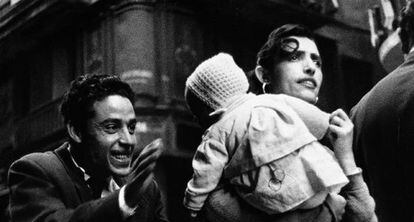
An image from Colom's show El Carrer, comprising photos taken in Barcelona's Barrio Chino from 1958 to 1960.Barrio Chino from 1958 to 1960.Photo by Joan Colom
PHOTOGRAPHY

Gift of a lifetime: Colom hands over image archive

Photographer donates his life's work to National Art Museum of Catalonia


ROBERTA BOSCO
Barcelona - Jul 22, 2012 - 06:42 

Joan Colom, one of the great figures of what came to be known as Spain's New Photography Avant-Garde, has donated his entire archive to the National Art Museum of Catalonia (MNAC). The collection comprises nearly 9,500 photographs, as many negatives, a 25-minute film of the entire material and a great many documents.


So ends a process that began over a year ago and included some moments of tension, especially after the life's work of another Catalan photographer, Agustí Centelles, was sold to the Culture Ministry and deposited in the Archives of Salamanca, rather than kept in the region.


"This is a historical moment; events of this nature are few and far between," said Miquel Roca, chairman of MNAC's board of trustees, as he thanked a visibly moved Colom for "his generosity, which is completely unselfish and without strings attached."


This of course does not mean there will be no compensation for the 90-year-old Colom. The Catalan culture department is negotiating a life pension for him and his family, the amount of which has not yet been made public. In any case, "it is not comparable with the real value of the archive," said Roca.

MNAC director Pepe Serra said Colom's work would "be showcased inside and outside the museum, in a national and international context." He also revealed a major Colom exhibition would soon be mounted and that its curator would be announced after the summer, when the museum presents the 2013 season.


Both Serra and David Balcells, photography curator at MNAC, insisted that the incorporation of Colom's work into the museum's photography holdings "opens new perspectives." They also underscored the excellent state of conservation of Colom's work, as well as the photographer's meticulous care in preserving his archive in good order - possibly a consequence of the fact he worked an accountant all his life.


Yet not all critics and colleagues from the same period - Oriol Maspons, Francesc Català Roca, Xavier Miserachs, Colita, Leopoldo Pomés, to name a few - shared his technique of not looking through the viewfinder so his subjects would not realize he was aiming his camera at them; he later selected the framing during the developing work. This system allowed him to capture images of prostitution and of Barcelona's notorious Barrio Chino that have remained impactful throughout the years.


An atypical character and an atypical photographer, Colom was praised as one of the greats of Spanish postwar photography, then largely forgotten again after 1964, as a result of a lawsuit brought against him by a prostitute who recognized herself in a photograph from the book Izas, rabizas y colipoterras , which included texts by Camilo José Cela - an innovative collaboration between a photographer and a writer.


The scandal caused by the book and the lawsuit pushed Colom into a depression and he quit photography until the early 1990s, when he began working in color.


His institutional comeback began in 1999, when the MNAC reproduced El carrer , his only solo show in Barcelona during his earlier period. That original exhibition, organized by Sala Aixelà in 1961, brought together a collection of shots taken between 1958 and 1960 in the Barrio Chino, and their quality awarded him a central spot among the Spanish photographers of his generation.


EL PAÍS