Dirty Harry at 50: Clint Eastwood’s seminal, troubling 70s antihero
This article is more than 2 years old
The off-the-leash cop archetype was cemented with Don Siegel’s taut, provocative thriller that neither condemns or condones extreme measures
Charles Bramesco
Thursday 23 December 2021
H
arry Callahan is the cop we’ve been warned about. Though this week marks fifty years since Don Siegel’s genre-defining thriller Dirty Harry busted into cinemas with Smith & Wessons blazing, the general profile of dangerous, off-the-leash law enforcement solidified over the last half-decade of public discourse sounds like it could’ve been traced from the film’s example. Played with a scowl of blanket disgust by Clint Eastwood – Paul Newman had passed on the role as “too right-wing” – San Francisco PD’s top inspector is more than your standard-issue misanthrope. He’s an equal-opportunity bigot, contemptuous of every ethnic group rattled off by a fellow officer in a laundry list of slurs. He’ll readily resort to violence in his work, not above a bit of crude torture to extract information from a perp with a bullet wound. And most hazardous of all, he believes himself unanswerable to anyone but God, who he’d probably just meet with the same glowering frown.
Anya Taylor-Joy attends the red carpet for 'Furiosa: A Mad Max Saga' in London (England) on May 17.LIA TOBY
The Latino side of Anya Taylor-Joy
The actress grew up in Argentina and is proud of her heritage; however, she is very ‘careful’ not to take on Latino roles in Hollywood for an important reason
Alonso Martínez
Mayo 24, 2024
In 2021, Anya Taylor-Joy had the honor of joining the list of personalities who have hosted the iconic comedy show Saturday Night Live, and she took the opportunity to remind the audience that she is proudly Spanish-speaking. At the end of her monologue, the actress — who at the time was gaining recognition for her work in the acclaimed series The Queen’s Gambit — requested to conclude in her native language, and displayed an impeccable Argentine accent that moved the Latino community.
Siddhartha Mukherjee: ‘Two hours writing, then a researcher knocks on the door with a pipette’
The author and oncologist on his red suede writing couch, his admiration for Orwell and his love of cell biology
Saturday 13 January 2018
B
y the time I sit down to write in my office, I’ve typically gone through several internal cycles of remission and relapse. I’ve probably finished my rounds in the cancer ward. Perhaps I’ve taught the red-eyed, exhausted overnight intern to recognise the difference between the drug rash from Amoxicillin (bright, angry, often harmless) and the innocuous-looking rash of immune rejection after a transplant (dusky, hazy, often deadly). Perhaps it’s eight in the morning now. I’ve had two shots of espresso. I might have written orders for chemo for a young woman with breast cancer, and – since her babysitter had to cancel this morning – I may have asked one of the nurses to distract a three-year-old daughter while another nurse puts an IV line into Mom’s arm. Then I may have scooted down to the pathology lab to look at the bone marrow biopsies that I did last week. There’s one man whose marrow shows a spectacular response to the drug that is on trial. Another patient has definitely relapsed. It’s barely midday, and my pulse has stopped, started and stopped about four times.
"Mrs. Dalloway said she would buy the flowers herself." So begins Virginia Woolf's much-beloved fourth novel. First published in 1925, Mrs. Dalloway has long been viewed not only as Woolf's masterpiece, but as a pivotal work of literary modernism and one of the most significant and influential novels of the twentieth century. In this visually powerful annotated edition, acclaimed Oxford don and literary critic Merve Emre gives us an authoritative version of this landmark novel, supporting it with generous commentary that reveals Woolf's aesthetic and political ambitions--in Mrs. Dalloway and beyond--as never before.
Friends, family and colleagues will celebrate the author with tributes and readings at St Martin-in-the-Fields church with limited tickets available for members of the public
Ella Creamer
Monday 27 May 2024
A celebration of the author Martin Amis, who died last May aged 73, is due to be held in London next month.
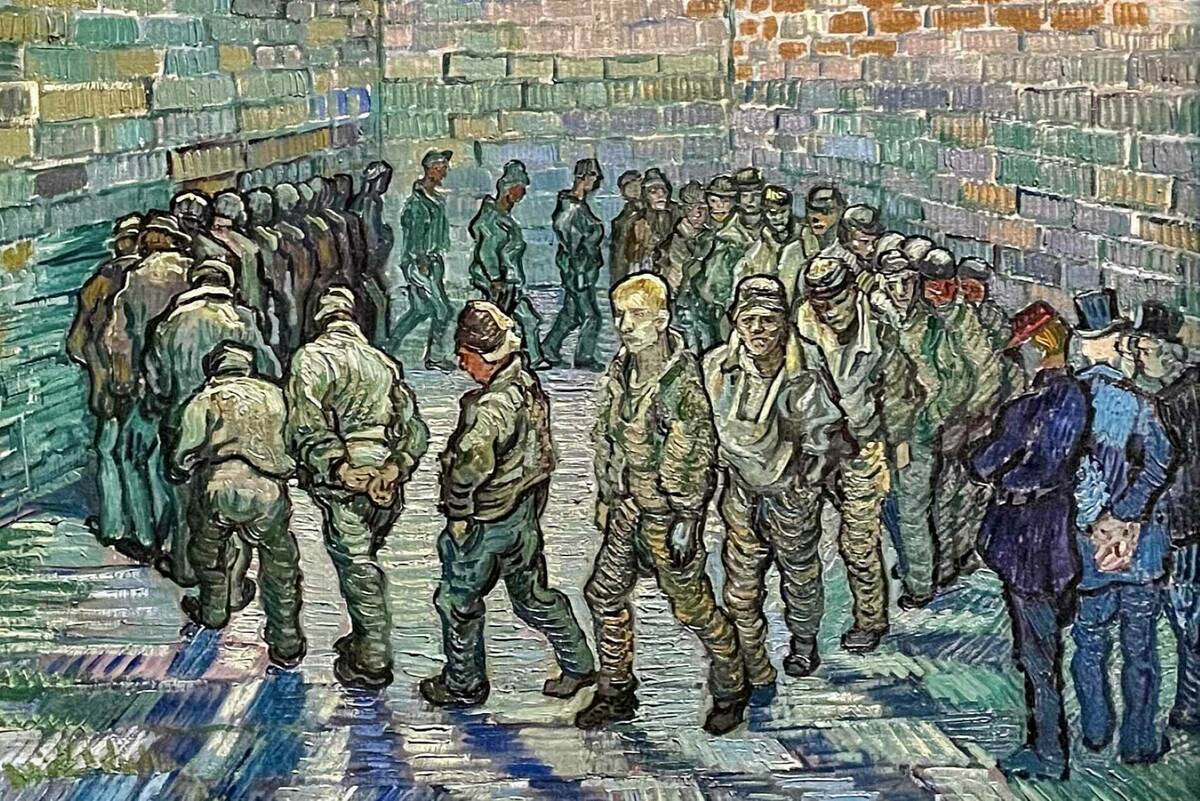
When my wife and I lived in Leavenworth, Kansas in the nineties, we had the great privilege to work in the prisons there. Leavenworth is a prison town, as is its abutting neighbor, Lansing. In Leavenworth one finds two federal civilian prisons, the historic “Big House” (so named for the domed central building that connects the blocks, oddly reminiscent of the U.S. Capitol) and what is interestingly called a “prison camp.” There are also two military prisons, the United States Disciplinary Barracks (USDB), the only maximum-security prison for the military, and a regional medium-security. To add to this penitential cornucopia, Lansing has a full complement of state prisons and gender-specific privately run prisons. Leavenworth and Lansing are nice enough towns, but an outsized number of their denizens are criminals, convicted and otherwise.
Kairos by Jenny Erpenbeck wins International Booker prize
Erpenbeck is the first German writer and Michael Hofmann the first male translator to win the £50,000 prize for novel which tells the story of a relationship set against the collapse of East Germany
Ella Creamer
Tuesday 31 May 2024
Jenny Erpenbeck and Michael Hofmann have won the 2024 International Booker prize for Erpenbeck’s “personal and political” novel Kairos, translated by Hofmann from German.
Breathless goodbye: the race to finish Jean-Luc Godard’s last film, one day before he died
The cinematic legend died the way he lived – in a blaze of inscrutable, impossible film-making. We meet the team who helped shoot the final scene of his swansong just before his death by assisted suicide
Xan Brooks
Monday 20 May 2024
In Friday 9 September 2022, Jean-Luc Godard had one last wish. He needed a quote from Jean-Paul Sartre to complete his film, Scénarios, but the book was missing from the shelf in his Swiss home. Time was pressing: he was up against a hard deadline. The film’s final scene was to be shot on Monday. On Tuesday, the director would die by assisted suicide.
Need proof who wrote Shakespeare’s plays? See The Merry Wives of Windsor
Set for revival at the RSC, this perfectly structured revenge comedy has an earthy vitality that no aristo or scholar could have created
Michael Billington
Monday 20 May 2024
have a question for those theatrical luminaries (and I’m looking at you Sir Mark and Sir Derek) who doubt the authorship of Shakespeare’s plays. Do they seriously believe that a capricious aristo such as the Earl of Oxford or a legalistic scholar like Francis Bacon could have written The Merry Wives of Windsor? In case they have forgotten, this brilliant comedy – about to be revived by the RSC – shows the middle classes getting their revenge on a knightly predator, Sir John Falstaff. It could only have been written by someone who understood the intricacies of a close-knit, provincial community.
What strikes me about the play is its quintessential Englishness, and you see this in myriad ways. One is in the earthy vitality of the language. There is a classic example when Anne Page, offered the prospect of marriage to a preposterous Frenchman, says: “Alas, I had rather be set quick i’th’earth / And bowled to death with turnips.” It is an extraordinarily vivid image and one of the play’s rare excursions into verse: 90% of it is in prose. But the language throughout has a localised vigour that stems from a writer steeped in English life. At one point Mistress Ford urges her servants to take the buck-basket containing Falstaff and “carry it among the whisters in Datchet Mead.” The “whisters” were the bleachers of linen who could be seen by any English river bank including the Avon.
That Englishness also takes the form of running gags at the expense of language-mangling foreigners: something today we may find mildly offensive but, if we are honest, a constant strain in English stage, film and TV comedy. In The Merry Wives, Dr Caius is the archetypal funny Frenchman who, invited to join a small, select twosome, blithely announces: “I shall make-a the turd.” Shakespeare, who had a fascination with the Welsh – think of Fluellen and Owen Glendower – here creates a voluble parson, Sir Hugh Evans, finally dismissed by Falstaff as “one that makes fritters of English”. A reminder that even today we use the language as a test of assimilation.
View image in fullscreen
The archetypal funny Frenchman … Ron Cook as Dr Caius in an RSC production directed by David Thacker in 1992. Photograph: Tristram Kenton/The Guardian
But how to represent this Englishness on stage? Broadly, there are two approaches. One is to treat the play as a realistic slice of Elizabethan life: the other is to find modern equivalents. Terry Hands – who deserves credit for putting the play back on the map and who directed it for the RSC in 1968 and 1975 and at the National in 1995 – and Trevor Nunn who directed it for the RSC in 1979 were both slice-of-life men. From Nunn’s production I remember half-timbered houses, mullioned windows and choirboys playing conkers. But both directors realised that it is the jealous bourgeois, Ford, who drives the play as much as Falstaff. In Hands’s RSC productions Ian Richardson displayed a sustained frenzy that made the jealousy of Othello and Leontes look like very small beer. In Nunn’s version Ben Kingsley exuded a wheezy jollity in the scenes where he accosts Falstaff in disguise, only to let out a manic scream of rage the second the fat knight left the room.
Other productions have located the play squarely in the modern world. Bill Alexander did a famous production at Stratford in the 1980s that set the play unequivocally in Harold Macmillan’s materialistic “never had it so good” England of October 1959. The defining image was of Lindsay Duncan and Janet Dale as the merry wives plotting their revenge beneath a pair of beehive hairdryers but there were equally good performances from Sheila Steafel as a bemused, brandy-tippling Mistress Quickly and Nicky Henson, whose Ford resembled a mini-Hitler from the Junior Chamber of Commerce. Rachel Kavanaugh in her touring 2003 productionwent further back in time to 1947, when ration books and clothing-coupons were used as bribes and where Richard Cordery’s Falstaff was like a demobbed serviceman scrounging pints in Windsor pubs.
My spies suggest that Blanche McIntyre’s new production will make the play even more urgently modern. But I cling to my belief that The Merry Wives is is one of Shakespeare’s most underrated plays. It is not only a perfectly structured revenge comedy but it also offers a classic definition of Englishness: in its language, its setting and its portrait of a smugly ascendant bourgeoisie. One thing’s for sure: Oxford or Bacon couldn’t possibly have written it.