Harry Holland
WOMEN II
WOMEN AND WATER


 |
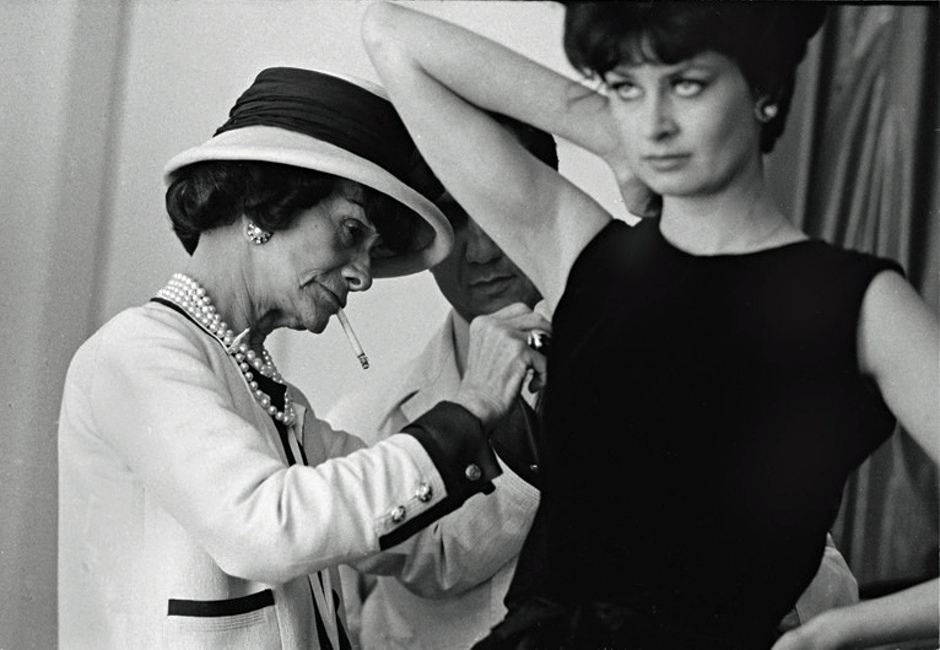
| Coco Chanel working in her Paris atelier in 1962. Click to see the full image. Photograph by Douglas Kirkland |
 |
| Richard Avedon |
 |
| Annie Leibovitz |
 |
| Richard Avedon |
Richard Avedon and his young wife, Doe, had no idea what they were getting into when they agreed to take a beach-house share in the summer of 1946 with his boss at Harper’s Bazaar, Lillian Bassman, and her husband, photographer Paul Himmel, in Cherry Grove, a community of bohemian intellectuals on Fire Island, 90 minutes outside of New York City. The slender barrier island, dotted with scrub and brush and dunes, was reachable only by public ferry or private boat (cars were not allowed). During the day, when the sun was out, the shimmering reflections on the ocean to the south and the glassy waters of the Great South Bay to the north created a unique and astonishing kind of light.

For a person who hasn’t released a book since 1981, Fran Lebowitz has found a way to gain new fans doing what she does most/best: talking, be it on talk shows, at colleges, at the 92Y, or whatever the 92Y equivalent is in other cities. Most recently, it was her six-part Martin Scorsese–directed Netflix series, Pretend It’s a City, in which Lebowitz waxes grumpy about how everyone and everything is annoying and, worse yet, it is annoying to her, Fran Lebowitz.
On Vulture’s Good One podcast, Lebowitz talks about Pretend It’s a City, comedy, and aliens. Below, you can read an excerpt from the transcript or listen to the full episode. Tune in to Good One every Thursday on Apple Podcasts, Spotify, Stitcher, Overcast, or wherever you get your podcasts.

 |
| Jim Shepard |

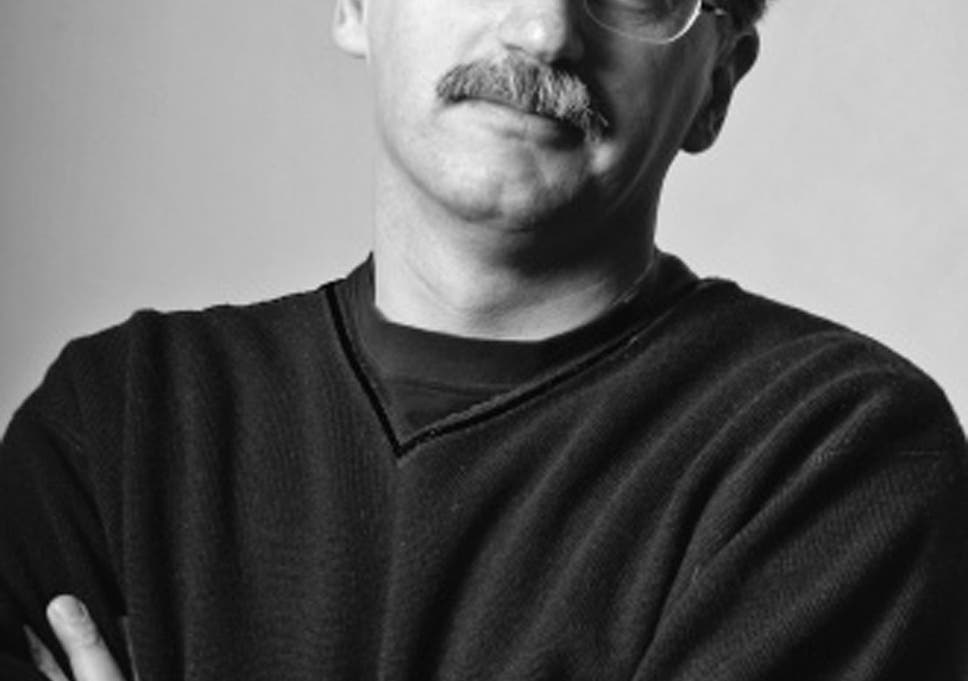
Jim Shepard is one of the best writers you’ve never heard of. He’s a tenured professor at Williams College, a job he’s held happily for 32 years — raising his family in pastoral Massachusetts, teaching generations of admiring acolytes, writing dozens of short stories and seven lean novels (including the intense character studies Nosferatu and Project X) to his own strange, exacting specifications.
 |
| Jim Shepard |
 |
| Jim Shepard |
 |
| Jim Shepard |
 |
| Jim Shepard |
 |
| Alexander Master's writing space. Photograph: Eamonn McCabe |
Saturday 6 June 2009
There's no pattern about the way I write, except it's always the first thing I do. I wake up anywhere between 4am and 10am, depending on the merriments of the night before or if a dream jolts me, then scribble, type or slash through yesterday's work till I start to feel a little sick from not eating. Breakfast is unhealthy; it makes me sleepy and stupid, so I put the nasty business off as long as possible. It was kedgeree today. (Zoom into plate and spoon, you'll see the yellow blobs. A spoon is the only safe way to cope with rice in bed.) When my girlfriend's here (that's her book, under the plastic flowers), I leave her sleeping and go to Haminados café up the road. That man never sleeps. Then once she's up I come home, close the curtains, leap back among the covers and, with any luck, don't use my legs again until about four.
The crocodile is my talisman. He was the first thing I drew for publication, was on the cover of the hardback of Stuart: A Life Backwards, and makes an appearance in my next book too. I bought him desiccated, rolled into a ball, and had to soak him in the bath for a week before he'd uncurl. Thrills - the book above the oil painting - is there because it's gorgeous.
The biography I'm working on at the moment is about a genius mathematician I know who tussles with something so large and mysterious that it's called "the Monster". So I have to learn mathematics and (to unravel what the contented character is babbling about) doodle cartoons, caricatures and comic strips, which merge in and out of the text. He thinks the Monster explains the symmetries of the universe. He says it is the voice of God.
My last place was a Suffolk shooting lodge by woodland. On the days I woke early there, I'd sit 15 feet up, in a deer-shooting perch strapped to a tree. That was the best study of all time: 5am, wrapped in blankets, with my gasman's clipboard, a thermos of coffee, and deer trotting below me through the mist.
THE GUARDIAN
 |
| Simon Callow's dressing room at the Haymarket Theatre where he writes between peformances of Waiting For Godot. Photograph: Eamonn McCabe |
Saturday 20 June 2009
As that odd portmanteau commodity, an actor-writer-director, I rarely have long in any one place for writing. I'm often on the road, or in a film studio, and I snatch my time wherever and whenever I can. I wrote a great deal of my first book about Orson Welles in my trailer in the middle of various fields while appearing in Four Weddings and a Funeral, heavily bearded and padded, in a kilt, with a small cigar clamped between my teeth. Most of the second book was written with a fancy hairdo and natty moustache in my functional dressing room at Shepperton while filming The Phantom of the Opera. And now I find myself at the Theatre Royal Haymarket, unquestionably the most beautiful theatre in the West End, with indubitably the best dressing rooms. I can write anywhere, as long as there's light and power for my plug, but Dressing Room 7 at the Haymarket is heaven for me. It's large enough for me to be able to carve a space for myself where I can write, I can look out of the window on to the Philippine embassy in Suffolk Street and I can import the things I need to sustain me: CD player, flowers in great quantities, tea-making facilities and, a recent recruit, the superb Russian Ganesha with a bell on his trunk, carved from wood by Eduard Bersudsky and until recently the star of Sharmanka, the extraordinary show created by Bersudsky and his wife Tatyana Jakovskaya. So here I sit, dressed as Pozzo in Waiting for Godot - moustached, riding-jacketed - pounding the keys, trying to explain what happened to Orson Welles. I can write only after the first act, when I have a 45-minute gap, but then I write happily and with great concentration. As it happens, I turned 60 this week, and so did the play - Pozzo and I are of an age. In the room with me is a large photograph of my family's Christmas in 1934, which contains the only surviving portrait of my great grandfather, who was first a clown, then a ringmaster, then an impresario, all of which Pozzo also seems to be, so the picture is there for direct inspiration.

 |
| Frances Spalding's writing room. Photograph: Eamonn McCabe |
Apart from its central chimney and platform base, this house is entirely made out of wood. And very sympathetic it is too. It was built for the artist Elisabeth Vellacott in 1959. She had very little money and so the architect, Peter Boston, insisted it had to be all roof. An A-frame building well suits an artist, for it permits a double-height window beneath the apex. But for a writer, it is less good, limiting opportunities for bookshelves as well as walls on which to hang pictures. I have, therefore, yet to achieve a library-room and still live with books and papers squeezed in wherever space allows.
But what I gained with this house was an enormous desk. It is an artist's working bench, with slots on one side where canvases can be stored. In Vellacott's day it was thick with oil paint and the grime of charcoal. Without my asking, the builders, while renovating the house, one day sanded the surface of the desk, to great effect. As a biographer and art historian, I often work with images and text. Recently, while coping with the last stages of my new book - John Piper, Myfanwy Piper: Lives in Art - the entire desk was covered with page proofs, making it possible to check illustrations against lists, sources and textual references.
With light coming in on all sides, the room absorbs the mood outside. Grey days here remind me of Stevie Smith and her "loamish landscapes". Despite having written her life, only now do I understand why an empty park, in the winter rain, had, for her, a "staunch and inviolate melancholy that is refreshing". Then, too, on sunny days, this room fills with light that quivers and slowly slides round the walls, sometimes forming diamond shapes. The novelist Rebecca Stott noticed this when viewing the house, after Vellacott's death. She eventually pulled out as its buyer, but recreated it and the surroundings in her novel Ghostwalk. So now, having been semi-derelict, the house lives on, in wood and words.

 |
| Michael Murpurgo's writing room for Saturday Review. Photograph: Eamonn McCabe |
I used to write longhand at a table in any room, anywhere so long as it was quiet. But I found that the more intensely I wrote, as the grip tightened on the pen, the smaller the writing became and the more my wrist and arm and shoulder began to ache.
One evening I asked my neighbour and friend Ted Hughes how he wrote. He said he'd had some trouble and now wrote standing up at a lectern. What's good enough for Ted Hughes, I thought ... so I tried it, but my feet hurt.
I was reading a biography of my great hero-writer Robert Louis Stevenson and discovered a photograph of him towards the end of his life, lying on his bed in Samoa, propped up on a pile of pillows, a writing book resting on his drawn-up knees. So that's how you write Treasure Island, I thought. I went up to my bedroom, piled up all the pillows I could find and began to write. Everything was supported and relaxed. It was wonderful for dreaming up a tale, weaving it inside my head, wonderful for scribbling in an exercise book. (I still don't use a word processor. I did try. I lost five chapters seven or eight years ago, probably the best chapters I ever wrote. They're still floating around up there in the ether.)
For many years, I wrote on our bed in the house. But there were complaints about ink on the sheets, dirty feet on the bed, and we felt we should try to create somewhere else, a storyteller's house. Clare, my wife designed it - it's based on the Anglo-Saxon chapel of St Peter-Ad-Murum at Bradwell-juxta-Mare in Essex, where I grew up, but it has a Devon thatched roof, a Japanese garden and an uninterrupted view of the countryside, looking towards Dartmoor.
So there I have made my writing bed. With flowers in the window - these a gift for our 46th wedding anniversary last weekend - and with Clare sitting at the computer, trying to make sense of my scribbly script as she types it up, it has become a perfect writer's hideaway.

 |
| Justin Cartwright's writing room Photograph: Eamonn McCabe |
This strange long room was once the entrance to a builder's yard. It was derelict when I bought it four years ago. From here I can go out of the yard into the street and straight into my front door. It's only about three metres, but the separation of home and work is crucial. There are some reminders of South Africa here: the table is a very traditional Cape table of yellow-wood and stink-wood. The Cameroonian figures, the Coca-Cola radio, the biplane - all come from South Africa. There is a statuette, which was a Jewish cultural award for my last book. Just visible is a picture of Nadine Gordimer, which I took in her house in Johannesburg a few years ago. Books are everywhere, and creeping from the Ikea shelves into the garage which leads off this room. The sofas were about to be thrown out by a photographer's agent - very 60s - when I acquired them years ago. They are fantastically comfortable and way too seductive: I often snooze here. Long ago I convinced myself that an afternoon snooze is a good thing, and I was relieved to read a few years ago that doctors now agree. The wooden chair is from my wife's family house in Lancashire.
I think the secret with writing is to do it every day. I have in this room more or less everything I need, from reference books to Post-it notes, so that I have no excuse for pencil sharpening. There is a small kitchen, where each day starts with an elaborate coffee ritual.
The computer on the table is an iBook. I agree with John Updike that writing on a computer produces a particular tone and texture. All my novels are written longhand; I revise them by hand and then type them on the iBook. Somewhere in this computer three full-length novels are sheltering. I use Jstor and Google constantly, so that sitting here, surrounded by my knick-knacks and fetish objects, I am both at peace and fully connected to the world outside. I don't mind being on my own in this little world for hours on end.
THE GUARDIAN