Wednesday, January 3, 2018

How to Stay Alive by Bear Grylls / Digested read


How to Stay Alive by Bear Grylls – digested read


‘Nipping out for milk? Take a 12-inch knife, a defibrillator, three chicken tikka masalas and a solar-powered microwave oven’

John Crace
Sun 12 Nov ‘17 17.00 GMT


The world is a dangerous place. More than 151,600 people die each day. You could be one of them if you don’t learn a few basic survival tips. Here are the rules on how to stay alive.
Never Leave the House Without a 100kg Bergen Rucksack Thousands of people get lost in forests each year on what they thought was a simple walk from their house to buy a carton of milk. Travelling with the right supplies can mean the difference between life and death. I always take a gallon of drinking water, a 12-inch knife, a defibrillator, three Sainsbury’s heat-up chicken tikka masalas, and a solar-powered microwave oven.


Lighting a Fire If you’re lost at night, you’re going to need to keep warm. Don’t worry if you’ve run out of firelighters and kindling – there’s plenty of other combustible material around. Use Google maps to find the nearest branch of Kwik Fit, where you can be sure to find some old tyres. These burn a treat and the noxious black smoke will help guide a helicopter in to airlift you out of Croydon.
Building a Shelter Keeping dry increases your chances of survival by 236%. If you are stuck in the snow, dig a hole and sit in it. Whenever I’ve been lost in the desert, I’ve found the best solution is to book myself into the nearest five-star hotel.

How to Communicate You can try using a mirror – I always carry one to check I’m looking my best (Scout’s motto: Be Prepared to Be on TV). But to be honest, it’s probably easiest to give someone a ring on your mobile.

How to Find Food You can eat almost anything providing it’s not poisonous. The simplest way to tell if something is edible is to let the person you are travelling with try it first. If she gets violent stomach cramps and starts vomiting, it’s probably a good idea to give it a miss.
How to Handle Yourself in a Fight Should you be attacked by a bloke who wants to kill you, apply the krav maga system of self-defence honed by Priti Patel’s friends inthe Israeli military. Simultaneously stick your fingers in your assailant’s eyes, punch him in the throat and knee him in the groin. Once he is on the ground, take out your semi-automatic rifle and shoot him through the chest.
How to Survive Getting Lost First of all, don’t panic. Then walk back the way you came until you reach a landmark you recognise. If you can’t remember which way you’ve come, you probably shouldn’t have been out in the first place. If all else fails, shout for help.


How to Land a Plane You’re on a commercial aircraft and both pilot and co-pilot are incapacitated. First kick your way into the cockpit, then radio air traffic control to let them know you’re going to land this motherfucker. Lose height as you come near the airport, lower the undercarriage and remember to use the brakes when the wheels touch down. Yippee-ki-yay!

How to Survive a Volcanic Eruption An active volcano can be extremely dangerous. If one starts to erupt, make sure you’re on the side where the molten lava isn’t. Otherwise, be prepared to run at 1,000mph into the nearest lake or sea. Keep your sunglasses on at all time because the glare from the flames can cause temporary blindness.
How to Survive Severe Trauma Imagine you’ve just jumped from 25,000ft, your parachute didn’t open and you’ve broken both your legs. Then you find you’ve landed in a warzone and someone has shot a six-inch hole through your chest. This has happened to me several times and you’ve got to think fast to stay alive. First, get out the defibrillator to restart your heart, then reach inside your body to sew up the aorta. Clamp the aperture with a dead squirrel, chop down a couple of trees to splint your legs, then walk into the jungle, hop on top of the nearest elephant and tell it to take you to a hospital.
How to Survive a Bear Attack Whether they are trying to get you to join the scouts, are on TV doing highly scripted Challenge Anneka routines with Barack Obama, or are grinning from posters trying to persuade you to go on the Alpha Course, there seems to be an epidemic of Bears. They’ve even taken to recycling books they’ve already written. There’s only one safe way of dealing with them: stay indoors, turn out the lights, and sit in a cupboard.
Digested read, digested: The Bear necessities.
THE GUARDIAN


Saul Bellow's Heart by Greg Bellow / Digested read


Saul Bellow's Heart by Greg Bellow – digested read


John Crace reduces the memoir written by the son of the American literary titan to a reputation-changing 600 words


John Crace
Sun 14 Apr ‘13 17.00 BST


I
n the painful days after Saul's death, I resolved to keep my grief private. But as I listened to yet more parvenus, such as the in-all-senses-diminutive Martin Amis, seek to claim my father as their own, I felt a need to put a halt to the absurd conflation of literary figure and family man. These self-appointed, self-serving narratives described a deified figure I didn't recognise. Saul was an intensely private man who would have hated to see his shortcomings ruthlessly exposed. But tough: he was a mean, cantankerous old sod, and it's about time I got some emotional and financial payback.

As a psychoanalytically oriented psychotherapist of some 40 years standing, you might have expected me to adopt a holistic approach to understanding my father. But I have found it much more helpful to divide his life into two: the Young Saul, who loved me greatly and was generally a good bloke; and the Old Saul, who found it hard to show how much he loved me and was generally a bit of a shit. This way I don't need to make sense of why he appeared to have a complete personality change. Or, indeed, examine the more troubling possibility that he never did care for me, and that I and the rest of his family were inconvenient physical manifestations of his narcissism.

The Young Saul was born in Canada in 1915 and, though his father was consistently abusive and his brothers bullied him, he came to look on his early years as "a very paradise", as even the most simplistic reading of Herzog will show you. The Bellow family moved to the coalyards of Chicago in 1924, where a loss of innocence ignited Saul's desire to be a world-famous writer; when he met Anita, they embarked on the Gypsy Years.
Saul loved Anita greatly, though his leftwing views forced him to rebel against petit-bourgeois monogamy by shagging almost every woman he met. I was born in 1944, and I clearly remember him saying: "My life is complete now I have a first-born son" as I appeared from the cosy, warm embrace of Anita's womb. Following my appearance, Saul's literary genius took wing and with The Adventures of Augie March he found a wealth and success that allowed him to leave my mother and have sex with even more women.

Before long, Saul had got remarried, divorced, remarried again, divorced again, remarried yet again and divorced yet again. "The reason I see so little of you," he would say, "is that my love for you is so intense that were we to meet more often my heart would explode with joy." How I enjoyed the 10 minutes I spent with Young Saul when he reluctantly invited me to Oslo for the Nobel prize ceremony – an award he never felt he deserved – and it is with great fondess I recall us discussing the failure of his Reichian therapy.
Such was the greatness and intensity of Saul's writing during this period (and it was with great reluctance that he changed the title of Greg's Gift to Humboldt's Gift) that he failed to notice I had got married and had children. Yet still I felt a unique filial bond between myself and the Young Saul. All this changed when he met Janis, a mere teenager with whom he had a daughter. Now he became Old Saul, a bitter and twisted, demented, mean old conservative who cast aside his old family and in whose last book, Ravelstein, it is clear that all his works were nothing but thinly disguised second-rate autobiography, a lashing out at all those whom he truly loved.
Yet, somehow, now I have completed my own book I feel reconnected to the father whom I truly loved and who loved me more than anyone else. The hatred and misunderstanding is past. The skies are clear. I forgive you, Father, for you know not what you did.
Digested read, digested: Oedipus Schmoedipus.


Buy a cat, stay up late, don't drink / Top 10 writers’ tips on writing


Ernest Hemingway
by Fernando Vicente

CREATIVE WRITING

Buy a cat, stay up late, don't drink: top 10 writers’ tips on writing


Made a New Year resolution to start writing that novel? Take some writing tips from Leo Tolstoy, Muriel Spark, John Steinbeck and other famous authors
Travis Elborough
Wed 3 Jan ‘18 11.27 GMT

O
ver the past year, Helen Gordon and I have been putting together Being a Writer, a collection of musings, tips and essays from some of our favourite authors about the business of writing, ranging from the time of Samuel Johnson and Grub Street, to the age of Silicon Roundabout and Lorrie Moore.

Researching the book, it quickly became obvious that there isn’t a correct way to set about writing creatively, which is a liberating thought. For every novelist who needs to isolate themselves in a quiet office (Jonathan Franzen), there’s another who works best at the local coffee shop (Rivka Galchen) or who struggles to snatch an hour between chores and children (a young Alice Munro).
Conversely, it also became apparent that alongside all this variety of approach, there are certain ideas and pieces of advice that many writers hold in common. In an 1866 letter to Mrs Brookfield, Charles Dickens suggests that: “You constantly hurry your narrative ... by telling it, in a sort of impetuous breathless way, in your own person, when the people [characters] should tell it and act it for themselves.” Basically: SHOW DON’T TELL. Three words that will be familiar to anyone who has sat in a 21st-century creative writing class.
Our book therefore contains a lot of writing advice, ranging from the sternly practical to the gloriously idiosyncratic. We have writers talking about what went wrong, as well as what went right. They discuss failing to finish a manuscript, failing to find a publisher, badly realised characters and tortuous, unwieldy plots. Here are a just few of our favourite tips, which we believe any aspiring writer should take to heart.
1. Hilary Mantel – a little arrogance can be a great help
“The most helpful quality a writer can cultivate is self-confidence – arrogance, if you can manage it. You write to impose yourself on the world, and you have to believe in your own ability when the world shows no sign of agreeing with you.”


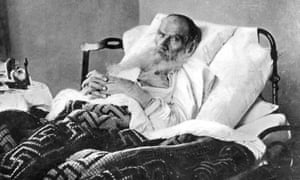
Morning thoughts … Tolstoy puts in a shift. c.1903-10. Photograph: Ullstein Bild/Getty Images

2. Leo Tolstoy and HP Lovecraft – pick the hours that work best for you

Tolstoy believed in starting first thing: “I always write in the morning. I was pleased to hear lately that Rousseau, too, after he got up in the morning, went for a short walk and sat down to work. In the morning one’s head is particularly fresh. The best thoughts most often come in the morning after waking while still in bed or during the walk.”


Or stay up late as HP Lovecraft did: “At night, when the objective world has slunk back into its cavern and left dreamers to their own, there come inspirations and capabilities impossible at any less magical and quiet hour. No one knows whether or not he is a writer unless he has tried writing at night.”
3. William Faulkner – read to write

“Read, read, read everything – trash, classics, good and bad, and see how they do it. Just like a carpenter who works as an apprentice and studies the master. Read! You’ll absorb it. Then write. If it is good, you’ll find out. If it’s not, throw it out the window.”

4. Katherine Mansfield – writing anything is better than nothing

“Looking back I imagine I was always writing. Twaddle it was too. But better far write twaddle or anything, anything, than nothing at all.”

5. Ernest Hemingway – stop while the going is good

“Always stop while you are going good and don’t worry about it until you start to write the next day. That way your subconscious will work on it all the time. But if you think about it consciously or worry bout it you will kill it and your brain will be tired before you start.”


FacebookPinterest
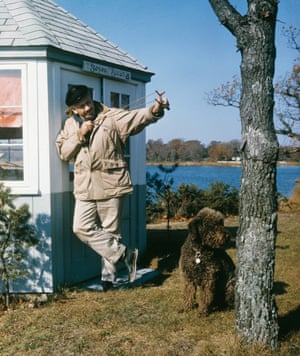
 John Steinbeck at Sag Harbor, 1962 … presumably after he’d finished his daily schedule. Photograph: Rolls Press/Popperfoto/Getty Images

6. John Steinbeck – take it a page at a time

“Abandon the idea that you are ever going to finish. Lose track of the 400 pages and write just one page for each day. It helps.”

7. Miranda July – don’t worry about the bad drafts

“I was a lot dumber when I was writing the novel. I felt like worse of a writer … would come home every day from my office and say, ‘Well, I still really like the story, I just wish it was better written.’ At that point, I didn’t realise I was writing a first draft. And the first draft was the hardest part. From there, it was comparatively easy. It was like I had some Play-Doh to work with and could just keep working with it – doing a million drafts and things changing radically and characters appearing and disappearing and solving mysteries: Why is this thing here? Should I just take that away? And then realising, no, that is there, in fact, because that is the key to this. I love that sort of detective work, keeping the faith alive until all the questions have been sleuthed out.”


FacebookPinterest
 ‘The first draft was the hardest part’ ... Miranda July. Photograph: Richard Saker for the Observer

8. F Scott Fitzgerald – don’t write and drink

“It has become increasingly plain to me that the very excellent organisation of a long book or the finest perceptions and judgment in time of revision do not go well with liquor. A short story can be written on the bottle, but for a novel you need the mental speed that enables you to keep the whole pattern inside your head and ruthlessly sacrifice the sideshows … I would give anything if I hadn’t written Part III of Tender Is the Night entirely on stimulant.”

9. Zadie Smith – get offline

“Work on a computer that is disconnected from the internet.”


10. Muriel Spark* – get a cat

“If you want to concentrate deeply on some problem, and especially on some piece of writing or paper-work, you should acquire a cat. Alone with the cat in the room where you work … the cat will invariably get up on your desk and settle under the desk lamp. The light from a lamp … gives the cat great satisfaction. The cat will settle down and be serene, with a serenity that passes all understanding. And the tranquillity of the cat will gradually come to affect you, sitting there at your desk, so that all the excitable qualities that impeded your concentration compose themselves and give your mind back the self-command it has lost. You need not watch the cat all the time. Its presence alone is enough. The effect of a cat on your concentration is remarkable, and very mysterious.’ 
*(or rather, the character of Mrs Hawkins in A Far Cry from Kensington.)

  • Being a Writer by Travis Elborough and Helen Gordon is published by Frances Lincoln, priced £15.

  • THE GUARDIAN


Tuesday, January 2, 2018

War and Peace by Leo Tolstoy / Digested read


War and Peace by Leo Tolstoy – digested read


We’re going to speak Frussian, join the army, fall in love, fall out of love, get very cold, and then die


John Crace
Mon 11 Jan ‘16 08.20 GMT


I
t was July 1805, and all St Petersburg was concerned about the advance of Bonaparte. Though not so much as to cancel a soiree at which Pierre, a bastard by birth but not by nature, was to be introduced to Russian society.

“Pierre is not one of nous,” several guests observed. “Not only does he forget choses but he doesn’t speak Frussian. Et he drinks even plus que nous.”
Prince Andrew, a bastard by nature but not by birth, cleared his throat delicately. “As a member of the officer class, I have decided to join the army,” he declared.

“Leave your pregnant wife if you will, Pierre said, willingly accepting the mantle of fecklessness. “I shall eat, drink and copulate for Russia. That will be my duty for the glorious Motherland.”
“I shall join the hussars,” Nicholas declared, while his sister Natasha eyed up potential husbands. They might become rather scarce.
Pierre checked his fob watch. The pages were turning faster than he expected and his father had now died. “I seem to find myself the richest man in Russia.”
War proved more terrible than either Andrew or Nicholas has expected. Dreams as well as men got killed. “How I embrace death,” Andrew murmured as the battle of Austerlitz raged. “Pas so vite,” said Napoleon. “Permettez-moi de vous donner une main. Now I must wash my chubby little body.”
“I’m home,” said Andrew as his wife died in childbirth.


Pierre felt the burden of expectation and married Helene but, helas, she had a bit on the cote. The anguish was intolerable, but Pierre felt obliged not to kill his love rival in a duel and left St Petersburg for many years to ruminate on Freemasonry before deciding a knotted handkerchief was not for him. Instead, he chose to improve the lot of his serfs, who had up till now remained entirely invisible. “Harrumph,” he concluded at last. “I cannot improve their lot because they have never had it so good.” Tolstoy nodded approvingly, lifting his eyes momentarily from the handsome handmaiden beneath him.
“So, 500 roubles on the peace lasting,” said Nicholas, as Napoleon and the Tsar embraced in friendship, thereby losing the remains of the Rostov fortune.
Andrew observed Natasha longingly. “Marry me, please,” he begged. “Oh, I do love you ever so much, Nick,” Natasha replied, but my father is making me wait a year and I’m bound to have developed une grande passion for the inside of Anatole’s trousers by then.”
“I am distraught,” Andrew declared as Natasha fell dangerously ill.
It was now 1812 and Pierre was beside himself as the French approached Moscow. “‘I am deranged with symbolism and Helene has left me even though I left her first. I vow to kill Napoleon,” he said.
“Je ne peux pas believe que je have justperdu the battle of Borodino,” Napoleon squeaked, his shoe-lifts giving him gip. “The French had by lointhe best army.”
“But Russia had nature and spirituality on its side,” said Tolstoy while a chorus of Volga boatmen sang patriotic songs.
“Can you not faire quelque chose about the fumee in Moscow?” asked Napoleon. “Et quand will I receive the surrender?”
“Jamais,” Mother Russia replied. First scorched earth, then General Winter. War is hell.
Illustration by Matt Blease

Pierre hovered between madness and death as the French performed atrocities during their withdrawal from the icy embrace of Mother Russia.
“There is a nobility in being broke,” said Nicholas’s aunt. “So I am going to give you some more money.” “Oh, thank you,” Nicholas replied. “Now I can marry Mary. And maybe you and Andrew can make up now, Natasha?”
“I forgive you, Natasha,” said Andrew, before dropping dead.
“That’s handy,” said Pierre, appearing out of nowhere. “Maybe I can marry you instead.”
“Yes please,” Natasha whimpered. “I can give up my singing, we can have four children and I can become a right old drudge, because Leo thinks that submission is a woman’s natural state.”
Tolstoy bowed his head. He was tired. The novel was a difficult thing. Not that his book was a novel, of course. Though people would be bound to call it that. Fools all of them. We can only know we know nothing.
THE GUARDIAN