Sunday, June 16, 2024

Cartoons / Mountaineering Madness


“Fenton’s gonna feel that in the morning.”
Jerry Marcus
September 19, 1959

Cartoons: Mountaineering Madness

These cartoons take humor to great heights!

Agust 10, 2022


Al Johns
September 17, 1960


Isabel Allende / ‘It would be terrible for the United States, and for humanity, if Trump were to be elected president again’


Isabel Allende

Isabel Allende: ‘It would be terrible for the United States, and for humanity, if Trump were to be elected president again’

The Chilean writer has authored her first children’s book: ‘Perla The Mighty Dog.’ In this work, she explores the problem of bullying and the importance of facing our fears. ‘If we face what we fear the most, it turns out that it’s not so terrible,’ she says, during a interview with EL PAÍS

Carlos S. Maldonado

México, 31 May 2024

The prolific Chilean writer Isabel Allende returned to bookstores this week, with her first children’s book: Perla: The Mighty Dog. It’s a story that was born from an everyday event. One day, Allende, 81, had gone out to walk with her little dog, who has the same name as the pet in her book. Perla approached a tree and started barking at a squirrel. Suddenly, a large dog broke off its leash and began to attack her.
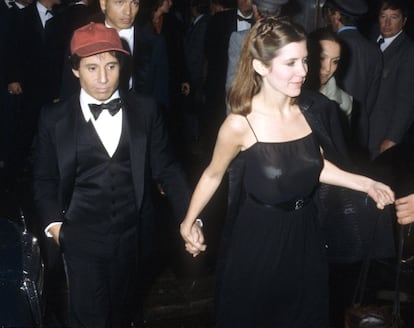
Wednesday, June 12, 2024

The forgotten marriage of Carrie Fisher and Paul Simon: 11 months of screaming, depression, fame and drugs


Carrie Fisher and Paul Simon at a party in London in May 1978. TOM WARGACKI 

The forgotten marriage of Carrie Fisher and Paul Simon: 11 months of screaming, depression, fame and drugs


A new documentary on the singer-songwriter’s personal and professional life revisits his romance with the ageless Princess Leia, a stormy relationship that lasted for years as they both dealt with mental illness. The couple finally broke up after a visit to a shaman

Tuesday, June 11, 2024

‘You’re Beautiful by James Blunt is terrible!’ / Paloma Faith’s honest playlist

Paloma Faith


‘You’re Beautiful by James Blunt is terrible!’: Paloma Faith’s honest playlist

The singer hates a certain James Blunt megahit and feels empowered by Chaka Khan, but which Aussie bard does she think wrote the best song of all time?

The first song I remember hearing
My mum was a massive fan of Nina Simone but she’s got dyspraxia. She was always having dinner parties, but she’d always make people dance. I just have an image of her clapping out of time to Simone’s song Baltimore.

Hot Tracks / Paloma Faith


Paloma Faith


Hot Tracks: Paloma Faith

BY LISA ROBINSON
JANUARY 25, 2013


I don’t really feel that I’m of this time,” says British singer Paloma Faith, who brings a mad splash of color and pizzazz to the current music scene. “I don’t connect much with the present. I have more of an affinity for what came in the past.” The London native has been compared to Amy Winehouse and called “the next Adele,” but Faith’s timeless singing style actually has more in common with the brazen drama of Shirley Bassey and the emotional delivery of Etta James. She eschews the “neo-soul” label that gets put on her, and says, “I think soul is soul. I don’t see new soul as any different to old soul. I tend to think of music in terms of old R&B, and soul is definitely more old-fashioned, which is what I am.”

Monday, June 10, 2024

The Great Wave by Michiko Kakutani review – overcoming ‘permacrisis’


Book of the day

The Great Wave by Michiko Kakutani review – overcoming ‘permacrisis’

The Pulitzer prize-winning critic turned author identifies a polarised and unstable world and suggests solutions: embrace risk, welcome otherness and open dialogue


Tim Adams

Monday 20 May 2024


For more than three decades from 1983, Michiko Kakutani was the lead book critic for the New York Times. She won a Pulitzer for her “fearless and authoritative” criticism, shorthand for an unflinching ability to dismantle heady literary reputations. Novelist Nicholson Baker described being reviewed by Kakutani as “like having my liver taken out without anaesthesia”.

The big picture: Bertien van Manen’s otherworldly arrivals hall


Budapest Station, 1975 by Bertien van Manen


The big picture

The big picture: Bertien van Manen’s otherworldly arrivals hall

After years working for fashion magazines, the Dutch photographer, who died last month, set off on an adventure to Budapest in 1975, where she found the curious Narnia she had dreamed of

Tim Adams

Sunday 9 June 2024

There is a fairytale quality to Bertien van Manen’s 1975 photograph of the arrivals hall at Budapest Keleti train station. Among the questions it demands is: who are the two women in shawls and where might they be going? (And then there is the slight double take required to be sure that the pointing woman’s arm is not somehow on both sides of the right-hand shawl-wearer’s head.)

Elephants call each other by name


Elephants call each other by name, study finds

Researchers used artificial intelligence algorithm to analyse calls by two herds of African savanna elephants in Kenya

Agence France-Presse in Paris
Mon 10 Jun 2024 17.24 BST

Elephants call out to each other using individual names that they invent for their fellow pachyderms, according to a new study.

Monday, June 3, 2024

Picasso / The Artist and his Model / Le peintre et son modèle


Picasso

 The Artist and his Model (Le peintre et son modèle)


Pen and black ink and white chalk on light brown card.
Dated 30.6.70. and signed Picasso at the upper left.
Dated and numbered 30.6.70. / I in brush and black ink and white chalk on the reverse.
224 x 309 mm. (8 3/4 x 12 1/8 in.)

In the last two decades of his career Picasso produced a very large number of paintings, drawings and prints on the theme of the artist and model. Indeed, as one scholar has noted, ‘the theme [is] one of the most frequently recurring motifs of Picasso’s late period…During Picasso’s later years, as he grew ever more obsessed with the theme, the repeated focus on the artist and his model became a means by which he could explore the mysteries of the creative process, parody the effects of aging and his own image as a living Old Master, while also, on a deeper level, actively denying his own fear of death.’ These works take a variety of forms, but in general depict a painter, armed with a palette and brushes, facing a canvas, usually seen from the side, and a nude model, either sitting or reclining. Sometimes the painter is shown alone with the canvas but without the model, while at times the scene is set in a studio, or else out of doors.

Picassoo / Embracing Couple / Couple enlacé


Picasso

 Embracing Couple (Couple enlacé) III

Pen and brown ink on a page from a large sketchbook.
Dated and numbered 1.1.59 / 111 at the upper left.
Numbered 331 and 5790 on the verso.
370 x 270 mm. (14 1/2 x 10 5/8 in.)
This drawing is likely to have come from one of two spiral-bound sketchbooks used by Picasso in 1958 and 1959. As the scholar Brigitte Léal has noted, ‘sketchbooks form an integral part of the whole of Picasso’s creative activity’, and some 175 sketchbooks by the artist are known or recorded, dating between 1894 and 1967. The earliest known example dates from when the artist was thirteen years old, and he continued the practice of using sketchbooks throughout almost the whole of his career. He often carried a small notebook in his pocket for making quick sketches, while larger sketchbooks or notebooks were used in the studio. While several of Picasso’s carnets have survived - notably twenty-nine examples today in the collection of the Musée Picasso in Paris – many other sketchbooks have been broken up, while others are known only from a handful of individual pages. 

Drawn on the 1st of January 1959, this large sheet was Picasso’s third drawing of the New Year. The previous drawing executed by the artist that day was a closely related composition of a dancing or embracing couple, and shared the same provenance as the present sheet until it was sold at auction in 2017. Both drawings come from one of the few late sketchbooks by Picasso. While the last two decades of his career were a time of great productivity for Picasso, not many sketchbooks are known from this fecund period. With the exception of 1962, when the artist filled eight sketchbooks with drawings inspired by Edouard Manet’s Le Déjeuner sur l’herbe and Jacques-Louis David’s Rape of the Sabines, only eight other sketchbooks are known from the final decade and a half of his career, before his last known carnet of 1967. As Léal has written of Picasso’s late sketchbooks, ‘The carnets are no longer places for preparatory studies for the paintings, which they accompany rather than precede, but supports for exercises combining relaxation…and discipline…, dominated by the theme of the nude, a pretext for variations on the arabesque, which appears clearly, through these final notebooks, as the formal link connecting him to the heritage of Delacroix, Ingres and Manet.’

The artist’s son Claude has written of Picasso’s sketchbooks, that ‘They are, from one page to the next, an adventure – a diary of the painter...They are the notes working up to something or bouncing off something else, perhaps a sculpture onto a painting and back. The pages of the notebooks are the sketches for paintings but they are also often the afterwords. Sometimes they stand as elaborate works on their own. Picasso’s notebooks are stepping-stones to trampolines for somersaults.’

The present sheet was until recently in the collection of the artist’s granddaughter Marina Ruiz Picasso (b.1951), the only daughter of Picasso’s eldest son Paulo. Though her relationships with both her father and grandfather were troubled, she was the only legitimate grandchild of the artist alive at the time of his death in 1973, and therefore received the second-largest inheritance, after that of Picasso’s second wife Jacqueline. As Picasso’s biographer John Richardson has noted, Marina Picasso ‘differs from the artist’s other five heirs in that she has made a point of exhibiting as much as possible of her magnificent collection in a succession of traveling exhibitions…for students of modern art in cities which have never seen a Picasso retrospective, these exhibitions have been a revelation.’ This drawing from Marina Picasso’s collection, however, appears not to have previously been exhibited.

A photo-certificate from Claude Picasso, dated 12 November 2019, accompanies the present sheet.


Sunday, June 2, 2024

Picasso / Maternité / Mother and Child


Picasso

 Maternité (Mother and Child)


Pencil.
Dated and numbered by the artist 5.1.51 / IV in pencil at the upper right.
Numbered 1088 / 24 in pencil on the verso.
269 x 210 mm. (10 5/8 x 8 1/4 in.)
Although motherhood and childhood are subjects that Pablo Picasso revisited throughout his career, the theme most notably presents itself in his oeuvre when the artist became a father himself. As his dealer and great champion Daniel-Henry Kahnweiler noted, ‘if one wanted to establish some sort of statistics of Picasso’s later subjects, it is quite certain that children would figure importantly. There is no esthetic reason for this. He has painted, drawn, etched, sculptured many children because he adores children, especially young ones…Even more so did he cherish and sketch his own children: Paulo, Maya, Claude, Paloma…The children painted or drawn by Picasso are of all ages. One can see them at every moment of their young lives. There are babies in the cradle, in their mother’s arms, children playing, Paulo riding a donkey, Maya with a little boat, Claude and Paloma with a little toy train.’

Many of Picasso’s earliest works on the theme of children date from the 1920s, following the birth of his eldest son Paulo in 1921. More paintings and drawings of children were produced in the late 1930s, with the birth of his daughter Maya (b.1935), and again in the late 1940s and early 1950s, with numerous depictions of Claude (b.1947) and Paloma (b.1949), his children with Françoise Gilot. However, although the three grandchildren born in Picasso’s lifetime – Pablo, known as ‘Pablito’ (b.1949), Marina (b.1950) and Bernard (b.1959), who were the children of his son Paulo - were close in age to his own children, there are very few portraits of them. The only drawings the artist made of one of his grandchildren were six sketches of his youngest grandson Bernard Ruiz Picasso as a newborn baby; all drawn on 9 November 1959 as a gift for the child and his mother, Christine Pauplin. 

In her memoirs, the artist’s grandaughter Marina Picasso recalls that she and her brother Pablito were never the subject of one of Picasso’s works. As she writes, ‘There isn’t a single hint of our existence in his work, not one drawing or painting. When we went to La Californie [Picasso’s home and studio in Cannes, where he lived between 1955 and 1961], we would search for ourselves desperately on the walls, secretly flipping through the catalogues and art books, trying to find our features in a faun, a bacchanal, or the kaleidoscope of a still life. We came across studies and paintings of Maya, Picasso’s daughter with Marie-Thérèse Walter; sketches and portraits of Claude and Paloma, his children with Françoise Gilot; of fisherman, his tailor, people we didn’t know, dogs, cats, birds, lobsters, guitars, coffee pots, fruit bowls, jugs, leeks…but not a single sketch of us, his direct heirs.’

Drawn with a sharp pencil on January 5th, 1951, the present sheet is numbered IV and is one of a small group of drawings by Picasso of a mother and a female child, all drawn on the same day on successive pages of a sketchbook. The present sheet was followed, in the sequence of drawings made that day, by two closely related studies, numbered V and VI, which share the same provenance as this drawing. While this drawing depicts the mother holding her infant in her lap, the two subsequent images drawn later the same day show her bringing the child to its cradle, kissing her, and laying her down. 

It may be argued that, despite their intimacy and charm, these three drawings - which were unknown to Christian Zervos when he published his monumental catalogue raisonné of Picasso’s work - lack the sense of evident affection found in Picasso’s more finished portrait drawings of his daughter Paloma, and of the artist and his family, which date from just ten days later. At the time these drawings were made, Picasso was supremely happy in his life with Françoise Gilot, and often drew his own children. Claude and Paloma were, however, by this time much older than the baby girl shown in the present sheet. As such, and despite Marina Picasso’s later protestations to the contrary, it may be tentatively suggested that this drawing, and the two related pencil studies executed the same day, may in fact have been drawn on a visit by Picasso to his new granddaughter, the infant Marina, who would have been less than two months old at the time.

The present sheet was until recently in the collection of Marina Ruiz Picasso, the only daughter of Picasso’s eldest son Paulo. Though her relationships with both her father and grandfather were extremely troubled, she was the only legitimate grandchild of the artist alive at the time of his death in 1973, and therefore received the largest inheritance, second only to that of Picasso’s second wife Jacqueline. Marina Picasso has also been the most vocal of the Picasso descendants in regards to her relationship, or lack thereof, with the artist; her memoir Picasso: My Grandfather details his neglect of her and her immediate family throughout his life.

Nevertheless, as Picasso’s biographer, the late John Richardson, has noted, Marina Picasso ‘differs from the artist’s other five heirs in that she has made a point of exhibiting as much as possible of her magnificent collection in a succession of traveling exhibitions…As Marina says, “despite the resentment I felt for my grandfather, I owe this to his memory”. And, for students of modern art in cities which have never seen a Picasso retrospective, these exhibitions have been a revelation.’ The present sheet from Marina Picasso’s collection, however, appears not to have previously been exhibited.

A photo-certificate from Claude Picasso, dated 15 May 2017, accompanies the present sheet


Picasso / Nude Combing her Hair / Femme nue se coiffant


Picasso

 (Nude Combing her Hair (Femme nue se coinffant)


Brush and red ink and red wash on light brown paper, backed.
Signed Picasso at the lower right.
Further signed Picasso in pencil on the verso and numbered 3, backed.
406 x 265 mm. (16 x 10 3/8 in.)

In the spring and summer of 1906, the young Pablo Picasso and his mistress Fernande Olivier spent several weeks in the remote mountain village of Gósol, in the mountains of the Spanish Pyrenees. During his stay in this small village of some nine hundred inhabitants, Picasso produced a substantial and varied body of work, including a number of very large canvases. Aged just twenty-four, he was more prolific during this period in the Pyrenees than at any previous time in his budding career.

Picasso / Reclining Female Nude / No couché


Picasso

 Reclining Female Nude (Nu couché)


Pencil on paper. 
Signed Picasso in brown ink at the lower left. 
Inscribed 473 PP on the verso.
195 x 270 mm. (7 5/8 x 10 5/8 in.)


Unknown to Christian Zervos when he published his monumental catalogue raisonné of Picasso’s work, this drawing is closely related to, and may be a preliminary study for, a sleeping peasant woman in La sieste (Les moissonneurs), a highly finished drawing in tempera and watercolour, executed in August 1919 and today in the collection of The Museum of Modern Art in New York.

Saturday, June 1, 2024

A century after his death, Kafka still sums up our surreal world


A century after his death, Kafka still sums up our surreal world


A sneak preview of a new exhibition about him sends shivers down my spine 


Rachel Cooke


Tomorrow, it will be 100 years since the writer Franz Kafka died in a sanatorium near Vienna from tuberculosis – and the good news is that as major literary anniversaries go, this one is easy to mark. You could, for instance, simply read him: a short story, perhaps, or a few pages of Ross Benjamin’s new, uncensored translation of his diaries. If you’re in Oxford, where his papers are in the Bodleian Library, you can see a new exhibition about him, and gawp at his sputum jar and a syringe of the type with which those treating him used to inject cocaine directly into his larynx; you might also wander in the city’s University Parks, where a giant inflatable “Jitterbug” – like Gregor Samsa in The Metamorphosis, it is half man and half insect – has appeared, as if from outer space.