Thursday, September 14, 2023

Alain the Gentle by Marcel Schwob


ALAIN THE GENTLE 

Soldier 

by Marcel Schwob


Marcel Schwob / Alain el Gentil


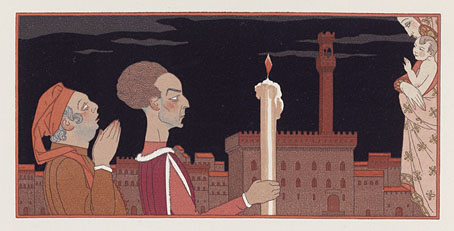
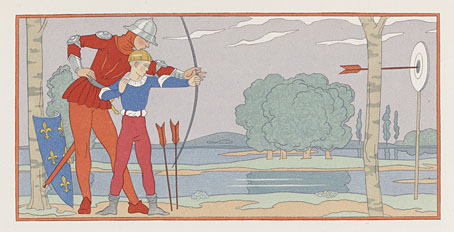
From the age of twelve he served Charles VII as an archer, for he was brought up by men-at-arms in the flat country of Normandy and the circumstance of his adoption was the following. When the armies came through that region, burning barns, skinning the legs of peasants with their sheath-knives and flinging young girls down broken on their beds, Alain was hid in an empty cask at the door of a wine press, and when the soldiers tumbled the cask upside down they found him. They carried him away just as he was, in his shirt and his perky petticoat, to the captain of the troop, who gave him a little leather jacket and a cape that had been through the battle of Saint-Jacques. Perrin Godin taught him how to draw a bow and how to gamble at cards. In this company he passed through Bordeaux, Angouleme and Poitou to Bourges; saw SaintPourcain where the king sat beyond the marches of Lorrain; visited Tout; returned to Picardy; entered Flanders; crossed SaintQuentin and turned again toward Normandy. During his twenty-three years of military travel he met the Englishman,Jehan Poule-Cras, from whom he learned British curses; Chiquerello the Lombard, who instructed him in the cure of Saint-Anthony’s fire; and young Ydre de Laon, who taught him how to pull down breastworks. 

Empedocles by Marcel Schwob


Empedocles


EMPEDOCLES

Supposed God 

by Marcel Schwob


Marcel Schwob / Empédocle

Marcel Schwob / Empédocles


 No one knows in what manner he was born or how he came upon the earth. He appeared near the golden banks of the river Acragas, in the good city of Agrigentum, a little after the time Xerxes had the sea beaten with chains. Tradition tells only that his grandfather named him Empedocles; nothing more is known. Undoubtdly he was said to be self-conceived, for he was admittedly a god. His disciples were sure that before visiting in his glory the Sicilian lands, he had already passed through four existences, having been plant, fish, bird and girl. He wore a purple mantle with his long locks falling over it; he had a fillet of gold around his head, on his feet were brazen sandals, and he carried a garland of fleece and laurel intertwined. 
Wednesday, September 13, 2023

Crates by Marcel Schwob


Crates
Illustration by George Barbier

CRATES

Cynic

by Marcel Schwob


Marcel Schwob / Cratès

Marcel Schwob / Crates


Born at Thebes, he was a disciple of Diogenes and he also knew Alexander. From his father, a wealthy man named Ascondas, he inherited two hundred talents. Then one day, while attending a tragedy by Euripides, he beheld a vision. He saw Telephy, King of Mysia, dressed in beggar’s rags with a basket in his hand. So Crates stood up on his feet there in the theater, declaring he would give the two hundred talents of his inheritance to all who wanted the money. Henceforth, he said, the garb of King Telephy would suffice him. Shaking with laughter, the Thebans trooped before his house where they found him laughing even louder than they. After throwing all his money and furniture out of the windows he took up a plain cloak and a leather sack and went away. 

Petronius by Marcel Schwob


Petronius
Illustration by George Barbier


PETRONIUS

Romancer

by Marcel Schwob


He was born in the days when greengarbed clowns used to sit around a fire roast¬ ing young pig; when bearded porters in cherry-colored tunics squatted by the gay mosaics at villa gates, shelling peas into silver platters; when rich freedmen played politics in the towns of Provence; when minstrels sang their epic poems to the desert; and when the Latin language was stuffed with redundant words and puffed-up names from Asia. 

Paolo Uccello by Marcel Schwob


Paolo Uccello
by George Barbier


PAOLO UCCELLO

Painter
by Marcel Schowob


Marcel Schwob / Paolo Uccello


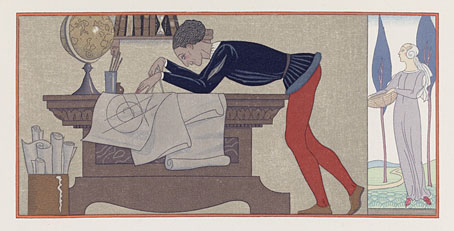
His real name was Paolo di Dono, but the Florentines called him Uccelli or Paul of the Birds because of the many bird figures and painted beasts in his house, for he was too poor to feed live animals or to obtain those strange species he did not know. At Padua he was said to have executed a fresco of the four elements, with an image of a chameleon representing the air. He had never seen one, so he made it a sort of pot-bellied camel with a gaping snout (while the chameleon, explains Vasari, resembles a small dry lizard and the camel is a great humped beast). Uccello was not concerned with the reality of things but in their multiplicity and the infinity of their lines. He made fields blue, cities red, and cavaliers in black armor on ebony horses with blazing mouths, the lances of the riders radiating toward every quarter of the heavens. He had a fancy for drawing the mazocchio, a headdress made of wooden hoops so covered that the cloth fell down in pleats all about the wearer’s face. Uccello drew pointed ones and square ones and others in pyramids and cones, following every intricacy of their perspectives so studiously as to find a world of combinations in their folds. The sculptor Donatello used to say to him: “All, Paolo, you leave the substance for the shadow.” 

Tuesday, September 12, 2023

Lucretius by Marcel Schwob


Lucretius
George Barbier


LUCRETIUS

Poet

by Marcel Schwob


Marcel Schwob / Lucrèce

Marcel Schwob / Lucrecio


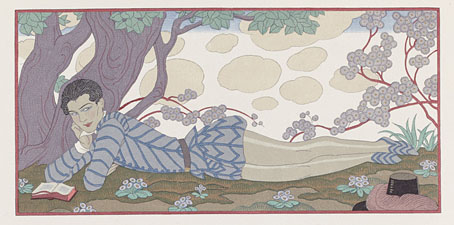
Lucretius belonged to a great familylong retired from public life. Memories of his early days recall the dark porch of a house far up on a mountain, a bleak atrium and silent slaves. From childhood he heard nothing but scorn of politics and men. Memmius, a noble of his own age, played with him in the forest—played whatever games Lucretius commanded. Together they stood astonished before the gnarled faces of old trees or watched the leaves trem¬ bling in the sunlight—light vibrant and virile, strewn like a veil with dust of gold. Often they gazed on the striped backs of wild pigs rooting in the soil, and sometimes in their walks they met a murmurous swarm of bees or a caravan of marching ants. Emerging one day from a dense underbrush they found themselves in a clearing set all around with ancient oaks so nicely placed that the circle of their tops formed a pool of clear blue sky above. The tranquillity of this spot was infinite. They were, it seemed, in a wide path leading straight to the divine depths of the heavens. Lucretius was touched by the calm benediction of the spaces.

Erostrato by Marcel Schwob


Erostrat


EROSTRAT

Incendiary

by Marcel Schwob


 With her two river harbors the city of Ephesus, birthplaceof Herostratos, stretched across the mouth of the Cayster as far as Panorama Quay. From there the shores of Samos could be seen in a misty line along the dark sea horizon. Wealthy in gold, in stuffs and in roses, Ephesus prospered now, since the Magnesians with their dogs of war and their javelineers had been vanquished on the banks of the Meander, and Miletus the Magnificent destroyed by the Persians. Relaxed during these days of peace, Ephesus feted courtesans in the temple of Aphrodite Hetaira. Citizens arrayed them¬ selves in tunics of amorgine, in transparent garments of spun linen tinted violet, purple and crocodile green. They wore sarapides the color of yellow apples or white or rose, and Egyptian fabrics in hyacinth shades, shot with flame hues and the changing tints of the sea. Their Persian calasiris were of finest crinkled tissues besprinkled with clus¬ ters of tiny golden beads. 

Monday, September 11, 2023

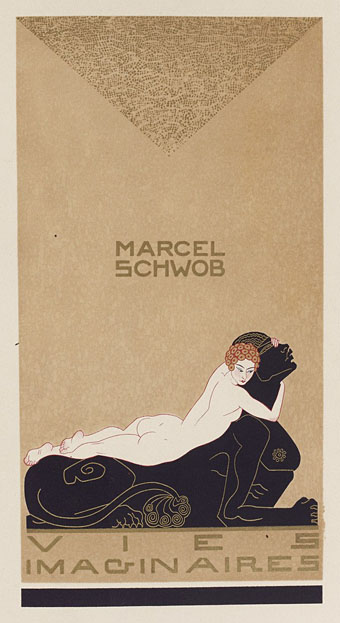
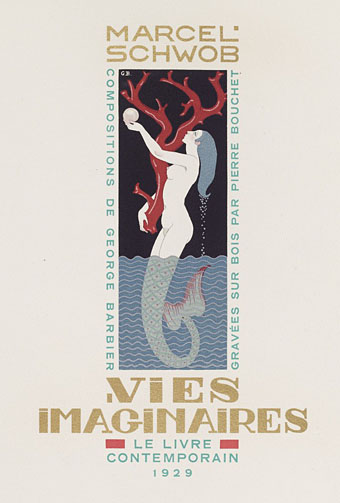
George Barbier’s Imaginary Lives


barbier-schwob01.jpg

George Barbier’s Imaginary Lives

It’s always satisfying when one perennial subject here connects to another. Imaginary Lives is a story collection by Symbolist writer Marcel Schwob that George Barbier lavishly illustrated in a new edition published in 1929. Wikipedia has a précis which conveniently explains the connection:

Imaginary Lives (original French title: Vies imaginaires) is a collection of twenty-two semi-biographical short stories by Marcel Schwob, first published in book form in 1896. Mixing known and fantastical elements, it was one of the first works in the genre of biographical fiction. The book is an acknowledged influence in Jorge Luis Borges’s first book A Universal History of Infamy (1935). Borges also translated the last story “Burke and Hare, Assassins” into Spanish.

barbier-schwob02.jpg

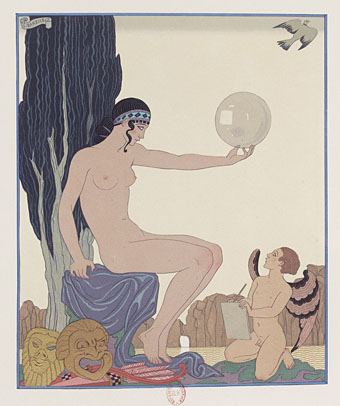
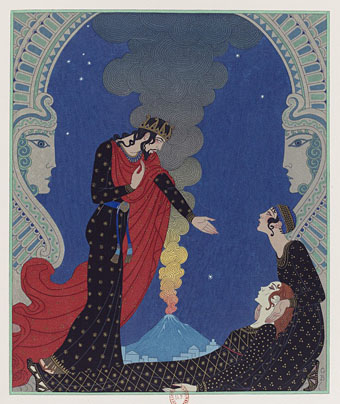
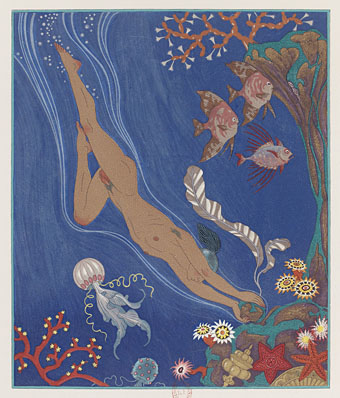
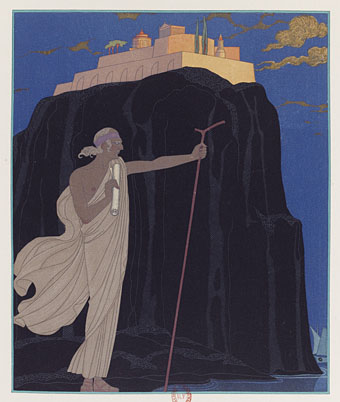
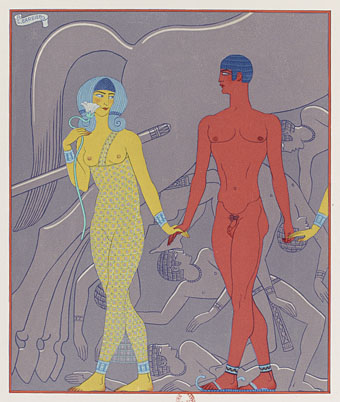
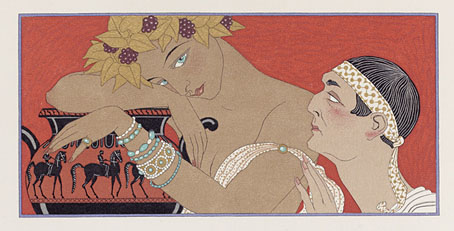
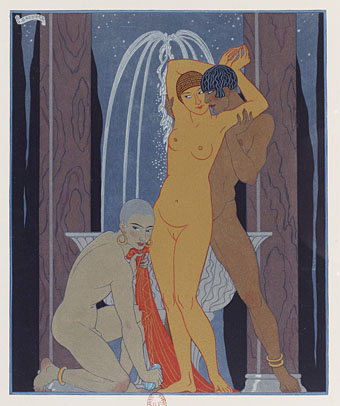
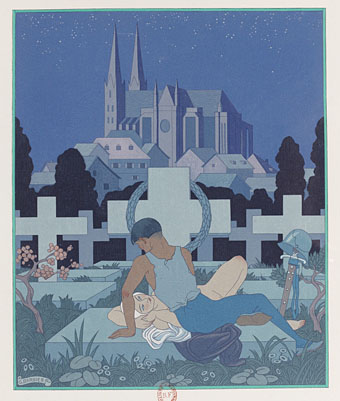
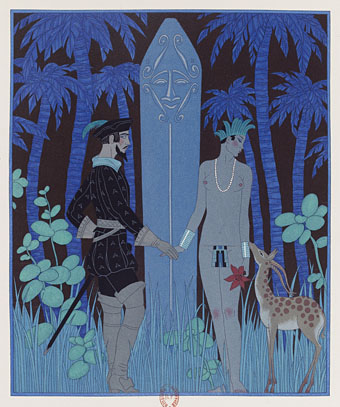
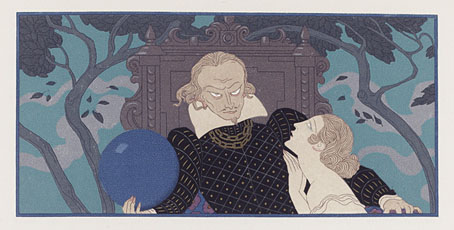
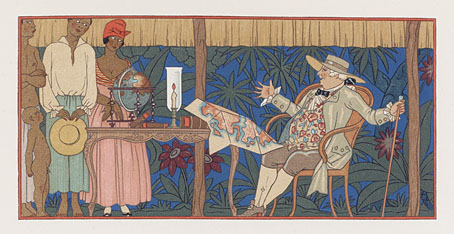
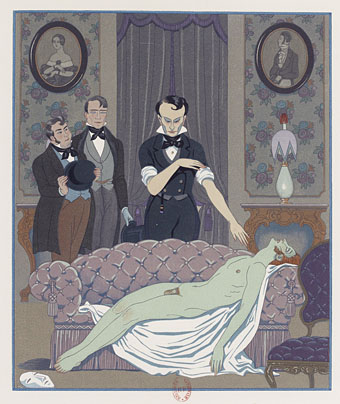
This is one of the best of Barbier’s illustrated editions, and the only one which allows him to combine his favoured references to the graphic styles of the ancient world with those of later centuries. The nude figures are also more explicitly detailed than in his earlier drawings, something only seen previously in his illustrations for an overtly erotic title, Les Chansons de Bilitis by Pierre Louÿs. The final full-page illustration is a further departure for the generally light-hearted Barbier, a drawing that so closely resembles something from Edgar Allan Poe it makes me wish he might have attempted a Poe edition of his own.

barbier-schwob03.jpg

barbier-schwob04.jpg

Empedocles, Supposed God.

barbier-schwob05.jpg

Erostate, Incendiary.

barbier-schwob06.jpg

Crates, Cynic.

barbier-schwob07.jpg

Septima, Enchantress.

barbier-schwob08.jpg

Lucretius, Poet.

barbier-schwob09.jpg

Clodia, Immodest Matron.

barbier-schwob10.jpg

Petronius, Novelist.

barbier-schwob11.jpg

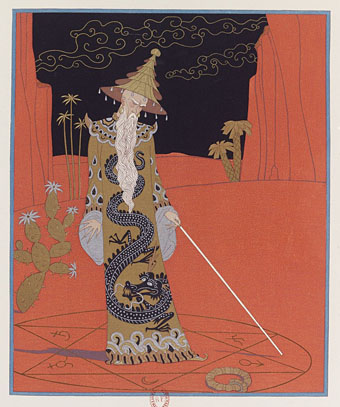
Sufrah, Geomancer.

barbier-schwob12.jpg

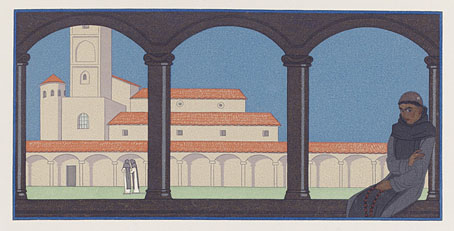
Fra Dolcino, Heretic.

barbier-schwob13.jpg

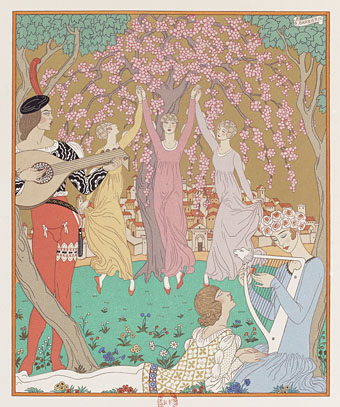
Cecco Angiolieri, Hateful Poet.

barbier-schwob14.jpg

Paolo Uccello, Painter.

barbier-schwob15.jpg

Nicolas Loyseleur, Judge.

barbier-schwob16.jpg

Katherine the Lacemaker, Girl of the Streets.

barbier-schwob17.jpg

Alain the Gentle, Soldier.

barbier-schwob18.jpg

Gabriel Spenser, Actor.

barbier-schwob19.jpg

Pocahontas, Princess.

barbier-schwob20.jpg

Cyril Tourneur, Tragic Poet.

barbier-schwob21.jpg

William Phips, Treasure Hunter.

barbier-schwob22.jpg

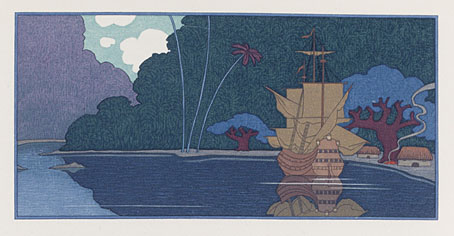
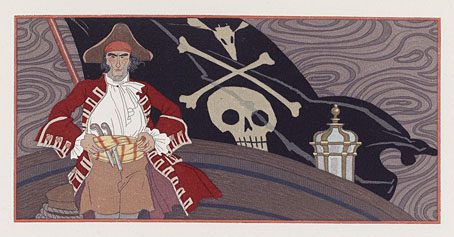
Captain Kidd, Pirate.

barbier-schwob23.jpg

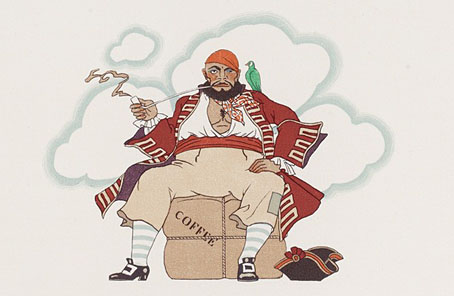
Walter Kennedy, Illiterate Pirate.

barbier-schwob24.jpg

Major Stede Bonnet, Pirate by Fancy.

barbier-schwob25.jpg

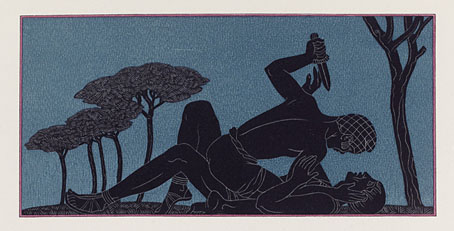
Mr. Burke and Mr. Hare, Assassins.


JOHN COULHART

Marcel Schwob / Imaginary Lives / Review

Marcel Schwob

IMAGINARY LIVES

by Marcel Schwob

“Won’t the dead come to talk for just half an hour with this sick man?” – Marcel Schwob’s Imaginary Lives Remixed


Chris Clarke’s recent translation of Marcel Schwob’s Imaginary Lives (Vies Imaginaires, 1896), the first English version in more than a quarter century, brings this remarkable book to a new generation of Anglophone readers. Though the influence of Schwob’s work extends widely, from Max Jacob to Rainer Maria Rilke to William Faulkner, Imaginary Lives in particular took hold in South America, where Jorge Luis Borges used it as a model for his A Universal History of Infamy, which in turn inspired J. Rudolfo Wilcock’s comic masterpiece The Temple of Iconoclasts and Roberto Bolaño’s Nazi Literature in the Americas

Marcel Schwob / Decadent Prose / An Interview with Translator Kit Schluter


Decadent Prose
An Interview with Translator Kit Schluter

By Sarah Gerard

April 10, 2013


marcel_schwobIt is 1891. Marcel Schwob, a well-know author, meets a “girl of the streets” in the rain, in a slum of Paris. Her name is Louise, and she is sick with tuberculosis. He takes her home and cares for her. He writes her stories—fairy tales—which she loves. They grow close. Louise shows Marcel the beauty of innocence. Two years later, she dies. He is crippled by his grief. For six months, he doesn’t write.

Then, he publishes The Book of Monelle, a groundbreaking work of decadence. An assemblage of fairy tales, nihilist philosophy, and aphorisms tightly woven into a tapestry of deep emotional suffering, it becomes the unofficial bible of the French Symbolist movement. Schwob influences writers and thinkers from Alfred Jarry to André Gide to Stéphane Mallarmé to Jorge Luis Borges and Roberto Bolaño. Translated obscurely into English in 1927, The Book of Monelle all but falls into obscurity shortly thereafter.

Sunday, September 10, 2023

Paris street named in honour of artists who lived in Jersey


Claude Cahun


Paris street named in honour of artists who lived in Jersey

27 November 2018

Claude Cahun, who was born Lucy Schwob, is regarded as one of the most important photographers of the 20th century, and there has been a resurgence in her work since the mid-1990s when Jersey Heritage acquired her collection.

Overlooked No More / Claude Cahun, Whose Photographs Explored Gender and Sexuality


“Que me veux-tu?” by Claude Cahun, 1928.

Credit...Claude Cahun, Musée d'Art Moderne de la Ville de Paris


Overlooked No More: Claude Cahun, Whose Photographs Explored Gender and Sexuality


Society generally considered women to be women and men to be men in early-20th-century France. Cahun’s work protested gender and sexual norms, and has become increasingly relevant.

Overlooked is a series of obituaries about remarkable people whose deaths, beginning in 1851, went unreported in The Times. This month we’re adding the stories of important L.G.B.T.Q. figures.


By Joseph B. Treaster
June 19, 20l19

In early-20th-century France, when society generally considered women to be women and men to be men, Lucy Schwob decided she would rather be called Claude Cahun.

A ghost in kiss curls / How Gillian Wearing and Claude Cahun share a mask


Claude Cahun


A ghost in kiss curls: how Gillian Wearing and Claude Cahun share a mask

The National Portrait Gallery is bringing together the works of two artistic visionaries exploring the complexities of identity in different eras


Adrian Searle
Sunday 8 January 2017


W

ith hearts on her cheeks, kiss curls on her forehead and cupid’s bow lips, Claude Cahun stares out at us in a small black and white photograph, taken in 1927. Her gaze is steady. Do you dare look at me, she seems to say, meeting the photographer’s gaze. The phrase I AM IN TRAINING DON’T KISS ME is emblazoned on her leotard. Her outfit makes me think of a circus act.

Claude Cahun / Finding a lost great

Claude Cahun


Claude Cahun: Finding a lost great

This article is more than 11 years old


Far too complicated and singular for her own good, she was also – as Breton said – 'one of the most curious spirits of our time'

Gavin James Bower

14 February 1012

A

writer born into literary royalty, with a pseudonym to hide the fact; a forebear of Cindy Sherman, with only one self-portrait published in her lifetime; a lesbian in love with her step-sister; a Jewish, Marxist Surrealist – Claude Cahun is probably the most complicated artist you and I have never heard of.

Saturday, September 9, 2023

William Boyd / Unmasking Graham Greene


Graham Greene

Unmasking Graham Greene

Graham Greene was the consummate literary professional. But a new biography shows how profound mental instability shaped his chaotic private life. 

BY WILLIAM BOYD 
9 DECEMBER 2020


In the early summer of last year, I found myself on the Cote d’Azur – in Antibes, to be precise – with a couple of hours to spare. Spontaneously, I decided to try to find the apartment block in the town where Graham Greene had lived for the last ­decades of his life – the Résidence des Fleurs on the Avenue Pasteur. I found the street and the apartment block without too much difficulty.

Love Is Blind by William Boyd review / A rapturous return to form


Love Is Blind by William Boyd review – a rapturous return to form

 
This audaciously unpredictable tale of passion and pianos in 1880s France and Russia is worthy of adulation

Alexander Larman
Monday 3 September 2018

I
n his latest novel, Love Is Blind – his 15th – William Boyd has pulled off an audaciously cunning trick, a literary bait and switch that both delights and surprises. At first glance, this historical travelogue-cum-romance follows in the vein of Boyd’s earlier successes such as Any Human Heart and Waiting for Sunrise, being a beautifully written and deeply humane account of its protagonist’s journey through a specific historical period: in this case, fin-de-siècle Scotland, France and Russia. Yet there is also a sense of mischief and playfulness imbued into its narrative that takes the form of several elaborate homages to other books and stories. If one never noticed, this would still be a thoroughly enjoyable read. Yet much of the pleasure here is in the gleeful way that Boyd dares the reader to draw parallels with other works (including his own), before throwing in a surprising or audacious reversal.

William Boyd / “In another life, I might have made a good spycatcher”


William Boyd

William Boyd Q&A: “In another life, I might have made a good spycatcher”

The author discusses his memories of Ghana, childhood literary heroes and the weather forecast. 


14 October 2020


William Boyd was born in Accra, Ghana, in 1952. He is the author of 16 novels and a winner of the Whitbread Literary Award. Between 1981 and 1983 he was the New Statesman’s television critic.