Tuesday, March 8, 2022

Isaac Babel’s Powerful Humor


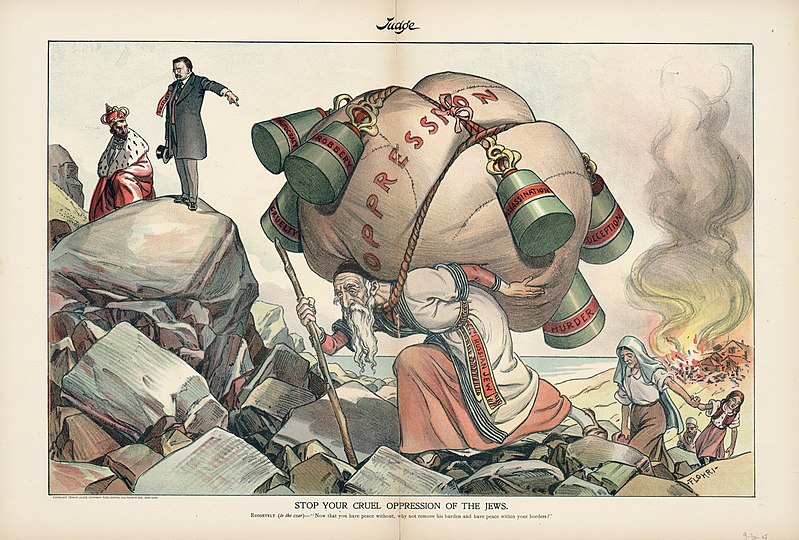
cartoon with the caption "stop your cruel oppression of the jews" - the image shows a mother with a child feeling a burning village being guided away by an elderly man who carries a large, weighted load labelled "oppression" - a man in a suit and a Russian Czar look on

Isaac Babel’s Powerful Humor


SUSAN KELLAM
February 5, 2020

Isaac Babel would witness pogroms in his youth, live through times of disdain for Jews and intellectuals—of which he was both—and die at the hands of Stalin’s secret police. Nonetheless, this master of the short story accomplished much. Babel’s intricately styled literary voice tangos with humor in its many forms, from subtle irony to outrageous characters and clever dialogue to jocular plot twists; his stories were, as a result, guaranteed popularity and an immortal place in literature despite their being banned in the Soviet Union from his death in 1940 to 1954, and censored until Glasnost. Now, with antisemitism on the rise worldwide, reading Babel reinforces the power of wit when challenging hatred.

Guy de Maupassant by Isaac Babel


Guy de Maupassant

Guy de Maupassant
by Isaac Babel

Translated from the Russian by Val Vinokur


In the winter of 1916 I found myself in Petersburg with a forged passport and not a penny to my name. I found shelter with a teacher of Russian literature — Alexey Kazantsev.

He lived in Peski on a yellow, frozen, foul-smelling street. He supplemented his meager salary by doing translations from the Spanish; at the time, Blasco Ibáñez was just becoming famous.

Monday, March 7, 2022

The Story of My Dovecot by Isaac Babel

Dove, 1949
Pablo Picasso

The Story of My Dovecot

by

Isaac Babel

Isaak Bábel / Historia de mi palomar


                                                                                                            To M. Gorky

When I was a kid I longed for a dovecot.  Never in all my life have I wanted a thing more.  But not till I was nine did father promise the wherewithal to buy the wood to make one and three pairs of pigeons to stock it with.  It was then 1904, and I was studying for the entrance exam to the preparatory class of the secondary school at Nikolayev in the Province of Kherson, where my people were at that time living.  This province of course no longer exists, and our town has been incorporated in the Odessa Region.

Crossing the Zbrucz by Isaac Babel


Crossing the Zbrucz
by Isaac Babel


THE SIXTH DIVISION commander reported that Novograd-Volynsk was taken today at dawn. The staff has moved out of Krapivno and our transport sprawls in a noisy rearguard along the highway that runs from Brest to Warsaw and was built on the bones of peasant men by Nicholas the First.

Sunday, March 6, 2022

Salt by Isaac Babel


Babel
Salt by Isaac Babel


Dear Comrade Editor, I want to tell you of some ignorant women who are harmful to us. I set my hopes on you, that you who travel around our nation's fronts, have not overlooked the far-flung station of Fastov, lying afar beyond the mountains grand, in a distant province of a distant land, where many a jug of home-brewed beer we drank with merriment and cheer. About this aforementioned station, there is much you can write about, but as we say back home: you can shovel til the cows come home, but the master's dung heap never gets no smaller. So I will only describe what my eyes have seen in person.

Awakening by Isaac Babel


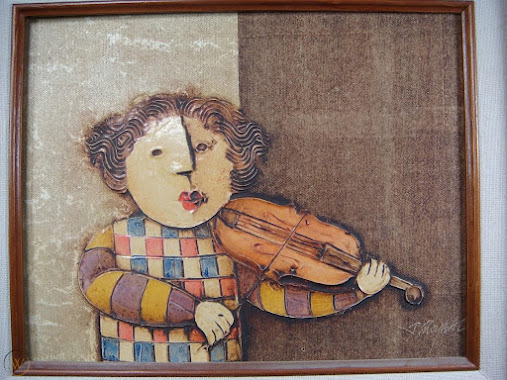
Ilstration by J. Roybal

Awakening 

by Isaac Babel


Translated from the Russian by Maxim D. Shrayer.


All the people in our circle—brokers, shopkeepers, bank clerks, and steamship office workers—taught their children music. Our fathers, seeing no future for themselves, came up with a lottery. They played it out on the bones of little people. More than any other city, Odessa was possessed with this madness. And it’s true—for decades our city supplied the concert halls of the entire world with wunderkinds. Mischa Elman, Zimbalist, Gabrilowitsch came from Odessa, and Jascha Heifetz started out in our city.

My First Goosen by Isaac Babel


My First Goosen 

by Isaac Babel

Translated by Peter Constantine

Savitsky, the commander of the Sixth Division, rose when he saw me, and I was taken aback by the beauty of his gigantic body. He rose — his breeches purple, his crimson cap cocked to the side, his medals pinned to his chest — splitting the hut in two like a banner splitting the sky. He smelled of perfume and the nauseating coolness of soap. His long legs looked like two girls wedged to their shoulders in riding boots.

Saturday, March 5, 2022

‘Odessa’ by Isaac Babel


Isaac Babel


‘Odessa’ by Isaac Babel

Translated by Val Vinokur
Photo by Igor Sytnik

Odessa is a nasty town. Everybody knows this. Instead of saying “what’s the difference,” over there they say, “what’s the differences,” and also, instead of “here and there,” they say, “hayr and thayr.” But still, it seems to me you could say a lot of good things about this important and most remarkable city in the Russian Empire. Just consider – a city where life is simple and easy. Half of the population consists of Jews, and Jews are people who are sure about a few basic things. They get married so they won’t be lonely, make love so they will live forever, save up money to buy their wives astrakhan jackets, love their offspring because, after all, it’s very good and important to love one’s children. Poor Jews in Odessa can get very confused by officials and official forms, but it isn’t easy to shift them from their ways, their fixed and ancient ways. Shift they will not, and one can learn a lot from them. To a significant degree, it is thanks to their efforts that Odessa has such a simple and easygoing atmosphere.

The Art and Science of Translating Babel


The Art and Science of Translating Babel


By Val Vinokur 
April 5, 2016

In 1929, the great American literary critic Lionel Trilling read a book “about Soviet regiments of horse operating in Poland” that disturbed him, charged, as it was, with an “intensity, irony, and ambiguousness” of the kind that the usually placid academic wished to avoid. That disturbing book was Nadia Helstein’s 1929 translation of Isaac Babel’s Red Cavalry (1926). Ernest Hemingway confessed: “Babel’s style is even more concise that mine,” proving that “even when you’ve got all the water out of them, you can still clot the curds a little more.” Trilling’s sensibility could not be more different from that of Hemingway, but they both seemed to find kindred interests in Babel. Hemingway had also read the Helstein edition, and also owned the 1955 Walter Morison translated edition of Babel’ Collected Stories. The generally ignored publisher’s note on the first page of that edition – now out of print for more than two decades – complicates its provenance:

The stories in the section entitled Red Cavalry, with the exception of “Argamak,” were originally published in Nadia Helstein’s translation by Alfred A. Knopf, Inc. in 1929; they have been revised by Walter Morison for this edition. “The Sin of Jesus” was translated by Mirra Ginsburg; “First Love” by Esther and Joseph Riwkin; and “Guy de Maupassant” by Raymond Rosenthal and Waclaw Soski. All the other stories have been translated by Walter Morison.

Friday, March 4, 2022

Dear Mr Joyce / An essay by Edna O’Brien

James Joyce


Dear Mr Joyce: an essay by Edna O’Brien

As Ulysses turns 100, O’Brien tries to pin down what its extraordinary author was really like


Edna O'Brien
Wednesday 2 February 2022


Was he garrulous? Did he wear a topcoat? Did he hanker after renown? Such questions we ask ourselves about the deceased great, trying in our forlorn way to identify with them, some point of contact, some malady, some caprice that brings us and them closer. Such questions are not satisfactorily answered in works of fiction, writers being by necessity conjurors, ex-lovers are unreliable, friends overreaching, enemies bilious, so the closest we can get to a legendary figure is from letters. Letters are like the lines on a face, testimonial. In this case they are the access to the man that encased the mind, which housed the genius of James Joyce.

Where to start with: James Joyce


James Joyce

Where to start with: James Joyce

Always wanted to tackle the great Irish writer but not sure Ulysses is for you? This handy primer may just help you find a way in


Justin Jordan
Friday 18 February 2022

The books of James Joyce, along with Middlemarch and War and Peace, were among the titles that many vowed to read when the UK was plunged into its first coronavirus lockdown. Almost two years later, we now know that most of us filled all that time indoors with Netflix and Zoom quizzes rather than catching up on lengthy classics (apart from the author David Mitchell, who did read Ulysses in 2020). But with this month marking the centenary of Ulysses and 140 years since Joyce’s birth, perhaps now really is the time to familiarise or re-familiarise yourself with the influential modernist writer.

Thursday, March 3, 2022

James Joyce's Amazing Chronicle

James Joyce


banner 


May 28, 1922
James Joyce's Amazing Chronicle
By Dr. JOSEPH COLLINS

ULYSSES By James Joyce. 

A
few intuitive, sensitive visionaries may understand and comprehend "Ulysses," James Joyce's new and mammoth volume, without going through a course of training or instruction, but the average intelligent reader will glean little or nothing from it- even from careful perusal, one might properly say study, of it- save bewilderment and a sense of disgust. It should be companioned with a key and a glossary like the Berlitz books. Then the attentive and diligent reader would eventually get some comprehension of Mr. Joyce's message.

Sylvia Beach and James Joyce / Books and their Makers


BOOKS AND THEIR MAKERS

SYLVIA BEACH AND JAMES JOYCE

The New yorker, march 5, 2010
The chattering masses these days are always on about the demise of publishing, by which they mean the vast ramshackle apparatus that churns out hundreds of thousands of inexpensive titles each year, many of which will see the light of fewer than a hundred pairs of eyes. Focussing on the macro is often depressing, any way you approach it: it's sad that the industry is shrinking, because casting a wide net perhaps ensures that the best fish are caught; but casting a wide net also means that a prize catch might not be properly fileted (to take the metaphor a bit too far). If you spend much time, as I do, talking with writers of books that have been published, you will soon acquire the ability, during a conversation about their experience, to predict what they are going to say, even to have their side of the conversation for them. "I had to do my own copy-editing," "I wanted a different title," "I hate the cover art," "It took three years to get my book out." Et cetera. On the other hand, some of the most brilliant people I know are book editors, who work quite literally day and night on behalf of their authors. They have, of course, their own set of complaints.

Thirty years' editorial labours produce 'more comprehensible' Finnegans Wake


Thirty years' editorial labours produce 'more comprehensible' Finnegans Wake

After 9,000 emendations to James Joyce's notoriously impenetrable novel, a 'smoother' new edition is promised
The editors' copy of Finnegans Wake
The editors' copy of Finnegans Wake. Photograph: Nick O'Neil

Thirty years of work and 9,000 amendments later, a new edition of James Joyce's most perplexing novel, Finnegans Wake, is promising to provide readers with a smoother, more comprehensible version of the author's final work.
On its publication on 4 May 1939, a review of the book in the Guardian despaired of making sense of it. Pointing to a sample from the book – "Margaritomancy! Hyacinthous pervinciveness! Flowers. A cloud" – reviewer B Ifor Evans said that "the work is not written in English, or in any other language, as language is commonly known". "In 20 years' time, with sufficient study and with the aid of the commentary that will doubtless arise, one might be ready for an attempt to appraise it," he wrote. "Compared with this, Ulysses is a first-form primer."

Dangerous, voyeuristic, transgressive, exciting / Anne Enright on James Joyce’s Ulysses at 100


Dangerous, voyeuristic, transgressive, exciting: Anne Enright on James Joyce’s Ulysses at 100


My mother considered it a dirty text, but this profoundly democratic book has liberated female Irish authors


Anne Enright
Saturday 29 January 2022


When I was young, growing up in Dublin, Ulysses was considered the greatest novel in the world and the dirtiest book ever written. I bought a copy as soon as I had money and it was taken away from me when my mother discovered me reading it – though Lolita, for some reason, had passed unnoticed in our house. I was 14. I was outraged, and delighted with myself, and a little confused. Ulysses contained something worse than sex, clearly, and I did not know what that could be.

Wednesday, March 2, 2022

George Saunders’s Humor

George Saunders


George Saunders’s Humor


By The New Yorker
June 19, 2014

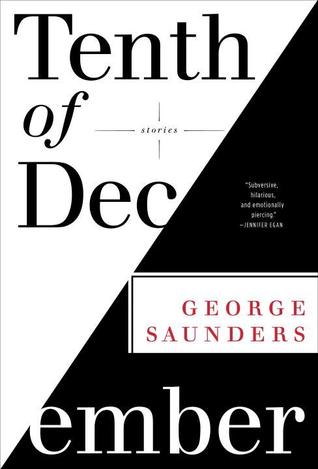
The forthcoming book “Poking a Dead Frog: Conversations with Today’s Top Comedy Writers,” by the humor writer and journalist Mike Sacks, includes interviews, advice, and “ultraspecific comedic knowledge” from several dozen comedians, filmmakers, and writers, including Mel Brooks, Amy Poehler, Roz Chast, and one of contemporary fiction’s funniest writers, George Saunders. In the conversation below, Saunders talks to Sacks about his family’s sense of humor, the connection between satire and compassion, his early comedy influences, and how he came to embrace the funny side of his writing.

Short Stories of the Month / Munro, Lahiri, Sanders

George Saunders


Short Stories of the Month:

Munro, Lahiri, Saunders September 2014


By Bennard Fajardo
August 29, 2014


Why short stories? Not even short story collections or anthologies but stand-alone, honest-to-goodness short stories. After all, the novel has often been treated as the measure of an author’s greatness and his/her short stories considered as afterthoughts or, worse, decorative paraphernalia in a career of writing. People talk about the Great American Novel but rarely about the Great American Short Story. The Russians have always been more known for writing dense and weighty tomes even though they arguably have the most acclaimed short story writer of all-time. Critics and writers alike have even considered short stories as the prelude to a career devoted to writing novels.The short story, in short, has always been regarded as the novel’s lesser sibling.

Interview with George Saunders


George Saunders


Interview with George Saunders

Posted by Goodreads on February 6, 2017

On February 20, 1862, Abraham Lincoln's 11-year-old son, Willie, died. The president, already drained from the ongoing Civil War, was distraught—so much so that, a few days later, he allegedly went into the crypt where his son's body was interred and took it out of its coffin. Comfort, anguish, sorrow—nobody has ever been quite sure why Lincoln did it, or even if he did. The tale may be apocryphal.

George Saunders couldn't get the story out of his head.

The Tenth of December author and short story master made several false starts at the emotional material before finally settling in to write something unusual for him: a novel. The result, Lincoln in the Bardo, uses a variety of voices—historical accounts, Lincoln acquaintances, cemetery spirits of many eras and backgrounds—to express something both personal and universal about that one night in 1862.

Interviewer Todd Leopold caught up with Saunders, who also teaches fiction at Syracuse University, on a phone call from Watsonville, California.


Goodreads: Why the Buddhist "bardo"? Why not "Lincoln in Purgatory"? Or "Lincoln in Limbo"?

George Saunders: I was raised Catholic, and my understanding of purgatory is, you go there until you kind of work off your sins. The distance you are from God is a form of terrible punishment, and after many, many years of this, you can escape. To me that was a little bit—it's like jail. But the bardo idea, the way I reimagined the bardo, you're there kind of by your own consent, in the sense that as long as you continue to have a deluded or confused idea about who you are, you're going to stay there. So these beings are free to leave at any time if they only have the correct realization about their own nature. All they have to do is recognize that they're dead and recognize that they're temporary, and then they can be freed.

GR: I was struck by the structure of the book. In the way the book is told by multiple narrators, I'm reminded of oral history. It's also been compared to a Greek chorus, and I even thought of something experimental like William Gaddis's JR. Were these in your mind, or did the structure come naturally?

GS: Strangely, the answer would be both. The way my mind works is that everything I've ever read or seen in a movie, it's in the hopper.

Sometimes a work of art is just trying to solve a problem. In this case, if I believed Lincoln went into that crypt, then that was really an interesting problem—and it caused a bunch of associated technical problems. For example, Lincoln in the graveyard late at night—how do we know? Who would be there to narrate this for us? That's where the ghosts come in. Also, given that moment in the crypt—at least for me, as I imagined it, it was so charged with all the other stuff that was going on in the world and in Lincoln's life—there's a technical problem that says, we have to get that historical spine in there, or the moment won't be as meaningful.

It was hard work, but hard work always led to pretty steady progress. It's difficult after the fact to remember and re-create what happened—it was sort of a four-year frenzy.

GR: In the early chapters you apparently quote from historical accounts. But it turns out some of them were fictional.

GS: Originally the intention was to use the straight historical documents and cut those and arrange those into a narrative. And what happened is, when I did that, I noticed a kind of a mismatch between what was on the page and the version that had formed in my head over all those years. So if I have to smooth over the latticework a little bit by adding some things, then it's a novel and that's fair game.


GR: Were there rules to the bardo?

GS: That's actually what I was doing when I was revising. In some places you'll have, this thing happened on page 10 and this thing happened on page 60, and they don't make sense together, so you have to choose. And by making those choices, draft after draft, you start to codify those rules a little bit. The interesting thing is, when you submit to that, the book rewards your quest for specificity by paying you back with some meaningful action.

GR: Some of the ghost figures aren't conventional. Where did those visions come from?

GS: In some ways you're always drawing on your own work and bringing it forward. I had a book called The Brief and Frightening Reign of Phil, which is all about these sort of made-up objects. There I got in the habit if a character has a certain psychological component, is there a physical manifestation of that—if somebody is very rigid in his thinking, can he be made of plywood.

Also, I think writing is sometimes a form of me as the writer anticipating your possible objections as a reader. For example, the word "ghosts" never appears in the book because I don't want you thinking of these as ghosts. Because if you think of them as ghosts, you think of them as white sheets. Part of the game is for you to be slowly drawn in—what are these things exactly? And if you say, They're ghosts, the book is saying, Welllll, not exactly. Part of the compositional challenge is to recognize when you're treading in too-familiar territory, and when you're in the territory, try to shake it up somehow, if for no other reason than to reinvigorate the reader's interest in some way.

The second reason—which is actually the same reason—is that one of the challenges of this book was to make it a little fun. My instinct is, if I'm getting too straight in a narrative, is to jangle it up with humor somehow. In this case there was the added benefit that the physical weirdness of the characters had to do with their psychological reason for being there.

GR: One of your other works is the short story CivilWarLand in Bad Decline. Do you have a particular fascination with this era?

GS: Something about it is just cool to me. Maybe it's the idea that these mythical events that could be out of Homer happened here—where there's now a Chick-fil-A or a mall parking lot. That's always been interesting to me.

I tend to kind of go where my interest takes me without a whole lot of intellectualization about it. To get a work of fiction done, you have to be so deeply interested in it. If something is only intellectually interesting to me, it tends to not be enough to sustain a whole project. But if it's viscerally interesting—if I can get some good jokes out of it, or if there's a verbal reservoir available to me—then I know I can proceed.

GR: Let's get to reader questions. Several readers—EmilyJames FigyKayla—want to know the difference between writing short stories and writing a novel.

GS: I really had kind of decided NOT to write a novel. I was very proud of the fact that I was not a novelist and very content with being a short story guy. But this material had been nagging at me for all those years, and once I got started, it wasn't long before I realized it was going to be longer than 50 pages. I was constantly telling the book, "You'd better not bloat up. I want you to stay short. If you can be a story, I want you to be a story because you know that's what works for us." So in a sense the book kind of pushed me around a little bit and said, "No, I insist." I was excited to see it wasn't a whole different world. It was just on a slightly bigger frame.

GR: From Saira: I'm very interested in how Buddhism has changed Saunders's approach to storytelling.

GS: My experience has been that the principles that I would call Buddhist principles were in play from the very beginning. When I first learned to write stories and became halfway decent at it, I was surprised that the main move was, simply, read what you've got already and see how you're doing. And if you're not doing very well, then tweak. Instead of imposing my projections on this moment and deciding what it is, I'm going to be as nonjudgmental as possible and react accordingly.

GR: This one is from a person who calls himself the Other, Lesser George.

GS: Oh, I know him. That's me most days.

GR: Could you elaborate on the allure of the apocalyptic for you personally and humans generally?

GS: Yeah. Honestly, those stories are what result when I try to keep the stories lively on a line-to-line basis. Basically, what's fun. And then you pursue that for as long as it takes to get the story done. And you look up and you go, Oh wow, it's dystopian. Then I go, All right, that's something I believe, but maybe I didn't know I believed it.

I'm always sort of embarrassed to say this, but it's mostly just trying to make a really jangly interesting surface, and what I found if I concentrate on that, all the other stuff happens just fine.

GRBen Griffin wants to know about compassion, a theme of your work. He asks: At any point when you were writing [The New Yorker article] Who Are All These Trump Supporters? did you feel like the actions at the rallies were beyond compassion?

GS: Not actions I saw…Depending on how you define compassion, actions are never beyond compassion. Sometimes we misunderstand [compassion] as being this bland, kowtowing niceness: Somebody hits you in the head with a rock and you say, "Thank you so much for the geology lesson." But compassion in Eastern traditions is much more fierce. It's basically calling someone on their bullshit. At the heart of it there's a clarity that would say, If I could press a button and make that person see his own actions, that would be the best.

I'm just trying to be really watchful in my own heart for any kind of gratuitous negative emotion. I'm [thinking] Jesus was here, Buddha was here, Gandhi was here, Tolstoy was here, Mother Teresa was here, and they all said basically the same thing: Our capacity for understanding the other is greater than we think. It's not easy and we're not very good at it habitually, but we can get better at it and it's always beneficial. It's beneficial to you, and it's beneficial to the other. That's what I say—in real life I'm swearing under my breath on the internet.

GR: Who are some of your favorite writers, and what are you reading right now?

GS: I just read Zadie Smith's Swing Time, which I loved, Michael Chabon's Moonglow, an amazing book. I'm reading Mohsin Hamid's The Reluctant Fundamentalist, and I'm looking forward to [his] Exit West on Zadie's recommendation. I wrote an introduction for a kind of collected works of Bobbie Ann Mason, so it was wonderful to go back and read some of her work. I also did the same thing for Grace Paley recently. I'm doing an event with Colson Whitehead in February, so I've been holding The Underground Railroad back, and that's what I'm about to start.

GR: Are there influences you always come back to?

GS: There's a Russian writer named Isaac Babel that I love. I can drop in anywhere in his works, read a few pages, and go, Oh yeah, language. It's almost like if you were tuning a guitar and you heard a beautifully tuned one and you say, Yeah, that's what we want. We want something that perfect. When I read him, it recalibrates my ear. It reminds me of the difference between an OK sentence and a really masterful sentence. Isaac Babel does it for me.

    
GOODREADS


Tuesday, March 1, 2022

Fyodor Dostoevsky Draws In His Manuscripts / Art of The Doodler


Fyodor Dostoevsky Draws In His Manuscripts – Art of The Doodler


Do Fyodor Dostoevsky's drawings fond in his notebooks dhow us his state of mind and the creative process?

By Paul Sorene on August 29, 2021

More than 200 sheets of Russian writer Fyodor Mikhailovich Dostoevsky’s notebooks and manuscripts contain drawings, among them mainly portraits, sketches of Gothic windows and arches, arabesques and calligrams. Dostoevsky (11 November 1821 – 9 February 1881) did not make his doodles for public view. His graphics do not illustrate the corresponding novels but are pictorial notes that make a link or suggest a line of thought or character development, a form of non-verbal communication, essentially hermeneutic and surely impossible to fully interpret without asking the writer.

Missed Connections in “Dostoevsky in Love”


Missed Connections in “Dostoevsky in Love”


BY ROSS COLLIN
March 25, 2021

Across his fiction, journalism, and letters, Fyodor Dostoevsky spoke in many voices. He spoke as a radical who would face mock execution and years in prison for plotting against the tsar. He spoke as a Russian Orthodox believer excoriating liberal society for its smallness and lack of faith. He spoke as a prophet carrying the flame of Russian literature toward a new day. As Dostoevsky said of his novels but could have said of his life: many “stories get squashed into a single one so that there’s neither proportion nor harmony.”