Wednesday, September 12, 2012

10 myths of the UK's far right by Daniel Trilling


Nick Griffin … the BNP project has failed, but will a successor emerge?
Photograph: John Giles


10 myths of the UK's far right

Economic crisis and political complacency create a hothouse for racism, Daniel Trilling warns in a new book. Here he lists 10 dangerous misconceptions about the far right

Daniel Trilling
Wednesday 12 September 2012

The threat has passed.

To be clear: Nick Griffin's project has failed – but support for the BNP remains. The party never shook off its associations with neo-nazism and violence, and thanks in part to one of the largest anti-fascist mobilisations this country has ever seen, its support did not spread far beyond a hard core of voters. Yet, although the BNP was severely damaged as an organisation, and its morale was smashed at the 2010 general election, its support actually went up, with the party receiving 564,331 votes. This indicates a small but apparently solid base of support.

Griffin, along with the BNP's Andrew Brons, remains an MEP. Lower-level activists, meanwhile, have been searching for a new vehicle. Some die-hard neo-Nazis have rejoined the National Front, but after the 2010 election, several ex-members joined the English Democrats, a rightwing, anti-immigration party whose candidate was elected mayor of Doncaster in 2009. Others have taken organising roles within the English Defence League. In November 2011, the EDL publicly endorsed the newly formed British Freedom Party, set up by disgruntled BNP members. One British Freedom activist praised the "endless" possibilities of "a grassroots social movement (EDL) working in tandem with a political party (British Freedom)". In April 2012, British Freedom announced that the EDL's Stephen Yaxley-Lennon would be joining the party as its deputy leader.

The BNP's rise was a consequence of "too much" immigration.

Without doubt, "immigration" was the main reason voters chose the BNP. But it relied on the hugely distorted public perception of immigrants, created largely by inaccurate press coverage. A survey carried out by Oxford University's migration observatory in the autumn of 2011, for instance, found that members of the public were most likely to associate immigration with asylum seekers, or illegal immigrants, even though these only make up a tiny proportion of the total. Burnley, where the BNP saw its first breakthrough into local politics in 2002, has a declining population: it is a town of emigration, not immigration. There's a further problem: when a BNP supporter expresses an opposition to "immigration", are they referring to people who have newly arrived in the country? Or do they regard non-white Britons as immigrants, even though they may have been born in this country? As John Cave, a BNP activist from Burnley, told me, the reason the BNP existed was "to give people a chance to say they don't want multiculturalism, they don't want integration and they want, as [BNP founder John] Tyndall used to say, a white Britain". The BNP did well in some areas that were experiencing new immigration, such as Barking and Dagenham, but also in towns with settled non-white populations, such as Burnley or Stoke-on-Trent.

Racism only played a minor role in driving BNP support.

"I don't suggest that everyone who votes BNP is racist," said the Conservative shadow minister for communities Eric Pickles in 2009, the day after Griffin and Brons were elected to the European parliament. "If we do that, the BNP benefits." In one sense, Pickles was right: blanket condemnation of BNP voters by mainstream politicians would have been a strategic mistake. For peripheral supporters, tempted to vote for the BNP because of their dismay at a lack of housing or a feeling of being ignored by the three big parties, this would merely have confirmed their suspicion that politics was run by an uncaring elite.

But the best available information on the attitudes of BNP voters speaks for itself. According to a study by the academics Matthew Goodwin and Robert Ford, a significant proportion (between 31% and 45% of those surveyed) shared the BNP's biological racism – that black people, for instance, were intellectually inferior to white people. A greater number still (81%) held strongly hostile attitudes to Islam. The immigrants who most exercised BNP voters, and whom the BNP targeted most often with its propaganda, were non-white.

The argument that anti-Muslim prejudice is less of a problem since it is directed at religion rather than skin colour holds little weight: ever since Enoch Powell, the fear of alien cultures has been a central feature of racist discourse. Today, the cultural fear of Islam marshalled by the EDL slips easily into racist violence directed at "Pakis".

The BNP gained support by exploiting racism in combination with economic resentment. It targeted people who felt they had been passed over for housing, or for regeneration money, and resented the presence of "Africans" in their borough, or felt it was unfair for Asians to be given resources, even when they were demonstrably in greater need. When the BNP was defeated, it was by campaigners who offered voters a positive, non-racist alternative. "I'm not racist, but I don't think these Asians should get houses before us white people," is a racist statement – but kick away the economic grievance that underpins it, and you undermine the racism on which parties such as the BNP thrive.

White people in Britain are discriminated against because of their skin colour.

In January 2012, the evening after two of Stephen Lawrence's killers were finally convicted of murder, the black Labour MP Diane Abbott made an ill-advised comment on Twitter, in which she suggested that white people "love playing 'divide and rule' We should not play their game #tacticasoldascolonialism."

Soul-searching over the Lawrence case was put on hold as a range of rightwing commentators rushed to condemn Abbott for her "racism". Surely this was proof – just as the BNP argued – that racism "cuts both ways"? Well, no. As one defender of Abbott neatly put it: "I can imagine a world in which Diane Abbott's tweet … would be racist. In this parallel universe Britain is dominated, politically and economically, by an unshakeable clique of black, working-class women and two black men have just been convicted, several years too late, thanks to an institutionally racist black police force, of the murder of white teenager Stephen Lawrence."

In 21st-century England and Wales, you are 30 times more likely to be stopped and searched by police if you are black than if you are white. Black and Asian people in Britain remain at a statistical disadvantage in employment opportunities and access to housing. Anti-racism laws are intended to level the playing field. Complaining about "anti-white" discrimination, as the BNP has done, is in fact an attempt to preserve privilege rather than remove it. There are indeed ways in which some white people in Britain are unfairly held back, but these have nothing to do with their skin colour.

'Tough talk' keeps the far right at bay.

In the early 90s, when the Lib Dems in Tower Hamlets, east London, offered housing for "sons and daughters", it opened the way for the BNP to win a seat in Millwall. In 2000, when William Hague made immigration a national election issue for the first time since 1979, it did nothing to halt the early growth of the BNP. In 2002, when David Blunkett accused asylum seekers of "swamping" British schools, it did not stop the BNP making its breakthrough in Burnley. And when the Labour government then decided to "triangulate" BNP voters, the problem spread. In 2006, after Margaret Hodge claimed her constituents couldn't get homes for their children because of immigration, the BNP won 11 seats on Barking and Dagenham council. In 2009, when Gordon Brown promised "British jobs for British workers", workers threw the slogan back in his face, and the BNP went on to win two seats in the European parliament. In April 2011, David Cameron suggested that "immigration and welfare reform are two sides of the same coin … we will never control immigration properly unless we tackle welfare dependency".

Blaming immigrants for the failings of the welfare state only fuels the misperceptions that drive support for the far right. If people complain they can't get council houses, for instance, then the only honest question a politician can ask is: "Why aren't there more council houses?" If there are large numbers of people receiving unemployment benefit or tax credits, then the only honest question is: "Why is the economy failing to provide more jobs, or pay sustainable wages?"

Anti-racism has been imposed on the white working class by a  politically correct elite.

"I used to hate working there," Jim Brinklow told me, as we sat in his car at what was once the entrance to Ford's paint, trim and assembly plant in Dagenham. "But it breaks my heart to see it gone." During the 80s, Brinklow, a white east Londoner, worked on the assembly line at Ford, where he was a convenor for his trade union branch. While Dagenham, where most Ford workers lived, was a largely white area, many black and Asian workers from elsewhere in east London also had jobs at the factory. Most of them worked alongside Jim on the assembly line – regarded as the worst job at Ford – and found that they were blocked from taking better-paid jobs elsewhere on the site. "When I started at the plant," said Jim, "there was a lot of nastiness. Lots of racist graffiti on the toilet walls." The far right was also active: during the 80s, BNP member Tony Lecomber – the convicted bomber who would later become Griffin's head of group development – was employed as a foreman at the plant.

Brinklow and his fellow workers took a stand. "Two foremen were distributing a racist leaflet. So we went on strike, we stopped the production line. We said to the company, something's radically wrong here when you have two foremen distributing stuff like that. As a result Ford set up an equal-opportunities committee. We insisted on monthly meetings. They began advertising jobs in the local press, the black press. They set up a prayer room for Muslims. Then black Christians began to complain: 'What about us, we want a prayer room.' They got one."

This is what anti-racism looks like. Equal opportunities are not handed down from on high by Westminster bureaucrats; they have been fought for by ordinary men and women. Even at its peak, the BNP never spoke for anywhere near the majority of working-class white people – in Dagenham, or anywhere else.

The growth of the BNP and the emergence of the EDL indicate the failure of multiculturalism.

It can be tempting to see the BNP as evidence that Britain is becoming a nation of ethnic and cultural ghettos, where there are no-go zones for non-Muslims, and that communities are living increasingly parallel lives. In fact, as the statisticians Nissa Finney and Ludi Simpson argue in Sleepwalking to Segregation? the trend is in the opposite direction: ethnic minorities are spreading more evenly across Britain. What's more, areas of cities with concentrated ethnic minority populations tend not to be ghettos: think of Burnley, where even the Asian areas of Daneshouse and Stoneyholme are still around 40% white.

Yet the idea that Britain is a nation divided by race and culture, rather than wealth, persists across a wide range of rightwing and liberal opinion, with multiculturalism named as the culprit. Beneath these anxieties, however, exists the everyday, thriving multiculturalism of modern Britain; the result of our daily interactions with one another. Each one of us is unique, yet each one of us has habits and customs and ways of seeing the world that overlap. Culture is not a fixed set of attributes, nor is it handed down by decree; it's what we do. This is a fact that even the BNP was forced to accept.

That's why Griffin had to set up an ethnic liaison committee, and it is why, in the end, he had to tell his party to "adapt or die" and accept non-white members. The EDL is further evidence of how the far right has had to accommodate to the reality of modern Britain.

The BNP's rise was Labour's problem alone.

The BNP saw its greatest successes in what were once Labour strongholds. Barking and Dagenham, Burnley, Stoke-on-Trent, even Tower Hamlets – these were all boroughs that had been solidly Labour for decades. Yet analysis of the BNP vote suggests supporters were only marginally more likely to have come from Labour-voting backgrounds. What the BNP benefited from was a much larger fall in Labour support: in Barking, for instance, Margaret Hodge's vote plummeted from well over 21,000 in 1997 to under 14,000 in 2005. By contrast, in 2005 the BNP could only attract 4,900 votes.

Yet when one mainstream party suffers a drop in support, another usually steps in to fill the gap. Where, we might ask, were the Tories? Where were the Lib Dems? Why did BNP voters feel that none of the three main parties had anything to offer them – and why, more broadly, did an official commission conclude in 2006 that there was a "well-ingrained popular view across the country that our political institutions and their politicians are failing, untrustworthy, and disconnected from the great mass of the British people"?

The BNP wasn't a fascist organisation.

As the BNP's own Language and Concepts Discipline manual advised, Griffin wished his party to be perceived as a "rightwing populist party" that espoused "right-of-centre views traditional to ordinary working people who are not leftists'. In fact, throughout its existence, the BNP has remained profoundly fascist, dedicated to a "revolution" that would make Britain an ethnically "pure" society. The BNP had its roots in the most extreme sections of Britain's far right. Griffin developed his own personal ideology from a concoction of "leftwing" nazism, racist mysticism and ideas borrowed from the French Front National about how to pursue cultural hegemony in order to win political power.

After taking over the BNP, he attempted to fashion a respectable public image behind which these ideas could be hidden. Yet even as the BNP tried to distance itself in public from violence, it still attracted supporters who harboured fantasies about armed conflict. In 2006, former BNP member Robert Cottage was jailed for stockpiling explosive chemicals at his Lancashire home. Another ex-member, Terence Gavan, was jailed in 2010 for hoarding guns and homemade bombs in his bedroom. A rise in reported hate crime followed the election of BNP councillors in the West Midlands, London and Essex. What's more, while the BNP attracted a layer of working-class support, it kept some roots in the middle classes, the traditional bedrock of fascism. Griffin was the privately educated son of a businessman; party members included company directors, computing entrepreneurs, bankers and estate agents. The genesis of the EDL indicates similar foundations. It has enjoyed the perception, reflected across the national media, of being a spontaneous expression of working-class anger. The origin of this group, which was conceived in a £500,000 apartment and shaped by a group of anti-Muslim ideologues including a director of a City investment fund and a property developer, suggest a more complex picture. The EDL has displayed increasingly fascist-like behaviour, targeting not only Muslims but leftwing movements too.

'It couldn't happen here.'

The communities among which the BNP thrived were those whose inhabitants had reasons to feel pessimistic, even during the boom years. Its voters were often skilled workers who had done well for themselves, but felt their position threatened. Now, during the worst economic crisis in a century, with a coalition government whose austerity policies are guaranteed to spread despondency further still, people have more reason than ever to worry about the future.

Across Europe, the financial crisis has inflamed tensions between a global market, a multinational EU and nation states that still count on patriotism as a social glue. Rightwing populism of various hues is on the rise, with neo-fascists in France and Hungary making electoral gains; the continued success of anti-Muslim parties in Holland, Belgium and elsewhere; and "nativist" movements such as Finland's True Finns causing electoral upsets for the more established political parties. Crisis in the eurozone has led to the emergence of Greece's Golden Dawn, an unashamedly neo-Nazi movement that swept into parliament at the country's general election of May 2012. And the conspiracy theories cited by the Norwegian mass murderer Anders Behring Breivik – that cultural Marxists are in charge of public institutions such as the BBC and that Europe is threatened by a Muslim takeover – have currency within mainstream political discourse.

In Britain, all three main parties are committed to varying degrees of austerity. We had a taste of the anger that can arise at feeling locked out of the political system when students smashed the windows of the Treasury in 2010. Perhaps aware of this, the coalition has been pursuing a media strategy that seeks to shift public anger on to convenient scapegoats: the unemployed, people on disability benefits and immigrants – who have been blamed at the same time for being benefit scroungers and for taking "British" jobs.

Societies that promise equality, freedom and democracy, yet preside over massive inequalities of wealth, are breeding grounds for racism and other vicious resentments. And wherever these resentments exist, the far right will try to exploit them. The fascism of the 20s and 30s succeeded because it played on wider fears, winning the support of those who would never have thought of themselves as extremists. The Nazis used antisemitism because it already existed in German society. Their successors today use Islamophobia and the hatred of migrants because it already exists in our societies. We do not need to wait for a successor to the BNP to emerge before addressing these much deeper problems.


Daniel Trilling is the author of Lights in the Distance: Exile and Refuge at the Borders of Europe and Bloody Nasty People: the Rise of Britain’s Far Right

THE GUARDIAN


Rachel Monroe / An Index of Fears


Wendy Zhao
An Index of Fears
by RACHEL MONROE
1
Today the girls are updating their index of fears. The previous index is, well, dated: moths, pop culture, earthquakes, facts, ex-boyfriends (theirs, other peoples'). But it’s 2012 and no one is afraid of these things anymore. The girls have earthquake-proofed their home, and they now keep ex-boyfriends as pets. The new index of fears will be alphabetized for easier reference. It will include more relevant, pressing fears: animals carrying other, smaller animals in their mouths; chimpanzees and what they might do to your face.
The smallest girl says something quietly. “What?” the other girls say. (Sometimes it gets pretty noisy in here.)
“But what if I fear having an index of fears?” she repeats.
The largest girl begins to hit her with the pages of the old index, the very large and heavy one from three years ago. The other girls join in. This is a good method for releasing tension, as everyone knows.
2
The brand new disease ravaged the village. "We've never seen anything like it," the elders cried. The disease had no name, and no cure, and hardly any symptoms. When you woke up the next morning, convinced that you'd caught it, I cried and cried and cried and cried. Stop crying, you said. What if it's contagious through tears, you said. Then you'd really be setting yourself up for something.
Like I said, there was no cure, and you lingered on for months. As far as I could tell, the only obvious symptom was that your sense of humor got much worse. You wouldn't leave a man with a disease, you said, You're not that kind of person. Due to the disease, it was unclear whether or not this was a joke. By now, just to be safe, I had figured out not to laugh at anything anymore. You're not that kind of person, you said again, more firmly, and I smiled at you sweetly from inside my quarantine suit.
3
The last time we met, you didn’t recognize me. I was welcomed into the antechamber, and your assistants anointed me. You were sitting in a large chair with your fingers folded. From the far end of the room, I thought you looked sad. Up close, though, I saw that you had just fallen asleep. When I showed you my wedding ring, you began to remember. “Oh yes,” you said. “There was a beach? And a hammock? Frozen drinks with twisty straws?” The acolyte who was washing your feet looked up, confused. “I tried to bring you a twisty straw,” I said, "But they confiscated it, your assistants." You refolded your fingers and your face turned stony. There were people - lots of people - who said that you were the Messiah.
4
I was in a canoe in the middle of a lake with my son. It was evening. The lake was ringed by lesser mountains, the kind that take only half an hour to climb, if you are moving quickly, which I usually do. I am fit; my son, less so.
My son believed that he had a magical talent for fishing - his mother was always whispering to him about his secret abilities, hidden royal lineage, magical gifts, all the ways he was invisibly set apart from other children. Three hours had passed and nothing was nibbling.
My son began to shout. Fish, I am your king. I command you to rise. A shadow of his voice bounced off the mountains, echoed back at us. And the water’s surface began to shiver.
5
My married friend tells me about her husband. I don’t have a husband, so I tell my married friend about my dreams. This week, they are full of small animals. First it was a tiny kitten, perched in my palm. The next night I dreamt of mice in the kitchen: one ran by my foot, a darling little mouse, and then a similarly darling mouse-sized chipmunk. The last small animal was a tinier mouse - he trotted across the dream-kitchen, holding something in his mouth, the way a cat will trot across the kitchen holding in his mouth a mouse he’s caught, and intends to take somewhere for torturing. In my dream, what this mouse was holding in his mouth was an even smaller mouse.
My married friend sighed. “It’s just that you’re ovulating,” she said. I sighed; she sighed. We sat together and considered the small things moving within us.
6
The government said that we should go down into the basement, so we did. Our family was having problems, but we could all agree on one thing: the government knew what it was talking about. We also agreed that the basement was the safest place. We had prepared it that way. Down there we had jars, canisters, casks, kits, jugs, trunks, racks, and other helpful things. Before we went down, we looked out the window one last time: the sky was wide, pale, wispy, innocent. But that's exactly what some threats look like, we decided. The worst ones.
In the basement, we felt it begin. Was the trembling from outside, or did it come from somewhere else? In the basement, we sat among all the things we'd saved, waiting for the shaking to stop, for someone to stop the shaking.
7
The three Russian men were in love. (Not with each other, though.) They jumped in the lake with their clothes on and kicked their way to the far bank; they picknicked on gooseberries, black bread, cheese, kvas. In the lake, after lunch, each one put his hand on his full belly, and pretended - for a moment only - that he was pregnant.
8
The girls were playing chess. Team chess! It involved cheering, extended narratives, emotional blackmail, kicks under the table, quadruple-crossing, the kinds of jokes that might also have been flirting. It was brutal, so the whole town came to watch. A fighter jet flew overhead, a spectating chimpanzee rested his head on his chin: from a certain distance, it was really quite depressing. The audience was sweating from empathy. This was the kind of chess that burned calories. Check! half the girls yelled; the other half cried. One did a cartwheel. The chimp knew something that no one else did: that it would never get better than this. That this was the absolute tops.
9
All day, near misses. The bird barreled toward your car but barely brushed the windshield with his wingtip. I almost drank the sour milk, but smelled it in time. You tripped and felt your body preparing for pain, then caught yourself. Still, your heart pounded. You sat on a bench to calm down, and I walked by, but I was on the phone. On the phone, a near miss: I almost told someone what I really thought, but then I was distracted by your face. Just to be clear: we had never met. When we were introduced two years later, I spontaneously hugged you. We both felt like we had been doing something wrong for a long, long time, and only now were we going to start to figure out what it was.
Rachel Monroe is a writer living in Baltimore. .
Wendy Zhao is an artist living in Brooklyn. You can find her website here.


Tuesday, September 11, 2012

Isaac Scarborough / An Organic Affair


Wendy Zhao
An Organic Affair
by ISAAC SCARBOROUGH
I used to shop at a local grocery store. This was something of an ethnic market. I think it was owned by Latin American immigrants, but I couldn't say for sure. They did stock a lot of horchata and tortillas. Hell, I don't know. It was nice to have a local store to shop at. I was never really friendly with the staff, but I did get the impression that they knew who I was, that I was a valued customer.
But problems soon developed in our relationship. My eating habits aren't exactly what people would call healthy. Which is not to say I eat potato chips by the bagful. My inclination is to aim at somewhere towards the opposite end of the spectrum. So my desire for a grocery store often amounts to wanting a closet full of carrots and pickles and other various items that don't really involve calories but are, technically, food. And here I found my local grocery sorely lacking. So I joined the masses, I'm afraid. I stopped shopping for groceries anywhere near my home. I began to take the train just to wander the aisles of Whole Foods.
This didn't always please me. I grew very angry about it at first. I blamed the local grocer for not stocking enough low-calorie food and bananas that weren't frighteningly overripe. I blamed society for allowing me to have a diet that had long forsaken bread and cheese and actual meat. And I blamed everyone around me for allowing the monstrosity that was my new grocery store to actually exist.

Monday, September 10, 2012

Joan Schenkar / The Secret Life and Serious Art of Patricia Highsmith


Patricia Highsmith


The Books: The Talented Miss Highsmith: The Secret Life and Serious Art of Patricia Highsmith, by Joan Schenkar

Daily Book Excerpt: Biography
Next biography on the biography shelf is The Talented Miss Highsmith: The Secret Life and Serious Art of Patricia Highsmith, by Joan Schenkar
I don’t think my books should be in prison libraries.
– Patricia Highsmith, 1966
I read this fantastic biography a couple of months ago, and while I would not count Patricia Highsmith as an obsession (I’ve only read three of the Ripley books, and Strangers On a Train – she wrote much much more), what I appreciate so much about Joan Schenkar’s writing is her ability to pour her obvious obsession about Highsmith into her prose in an interesting and engaging way. It takes courage to write the way she does. It’s perhaps difficult to describe, and the book is unlike any other biography I’ve ever read. Schenkar has lived and breathed her Highsmith obsession for decades. You can feel, in the introduction, her own baffled question of how on earth to start. How to even BEGIN to describe this personality in a way that someone not up to speed would understand? Well, Schenkar made me understand. She did so by not worrying too much about making Patricia Highsmith comprehensible (because, let’s be honest, the dame was extremely difficult to understand, with all of her deceptions and secretiveness), but by saying, essentially: “Isn’t this woman off the charts fascinating? Let me share with you all of the reasons that I personally find her fascinating.” It’s a very vulnerable biography, in terms of what it reveals of the author, and while that may sound annoying, it is not at all. That’s what I want in a biography. I want to feel the author’s passion. Ron Chernow does that, although he has a more conventional style than Schenkar.

Sunday, September 9, 2012

James Sallis / The Selected Stories of Patricia Highsmith


The Selected Stories of Patricia Highsmith

Patricia Highsmith 
W.W. Norton, $27.95 (cloth)

by James Sallis

A writer is a distinctive kind of loner—psychologically apart, yet committed to communication. This conflict seems particularly true of writers who simultaneously court and challenge genre conventions, people like Theodore Sturgeon, Chester Himes, Iain Sinclair, Jonathan Carroll, Jack O'Connell; often they struggle with self and with reader's expectations as much as with the material at hand. There's a gravity forever working to draw down both work and worker. Each new day, each new novel or essay, each new paragraph and page, requires renewed conviction—a new act of self-persuasion that this is worth doing, that what one does, matters. No surprise then that writers so often prove such a stubborn, contrary lot.

Saturday, September 8, 2012

Patricia Highsmith / Innermost Secrets / Kate Hart


Innermost Secrets
by KATE HART
During my last few days at the Swiss Literary Archives in Bern, where I had spent three months reading through the personal letters and papers of the American author Patricia Highsmith, I came across a manuscript fragment in a box marked “unfinished novels.”
Simply titled First Person Novel, this unpublished and loosely autobiographical novel contains a series of a letters that reveal an intense romance between two young women. With the exception of The Price of Salt, a lesbian cult classic that she published under a pseudonym, Highsmith’s treatment of homosexuality in her fiction is coded and evasive.First Person Novel provides a rare, personal glimpse into Highsmith’s experience, as well as those of other gays and lesbians, in the forties and fifties.

Friday, September 7, 2012

Kate Hart / The Inner Life of Patricia Highsmith


The Inner Life of Patricia Highsmith
by KATE HART

« In Which Patricia Highsmith Endures A Depression Equal To Hell »


I opened the first of the American author Patricia Highsmith’s notebooks with trepidation one cloudy day in the Swiss National Library. The austere, modernist library building located just outside the historical center of Bern, Switzerland is the improbable final resting place for Highsmith's literary journals, private diaries, manuscripts, and other personal papers. As an American citizen who was born in Texas and who spent most of her life in the United States, Highsmith made the unconventional decision to leave her literary remains to the Swiss government because of the large sum she was offered (she disparaged the University of Texas at Austin’s proposition of $26,000 as merely "the price of a used car").
The record of her life she left behind is extraordinary, totalling more than eight thousand pages, many of which contain incriminating and revealing insights into her complicated and at times alienating life. Highsmith’s death in 1995 sparked two biographies, both of which recount her many tumultuous affairs with women and men — Highsmith herself described her love life as "tortuous" — and cite her frequently homophobic and misogynistic remarks. I was expecting to learn a little too much about one of the most compelling American novelists of the twentieth century.  
What I found by reading through her notebooks written in the postwar period, when she wrote her most celebrated novels The Talented Mr. Ripley and Strangers on a Train, was not the ramblings of a homophobe or a misogynist, but a series of conflicted, even anguished entries about being a lesbian in Cold War America. Highsmith was frustrated, horrified, baffled and intrigued by her sexuality, and at times, defensive and proud of being gay.

Thursday, September 6, 2012

Patricia Highsmith / This Woman Is Dangerous

This Woman Is Dangerous

JULY 2, 2009

Michael Dirda

The Complete Ripley Novels: The Talented Mr. Ripley, Ripley Under Ground, Ripley’s Game, The Boy Who Followed Ripley, Ripley Under Water

by Patricia Highsmith
Norton, 1,456 pp. (boxed set), $100.00    
The New York Review of Books
July 2, 2009              


dirda_1-070209.jpg
Patricia Highsmith at her house in Aurigeno, Switzerland, April 1984; photograph by Gérard Rondeau from his ‘One Hundred Portraits of Famous Authors and Artists,’ a recent exhibition at the Cultural Services of the French Embassy, New York City
The essential American soul,” wrote D.H. Lawrence in a celebrated description, “is hard, isolate, stoic, and a killer.” Of course, he was talking about Natty Bumppo and similar rough-and-tumble frontier spirits. By contrast, the amoral Tom Ripley—novelist Patricia Highsmith’s most famous character—is easygoing, devoted to his wife and friends, epicurean, and a killer only by necessity. By my count, necessity leads this polite aesthete to bludgeon or strangle eight people and watch with satisfaction while two others drown. He also sets in motion the successful suicides of three friends he actually, in his way, cares about. Yet aside from an occasional twinge about his first murder, Ripley feels no long-term guilt over these deaths. (Tellingly, he can never quite remember the actual number of his victims.) He was simply protecting himself, his friends and business partners, his home. Any man would, or at least might, do the same.

Wednesday, September 5, 2012

Casey N. Cep / A Snail's Pace / Patricia Highsmith


A Snail’s Pace

by Casey N. Cep

The Paris Review, July 31, 2012 

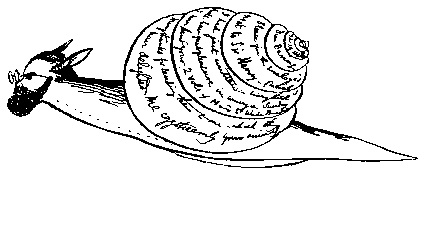
Edward Lear, self-portrait as snail.
When John Ashbery reviewed Elizabeth Bishop’s Complete Poems in 1969 for The New York Times, his review was accompanied by an illustration: two giant snails stretching from under their shells to touch one another. Ashbery never mentions the mollusks in his review, but beneath the image is an excerpt of Bishop’s prose poem “Giant Snail.”
“I give the impression of mysterious ease, but it is only with the greatest effort of my will,” Bishop’s mollusca persona muses, and one senses how very likely a proxy it is for the poet herself.
Bishop is not the only writer to have found solace or some of herself in a snail. Her coil-shelled critter was an homage to a paean by her mentor Marianne Moore. Moore’s “To a Snail” is a discourse on poetics that culminates “in the absence of feet” and “the curious phenomenon of your occiptal horn.” Moore seized on the snail’s self-sufficiency and endless ability to contract, praising its “grace” and “modesty.”

Moore’s praise of the snail was self-promoting, while Bishop’s portrait of the mollusk is tinged with sorrow. “But O! I am too big. I feel it. Pity me,” Bishop’s snail wallows before collapsing in defeat: “All night I shall be like a sleeping ear.”
Bishop’s snail was on a self-determined journey: “I have set myself a goal, a / certain rock, but it may well be dawn before I get there.” He shares that determination with the snail one finds in Virginia Woolf’s short story “Kew Gardens.”
Although their destinations differ, Bishop’s snail labors with the same ferocity as Woolf’s: “It appeared to have a definite goal in front of it,” Woolf writes, “differing in this respect from the singular high stepping angular green insect who attempted to cross in front of it.” Moving from one side of the flowerbed to another, traversing a tiny terrain that Woolf magnifies into cliffs, lakes, and boulders, the snail finds himself in the path of the many human characters of the story.
Woolf begins “Kew Gardens” with the snail’s perspective and returns to it after each human encounter: Simon and his wife Eleanor as they reveal to each other previous romantic encounters in the garden; William and an old man who is blabbering about heaven, war, and electricity before he retreats into silent thoughts of women he has known; two lower-class women who watch the old man attempting to discern whether he is “mad” or merely “eccentric” until they tire and decide to have their tea; and finally young Trissie and her unnamed male companion who debate the admission price for Kew Gardens.
“One couple after another,” the narrator observes, “with much the same irregular and aimless movement passed the flower-bed.” The aimlessness of the couples contrasts the snail’s determination, which for any artist, especially for Woolf and for Bishop, is enviable.
Snail envy animated the life of Patricia Highsmith, whose obsession with snails and their slimy sexual habits fills Joan Schenkar’s recent biography The Talented Miss Highsmith. A friend described Highsmith as “the woman who produced snails from her handbag and encouraged them to leave sticky trails all over her host’s tabletop.” She kept them as pets and carried them across borders in cheese cartons when she traveled, while her own fiction includes enough mentions of mollusks to merit a dissertation. There’s the short story “Two Disagreeable Pigeons” whose eponymous couple make their way around London harboring the hope that “rain would bring the worms out, maybe a snail or two.” Vic, the keeper of aquaria in the novel Deep Water, has a thousand or so snails that are mostly the product of one mating pair, Edgar and Hortense. Hortense takes her name from Highsmith’s own favorite gastropod, one of the three hundred snails that flew with her from New York to Paris, Rome, and Venice.
Another one of her characters, Professor Avery Claveringi, leaves the safety of tenure at a California university to search for a giant snail species not yet named. “The Quest for Blank Claveringi” chronicles the professor’s efforts, including the uncanny moment when he spies his first fifteen-foot-tall mollusk: “It resembled a peach-colored sail filled with wind, and the sunlight made nacreous, silvery patches gleam and twinkle as the great thing stirred.” The hunter becomes the hunted when Claveringi’s snails chase him into the sea, leaving him to decide between drowning and being devoured.
Highsmith’s first foray into gastropods was “The Snail-Watcher” with a Mr. Knoppert who delights, like the author herself, in watching the creatures mate. Rescuing his first gastropods from his wife’s gustatory intentions, Mr. Knoppert soon has more than eleven hundred of the beasts in his study. Within a few hundred words, Mr. Knoppert’s curiosities take over his study and then overtake him in another one of Highsmith’s death-by-snails dénouements. The punishment for voyeurism is clear, though Highsmith herself, Joan Schenkar tells us in the biography, “found it ‘relaxing’ to watch her sails mate because their copulation had ‘an aesthetic quality, nothing more bestial in it than necking, really.’” Highsmith was also drawn to the androgyny of the hermaphroditic creatures, remarking how “it is quite impossible to tell which is the male and which is the female, because their behavior and appearance is exactly the same.”
Not surprisingly, then, Snail was the pseudonym chosen by the French writer Hélène van Zuylen van Nijevelt when she entered the 1898 Paris–Amsterdam–Paris motor race, becoming the first women to drive in an international race. A socialite from the Rothschild family, she had been disinherited by her family for marrying a Catholic man who raced under the name Escargot, and copublished most of her stories and poems under the nom de plume Paule Riversdale with her lover Renée Vivien.
It’s not only the androgyny and arduous ethic of snails that attracts artists. Gastropods were the source of one of the rarest dyes in antiquity. Thousands of snails are needed to produce a single pound of Tyrian purple dye. Pliny wrote one of the most careful descriptions of the process, devoting five chapters of his Historia Naturalis to the production of this deep, deep purple hue. Created from the mucous of Mediterranean sea snails, Tyrian purple became synonymous with royalty, with several emperors legislating that only the emperor himself could wear the color.
The poet Dan Chiasson was moved by the color in his revisioning of Pliny’s ancient record. “Making Purple,” one of the poems in Chiasson’s Natural History joins Bishop and Moore in rendering the dramatic monologue of a snail:
Imagine yourself suffusing a woman’s gown or sheets
your bloodstream running through her inkwell.
Those rich dyes once were your ideas, your love
of broccoli rabe. Half-killed cockles attract purples,
the reef is littered with the open mouths waiting to snap.
I am trying to make my pain attractive, my yearning
pretty. A man caught me in a fine-ply lobster pot.
He scalded me until I nearly died, then threw me back.
“I am trying to make my pain attractive, my yearning / pretty,” Chiasson’s critter cries, echoing the suffering sounds of those earlier snails crawling their way through the poetry of Elizabeth Bishop and Marianne Moore. Those plaintive declarations go far towards explaining why snails are both muse and mirror for so many artists: their enigmatic efforts to become beautiful, while never seeming to tire of their slow struggle.

Casey N. Cep is a writer from the Eastern Shore of Maryland.


Tuesday, September 4, 2012

Susan McCarty / City / Body / Fragments


City/Body: Fragments
Susan McCarty
CONJUNCTIONS:55, Fall 2010
Corner of A and Fourth/Eye 

In New York, there is an important distinction to make between where you live and where you sleep. You sleep in your apartment. You live in the city.
     It is a dripping August, which you know by the smell of it: dried urine, rotting garbage, and the unleaded smell of cabs burning off fuel as they idle in the shimmering heat, each a mirage, a promise of something better on the other side. You can’t get into a cab today because the ten dollars in cash and change sitting on the desk in your apartment is all you have until payday, which is Friday. Today is Sunday. You don’t have a bank account because the check-cashing place is convenient to your apartment. Also, you don’t trust yourself with a bank account; the margin of error is always, always so small. Instead, you like to watch the stack of cash dwindle in front of you. It causes you anxiety, but it also makes you feel as though you are in control of something here, in New York. You are in control of nothing, of course, but the illusion helps.
     Because you sleep in the East Village, in a studio apartment in an old tenement that you share with a roommate, you walk the streets for entertainment. On paydays, you allow yourself a Cuban sandwich from the take-out counter on Avenue A. Today, however, you simply stand in front of the door for a few minutes, because smelling something is almost as good as eating it, and smelling something other than urine and garbage makes you happy. The smells are engrossing, in fact, which is why you don’t notice what has been going on behind you until there is the sound of something whining through the air, not very far from your head, and then the noise of the bystanders, who must have been there all along, suddenly rushes in and you turn in time to see two men grappling with each other, in the street, just feet away. One of them has a hammer. In the moment it has taken you to notice the scene and become confused by it, the man with the hammer bounces it off the side of the other man’s head and there is a sound that would, under other circumstances, be a satisfying sound—the sound of a job being completed, of something being forced into its proper place. You actually see the eye of the struck man wobble in its socket, as if it has just been dropped there to settle. And they are both screaming—one in anger and the other in pain, but the sidewalkers are screaming too and so the scene takes on a kind of miserable white noise wherein no one person’s distress can be sorted from another’s. 
     The police sirens are what finally cut through and break the cord that had knotted around you, anchoring you to this place to watch a man maybe get killed. This is true for everyone, and when the cop car screeches up, the men have already run off together, like wild elopers, one with his hand over his eye and a trail of blood down his shirt, the other just behind him, brandishing the hammer like a cartoon wife with a rolling pin after a mouse. 

Monday, September 3, 2012

Ben Marcus / Secret Breathing Techniques


Secret Breathing Techniques 
by Ben Marcus
                                          
I HAD APPARENTLY BEEN living in one of the towns that was now gone. According to reports, I held my own against one of the younger organizations. I fought well and long. The ending of the report is muddy, with many foreign words and phrases, and an indecipherable series of pictures. There is no clear sense that I survived.
    Photographs of my body had circulated, flags had been stitched with secret instructions.
     There were instances of my name in the registry—the spelling varied, and my date of birth was frequently listed as unknown. A scroll of hair, probably my own, was taped to the paper. Mention was made of what must have been my house, a vehicle I summoned to cross the water (skirmishes, courtship, evasions—the report is unclear), and the amount of sacking I had contributed to the yearly mountain effort. I ranked slightly above average.
  People wrote of seeing me in the morning by the water; several photographs featured me wearing a beard, concealing something in my coat. A Nacht diagram rated me favorably, prior to the revision. The Wixx index claimed I might have perished. I read accounts of myself ostensibly accompanying a family to the market on Saturdays. I may have been their assistant; I may have been their captor. The wording is vague. Some sentences depicted me handling the bread in an aggressive manner, as if searching for something inside it.
    It is possible I was collecting samples. I would not rule it out. It would explain the long clear jars I found stored in my clothing that day when I woke. But it would not explain why those jars were empty.
In the clearing beyond where I’d slept there were men smashing spades against the sand, the sound of children holding their breath. It was the first promising sign I had seen. I knew to breathe in threes, to squint, to crouch while surveying, lest I be deceived. Such were the ways I would keep myself alert.

Sunday, September 2, 2012

Susan Steinberg / Cowgirl


Cowgirl
by Susan Steinberg

CONJUNCTIONS:54, Spring 2010
; it was virtual, the killing; it was conference call, the killing; it was party line, a party; it was everyone talking at once; it was everyone talking and me in charge; it was nearing morning, almost light; it was the doctor begging me, come on already; it was the doctor begging me, do it already; it was me saying, you do it already; it was my brother laughing into his phone; it was my mother sighing into hers; it was my mother saying, this isn’t funny; it was my mother saying, you kids are monsters; it was my mother saying, I’m hanging up; it was the voice she used when we were kids; we hated that voice when we were kids; my father hated that crazy voice; he called her crazy with that voice; he called her crazy, that way she got; it was his fault she was crazy; it was his fault everything went the way it did; it was his fault everything in the world: like planes falling from the sky, like suns exploding into dust, like the whole world how it was; but it was too easy to blame the father; I was done with blaming the father; I would take the blame from this point on; I would take the blame for the world how it was; the world was in a state of collapse; the world was collapsing in my hands; the world was my mother and the voice we hated as kids; it was my brother saying to my mother, take a fucking pill; it was my mother laughing too hard now; it was my brother laughing again; it was funny because we were on the phone; it was funny because we were in different rooms on different streets in different states; it was funny because it wasn’t funny; it was funny because it was nothing even close to funny; but it was totally ours; it was no one else’s but stupid ours: like words you made up as kids, like things you watched through a keyhole as kids; it was my tv on when it shouldn’t have been; it was my brother saying, turn down the fucking tv; it was me saying, no fucking way; it was my brother saying, this is serious shit; it was me thinking you don’t know serious shit; it was rain for the tenth day in a row; it was twelve spiders in twelve corners in three rooms in the house; it was a different time zone where I was; it was a different altogether time; it was the doctor saying, I need you to focus; it was never just, I need you; it was never just, let’s have a good time; it was the doctor saying, I need you to pull the plug; it was never that; it was softer than that; it was more like, I need you to do the right thing; it was more like, your father would want it this way; it was me not knowing what he would want; it was no one knowing what anyone else would ever want: even if he said it to your face, even if he wrote it down, even if he carved it into a tree, into the sidewalk, into the softest part of your arm; it was the doctor saying, this isn’t funny; it was the doctor saying, this isn’t life; it was the doctor saying, trust me; it was hard to trust a person I couldn’t see; it was hard to trust a person I could; it was like watching though a keyhole as a kid; it was long ago that one day; it was no big deal that one day; it was no big deal looking in at him; it was no big deal walking in on them; my father screamed; the lady screamed; my mother was out of town; I called her; she came back to town; she kicked him out; the end; it was not the thing that did me in; it was the conference call that did me in; it was the conference call why I had issues; and here I was on a date in a bar; here I was on a date with a guy and I told him there was no way; here I was in a lovely skirt, my knees exposed, his hand about to touch my knee, and I told him no fucking way; now was always no fucking way; now was always no fucking; now was the luxury of years passed; now was the luxury of the bartender’s serious face; now was his serious eyes as he described this wine or that; and it was me drinking way too much; it was the date saying, I think you’ve got issues; it was me saying, I think everyone’s got issues; it was the date saying, I think you know what I mean; it was me saying, bartender; it was the date saying, what’s your deal; it was me saying, there’s no deal; it was no big deal my deal; it was too easy to blame the father; it was too easy to blame a father dying on a terrible narrow bed I never saw; it was stupid to blame a terrible plug I never saw; it was unclear if the plug was a literal plug or not; it was possibly a switch one flipped; it was possibly a metaphor; it was easier to say a plug; it was something I never saw, the plug; it was virtual, the plug; and it was virtual, the terrible narrow bed; and it was virtual, the father; and it was crazy how he got that way; it was crazy that way he got; it was clichéd that way he got; it was too many drinks; it was too many pills; it was rock star how he was; it was hotel room how it was; it was calling me in the night; it was singing stupid songs to my machine; it was, wake up little, etc.; it was, wake up little, etc.; it was never funny; and then he got sick; and then he got sicker, and then, and then; it was never once funny; it was never me laughing; it was me looking for the bartender; it was another round; it was another round; it was me feeling slightly better; it was a shame of course, ever feeling better; it was the worst shame ever, killing one’s father; it was the worst shame ever, really killing him really; it was the worst shame ever the virtual way I did; it was me lying on my bed; it was me and the phone pressed to my ear; it was me watching some actor on tv; it was some familiar face that shouldn’t have been familiar; it was my brother and mother in my ear; it was all the voices I didn’t want in my ear; it was all the voices telling me to do the right thing; it was all the voices somehow knowing the right thing, and I didn’t even know the exact time; because there was no such thing as exact time; because it was one time where I was, one time where they were, one time where he was; it was me saying, wait a second; it was me saying, just wait a fucking second; it was me saying, just shut up a fucking second; it was wrong to say this to my family; it was only an actor on tv; it was only the actor saying something funny; it was only the actor saying a really funny joke; it was me needing a really funny joke right then; it was a shame to need a joke right then; it was me waiting, everyone yelling; it was me about to laugh my ass off; it was my mother complaining weeks later; it was my mother complaining, you shouldn’t have called me; it was my mother complaining, you put me in a hard place; it was my mother complaining, he was a monster; it was me thinking who put who in a hard place; it was me saying, who put who; it was me saying, you had me; it was me saying, you put me in the worst hard place: the oldest kid, the only girl; I said, who put who; she said, who put whom; I said, exactly; my father put me in a hard place; my father put my mother in a hard place; my father put the lady in a hard place; my eye was pressed to a hard place; my father put the lady in front of him; he stuck her there in front of him; she was younger than my mother; it was a hard place to be; it was probably love; it was probably total love; it was her laugh that waked me; it was her stupid laugh; and there was no keyhole; it was only a metaphor, I think; it was only me opening the door, I think; it was only me screaming, I think now, something awful; it was my father screaming something too; and it was me screaming something else; and it was shameful the lady screaming something too; it was shameful how trashy just screaming like that; it was shameful being a lady like that; it was my brother hiding in his room; it was my mother out of town; it was my mother still able to dream something lovely; it was my mother about to dream something lovely; it was me running out to the lawn; it was me standing under some dumb moon not knowing what next: like maybe I could run away, like maybe if I were a guy, like maybe I was not that girl, like maybe if I were I wouldn’t care; but I went back inside; and it was not the beginning of the end; it was the beginning of something else; her purse was on the hallway floor; and it was my floor, that hallway floor; meaning it was my purse on the hallway floor; meaning it was my stuff in that purse: meaning her comb, meaning her ten dollars, meaning her ID; it was the beginning of the beginning; I deserved something that night too; and her picture looked nothing like me; and her name was impossible to pronounce; and I memorized the spelling of her name; and I memorized her address; and I figured out her sign; and I styled my hair to look like hers; and I made a face that looked like hers; and the ID worked for many years; meaning I was a piece of trash for many years; I was a piece of trash walking into bars; it was me before I had issues; it was me before no fucking way; it was me before no fucking; it was me before, I’m too fucked up; it was the date giving that look dates gave; it was me thinking try killing yours, motherfucker; it was me saying, drink your drink, motherfucker; it was just shut up shut up shut up; it was a shame to make a virtual decision; it was a shame pulling a virtual plug; it was a shame my ear pressed to a hard place; it was only voices in my ear; it was only some actor on tv; it was half my brain waiting for the punch line; it was half my brain pulling a plug from a wall; it was pulling the plug in my brain like a pro; it was swinging the cord like a lasso; it was me like a cowgirl, swinging the cord around my head; it was the date saying, you’ve got issues; it was the date saying, serious ones; it wasn’t always like this though; it was a good time with that ID; I was a good time with that ID; I met guys and it was a good time back then; it was the ID always getting me in; it was the ID always getting me what I wanted; but there was a night a bouncer said, ID; I looked around like no big deal; there was a guy in the bar; there was a guy in the bar I wanted; the bouncer looked at my ID; he said, what’s your name; he said, where do you live; he said, what’s your sign; I was ready for this; I was well rehearsed; I said, Virgo; he said, no way; he said, you’re a Capricorn; he said, and a liar; it was true; I was a Capricorn; I was also a liar; the whole point of the story is something else; the whole point is I wasn’t always this pent up; the whole point is I wasn’t always; I said, you caught me; the bouncer said, get out of here; he said, liar; he said, get; but I wanted to go into the bar; I said, come on; I touched his leg; I said, I’m a Capricorn; I said, you guessed it; I could not hide what I was; I said, I’ll buy you a drink; he shifted; his leg was too warm; another bouncer walked up; then there were too many men in the picture; then there were too many men I needed to please; there were often too many men; some nights I just wanted to kiss the softest part of my arm; some nights I just wanted to think of some guy I thought I loved; some nights I waked, my mouth still pressed to my arm; some nights I could stay there and fall back into dreams; some nights, though, the phone rang through the night; some nights were songs on my machine; some nights were rain on my machine; some nights were dead air on my machine; some nights I should have said, no and no and no; some nights I should have fallen back into my arm; I was in love with myself some nights; but there were often too many men in the picture; there were often too many men I needed to please; and there was no way to shut it off; there was the date wanting something I didn’t want; there was my father singing, wake up wake up; there was the doctor saying, do it already; there was my brother saying, do it already; there was a plane past the window; there was sun past the window; and there was me saying, mother, to nothing there; there was me saying, mother, but she had hung up; because nothing was left but, shut it off; because nothing was left but, do it already; then it was a hum from some machine gone dead; then everything went dead; all the voices in my ear went dead; then the plane; then the sun; then light; then air; then the punch line to the actor’s joke; then another joke; then another joke; 


Saturday, September 1, 2012

H. M. Patterson / Sailing by Night


Sailing by Night
by H. M. Patterson
CONJUNCTIONS:54, Spring 2010
Perhaps it was some childhood backmind cinema of the snowpack that had been melting from the top of Roan Mountain that springlike winter—two wholefainéant feet of it lollygagging its way down to the Doe River like a little girl picking mountain flowers—that caused me to dream my dream so deep: Our kitchen pooled with the oaky aqueous collection, then the hall, then my room, and in I slipped from my bed’s edge, sank down opposite bubbles breaking away from my cowboy-clad pajamas. I breathed in the mountaintop’s sweat. My lungs waxed with the earthy wet of it.
      Meemaw’s antiques grew. Her mammoth cupboard contents bobbled by. I clamored aboard a colossal ultramarine-colored teapot, hefting myself up, trembling and coughing, by its swan-neck spout. There were others inside the porcelain vessel, peeking out from beneath the half-fluted lid, neighbors, and some folks I didn’t know: a flannel-shirted man holding a writhing, venomous serpent, a boy in Mac-Alpine tartan—redheaded, with a crescent-shaped scar on his chin— playing cat’s cradle, and a stunning, big-busted lady working her wavy auburn hair into a bun. Our helmsman, an orange-toothed beaver, rode the handle and steered us with its waffled rudder tail. 
      A pirate, ocular socket patched and velvet vested, stood balanced atop the baluster kettle in stereotypical high-seas freebooters pose, pointed his sword in the direction he required we travel—he had a peg leg, too! … no parrot—and he winked at me with his exposed eye. We wove through the misty, swollen gorge before the real-life cloudburst sluiced in, and Meemaw nudged me awake and whispered … flood