Tuesday, October 23, 2007

Fetish by David Lynch and Christina Louboutin


Fetish 

by David Lynch and Christian Louboutin


by  in Culture on 23 October 2007

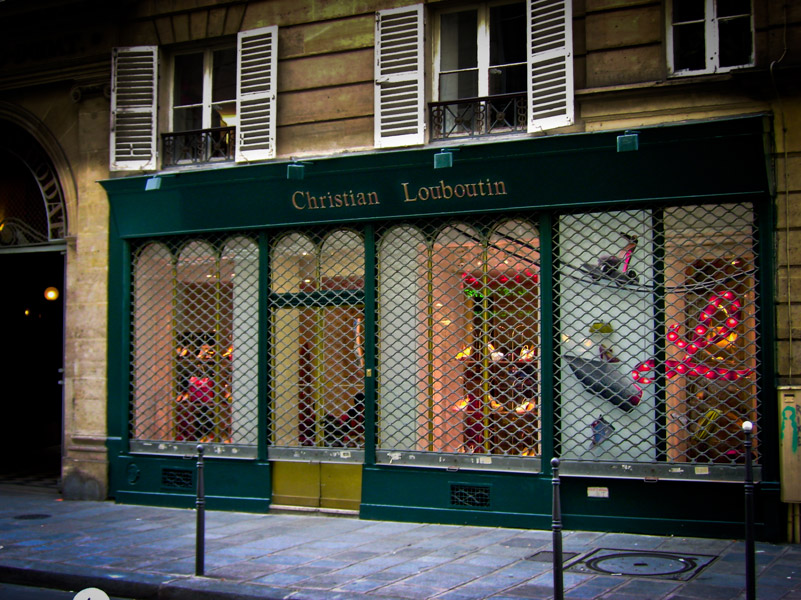
A perfect example of the strange and creative works that can come out of a collaboration between very different artists is the recent project by the filmmaker David Lynch and the shoe designer Christian Louboutin, both absolute masters of their medium. We discovered "Fetish" at Design Art Londonwhere these extraordinary shoes by Louboutin and their erotic photographic counterparts by Lynch were on show at the Pierre Passebon Gallery.
Many believe Louboutin's sexy red soles to be art forms in their own right, but he has taken this fetishistic view of footwear to a new extreme with this series that's more sculptural than wearable. Lynch, in his signature darkly twisted and sensual style, shot images of women bound into these sadomasochistic creations.
Louboutin says of the collaboration, "The models wore these unwearable shoes with natural grace. Their very white skin, very dark eyes and bright mouths melded with Lynch's aesthetics…As is his habit, David Lynch made it into a décor populated with shadows."
The reception of this project during its opening at Paris Fashion Week earlier this month was so rapturous that Lynch and Louboutin agreed to make five sets of shoes and five sets of prints for collectors to buy. The show continues at Galerie du Passage in Paris until 3 November 2007.


Christian Louboutin
GALERÍA


Alison MacLeod's top 10 short stories

Alexis Lago

Alison MacLeod's top 10 short stories


Alison MacLeod is the author of two novels, The Changeling and The Wave Theory of Angels. Her short stories have been published by Prospect, London Magazine, Pulp.Net and Virago, and her first collection, Fifteen Modern Tales of Attraction, was published by Penguin last month. She lives in Brighton and teaches creative writing at the University of Chichester.
Writing a short story is a high-wire act, sentence by sentence, foot by foot. Very few story writers work with the safety net of a plot conceived in advance. They trust in the humming tension of a single opening line or in an image that rises in their mind, or in a fragment of a character's voice. They might have a sense of where they want their characters to go; they rarely know how they'll get them there. At times it's unnerving work. Lose your concentration or the line of tension in the story and both you and it fall. The best short stories have a breathless, in-motion quality to them, a quality that makes them ideal for adaptation into film, as directors are increasingly realising. A great story ending resonates far beyond its final word. It's a hit to the brain. I read stories and love them for that hit. As the writer Elizabeth Taylor commented, the short story gives the reader the feeling of "being lifted into another world, instead of sinking into it, as one does with longer fiction". The best stories leave you exhilarated.

1. The Nose by Nikolai Gogol

On March 25 the barber Ivan wakes to find a nose in his morning bread roll. He is alarmed and confounded. He tries to abandon it in a gutter, then tries to throw it from a bridge but his plans are scuppered. Meanwhile, Kovalev has woken without his nose. Is it a terrible dream? No. The absence grows into an outrage. Then "a door of the carriage opened, and there leapt thence, huddling himself up, a uniformed gentleman... And oh, Kovalev's horror and astonishment to perceive that the gentleman before him was none other than - his own nose!" This story is delicious. It always makes me smile even though I now know well the exploits of said Nose, the eponymous hero. Gogol's story says the imagination, like the Nose, can go absolutely anywhere. He shows us that dream-realities have their own kind of logic. I love Hanif Kureishi's homage, Rhe Penis. Lord knows it was crying out to be done. After all, isn't the Nose sometimes referred to by Gogol as the member? I also love the fact that a statue erected in St Petersburg to honour Gogol and the story of The Nose disappeared from the face of the city in 2002 - another fitting tribute.

2. The Dead by James Joyce

As fate thankfully had it, Joyce added this story to the Dubliners manuscript as a sudden afterthought while his publishers prevaricated. The most powerful in the collection, The Dead is not about death. It's about life force. Gabriel and Gretta have enjoyed a jolly New Year's do at the home of his aunts in Dublin. Later in their hotel room, Gabriel is filled with tenderness and desire for his wife. But a song from the evening has filled her with memories of a boy long dead, Michael Furey, who once stood outside her window, ill and shivering in the rain just for a glimpse of her. Gabriel is firstly jealous, then disquieted by "how poor a part he, her husband, had played in her life", then moved finally by a sudden insight into the strength of the life that Michael Furey gave up for love. The last three paragraphs are among the most beautiful ever written.

3. The Rocking-Horse Winner by DH Lawrence

This story is inexplicable, uncanny - a testimony to Lawrence's interest in alternative states of mind, whether accessed by love, sex, dream or artistic creation. A mother needs money. Her young son loves her and worries. (Another intense mother-son relationship for Lawrence.) Astride his rocking horse high up in the nursery, Paul rocks himself into a trance through which he becomes strangely prescient. The dialogue is a bit wooden, the plot a tad tortuous, yet the ending is compelling and completely unforgettable. VS Pritchett once said that a good short story captures a character "at bursting point". Lawrence doesn't let you down.

4. Johnny Panic and the Bible of Dreams by Sylvia Plath

"Every day from nine to five I sit at my desk facing the door of the office and typing up other people's dreams." So begins the story of the Out Patients typist whose "real calling" is to collect the dreams of the frightened, lost and despairing, and to dedicate herself privately to the service of "Johnny Panic", her own low god of fear. The story is hilarious (she has to share her office space with the Foot Clinic), giddy and breathtakingly stark. It's alive with the bravura of Plath's dark and shining mind.

5. What We Talk About When We Talk About Love by Raymond Carver

Story writers are naturally drawn to life's undersides - to the bits we perhaps shouldn't see. They're often private worlds, stolen glimpses, and we, the readers, are licensed voyeurs. Here, two couples, Mel, a cardiologist, his second wife Terri, and young Nick and Laura in their first flush of love, sit around a kitchen table sharing a drink. They talk, the sun goes down, the gin bottle drains. That's it. Or it would be, except inhibitions slip. An argument starts, emotions burst like blisters; they're covered over and burst again. As Nick and Laura struggle to hold onto their clichés of romantic love, Terri claims that the ex-husband who used to drag her around the living room by her ankles really did love her. Carver had to have been influenced by Edward Albee's Who's Afraid of Virginia Woolf? Things get that ugly. But it's also profoundly moving as Mel struggles through the blur of the gin and the shadows of the setting sun to believe in the strength of the human heart.

6. Meneseteung by Alice Munro

While novels are arguably about life's big moments, stories, Munro says, are about "the moments within moments". This is the story of Almeda Roth, a little known Victorian poetess-spinster who lives in a small Canadian town. She resides on the respectable Dufferin Street but her back gate opens onto the edge of a boghole, an area known locally as the Pearl Street Swamp. "Bushy and luxuriant weeds grow there, makeshift shacks have been out up ... " and a woman cries out: 'Kill me! Kill me!' ...Yet there is something taunting and triumphant about her cry." It makes Almeda uncomfortably aware of the narrowness of her own life, one in which she waits to see if Jarvis Poulter will finally deem her to be suitable wife material. The woman of the Pearl Street Swamp is to Almeda what Bertha is to Jane Eyre: her alter ego, her nemesis, but also the agent for Almeda's new, painful insight. The detail of Almeda's home and her inner world are tenderly and sharply observed. Munro's prose is, as usual, translucent - so breathtakingly clear there is nothing between you and the world she creates.

7. Love is not a Pie by Amy Bloom

This is one of the most poignant coming-of-age stories I know. Ellen's mother's funeral brings back fond memories of idyllic summers spent long ago at a cabin in Maine. It was in these days she first began to understand how vital, lovely and flawed a person her mother was. Ellen's family shares the cabin with their old friends, Mr. DeCuervo and his daughter. Everything is close, warm and comfortable for Ellen until the night she pushes open the creaky door and sees her mother "spooned up" against her father - and Mr DeCuervo "spooned up against her, his arm over the covers, his other hand resting on the top of her head". Three middle-aged bodies in a bed. Stories aren't plots so much as the unfolding of characters. Bloom knows this. Ellen's mother, father, Mr Decuervo and their shared lives are drawn by Bloom with sharp realism as well as great tenderness. She yokes the two together without contradiction - because she's that good.

8. Lilac by Helen Dunmore

In story after story, Dunmore's prose is lucid, sensual and beautifully understated. It just doesn't get much better. Here, Christie spends a spring holiday in Sweden with her cousins Agnes and Tommy, and Tommy's best friend Henrik. Christie tell us a story that, in the context of the world she has known so far, is shocking, even taboo - in the final pages, she sees something. I'll keep her secret so I don't spoil the story, which is also unbelievably lovely. Exquisite even. I admire the last few paragraphs so much, I want to eat them.

9. Vanilla Bright like Eminem by Michel Faber

The opening line is quirky, involving. It offers the reader an enticing prospect: "Don, son of people no longer living, husband of Alice, father of Drew and Aleesha is very, very close to experiencing the happiest moment of his life." How can you not read on? This story breaks all the rules. Nothing happens for a long time. An American family are on holiday, en route to Inverness by train. That's it. Then suddenly the story abandons the usual unity of time and space, zooming forward through many years and vast changes in the characters' lives. Usually such a narrative spree would leave anyone bored. But not here. It makes us, along with Don, return to that train journey when life was simple and whole. On the train Don observes the mundane details of his wife and children with a credibly odd mixture of honesty and deep affection. It's moving, if a bit of a narrative cheat. As one writer-friend said to me, "Would we find it so moving if a mother were observing her children so lovingly?" Probably not. We take it for granted that mothers do. But we feel moved when fathers take note. That is admittedly part of what makes this story the success it is. But that said, an unexpected epiphany - a moment of radiant insight worthy even of Joyce - is what makes and sustains this story. It is an apparently ordinary vision: Don's daughter combs her sleeping brother's hair. Don watches. But he watches mesmerised, filled with a sense of a present moment that is bigger than him, bigger than any of them. As in the best of stories, the moment can't be paraphrased. It can only be experienced. You'll have to read it yourself.


10. Weddings and Beheadings' by Hanif Kureishi


This story is dark, deadpan and knocks you sideways. A quiet bomb, to use a phrase coined by writer Joseph O'Connor. A film-maker in a present-day "war-broken city" is forced at gunpoint to film the beheadings of kidnapped prisoners. But he is also paid for the work. It becomes his living. "You don't know me personally," he says. "My existence has never crossed your mind." But Kureishi makes us look. The story is less than five pages long, told as the narrator awaits the knock at his door. Less is more. The details are matter-of-fact - what isn't said boomerangs back at you and hits you between the eyes. I admire Kureishi's daring and his willingness to explore the turbulence of the here and now. I suspect this story won't leave me, and that's a good, awful thing.


Friday, August 24, 2007

Obituries / Grace Paley


Grace Paley

US writer of subtle and discursive short stories, poet and 'combative pacificist'

Mark Krupnick
Friday 24 August 2007 00.19 BST


Grace Paley, the American short-story writer and a prominent activist during the Vietnam period, has died of breast cancer aged 84. Her "combative pacifism", as she called it, took her to Hanoi in 1969, to Chile during the precarious rule of Salvador Allende, and to Nicaragua in 1985. Paley was what is known, in the US, as a "movement" person, which meant that political activism was part of her normal life, not an off-again, on-again response to the most spectacular crises. She joined the War Resisters League in the 1960s and, for years, could be found every Saturday handing out protest leaflets on a street corner near her New York apartment.
Paley's unglamorous, day-to-day activism caused her to be admired by other movement people, but it was her short stories that made her loved. She grew up in a Jewish immigrant family amid the sounds of Russian, Yiddish and English, and became as acquainted with the idiom of New York street talk as with the language of respectable literature. So Paley was able to create in her fiction a world of voices and an ethnic style that was uniquely her own. With her humour and humanism in mind, some critics compared her with the Russian-Yiddish storyteller Sholom Aleichem. But the truth is that the oral folk tradition was not lying around waiting to be inherited by a young American writer finding her voice in the 1940s. Her literary manner, which has the effect of simplicity and naturalness, owes a great deal to modernist self-consciousness about questions of style and form.
The confidence that enabled Paley to write like a turn-of-the-century Russian or a female Mark Twain in the Bronx owed a great deal to the happy circumstances of her early years. Her parents, Isaac and Manya Goodside, were revolutionary students in Russia, and her father had spent time in one of the tsar's prisons. But they were able to escape to the United States in 1905, thereby avoiding the worst pogroms that would traumatise Russia's Jews, particularly in the aftermath of the Bolshevik Revolution. Like so many other eastern-European Jews without money, they settled in New York's Lower East Side.
Supported by his wife and sisters, Paley's father was able to study for a medical degree in New York. By the time she was born, the Goodsides were comfortable, though not rich, and had moved to the Bronx, which was then (1922) primarily Jewish and middle class. Paley was the much-loved baby in a household that included her father's mother, her parents and an aunt, a brother of 16 and a sister already 14. She recalled being much fussed over and strongly encouraged by her parents to accomplish all that she could. Paley evokes her own childhood self-confidence in her charming early story The Loudest Voice, which depicts little Shirley Abramovitz belting out the story of Jesus in her school's Christmas pageant.
At 19, Grace attended Hunter College and briefly New York University, but, abandoning her formal education in 1942, she married Jess Paley, a cameraman and film-maker. Because her husband was serving in the army from 1942 to 1944, she lived among other women, separate from their men, in army camps. She said that it was in these camps that she first became conscious that the ordinary lives of women were an actuality of great importance, albeit largely ignored in formal literature. She was writing poetry and continued after the end of the war, when she gave birth to her two children, Nora in 1949 and Daniel in 1951.
In the 1950s Paley turned to the writing of stories: she never wrote a novel, though she tinkered with drafts. Although she was starting late, it was as if, from the start, her voice was hers alone, as was her perspective on things. Critics greeted Paley's first collection, The Little Disturbances of Man (1959), with the kind of superlatives used in the same decade for first books by Flannery O'Connor and Philip Roth. Roth himself praised Paley for "a language of new and rich emotional subtleties, with a kind of backhanded grace and irony all its own."
Despite this reception and many fellowships and awards, it was 15 years before Paley published her second collection of stories, Enormous Changes at the Last Minute. During those years, she had to fit her writing in among a wide range of activities, some of which had as great a claim on her as fiction. Most importantly, she was raising her children. Although she and Jess were not formally divorced until 1971, she was effectively a single mother during much of her children's early years. In 1972 she married a fellow writer, Robert Nichols.
Paley dedicated Later the Same Day (1985), her third collection, to her children, "Without whom my life and literature would be pretty slim". The body of work is small - Paley's Collected Stories (1994) takes up only 386 pages. Where did her time go? For over 20 years she taught writing at Sarah Lawrence College in New York. But the main non-family commitment was to politics. Sometimes it was upper-case "Politics", as when, during the Vietnam war, she literally put her body on the line at sit-ins, where she risked being trampled by the horses of mounted policemen. But sometimes it was the "politics" of ordinary life, at least the ordinary life of an advanced feminist with old-fashioned loyalties and emotions.
Her vicissitudes are well documented in Paley's stories about the compasssionate Faith Darwin, the fictional alter ego whose perils we can follow in Paley's successive collections and in Long Walks and Intimate Talks (1991), a thin medley of stories and poems that should be read alongside her attractive New and Collected Poems (1992).
In the stories about Faith, we have the portrait of a modern woman whose openness to life disposes her to have affairs with men who often let her down. Her closest relationships are with other women. Together they converse endlessly about their children, men and sick parents. In one story Faith has parents in an old people's home who wish only she would find a way to live that would cost her less pain. In the story A Conversation with My Father, her father wishes also that Faith would write fiction with a beginning, middle, and definite ending. But Faith counters with an explanation of her stories, with their seemingly plotless meandering, which might be Paley's own credo both as a writer and as a secular radical. She explains that she doesn't write well-made stories "because the traditional form of fiction takes all hope away". And for Faith, "Everyone, real or invented, deserves the open destiny of life."
A new book of poetry, tentatively titled Fidelity: A Book of Poems, will be published next year. She is survived by her husband, son and daughter.

· Grace Paley, writer, born December 11 1922; died August 22 2007


Grace Paley / El hombre agobiado


DRAGON
Obituries / Grace PaleyGrace Paley / The Art of Fiction
Grace Paley / Wants
Grace Paley / Samuel
Kelly Link / Books that changed me

Sunday, July 29, 2007

James Bond / Goldfinger / Review by Philip French


James Bond

Goldfinger

Philip French
Sunday 29 July 2007


M
ade in 1964 and now back on the big screen, Goldfinger is a crucial work in the development of the Bond legend. For the first time Connery was truly relaxed and drove the Aston Martin DB5, that year's must-have toy for every boy in the land. Ken Adam came from creating one iconic American set (the War Room in Dr Strangelove) to another (the interior of Fort Knox), and established himself as co-auteur of the Bond movies. Screenwriter and ex-movie critic Paul Dehn (who the following year co-scripted The Spy Who Came in From the Cold) helped to establish the franchise's special combination of suspense and tongue-in-cheek schoolboy sophistication, though it was Fleming, of course, who came up with the name Pussy Galore. The name Goldfinger led to a threatened libel action by architect Erno Goldfinger (he of the controversial high-rise council house block), and the film was briefly banned in Israel because of Gert Frobe's one-time membership of the Nazi party. And of course Shirley Bassey belted out the title song, the first of her three 007 assignments.


THE GUARDIAN


Sunday, July 8, 2007

Dita von Teese / This much I know / The young Marilyn Monroe was a pretty girl in a sea of pretty girls

Dita von Teese

Dita von Teese

This much I know


The young Marilyn Monroe was a pretty girl in a sea of pretty girls

Dita Von Teese, stripper, 34, London

Interview by Barbara Ellen
Sunday 8 July 2007 00.03 BST


Burlesque is not a style or a fashion statement. It's about striptease.
I always wanted to be someone. I had an Aunt Opal, who was very painted - green eye shadow, drawn-on beauty marks, flaming red hair. She smoked from a cigarette holder and swore like a sailor. Most people thought she was vulgar, but I wanted to be like her when I grew up.
I love the word stripper. It's a fabulous word. There's a lot of snobbery about burlesque. You hear it all the time: 'I'm not a stripper, what I do is different.'
Even when I did regular stripping, I was dressed vintage-style. I wasn't ever this tanned bikini babe swinging around a pole.


Dita von Teese

My martini-glass act is the one I've done more than any other. I've been performing it since 1993. I have about 15 other shows, but that's the one that always gets booked.
I'm more attracted to glamour than natural beauty. The young Marilyn Monroe was a pretty girl in a sea of pretty girls. Then she had her hair bleached, fake eyelashes, and that's when she became extraordinary. It's that idea of what you're not born with, you can create.
I'm used to corsets now. A 22in, even a 16in, I know how to stand, walk, sit, stay composed.
I've never had any inhibitions about being nude onstage. I will think about what the steps are, how my costume comes off, but never the nudity. It's never even crossed my mind.


Men rarely say anything to me after a show. Maybe they're intimidated. It's usually the women who come up - a lot of them are inspired to bring elements of burlesque into their private lives.
People paint me out to be this person into exotic sex, which I am - I've said I'm into bondage and spanking. But I think a lot of people, if they were honest, would say, 'Yeah, that sounds fun.'
I like vanilla sex as much as the next girl. Sometimes when I date men, they feel they have to put on a show. I'm like: 'Stop trying so hard to impress me with your sexual perversions.'
People say, 'How can you be a feminist?' I would say, 'It's all about equal rights, isn't it?' And the second someone says you can't do what you love, do you have equal rights?
I've never been that girl out looking for a rich husband. I never wanted to have anyone say what I can or can't do. My soon-to-be-ex husband [rock star Marilyn Manson] asked me to quit my work so he could support me. I quickly realised that he wanted to change me. The things people like about you in the beginning end up being the things they don't like.
We were painted as this weird couple, because we had taxidermy in our home. But I've been to castles and there are all these hunting trophies and bear rugs.
We were so terribly in love. I never took him for someone who would exploit our divorce for the sake of records. I don't think people realise he used our marriage bed in that music video to have sex with that girl [Manson's new girlfriend Evan Rachel Wood]. And he wore his wedding ring. I just thought, 'Wow, this is kind of obsessive. I guess I still matter.'


Dita von Teese

I'd get married again. I'm not going to let one bad experience ruin it for the rest of my life.
I performed my show Liptease at the Cannes film festival. The room was full of big movie stars and producers. They'd never seen a girl take off all her clothes and ride a giant lipstick before. Sharon Stone came up to me afterwards to say how much she loved it.
I've had breast enlargement. It's so tiresome when people lie about their surgery.
Am I going to be frolicking about in my G-string in a champagne glass when I'm 60 years old? No. I'll be thinking about how to evolve accordingly.
· Dita is a spokeswoman for Viva Glam, the MAC range which supports men, women and children with HIV/Aids.

THE GUARDIAN


THIS MUCH I KNOW