
 |
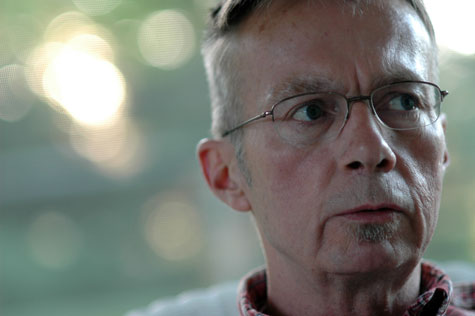
| Donald Ray Pollock |
Sincerity, rawness,Ohio
Conversation with Donald Ray Pollock
Question: Knockemstiff was a lacerating piece of writing, harsh and gritty, sometimes even nasty and cruel. Its sudden appearance on the literary scene was like a punch in the face that knocked quite a few readers out. The stories leave us with a feeling of emptiness which grows and grows as we keep on reading, partly because we are aware that they are based on real events and real people. Was Knockemstiff an introspective effort to release yourself from the drowsy grip of the city itself, of your hometown?
Donald Ray Pollock: Thanks for the kind words. One thing I need to point out is that Knockemstiff is not really based on «real events and real people». Sure, there’s a real place called Knockemstiff in southern Ohio where the stories take place, but pretty much everything else is fiction except for geographical details and other little stuff, like the name of the church, etc. As for your question, no, I think I was doing quite the opposite, in that I wanted to try in my own small way to create some sort of «memorial» to the place before it disappeared. I did feel trapped there when I was young, and I can still remember that feeling, but that was a long time ago.
Q: Each character embodies one defining trait of the human condition, with a very thin line setting the border between despair and insanity. We find ourselves in a somewhat wicked town where redemption is not an option. Isn’t that a bit too disheartening?
D. R. P.: It’s definitely a bummer if you’re looking for a «feel-good» story. But if you think about it, how many people have gone to their graves without ever finding redemption? Millions, I would guess.
Q: How do you shape the psychology of the characters? In other words, how come is it possible to be so cruelly honest?
D. R. P.: I don’t think about the reader while I’m writing, which helps as far as being «honest.» If I was constantly thinking that some day someone is going to read this stuff, then the readers and not the characters would probably become the priority. In other words, I’d become a people-pleaser.
Q: Knockemstiff was your first book. Did you expect it to become so successful? Here in Spain the critics, for the most part, enthusiastically praised your collection of stories full of misery and violence. We were stunned!
D. R. P.: No, I certainly didn’t expect it. I was just hoping that Doubleday made enough money to cover the expense of publishing the thing in the first place, so that they might be willing to take a chance on the second book. Of course, you have to understand that some of the publicity I received in America came from the fact that I was a factory worker from southern Ohio who had somehow, almost miraculously even, written a book, but that’s fine with me. I remember how fascinated I was when I first read about William Gay, the American writer who hung dry wall and worked as a carpenter a good part of his life. His story was very inspiring to me, and I’d like to think that there’s someone out there who reads about me and says, «Hell, if he can do it, maybe I can too».
Q: Kiko Amat, who wrote the preface to the Spanish edition, said it to be «one of the best books you’ll ever read». What do you think about that? Does this kind of comments put too much pressure on you? Have you now become more self-conscious? Honestly, for us it was and it will be unforgettable.
D. R. P.: I owe Kiko Amat big time for that introduction. As for positive reactions making me more self-conscious or nervous than I already am, yes, they do, but if I consider the alternatives, which are to be ignored or knocked down, I’d much rather deal with the pressure of a good review!
Q: When did you first think: «This is my time, I’ll go and try to get my stories published».
D. R. P.: Well, I can’t recall having a moment like that, but I did start sending stories out to mostly small magazines after I’d been working at it for a couple of years. And believe me, I got lots of rejections. But I wanted to see my stuff published, like any writer, and I kept at it. By the time an agent at Inkwell Management contacted me (he’d read one of my stories in Third Coast), I’d been trying to learn how to write for around 6 years and had published maybe 7 or 8 stories. So it was a fairly long process.
Q: We are particularly interested in the methodology of writing. Are you one of those authors who follow a strict work schedule, or do you rather catch a fleeting insight and then you sit down and write?
D. R. P.: In order to get anything done, I’m one of those people who need to follow a schedule. Without some discipline, I’m worthless. When I’m working, I either get up around 5:30 in the morning and work from 6:00 until 11:00, or I work from 8:00 in the evening until around 2:00 am. I tend to write a little better at night, but I like the feeling of getting the work over with in the morning and not having to fret about it the rest of the day.
Q: In The Devil All the Time there’s a waitress who, since his boyfriend is unemployed, needs to make some extra money by selling her body. There’s a good preacher man and a couple of losers. There’s Willard, who comes back from the war and, after being served a lousy meat pie, falls in love with the waitress. People are poor, towns are small, and suffering and darkness go hand in hand. Definitely, your first novel is not a joke! How did you manage the process of composing a much wider story? Was it a challenge?
D. R. P.: It was definitely a challenge. I’d never written a story that was more than 15 pages before, so I was intimidated by the thought of trying to write something as long as a novel. As for how I managed to do it, I just kept plugging away and it eventually started to take shape.
Q: You don’t seem to be one of those writers looking for recognition at any price, constantly craving for flattery and prizes. So, from a personal perspective, how do you really conceive your writing career?
D. R. P.: I don’t think I have any aspirations that haven’t already been more than fulfilled. I started out wanting to write just one decent short story, and now I have two books. I’ve been extremely lucky so far, and if nothing else comes my way, I’ll still be happy. With that said, it would be nice if I could write three or four more books that don’t totally flop.
Q: The future, both in Spain and abroad, doesn’t look very bright. Economic troubles, political scandals and disappointment are commonplace. Do you believe that literature can help to strengthen our critical mind, to encourage people to keep going no matter what?
D. R. P.: I’m beginning to doubt that, I guess, at least in America. When a country becomes as obsessed with the economy and wealth and technology as America is, stuff like the humanities are considered less and less important. So now we’re beginning to do do away with art and literature and music classes and on and on in the public schools and even the universities because we’ve decided that students really just need a set of «skills» that will make them good workers. The growing attitude is that they don’t need to read, for example, The Odyssey or Huckleberry Finn or Walden or Madame Bovary; instead, they need to learn how to pass the standardized tests issued by the government, which have absolutely nothing to do with real learning. Thus, as conditions continue to deteriorate, there will be less and less serious reading and critical thinking going on, which will, of course, make it easier for the government to control the population and develop a nation of drones. This isn’t original thinking on my part; though they’ve mostly been ignored, critics like Neil Postman and Morris Berman have been warning us for years.
Q: Do you listen to music while writing?
D. R. P.: Only when I’m revising. Then I usually choose five or six CDs and play them over and over, until I’m really no longer conscious they’re even playing. Just a rhythmic sound in the background.
Q: What’s there in Ohio that makes of it a decisive swing state in every political election? Is it really a microcosm reflecting the whole American society?
D. R. P.: These days, much of the east coast and almost all the west coast always go Democrat. That’s pretty much a given. Then there are a lot of states who almost always vote Republican, most if not all of the South, for example, and the upper mid-west. Finally, there are the swing states (nine of them this year, including Ohio) that might go either way because they seem to be made up of approximately 50% Democrats and 50% Republicans, thus making them what might be called a microcosm of the society as a whole. Because of this, they’re the ones that garner the most attention from the media and the politicos. Fortunately, because the big urban centers like Cleveland and Columbus got out and voted, Obama won Ohio’s electoral votes. The other parts of the state, however, the rural areas and smaller towns, supported Romney for the most part. Sadly, though many of them won’t admit it, a lot of this current divisiveness comes from the fact that Obama is a black man. My God, he has a far better record that any Republican president we’ve had in decades, even with Republican leaders like Mitch McConnell from Kentucky swearing they would do everything in their power to see him fail (which should be seriously regarded as an act of treason), but nearly 50% of Americans still voted for Romney, a businessman who has made an obscene amount of money shutting down American factories and either filing bankruptcies or shipping the jobs overseas. And now some red states are talking about secession because Obama won. Not only are we divided, many of us are insane!
 Donald Ray Pollock


No comments:
Post a Comment