
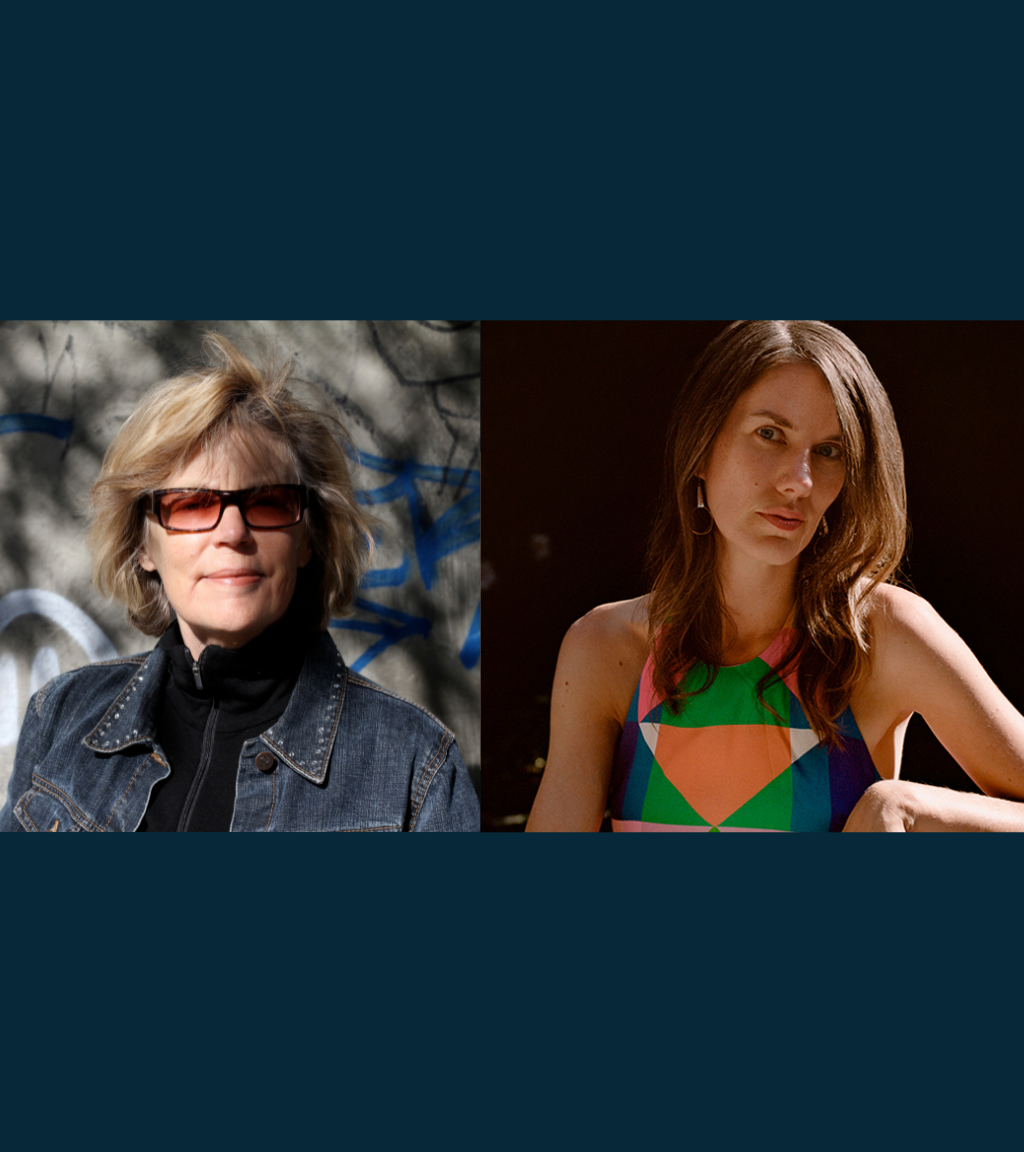
 A Conversation with Leslie Jamison
The following conversation took place at the Royal Ontario Museum in Toronto on September 15, 2025, presented by the Writer’s Trust of Canada in honour of Leslie Jamison’s receipt of the Weston International Award, supported by the Hilary and Galen Weston Foundation.
Marni Jackson: I know there are quite a few writers out there tonight, and I’m pretty sure some of them wake up at four in the morning and think, Who cares what I’m writing? What does a mere book do? It’s so easy to feel helpless as a writer these days because the world is in tatters. How do you keep believing in the value of your work?
Leslie Jamison: Such a great place to begin. I can never bolster my faith in my writing by looking at my writing. I always come back to my life as a reader for a sense of belief and commitment. As a reader, I feel not only grateful for but truly saved by books, glad they’re in the world. It’s not just that a particular book helped me understand something—what life might be like for somebody in a completely different country or a completely different time or a completely different place—but that it gave me an experience of being utterly transported as I’m curled in the corner of the couch with a little stack of graham crackers. That feeling of immersion and magic—I just believe in that. I believe in what books have given me. A book is not going to get Trump out of office, but maybe it’s going to give somebody some version of what I’ve felt. So we fight the fight on all the fronts, but we keep doing the thing that makes the world bigger and deeper.
Jackson: I think you’re an optimist. You’re very skeptical about skepticism, which is the default tone of journalism. I know you did your Ph.D. at Yale on sincerity and addiction in twentieth-century American literature. Can you tell us what you consider sincerity in a writer?
Jamison: I started to feel it when I was reading Joan Didion’s canonical essay “The White Album.” She basically begins with this idea: “We tell ourselves stories in order to live.” We tell ourselves these neat, sentimental narratives of experience so we can survive in this irredeemably broken world. But she pushes back on that idea. She’s quite skeptical about it. For her, there’s a falsehood in that kind of storytelling; this is something she reiterates at the conclusion of the essay. And I remember thinking, Have you gotten anywhere? It feels like you’re ending in the same place you began, which is this eternal note of skepticism. Sometimes skepticism is very necessary, especially right now, but there is also something easier and safer about doubting. It is harder to stand behind something, to say it and mean it. So when I think about sincerity and writing and the production of literature, part of what I think about is being willing to do your very best, to express a feeling, an experience, a relationship, a place, and not second guess it, not undermine it, not wink about it. Just say it in the truest way you can.
Jackson: In one of your essays, you talk about the ethical failure buried in skepticism.
Jamison: I think if one isn’t moving from skepticism to try to develop, even provisionally, an alternative, there’s a kind of retreat or withdrawal or an implicit alibi in it.
Jackson: I know you have a tattoo on your arm that reads, “Nothing human is alien to me.” I’m guessing you chose that before the current administration.
Jamison: Touché. I did get this tattoo well before Trump, but I mean, not before Hitler. There have been plenty of people throughout history who I don’t really resonate with. But I got this quote, which comes from an ancient Roman play called The Self–Tormentor by a playwright named Terence. I was drawn to it less as a statement of absolute truth—like I can understand everything that everybody’s lived, or share every feeling or every experience—but as a kind of asymptote, a question to ask. In any given experience, what can I imagine my way toward, or what’s there that I can try to understand better or listen to harder? And as I have lived for years with this quote on my body, I’ve come to be interested in it as a kind of eternal embodied litmus test. Everybody has a feeling about this quote. What about so and so? What about Pol Pot? What about, you know, my mom? It’s all a desire to prove it wrong in some way, which is itself an interesting reaction. But I’ve also learned it was Karl Marx’s favourite quote; it was one of Michel de Montaigne’s favourite quotes. It has this journey through history that’s interesting to me. A friend of mine told me that in the original play, which I should confess I haven’t read, it’s actually uttered a bit ironically. A gossip is saying, This is why I gossip: Nothing is alien to me. But that felt very on brand, that I was taking as deadly earnest the thing somebody else had offered as a parenthetical aside.
Jackson: You were talking about the first person, and the first person has quite a long history. It’s gone through many stages. When I was a journalist starting out four or five decades ago, personal writing was dismissively referred to as “soft news.” There was no Substack, and if you wrote a column about motherhood, it would be in the lifestyle section, right below the bridge column. Then the first person enjoyed a moment in the 1990s when the personal was political. At that point it became more authentic to write from your life. But look at us now: We’re awash in the first person, in tell-all TikToks and autofiction and celebrity memoirs. You’ve made a really persuasive case for the personal narrative, but I want to know how you go on trusting that the first person has value. How does it cut through the noise?
Jamison: I think your point about the long history of the first person is really important here. There is a temptation to think about things in terms of literary trends or marketplace trends. Memoirs were really big in the aughts, but they don’t sell as well now. There was a personal-essay boom on the internet between 2014 and 2018. These things might be true, but I don’t really care. What matters to me is that there’s something primal about the impulse to speak what we’ve lived. That doesn’t feel like a fad. It’s not contaminated or undermined by other acts of self-expression—TikTok or the off-handed tweet. Not all acts of self-exposure are art, but it doesn’t follow that there is no art that involves self-exposure, right? To me, it comes down to the same things that would make a piece of literary fiction work. Is language being used in rigorous and original ways? Are you paying attention to consciousness as something complex rather than falling into easy clichés or truisms? Whether the source material is your own life; another person’s life, as in a piece of journalism; or an imagined life, as in a work of fiction, it’s that commitment to complexity, to using language to get to difficult and seemingly inexpressible places that makes it art. I don’t believe in all first person, but I believe in that first person.
Jackson: I’ve taught a lot of memoir in my life. It’s always interesting when someone brings a personal story to the workshop, and they say it’s in the third person, but it’s their story. Then the class asks, Have you tried the first person? And they say, Oh no, I couldn’t. That would be too selfish. That would be too indulgent. But I teach them that with enough craft, with the right language, the right details, the first person becomes a character. That’s the great alchemy one experiences writing a memoir that becomes a crafted thing and not just personal catharsis. Every single year, I have students who go through this. Don’t you find that with your students?
Jamison: Absolutely. I think that way of framing it is just right. That’s why it’s so important to talk about revision as a particularly acute and extended part of the process when it comes to first person. It’s not just that I say what happened, it’s that I have to figure out what matters to me about what happened and all the layers of what happened. The only relationship they have to me as a character is what I’ve built for them on the page. I have to create it from scratch.
Jackson: Yes, it’s architecture. The adjectives that reviewers most often use for you are “unflinching” and “unsparing” and “unstinting”—a lot of un words—because you go so deeply into these messy, visceral stories and you map your experience of addiction in such incredibly raw detail. Basically, you’re the queen of the unforgettable detail. There’s one that stuck in my mind. In The Empathy Exams, your collection of essays, you talk about being on a trip, and you felt there was something under your skin, something in your ankle. You saw doctors, and of course they thought you were crazy and didn’t listen to you. Then, lo and behold, you went to the ER and a Bolivian worm, a larva, crawled out of your ankle, and you described it as a “tiny white snorkel.” I’m never going to forget that detail.
Jamison: You’re welcome, Marni. I’m glad to have given that to you forever. Dessert will be afterwards.
Jackson: Let’s talk about your most recent book, Splinters, a memoir about the end of a marriage and the beginning of motherhood—another kind of love story. There are shelves of books about motherhood, and one of them is written by me, but I accept that this is a bottomless subject for each new generation, because it is such a revolution of the self, a storming of our sense of identity. Can you talk about the tension between writing and motherhood?
Jamison: “A storming of our sense of identity” is such a perfect way to describe it. The tiniest little invader storming the gates. One thing I love about the framing of that question is that it gets at another tension—the tension between writing an experience that has already been written many times and finding something new to say about it. In a way, my life in recovery totally flipped how I relate to ideas of originality, or originality as a kind of precondition for literary value or any kind of value. The whole premise of fellowship-based recovery is that none of our stories are original. But that’s not a liability; it’s an asset. There’s something really saving about that. So when I became a mother and started to write about motherhood (at first just in these little scraps), it was helpful to me that I had already, in some ways, learned to resist the idea that an experience had to be just mine. I went into motherhood assuming this is possibly one of the least original experiences ever. Everybody has a mother. But there’s still something profound in it. For me, there was a certain tension between motherhood and writing. Motherhood takes up your time, like writing. It takes up your attention. As content, it’s unstintingly repetitive. And some of it is pretty tedious. But on another level, a deeper level, there was so much about the experience of parenting that felt aligned with what I’d always wanted to write about. What does intimacy feel like? What does love feel like? What is it like to take care of another human being and feel a thousand different ways toward them at once? What is it like to watch another consciousness crystallize right in front of you over a period of many years? These are questions that felt so profoundly connected to what had always interested me about writing.
Jackson: Is parenthood the ultimate empathy exam?
Jamison: Yes, and not always one that I’ve passed. That’s another thing that’s powerful to me. I’ve sometimes had an impulse to run away from my own failures. But in parenting you can feel like just the worst version of yourself. You lost it or got angry or were impatient, and then what do you do? You show up the next moment; you show up the next hour; you show up the next day. It’s an exam you’re perpetually taking, and no matter what your score was, you take it again.
Jackson: You have written that your aspirational parenting self kept colliding with your actual parenting self.
Jamison: Still true. That’s part of why I believe in, as you said, parenting as a bottomless subject. Where does the aspirational self come from? The aspirational self comes from consuming narratives where there’s some idealized version of a self or parent or mother that’s impossible to live up to. So it’s helpful to have a polyculture of stories where the figure of the mother gets to be flawed and complicated but also has deep love. Those stories are better company than the tyranny of the aspirational self saying, You’ll never be this perfect.
Jackson: Do you find joy in writing?
Jamison: I do, and not always. Certainly there are times where I feel frustrated by that essential experience of coming up against the limitations of language or trying to say something hard and important and wanting to do justice to it. That’s when I find myself thinking, What could I have for a snack? I always want to go somewhere else. But those times when I remember a detail that brings things into focus or when I find the metaphor that might get it just right: Those are moments of joy and excitement for me. They feel weirdly communal. Even if it’s just me and the page, it’s as if I become part of some great lineage of struggle and attempt.
Jackson: I want to quote something that you’ve said about your process, which I really like. It’s about how things come into focus so slowly when you’re writing and how revision is so important—multiple, multiple drafts. You say, “In a way, that’s part of how writing nonfiction always works for me—identifying some strange, persistent presence lurking at the edges of my peripheral vision, and illuminating it more fully, draft to draft, forcing it into the light.” Writing it into the light—I think that’s what you do so beautifully.


No comments:
Post a Comment