

Karl Friedrich Kahlert’s "The necromancer"
Unmasking the supernatural in a gothic tale of mystery and deception
The Necromancer, in common with The Horrid Mysteries, is another German tale. It relies on dark subterranean passages and caves, along with ghostly apparitions, to add horror and suspense. However, unlike The Monk, it seeks to expose these ghostly appearances as the work of charlatans and robbers, aligning it with the explained supernatural advocated by Ann Radcliffe.
The story starts with two friends who have not seen each other for thirty years and gives an account of their lives in the intervening period. Elfrid returns home to his aged parents and undertakes their care until they pass away. Herman is married and is informed that his friend enlisted and is presumed dead. Elfrid then asks if his friend believes in ghosts and recounts his adventures in F. When staying at an inn, he suffers the theft of a ring, a pocket watch, and his wallet containing his money. A benevolent stranger gives him money so that he may pay his bills and leave, but he is reluctant to do this without discovering the identity of the benevolent stranger. That evening in his room, he is visited by his deceased mother’s ghost. It is not until the end of the book that we learn the stranger is part of a criminal gang and that someone is dressed up to look like his mother to deceive him.
Herman suggests he would not have believed his tale if he had not experienced something similar. He had been the governor to the young Baron R and was travelling through the Black Forest. Concerned about the reports of robbers in the forest, they stopped at an inn. They enquired about the Lord of the Manor but were told the castle was deserted after the owner, a cruel man, had died. That night, they heard the stampede of horses through the village heading toward the castle. When the clock struck one, the ghosts were said to return to hell. Superstition states that anyone who looks out the window with curiosity will get a swollen face.
The officer seeks to dispel this fear and agrees to spend the night in the castle along with his men. They hear the horses and the men climbing the stairs, but they cannot apprehend them and vow to go again another night. This reinforces the idea that there is a human explanation for the nightly visits and not a supernatural one, despite the fact that at this stage, the reader has no proof that it is the work of men.
When they venture into the Black Forest, they come across an old man reading a book. When asked what the book contained, he replies 'wisdom' and defines it as all that they do not understand. This phrase includes subjects to which they are ignorant, along with the supernatural. When asked about the spirits at the castle, the old man replies that they would have to ask the spirits themselves. This necessitates the group returning to the castle. The old man accompanies them, guiding them down into the cellar, then through an iron door into a black vault with a faint light suspended from the ceiling. We are told there is coldness being underground with the “icy fangs of horror” as they look upon skulls, bones, and rotting coffins.
At the centre of the vault is a black marble coffin. Adding to the mystery, the old man conducts a ritual, spreading reddish sand on the floor, drawing a circle with an ebony wand, and then pronouncing some incantations along with convulsions of the body. In response, there is a noise and a flash of lightning, and the lid is raised on the coffin, with a grisly figure appearing to be raised from the dead. When questioned about the haunting, the spirit blames her husband. The old man dismisses the ghost, stating he holds the power that every spirit dreads. After sealing the tomb with more incantations, the old man summons a second ghost who is described as a horror to behold, its clothes stained with blood, its skull fractured, and its eyes like comets. This one seeks redemption through the forgiveness of his wife.
The old man banishes the spirit; there is again a flash, and this time a smell of sulphur before the vault returns to darkness. Sulfur underlines the idea that this is an evil spirit being returned to hell. The horror is not only demonstrated by the appearance of the ghosts, but it is compounded by the fact that the occupants of the vault find the gate locked, and they are trapped in the dark. Although the unexplained nature of the ghosts at this point serves to create a mystery, it is the setting of the vault and the appeal to the senses through lightning, sulphur, and darkness that reinforce the horror of the situation.
The book then turns to a manuscript written by the Baron about Volkert. Here, the mystery and the robbers are explained. Volkert reveals how the ghost could be hidden behind a sheet of paper, his entrance and exit being disguised by thick smoke. In the vault, the lid of the coffin was raised by a cord concealed by the darkness, and the spirit was played by the son of a local publican, the light coming from a dark lantern, and the thunder a kettle drum. The second ghost was played by one of the robbers, with his head being fashioned from a pumpkin. The smell of sulphur was from brimstone left burning on the stairs. By explaining the mysterious events, the novel undermines the supernatural and attributes the incidents to reason and deception on the part of Volkert and the robbers.
Therefore, although The Necromancer promises tales of supernatural horror, it actually explains how the naïve and superstitious can be deceived. This makes this novel closer to those of Ann Radcliffe than Matthew Lewis and more mystery than horror. From a Northanger Abbey point of view, it is undoubtedly the dark nature of the subject matter and subterranean vaults that lead it to be branded one of the horrid novels.
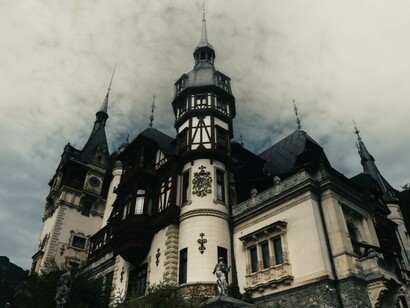
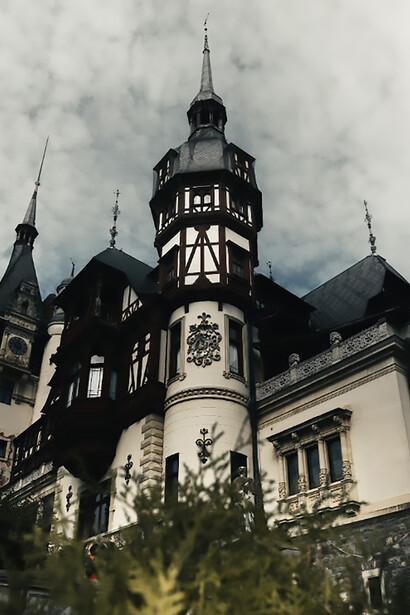
- A large spooky castle with a clock tower in Romania
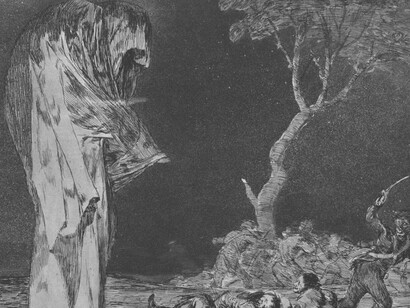
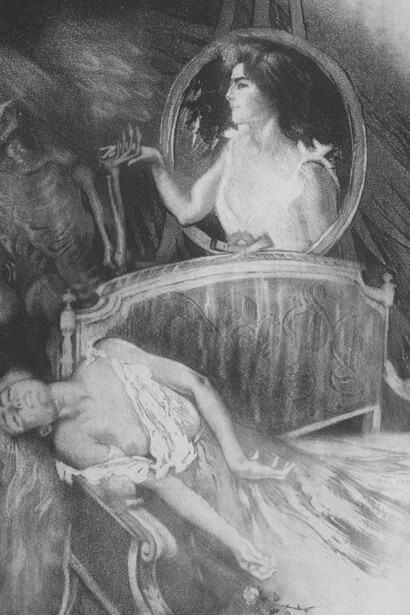
- Disparate de miedo,’ Miriam and Ira D. Wallach Division of Art, Prints and Photographs: Print Collection, The New York Public Library Digital Collections, 1815
- A large, eerie castle featuring a clock tower, located in Romania
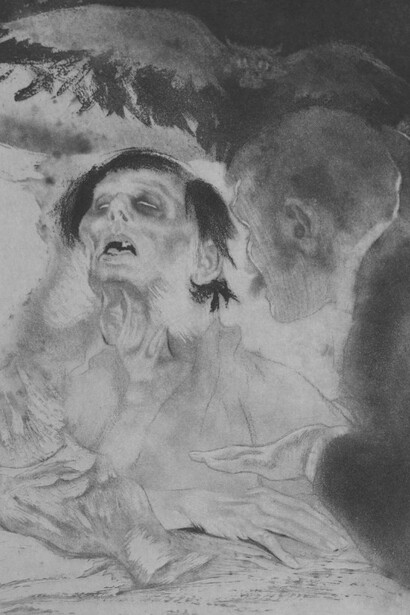
- ‘La vérité sur le cas de M. Valdemar,’ Spencer Collection, The New York Public Library Digital Collections, 1897
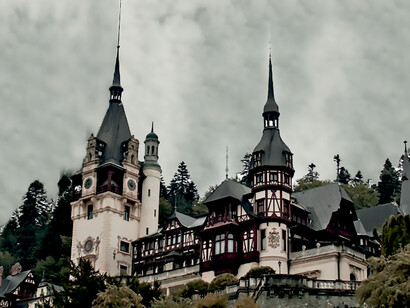
- An imposing Romanian castle with a prominent clock tower and a spooky atmosphere
- Le Portrait Ovale,’ Spencer Collection, The New York Public Library Digital Collections, 1897
.jpg)
Karl Friedrich Kahlert’s / “The necromancer" Unmasking the supernatural in a gothic tale of mystery and deception
Eleanor Sleath and "The Orphan of the Rhine"
Rituals & politics in Carl Grosse’s Horrid Mysteries
The gothic deception / Fear and morality in Clermont
The allure of The Arabian Nights
The dark allure of orientalism in Beckford’s Vathek
Sensibility and reason in "The memoirs of Emma Courtney"
A view of Jane Austen’s life and work by Lucy Worsley
A gothic critique of Jane Austen’s Northanger Abbey
The fable of the bees / Mandeville's critique
The nature of hate / A Hazlittian perspective
Courtiers by Lucy Worsley / Power and intrigue in Georgian England's royal court
Rediscovering Dr. John Moore's "Zeluco"
Virtue and vanity in Pope's eighteenth-century women
Satirical brilliance in Pope's 'The Rape of the Lock'
Mandeville's economics: social hierarchy insights
Frances Burney's Evelina, 18th century male manners
William Cowper's "The Task" / Faith and nature
Richardson’s Pamela / A tale of moral virtue
Zastrozzi / A Gothic pastiche
Exploring education in Rousseau's “Emile”
Rousseau / A man of many contradictions
Sarah Scott’s Millenium hall / Imagining a female utopia
Frances Burney’s Evelina, female propriety and a reputation


No comments:
Post a Comment