

Greenland sharks aren't born or grow up near Greenland
Despite being most associated with cold Arctic waters, the Greenland shark - the world’s longest-living vertebrate - aren't born in Greenland or anywhere else in the Arctic, while the species’ nursery is most likely Skagerrak.
Despite being – as its name would suggest – most associated with cold Arctic waters, the Greenland shark, the world’s longest-living vertebrate, are not born in Greenland or anywhere else in the Arctic, while the species’ nursing area is most likely Skagerrak off Denmark.
These are the conclusions drawn by a new international study led by researchers from the Greenland Institute of Natural Resources and the University of Copenhagen.
The Greenland shark is an enigmatic yet mysterious species not only for the fact that it can live for several centuries and grow to at least 5.5 metres in length, making it one of the world’s largest carnivorous sharks.
It is usually associated with the cold deep waters of the Arctic, where it lives a slow life shrouded in mystery, with a white worm-like parasite dangling from each eye.
A new study led by researchers from the Greenland Institute of Natural Resources and the Natural History Museum of Denmark has presented an important piece of the puzzle surrounding this mysterious life. Among other things, the study shows that the Greenland shark is actually found much closer to Denmark than most would imagine.
Researchers have examined catch data from over 1,600 Greenland sharks across the North Atlantic, but it is Skagerrak – a region between Denmark, Norway, and Sweden – that stands out as the area with the highest proportion of young sharks between 90 and 200 centimetres.
“We consider the deepest areas of the Skagerrak to be a potentially important feeding ground for teenage Greenland sharks’, and in fact, the study is the first to systematically examine the occurrence of Greenland sharks in the Skagerrak,” said associate professor and marine biologist, Peter Rask Møller from the Natural History Museum of Denmark.
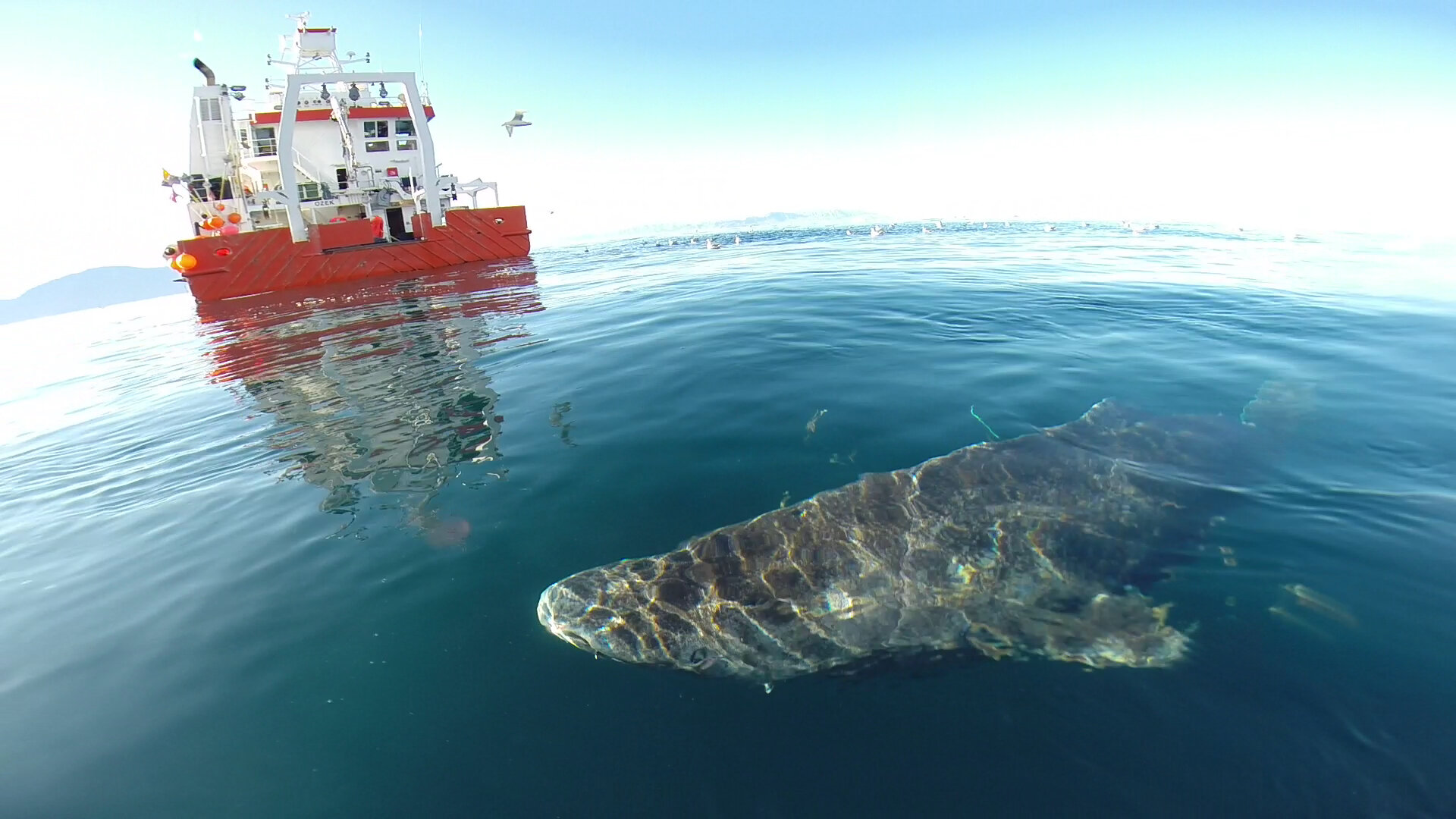
One of the biggest mysteries surrounding the Greenland shark is where it gives birth.
Newborn Greenland sharks measure approximately 40 centimetres at birth, and the new study concludes that this is unlikely to take place in fjords or on the continental shelf in the waters around Canada, Greenland, Iceland, Norway, or Russia. This is because neither pregnant female nor newborn pups have ever been recorded in any of these areas.
Through a review of Danish, Norwegian, and German museum collections however, as well as unpublished scientific databases from Iceland, Norway, and Russia, the researchers have managed to find observations of newborn Greenland sharks – all recorded near the Mid-Atlantic Ridge and the Irminger Sea south of Iceland.
“Future targeted studies will most likely confirm that the Greenland shark gives birth to its many pups in undisturbed parts of the deep sea near the Mid-Atlantic Ridge in deep waters, where there is little activity from commercial fisheries,” said the study’s lead author, Julius Nielsen, a visiting researcher at the Natural History Museum of Denmark.
Listed as vulnerable on the International Red List of Threatened Species, the Greenland shark is currently exposed to significant bycatch in trawl, gillnet, and longline fisheries for halibut and cod in deep water.
New understanding about the geographical distribution and distribution of different life stages of the species is therefore important in relation to protecting it across national borders in the North Atlantic.
“The study breathes new life into the story of the Greenland shark throughout the North Atlantic and provides an understanding of how Denmark’s deepest sea area also plays a role in the species’ life history,” said Møller.
Even though the birth area is the Mid-Atlantic Ridge, the teenage years may well be spent in the Skagerrak, and later in life the adult shark may reside in South Greenland or Iceland. However, much more knowledge is required to understand exactly how the different areas are used.


No comments:
Post a Comment