
 |
| Franz Joseph Order, Officer's Cross breast badge, 'There are 5 classes of FJO – knight, officer (since 1901), commander, commander with star and grand cross. Badge for grand cross and commander/ commander with star is the same and has the size of 70mm/38mm. Grand cross was on sash and commanders were worn on neck ribbon. Grand cross is also having breast star which is larger than breast star of commander with star. |
Chapter 95
A Brief History of Royal Decorations, Military Badges and Lapel Pins
Royal decorations, military badges and medals together with lapel pins are part of visual communication conveying various message of majesty, power , bravery and at times pure vanity. Detachable badges in metal or cloth are a key element of military uniforms. They can be worn on a cap, collar, shoulder, arm, or cuff. They can be stitched, or attached with brass pins or ‘sliders’. They can identify the rank of the serviceman, their particular regiment or ship, qualification or specialist trade, and distinguish those with gallantry awards, long service or who have been previously wounded. Servicemen may also wear badges of larger formations (such as Brigades, Divisions or Armies), within which their unit is currently serving. Lapel Pins are worn to show affiliation with an organization or cause, they have become a new collectible trend . Exceptionally cheap to produce, custom enamel pins are bringing individual flair to hats, jackets and lapels around the world, and giving artists the chance to make their work into an affordable and collectible commodity.
 |
| Order of the Black Eagle (Prussia). George V's star with garter, c.1901-10, given to King George V when Prince of Wales by Prince Henry of Prussia. |
 |
| Garter star, belonged to Leopold II, King of the Belgium . |
 |
| The Order of the Red Eagle (German: Roter Adlerorden) was an order of chivalry of the Kingdom of Prussia. It was awarded to both military personnel and civilians, to recognize valor in combat, excellence in military leadership, long and faithful service to the kingdom, or other achievements. |
 |
| Royal Order of Holland 1807, Knight Grand Cross In 1806 Lodewijk Napoleon was appointed King of the Kingdom of the Netherlands by his brother Napoleon Bonaparte. One of his first actions was to institute two orders: The Grand Order of the Union and the Order of Merit. The Grand Order of the Union should hold 30 Knights Grand Cross. The Order of Merit should hold 50 Commanders and 300 Knights. On 1 January 1807 294 Knights were appointed. Bonaparte was very displeased by the actions of his brother and both orders were abolished on 14 of February 1807 and replaced by The Royal Order of Holland. Only very few medals were actually struck and issued. |
 |
| Order of the Bath, K.C.B. (Military) Knight Commander's set of insignia neck badge and breast star, |
 |
| Established in 1888 by Queen Victoria, the Most Venerable Order of the Hospital of St. John of Jerusalem is a working order of charitably minded men and women whose philanthropy is expressed principally through its two foundations, the St. John Eye Hospital in Jerusalem and St. John Ambulance. The Order traces its origins to the Knights Hospitaller, of the Crusades, who served the Abbey of St. Mary’s small hospital for sick pilgrims in Jerusalem in the 12th century. |
The military decorations and badges have a long history. It is known that awards in ancient times were given solely for military achievements. Daggers of gold were once more common in Assyria and Persia. Sargon, who conquered and looted the Urartean city of Musasir, listed no fewer than six as being in the treasury of Urzana, the king of Urartu. And in the later times of the Achaemenian kings of Persia, as we learn from Xenophon in the Anabasis, Cyrus the Younger, shortly before he was slain at Cunaxa (40I B.C.) trying to take the throne from his brother Artaxerxes II, presented a golden dagger to Syennesis, the king of Tarsus, in Cilicia. The treatment of the lion heads on the dagger is entirely in the tradition of Achaemenian. During the period of the Achaemenian empire the stylized lions, featuring a slightly changed natural form by minor details, became almost standard practice so that it is composed into a neat and tidy decorative pattern.
 |
| Lion and Sun order of Persian Empire |
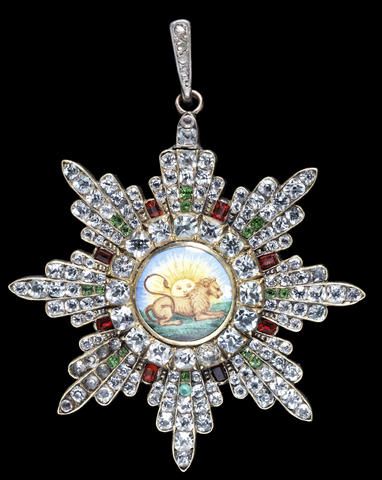 |
| Lion and Sun Order of Qajar dynasty of Persian Empire |
 |
| Lion and Sun Order of Qajar dynasty of Persian Empire |
 |
| Lion and Sun Order of Qajar dynasty of Persian Empire |
 |
| After a coup with the help of British, against the newly established constitutional monarchy of Iran, Reza Palani, from the the Palan tribe of Savadkooh, who served as a petty officer in the Cossack army of the old tsarists Russia in Iran, became a dictator and soon after, in 1925, declared himself the king. Given a negative connotation of Palani in the Persian language, he changed his surname to Pahlavi, by forcing the historian Mahmood Pahlavi to abandon his surname. The historian afterward assumed the name Mahmood Mahmood. Reza founded the Order of Pahlavi in 1932. The ancient emblem of Sun and Lion in the center design was replaced with the summit of mount Damavand and sun. It was awarded in two classes, i.e.: 1st class (with collar) and 2nd class (without collar). |
 |
| Kingdom of Hanover: Guelphic-Order commanders cross |
 |
| The Order of the Netherlands Lion (Orde van de Nederlandse Leeuw) is an order of the Netherlands which was first created on 29 September 1815 by the first King of the Netherlands, King William I. The Order of the Netherlands Lion was until recently awarded upon eminent individuals from all walks of life, including generals, ministers of the crown, mayors of large towns, professors and leading scientists, industrialists, high ranking civil servants, presiding judges and renowned artists. It could therefore be considered the Dutch equivalent of the Order of the Bath. Since 1980 the Order has been primarily used to recognise merit in the arts, sport and literature; others have been awarded the Order of Orange Nassau instead. The Order of the Netherlands Lion ranks after the coveted Order of William. Every year on the Queen's official birthday, April 30, several appointments in the Order are made public. The second and third class of the Order are not awarded to foreigners; they are eligible for the Order of Orange Nassau or the Order of the Crown instead. |
 |
| Austria, Golden Fleece Order, a commander's badge |
 |
| The Order of the Holy Trinity was established by Emperor Haile Selassie I in 1930 for his coronation. The Order was generally limited to the nobility, high clergy and a handful of courtiers. |
 |
| The sash, star and badge of The Duke of Edinburgh’s Order of the Queen of Sheba is made by Spink, the Queen’s medallists, of London, although Arthus-Bertrand has also made it. Significantly, however, new copies of the set have recently appeared at auctions, marked as having been made by the original manufacturer, B. A. Savadjian, in Addis Ababa. |
 |
Order of Leopold (military), Grand Cross sash badge. The Order of Leopold was established in 1832 by King Leopold I and is the senior order in Belgium. The Order is awarded in three divisions – Civil, Maritime, and Military (with each having 5 different classes) for contribution to the military, society or the Belgian State. |
Persians and their Parthian cousins wore the torques or neck-ring as a badge of honor or symbol of rank. Greeks and Romans in their wars with Persians and Parthians adopted the practice of giving the torques as a military decoration. A formal award was created in the form of the Persian necklace which must on many occasions have been striped as booty from the neck of a slain soldier. The Roman soldiers did not wear their torques in traditional Persian fashion around neck. They were usually, awarded in pairs and in the reliefs the torques are shown as though they are attached to the cuirass on either side just below the collar bones.
 |
| A Parthian phalarae |
 |
| A Parthian phalarae |
 |
| Roman lion's head phalarae |
Romans called these decorations phalarae (φάλαρον) meaning Award. The word “phaleristic” is used to classify the science that studies orders, decorations, and their history. A phalarae was a circle or crescent shaped plaque worn by war horses, or mounted to soldiers armor, and are visible on Roman tombstones. Also the tiara of the king of Persia was thus adorned (Aeschyl. Pers. 668).
 |
| The Japanese Order of the Sacred Treasure (瑞宝章 Zuihō-shō) is established on 4 January 1888 by Emperor Meiji as the Order of Meiji. Originally awarded in eight classes (from 8th to 1st, in ascending order of importance), since 2003 it has been awarded in six classes, the lowest two medals being abolished that year. |
 |
| THE ORDER OF ST. STANISLAUS, third class badge (Civil), in gold and enamels |
 |
| Kingdom of Bavaria: military merit order, cross 3rd class with swords |
 |
| Kingdom of Hanover: Guelphic-Order commanders cross |
 |
| The Russian Order of St. Andrew the Apostle the First-Called with motto band |

The first organized system of military medals was created by the Romans, who developed a complex hierarchy of military honors ranging from crowns that were presented to senior officers to mark victories in major campaigns, to phalarae or metal disks bearing the Emperor's image, which were awarded to centurions and soldiers for valour in battle. Decorations were usually worn by the soldiers on parades and were generally awarded at the end of a campaign or could be added to the eagle standards for entire units. These phalarae are the ancestors of modern military medals.
 |
| Kingdom of Prussia: Order of the crown cross 3rd class with swords |
 |
| The Star of the Grand Cross of the Iron Cross (German: Stern zum Großkreuz des Eisernen Kreuzes) was the highest military decoration of the Kingdom of Prussia and the German Empire. It was considered a senior decoration to the Grand Cross of the Iron Cross. |

 |
| Badge of The Order of the Garter, 1775-1800, |


During the Crusades in the 11th century, knights formed into religiously organised military orders. The Order of the Holy Sepulcher was founded after storming Jerusalem in 1099 and united with the Order of St. John in 1291; the Order of St. John in 1118 was formed out of the monks’ Order of the Holy John of Jerusalem; the Order of the Templar was also founded in 1118, and merged in 1312 in the Order of St. John. And lastly, in 1170, the Marianer knights Order, which later became the German Order, was formed.


 |
| The Order of the Zähringer Lion was founded by Grand Duke Carl Ludwig von Baden in 1810. |
 |
Order of the Zähringer Lion: Commander star |
 |
| Distinguished Service Cross |
 |
| The U.S. Army Distinguished Service Medal |


The grand master of these orders founded multiple branches of their order societies before the downfall of Jerusalem and enhanced their political powers in all parts of Europe . Being reinforced through all their gains during the Crusades and their fast growth, the orders’ masters were coveted by almost all of the royals. This triggered the development of awarding memberships in orders.
 |
| Russian Order of the White Eagle |
 |
| Order of the Bath, G.C.B. (Civil) Knight Grand Cross set of insignia, sash badge, hallmarked London 1865, |
The Anglo-Saxon tradition of marking major military campaigns or victories with medals goes back to the reign of Elizabeth I. She issued commemorative medals to mark England's victory over the Spanish Armada in 1588. At that time and up until the 19th century, medals like these were only presented to the most senior officers engaged in a battle. The modern practice of issuing a campaign medal to participants of all ranks began during the time of Oliver Cromwell, when all members of the Parliamentary army who had participated in the Battle of Dunbar received a medal marking the occasion. The practise would not be repeated until 1815, when a medal was awarded to all members of the British forces who served during the Battle of Waterloo.
Medal design shows the talent and the skill of the most famous jewelers of their time in an impressing way. Many known names like Fabergé in Moscow or Le Maitrè in Paris are among those. Each order decoration is a mirror of the time it was made. Several processing steps led to extremely fine and intricately made jewelry consisting of several complex, joined individual parts. The cross bodies are usually made from red and yellow gold and sometimes feature silver foil underneath the colored glass arms to enhance light reflection. The center of the medals usually depict the family's heraldry crescent in finest enamel hand painting.
 |
| Order of the Bath, K.B., Georgian Knight's set of insignia, , comprising sash badge |
 |
| Badge of The Order of the Garter, centre enamelled en grisaille with St. George and the dragon, c.1780-85 |
 |
| France. A Legion D'Honneur, Grand Officer Breast Star, Third Republic (1870-1951) |
 |
| After the abolition by the Revolution of the ancient orders of chivalry in the name of égalité, the Légion d'honneur (Legion of Honour), instituted on 29 Floréal, An X (19 May, 1802), was created as an honour of a completely different type. By honouring personal merit, both civil and military, without distinction of birth, the award was “a start towards the organisation of the Nation”, as the First Consul put it. The law which created it did not provide for insignia or motto; a simple letter of notification, signed by the Grand Chancelier, was sent to new members. It was only two years later, by the decree of 22 Messidor, An XII (11 July, 1804), the famous decoration saw the light of day: |
 |
| The Ordre de la Réunion was an order of merit of the First French Empire, set up to be awarded to Frenchmen and foreigners to reward services in the civil service, magistracy and army, particularly those from areas newly annexed to France, such as the Kingdom of Holland. |

Since then enamel and lapel pins have been worn by soldiers during battle. The trend is thought to have started during the Revolutionary War and continued through to World War I. The use of enamel and lapel pins had also become very popular for politicians and political supporters during rallies and events. Whatever the process used to produce it, the heart of a lapel pin is in its design. Without the correct form, a lapel pin falls short of meeting its goal. After all, these are very small pieces. They must be designed with both preciseness and legibility in mind.


No comments:
Post a Comment