
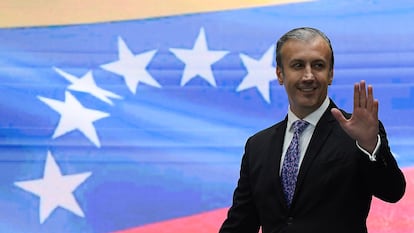
Tareck El Aissami Maddah was until now one of the most powerful members of Nicolás Maduro’s government. On Monday, he resigned over a corruption investigation into the Venezuelan state-owned oil company, PDVSA. El Aissami, who had held the post of Minister of Petroleum since April 2020, stated that he was at the president’s disposal to support him in his “crusade against anti-values.” But the arrest of several high-ranking officials linked to El Aissami suggests a change in the balance of power in the Venezuelan leadership. The former minister was a member of the radical left in the 1990s, when he was a student leader at the University of the Andes (ULA), one of the most traditional educational institutions in the country. There, he befriended one of his lecturers, Adán Chávez, former president Hugo Chávez’s brother and a political activist, through whom El Aissami first dipped his toe in the early currents of Chavism.
When Maduro ascended to power El Aissami was able to increase his sphere of power and influence beyond citizen security matters. A group of businessmen of Arab origin gravitated toward him, positioning themselves on the country’s economic map amid an exodus of millions of Venezuelans. During that time, he adopted a decisive position in favor of an official opening toward the private sector and several emerging businessmen, both Chavist and non-Chavist, flocked to his banner.
As the social and political crisis worsenedand the popularity of the Chavist movement began to decline, El Aissami’s name was linked with rumors of corruption. In 2019, the Manhattan Federal Court accused him of involvement in drug trafficking, along with businessman Samarck López. U.S. Immigration and Customs Enforcement added him to the 10 most wanted fugitives list, and the Department of State offered a $10 million reward over allegations of drug-trafficking and narco-terrorism. El Aissami brushed off the accusations, stating that they represented an honor coming from the United States and that his “revolutionary morale” remained intact.
On the international stage, El Aissami has been a natural ambassador and interlocutor for the political ties between Maduro’s regime and Iran and Hezbollah. He was also key to the commercial and political rapprochement with Recep Tayyip Erdoğan’s Turkey. These personal and political relationships, vital to obtaining alternative routes for the commercialization of Venezuelan oil in a context of international sanctions, would prove of great use to him in his role at PDVSA. However, on Monday an unprecedented operation led to the arrest of two figures close to El Aissami: Joselit Ramírez, the national superintendent of Crypto Assets, a public agency that manages Venezuela’s increasingly scarce oil industry funds through cryptocurrency operations, and National Assembly Deputy Hugbel Roa.
When Maduro ascended to power El Aissami was able to increase his sphere of power and influence beyond citizen security matters. A group of businessmen of Arab origin gravitated toward him, positioning themselves on the country’s economic map amid an exodus of millions of Venezuelans. During that time, he adopted a decisive position in favor of an official opening toward the private sector and several emerging businessmen, both Chavist and non-Chavist, flocked to his banner.
As the social and political crisis worsenedand the popularity of the Chavist movement began to decline, El Aissami’s name was linked with rumors of corruption. In 2019, the Manhattan Federal Court accused him of involvement in drug trafficking, along with businessman Samarck López. U.S. Immigration and Customs Enforcement added him to the 10 most wanted fugitives list, and the Department of State offered a $10 million reward over allegations of drug-trafficking and narco-terrorism. El Aissami brushed off the accusations, stating that they represented an honor coming from the United States and that his “revolutionary morale” remained intact.
On the international stage, El Aissami has been a natural ambassador and interlocutor for the political ties between Maduro’s regime and Iran and Hezbollah. He was also key to the commercial and political rapprochement with Recep Tayyip Erdoğan’s Turkey. These personal and political relationships, vital to obtaining alternative routes for the commercialization of Venezuelan oil in a context of international sanctions, would prove of great use to him in his role at PDVSA. However, on Monday an unprecedented operation led to the arrest of two figures close to El Aissami: Joselit Ramírez, the national superintendent of Crypto Assets, a public agency that manages Venezuela’s increasingly scarce oil industry funds through cryptocurrency operations, and National Assembly Deputy Hugbel Roa.


No comments:
Post a Comment