Kintsugi, also known as Kintsukuroi, is a Japanese art form that involves repairing broken pottery using lacquer mixed with gold, silver, or platinum. While Kintsugi is primarily a visual art form, it is also rooted in both science and philosophy and has been used as a metaphor for resilience.
An image from the film 'Plan 75,' by Chie Hayakawa.
See, read and listen to modern Japan
Just two decades ago, the island country was seen as being so far away. But nowadays, it’s much closer culturally, while also forming part of the imagination of youth
PATRICIA ALMARCEGUI
SEP 10, 2023
Japan continues to be an excellent travel destination. Access was limited to the island country for more than two-and-a-half years due to strict measures during the Covid-19 pandemic, which damaged the economy. But today, thanks mainly to international tourism and the development of domestic consumption, the third-largest economy in the world has finally recovery.
The country — which, just two decades ago, seemed incredibly distant from the rest of the planet — is now much closer culturally, while also forming part of the imagination of youth. This is mainly due to the entertainment industry… anime, in particular. A genre that, in Japan, has the same recognition as other forms of art, such as cinema, literature or theater. There has been a global phenomenon of a young public leaning towards Japanese food and music, as well as literature and cinema. What used to be viewed as strange themes and motifs are now fundamental to interpret the contemporary world.
The winner of the 2021 Japan Booksellers Award — 52 Hertz Whale, by Sonoko Machida — deals with the rural world, youth and abuse. Translated widely, it narrates the friendship of protagonists Kiko and Mushi, in a fishing village. The novel is essentially cinematographic, thanks to the action-packed dialogues. It can also be read in the context of the latest government policy, which aims to reclaim rural areas and encourage youth to settle there. If the density of the population of Tokyo, the largest city in the world, keeps increasing, half of Japan’s towns will have disappeared by 2040.
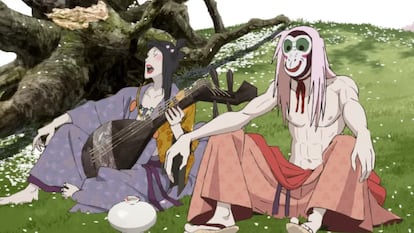
An image from the anime film 'Inu-Oh,' by Masaaki Yuasa.
The Ladies of Kimoto (1959), by Sawako Ariyoshi, narrates the lives of four generations of women, while also dealing with Japan’s history. It includes the country’s feminine traditions, as well as its restrictions on women and girls. Ariyoshi, who has been compared to Simone de Beauvoir or Scheherazade, writes of the space in which women can claim their desires. In the novel, Ariyoshi writes: “She remembered her grandmother every time she refused a marriage proposal. Grandmother repeated that it was necessary to think it through, because it was the woman who gave birth.”
In A Woman and War (2023), manga artist Yoko Ondo illustrates Sakaguchi Ango’s two stories of the same title, which were published in 1946. These stories entail both a female and a male perspective of the devastation and destruction of World War II. What was life like for women during the war? How was their sexuality impacted? The protagonist only feels pleasure in the midst of fire, ruins and destruction. The tension and physicality of the work is enormous: the louder the clamor of the explosions and the heat of the bombs, the more the bodies throb with desire.
Nagori (2018) by Ryoko Sekiguchi is a short essay about Japanese thought, which progresses and dissolves into a delicious reflection on gastronomy and the passage of time. The writer, who has lived in Paris for more than 20 years, reflects on taste and the passage of time, treating food and its cultural constellations as literary themes.
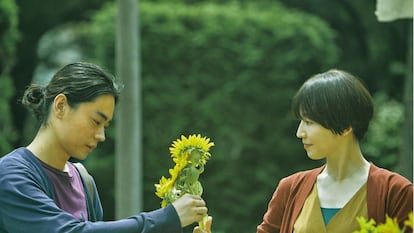
An image from the film 'A Hundred Flowers' (2022), by Genki Kawamura.
In the context of poetry is the anthology The Seed and The Heart, translated by Teresa Herrero. A compilation of 180 Japanese poems from the 7th century to 1945, the collection is rigorous and detailed. It also includes valuable comments written with the same clear, raw and exact syntax of the selected poems: “The birthplace of poetry is song and — more specifically — the popular song of rice workers.”
One of the serious issues that Japan is contending with today is an aging population, with 30% of its inhabitants over 65. In the next 40 years, the population is expected to drop from the current 125 million to around 90 million. Japanese-Canadian novelist Aki Shimazaki deals with this subject matter in her books (which are only published in French and Spanish). In one work, she writes a novel about memory loss and the life of an elderly couple in a nursing home in Yonago, in the western Tottori Prefecture. With the faded and poetic atmosphere of Yasunanari Kawabata (the first Japanese citizen to win the Nobel Prize in Literature) but with a more contemporary rhythm and conciseness, she also reflects on the silences that women have had to keep as generations pass.
The theme of aging is seen in a different narrative form with the film Plan 75 (2022), directed by Chie Hayakawa. One of the great Japanese films of recent years, it has a heavily dystopian element, which, little by little, manages to coincide with our reality. The movie eventually transforms into something similar to horror, encompassing society’s fear of growing old. In the plot, Japan approves a law that citizens over the age of 75 — even if they are not suffering from any type of disease — can be part of a euthanasia program that will leave the world with fewer burdens (and more money and youth).
Less controversial is the novel My Mother(1975), by Yasushu Inoue. Republished in recent years, it’s a beautiful narrative about the dignity with which aging parents deserve to be treated by their children. And, in the film A Hundred Flowers (2022), directed by Genki Kawamura, a son is grief-stricken over the loss of his mother’s memory.
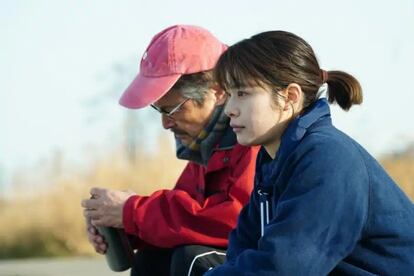
An image from film 'Small, Slow but Steady' (2022), by Shô Miyake.
On the other end of the age scale, Small, Slow but Steady (2022), by Shô Miyake, is one of the most critically acclaimed films in Japan. It narrates the life of a young professional boxer, deaf from birth, in contemporary Japan, where many things are disappearing, including the sport she practices. Shot in 16mm film, it’s tinged with melancholy. The sound is especially subtle, adding a sense of solitude to the narration and the protagonist.
Youth and adolescence are also tackled in Monster, by Hirokazu Koreeda, a candidate for the Palme d’Or at Cannes in 2023, as well as in How Do You Live? by anime master Hayao Miyazaki. Also in the realm of anime, Masaaki Yuasa has recreated 600 years of Japanese music and dance through his colorful film Inu-Oh (2022). Meanwhile, a film about the Japanese animation industry itself, Anime Supremacy (2022) by Kōhei Yoshino, uses live actors to break down the work process and competitiveness behind anime.
An image from 'Monster,' by Hirokazu Koreeda.
As Japan undergoes profound economic, political and social reconfigurations, books and films are able to capture these experiences. Special attention must be paid, because — as history has shown — Japan tends to be the first country to be affected by problems that are later experienced elsewhere.
The statesman Fujiwara no Michinaga has a reputation for arrogance, due to a famous poem expressing self-satisfaction over his power. However, his diary reveals him as a multifaceted character.
The Path to Advancement
The powerful statesman Fujiwara no Michinaga is associated with the poem celebrating his political triumph, written in 1018, while he was in his early fifties: Kono yo o ba / wagayo to zo omou / mochizuki no / kaketaru koto mo / nashi to omoeba (This world / belongs to me— / lacking in / nothing like the / full moon). Many readers view the poem in a negative light, interpreting the pride Michinaga expresses in his power as hubris.
Photograph: Robby Ogilvie, UK winner, Open Competition, Object, Sony World Photography Awards 2026
SMART SHOT
‘As soon as I saw it, I knew the image’: Robby Ogilvie’s best phone picture
A Ford Cortina the colour of the sky against brightly coloured houses in Cape Town was a gift to the Scottish photographer
Grace Holliday
Saturday 14 March 2026
Edinburgh native Robby Ogilvie was visiting South Africa when he took this image. “I’d spent the first week in and around Kruger national park, photographing the culture, landscapes and wildlife, before moving on to Cape Town.”
Beryl Cook in 1979. Photograph: Chris Capstick/Shutterstock
‘Ordinary people enjoying themselves’: Beryl Cook exhibition to open in Plymouth
Exclusive: Show at The Box in artist’s home town spans entire career and includes previously unseen works
Dalya Alberge Fri 20 Jun 2025 15.00 BST
She was a seaside landlady who left school at 14 and who, without any formal training, became one of Britain’s most popular artists. Now, 17 years after Beryl Cook’s death, her home city of Plymouth will this week announce a major exhibition that will include previously unseen works as well as much-loved humorous paintings with larger-than-life characters.