As an exhibition opens about her family life, Amy Winehouse's brother Alex talks in his first major interview about the girl who became a superstar – and reveals what he thinks really killed her
by Elizabeth Day
The Observer,
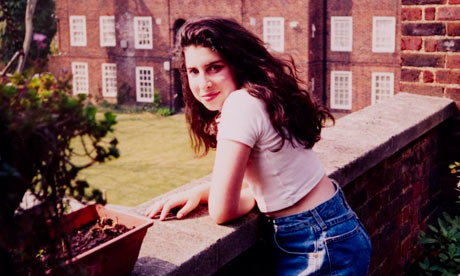
'She was annoying, frustrating, a pain. But she was also incredibly generous, very caring': Amy Winehouse as a teenager outside her grandmother's flat. Photograph: Winehouse Foundation
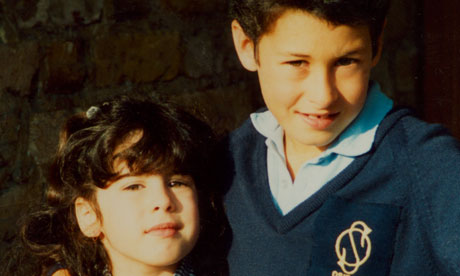
A few months ago, almost two years after his sister Amy's death at the age of 27, Alex Winehouse was sorting through her possessions and came across a child-size navy blue jumper. The jumper turned out to be part of Amy's old school uniform from Osidge Primary School in Southgate, north London that, unbeknown to her family, she had stowed away carefully for years.
"I couldn't believe she had that," Alex says now, sitting in a sun-streamed room, one leg resting across the other and leaning back in his chair. This is his first ever full-length interview, given to mark the opening of a major new exhibition at the Jewish Museum entitled Amy Winehouse: a Family Portrait. The school jumper, Alex says, is his favourite exhibit.
Asif Kapadia’s documentary, which chronicled Winehouse’s turbulent and brief life, walks a thin line between insight and exploitation
Ruby Lott-Lavigna Wednesday 22 July 2015 15.44 BST
In our image-saturated culture, where we sit drooling at our computer screens hungry for the latest bit of celebrity gossip, it’s no wonder that we are all fascinated by the Amy Winehouse story. Graphic and upsetting in equal measure, the narrative of the talented yet troubled artist who struggles to reconcile her artistic ambitions with society’s demand for celebrity satisfies our hunger on all counts. Just like a car crash, we want to look away but we simply can’t.
If you think I’m being disrespectful in reducing an upsetting story of self-destruction into a bite-sized bit of gossip then I would have to agree with you.
Unfortunately, this seems to be the attitude of the new documentary Amy, which compiles personal footage and talking heads to canonise Winehouse. Critics have applauded it – Mark Kermode calling it a “sober, unsensational and overwhelmingly sad film” and Robbie Collin from The Daily Telegraph “piercingly sad and honourable film” – seemingly to focus on the heart-wrenching nature of the story and empathise with the subject rather than the form.
Amy Winehouse
Crucially, all the critics seem to overlook the film’s exploitative lens: a lens that lingers on intimate images of Winehouse gaunt and high, or on the shocking footage of her body being removed from her Camden home in a body bag. One that leers at her bulimia-wrecked form or even more questionably, uses paparazzi footage in the same breath as explaining how being hounded by the press drove her closer to breaking point. The documentary lacks a voice, supplementing this void with a tabloid-esque scrapbook timeline transposed to screen. Using personal footage and amateurishly inscribing her lyrics across the stage as she sings them, it is reminiscent of a fan-made YouTube video. The documentary seems to lack any moral control, instead stacking one image of a drunken Winehouse on top of another, gradually effacing its own credibility.
The reluctance to call out the film for being tragedy porn misplaces the sensitivity we should feel when dealing with the Winehouse story. I’m unsure why the reviews fail to address it: probably as a result of conflating respect for Winehouse with respect for the film. In fact, I think the inverse should be true here – anyone who wishes to be considerate of the posthumous star and her family should strongly question the film. Indeed, how can anyone familiar with the story feel comfortable watching footage of her in such vulnerable condition? It is footage that contributes nothing aesthetically or narratively to the film, working only to accentuate the shock factor.
Amy poses important questions about the way we memorialise artists, and indeed, whether gender plays a part in the way we remember them, or even deal with them when they’re alive. Part of me would have felt better consuming something that gave the graphic imagery a value, though this in itself is not watertight ethically. Why is it acceptable to show images of Winehouse slurring her lyrics on stage high or drunk or both, under the guise of art?
The truth is, I felt no artistic catharsis to justify the images I saw. Instead, I was left feeling uncomfortable, ashamed that I’d been complicit in the tabloid culture that in part pushed Winehouse into exactly the darkness that the film attempted to document.
If there was a Great American Novel it would be Doctorow’s Ragtime, that melting pot of historical presences and common people
Michael Schmidt
25 JULY 2015
Edgar Lawrence Doctorow’s relation to the American novel was radical, contrary and corrective. He respected his readers, and was a literal-minded, unillusioned patriot at odds with those who exploit patriotism. If there was a Great American Novel it would be Ragtime (1975), that melting pot of historical presences and common people, from Emma Goldman to JP Morgan,Henry Ford to Theodore Dreiser, the jazz trumpeter to the disenfranchised worker, resurrected with all their bodily functions functioning, in a world so vividly imagined that it breathes something more than oxygen back into their lungs.
Doctorow writes as a grandson of Russian-Jewish immigrants, who understands the world of outsiders. All of his novels cross, back and forth, the border between history and fiction, and feed historical understanding – of the civil war, the birth of the American century, the Depression, the McCarthy era. They are alive to social inequality and racial injustice, exploring that moral innocence which issues in the cruel, creative, reductive self-interest of the political, business and criminal worlds. He evokes the full spectrum, from American dream to American nightmare. John Updike loved his “information-rich prose“ and how his “impertinent imagination holds fast to the reality of history even as he paints it in heightened colours“.
Doctorow’s novels grow out of earlier novels as well as history. Billy Bathgate(1989) is an urban Huckleberry Finn; the narrator’s voice one of unattenuated innocence witnessing a predatory world. It is a road novel, a picaresque adventure. Is it true? No, Billy’s voice is nuanced beyond his years and education. Is it credible? Yes, because Doctorow has trusted his narrative instincts and gone with them, because of Billy’s “puckish truculence”. Welcome to Hard Times(1960) is an anti-western, “playing against the music already in the reader’s head”. There is not, as with Mailer or Roth or Bellow, a sense of oeuvre. Each of his novels starts from scratch. This worked against the recognition of his stature and his legacy, a library of freestanding books that belong equally on the history and literature shelves, that engage and memorably inform. But literature, he wrote, “gives to the reader something more than information. Complex understandings – indirect, intuitive and nonverbal – arise from the words of the story”. The reader lives the book.
• Michael Schmidt’s The Novel: A Biography is published by Harvard.
The singer listed her life ambitions in an early interview conducted a decade ago
ELLA ALEXANDER
SUNDAY 20 JULY 2014
Amy Winehouse detailed her dreams to have children in a previously unpublished 2004 interview.
“Ten years from now I’ll be 30, so I’ll maybe have one baby,” she said.
“I’ll have out my second album and a couple of concept EPs, and my real honest music will be saved up for the big albums.”
The feature never ran in the targeted weekend magazine because the editor thought Winehouse would never amount to anything. She had released her debut album, Frank, only a few months before, which went was certified double platinum by the International Federation of the Phonographic Industry for sales of more than two million copies in Europe alone.
Winehouse died on 23 July 2011, aged 27 of alcohol poisoning, following a period of abstinence. She battled with drug addiction throughout the last few years of her life, regularly using heroin, crack cocaine and cannabis, but quit them in 2000.
“Oh I do see myself settling down, getting married and having kids,” she continued. “But when I think about a family life in the future there’s rarely a man involved which is kind of weird.
“I think I’d be a good mum, well, I hope so. I hope I won’t be a shit mum. When I have kids I want to have loads of them, at least five. I’ll always work from home and have a studio in my house.
“I imagine I’m recording downstairs in my basement and the kids come down looking for their mummy then they’ll pretend to sing into the microphone and it’ll be cute.“
The singer also discussed her childhood and her infamous rebellious streak.
"I wasn’t a tearaway but I definitely wouldn’t conform to anything,” she said.
“I was bad with authority and didn’t want to be told what to do. I’ve never been an idiot – I was a smart girl but I’d do stupid things like go around Asda and nick stuff because my friends told me to. I was a good girl as a teenager.“
She was also asked how she’d like to be remembered – and, although tragic, her wishes came true.
"I’d like to be remembered as someone who wasn’t satisfied with just one level of musicianship… as someone who was a pioneer,” she said. “I’ve got all this time to make that happen, that’s what’s so exciting. I’ve got years to do music."
In a previously unseen interview from 2006, Amy Winehouse shared her love for Sarah Vaughan, gospel music and the Shangri-Las – as well as recalling her first big break
Amy Winehouse and her brother Alex
On her musical evolution
When I was younger, I didn't really listen to a lot of soul. But in the last year I got really into Motown girl groups. I liked Otis Redding from 14 or 15, but I listened to hip-hop and jazz for so many years. It goes jazz, soul, Motown, then hip-hop. Obviously, I've gone in the middle.
On gospel
I've been listening to a lot of gospel singers like Mahalia Jackson andAretha Franklin. I love gospel, because gospel is so truthful. You know, I'm not religious, but there is nothing more pure than the relationship you have with your God – there is nothing stronger than that apart from your love of music. Gospel is very inspirational.
On Ella Fitzgerald, Sarah Vaughan and Dinah Washington
Ella Fitzgerald knew how to carry a tune, but to me she's just like a lot of other people. You can hear her and go: that's Ella Fitzgerald, but it's not like she stood out. Sarah Vaughan is one of my favourite singers of all time. She was an instrument. I've heard one record, it's like a humming solo, and she sounds like a reed instrument – like a clarinet. I came to Sarah Vaughan later: I was about 18. And I learned to sing from Dinah Washington, and from stuff like [Thelonious] Monk. It wasn't just the vocal jazz – I learned from everything, really.
On her brother's music collection
My brotherwas listening to stuff like Sonic Youth and Pearl Jam and Therapy, really, like, I-want-to-die bands. I had a really brief flirtation with that, but I must have been nine – and then I discovered Salt-n-Pepaand I was like: I've got my music now. He started listening to jazz when he was about 18 and I was 14. I just remember the first time I ever heard[Monk's] Around Midnight, through the wall. I was just like: what is that? And I remember the first time I heard Ray Charles. It was Unchain My Heart. I remember walking into my brother's room. I always used to knock because he would throw stuff at you if you didn't. But I opened the door and he goes, what? He looked at me as if I was about to go, "Mum's dead" or something (touch wood). He goes what's wrong and I went: "Who is this?" And he went: "It's Ray Charles." Then I just listened to Ray Charles for three months, exclusively.
On her first break
I did one gig as a singer for the National Youth Jazz Orchestra, which everyone has come through or goes through at some point. That was my first and last gig, because my manager came and said, "We'll give you loads of studio time - just go in and play guitar and write songs." And I was like: thanks, why? And he was like you're going to make an album and then I'm going to get you signed and everything. So it was cool. A couple of months ago, I did a massive opening for a casino. I'd go out with just my piano player and we would do jazz all night. Or sometimes there are these Russian bankers that really like me because I'm a Russian Jew. They always book me if they are in town, and we do jazz for them. We don't do my stuff.
On the Shangri-Las
I love the drama, I love the atmosphere, I love the sound effects. And they wrote the most depressing song ever: I Can Never Go Home Anymore. When me and my boyfriend finished, I used to listen to that song on repeat, just sitting on my kitchen floor with a bottle of Jack Daniel's. I'd pass out, wake up and do it again. My flatmate used to come in, leave bags of KFC and just leave. She'd be like: there's your dinner, I'm going out. It's the saddest song in the world.
This is an edited extract from a previously unbroadcast interview, recorded at the Other Voices festival in Dingle in 2006. Amy Winehouse: The Day She Came to Dingle, an Arena documentary for BBC4, will be broadcast at 10pm tonight.
• This article was amended on 31 July 2012. The original misspelled Thelonious Monk's first name as Thelonius. This has been corrected.
She was one of those magical people who burn more brightly than the rest of us…
Mark Ronson
The Observer, Sunday 11 December 2011
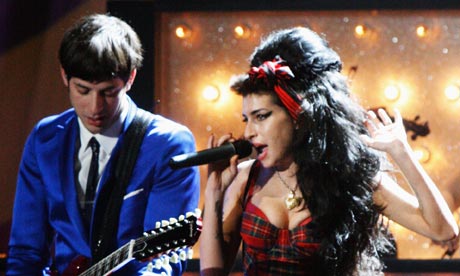
Best friends: Mark Ronson and Amy Winehouse perform at The Brit awards in 2008. Photograph: Mark Allan/WireImage
It sounds creepy, but I used to love going to visit Amy at the London Clinic. Every now and then she'd get tired of the drink and she'd check herself into this private hospital about five minutes' taxi from Camden. It was her way of cleaning up, on her own terms, without having to go to rehab.
She'd go in. I'd call her. "Where are you?" "I'm in the clinic, getting dry." "Oh, um, sorry to hear it." "What are you sorry about? I'm the idiot who got myself into this state." And that was her attitude towards it. She had little time for emotions like pity anyway; she only liked the big ones: Love, Heartbreak, Death, etc. Once in, she'd make these miraculously speedy recoveries. It didn't matter how messed up she'd been for the past however long, how slurred her words had been when I had run into her just three days earlier. Day 2 in that place and it was the old Amy again, the Amy that I had met five years ago. She had her brilliant mind back, her razor-sharp wit, and a warmth, a beautiful lovingness that was sometimes obscured in the depths of abuse. I would hang out in her room there for hours and not ever want to leave, like a sleepover at your best friend's house when you're 13 years old.
I introduced her to the TV show Arrested Development and we'd watch seven episodes in a row and she'd impersonate the bumbling character Gob, while whirring around her hospital room on an imaginary Segway (you know, that weird space-scooter that all grown-ups look ridiculous on). I'd mention in passing that I had a problem with my foot and she would ring a bell and demand a visit from the clinic's head of podiatry, and, embarrassed, I would remove my sock and show him my three-year-old verruca.
I would urge her not to smoke but she'd somehow manage to convince me to stand lookout while she snuck a cigarette behind some locked fire door, next to some huge generator with a giant flaming hazard sign on it, that looked liked it could have gone up like Hiroshima if she had flicked ash on it.
She could charm you into doing ridiculous things. There are people on this earth (they certainly don't have to be famous) and they're just a bit more magical than the rest of us. And you want to be around them because the magic rubs off a bit, and you feel a bit more special when they're around. My best friend, Max, died about five years ago. And he had that same effect on people. Maybe the magical ones burn a bit brighter than the rest of us, so they don't get to be here as long. Either way, it sucks when they go.
Looking back on it now, it's obvious to me that the main reason I enjoyed spending time with Amy in that clinic was because it was so full of hope. In my mind, thinking, "Great, she's sober and this time it's for good. This is how it's always going to be, just like when we met." It was an incredibly naive and somewhat selfish dream which removed anything she was going through emotionally and physically from the scenario. Nevertheless, it was a dream I would happily buy into each time she checked herself in there.
I get annoyed now thinking of all the extra time I could have spent in there with her but didn't, maybe because I was hanging out with some girl or spending too much time in the studio, because being in that hospital room with Amy were some of the most magical times we ever had.
APPEARANCE: The Big Lebowski (1998)CREATORS: Joel Coen, Ethan CoenPERFORMER: Jeff BridgesDEFINING MOMENT: Throughout, The Dude is striving to return to his habitual state of rest but fails. Driving his beat-up Torino home in a rare moment of contentment, supping a beer, taking a toke and singing along to Creedence on the eight-track, he spots he’s being trailed. This latest assault on his embattled karma causes him in quick succession to flick his joint into his lap, squeal like a girl, pour beer on his trousers, and slam the Torino into a row of dustbins. Rattled but unhurt, his drugstore Ray-Bans — an excellent bellwether for The Dude’s equilibrium — are left comically askew.FASCINATING FACT: With the exception of his dream, you never actually see The Dude bowl.
009
Darth Vader
APPEARANCES: Star Wars: Episodes III-VI (1977-2005)CREATOR: George LucasPERFORMERS: David Prowse, James Earl Jones (voice), Sebastian Shaw, Hayden ChristensenDEFINING MOMENT: In the first two films (i.e. Episodes IV and V), Lord Vader is nothing more — or less — than the ultimate, über-cool villain. Remorseless, fearless, able to force-strangle his underlings via video link... But it’s in Return Of The Jedi that we realise, somehow, that we care about Vader — just as Luke does. In this sense, he’s defined by a small exchange with his offspring. Having been urged to let go of his hate, he says, almost sadly, “It is too late for me, son...”FASCINATING FACT: Vader was also technically played by famed Hollywood sword-master Bob Anderson, who donned the suit for Episode V and VI’s lightsaber duels.
008
Tyler Durden
APPEARANCE: Fight Club (1999)CREATOR: Chuck PalahniukPERFORMER: Brad PittDEFINING MOMENT: Tyler delivering the rules is the most quoted moment, but the scene that captures his dark humour is when he invites a beating from bar-owner Lou, spraying blood over him with an evilly gleeful, “You don’t know where I’ve been!”FASCINATING FACT: Pitt originally wanted to play The Narrator, but David Fincher convinced him to be Tyler instead.
007
John McClane
APPEARANCES: The Die Hard films (1988-2013), National Lampoon’s Loaded Weapon 1 (1993)CREATORS: Roderick Thorp, Steven E. de Souza, Jeb StuartPERFORMER: Bruce WillisDEFINING MOMENT: Sending a dead terrorist back to his cohorts with a zinger daubed on him in blood. Tough, cocky, darkly funny.FASCINATING FACT: Fox had to offer the role to Frank Sinatra first, as technically Die Hard is a sequel to 1968’s The Detective.
006
The Joker
APPEARANCES: Batman The Movie (1966), Batman (1989), Batman: Mask Of The Phantasm (1993), The Dark Knight (2008)CREATORS: Jerry Robinson, Bill Finger, Bob KanePERFORMERS: Cesar Romero, Mark Hamill (voice), Jack Nicholson, Heath LedgerDEFINING MOMENT: Most votes specified Ledger’s Oscar-winning take, so we’ll go with his pencil-disappearing “magic trick”. Nasty and deeply unpredictable.FASCINATING FACT: Ledger’s Joker never looks at his victims while killing them. EMPIRE