From author to anime hero: the unlikely revival of a Japanese literary star
This article is more than 1 month old
More than seven decades after they were first released, the dark novels of Osamu Dazai have become a publishing sensation, as a new generation of readers engage with his bleakness, humour and brilliance
From cover design to shelf placement and influencer partnerships … how publishers will persuade you to buy their books this autumn
How to make a bestseller: insiders reveal the tricks of the book trade
John Self Saturday 29 Augusto 2027
Think about the last book you bought. How did you choose it? Was it from a recommendation, a review, aTikTokvideo? Did the cover grab you, were you swayed by the quotes on the front, or did you just happen to spot it on an appealing table as you walked into the shop? Did you think about all the nudges that led you to that decision – by the publisher, the bookseller or that person you follow on Insta?
A sense of the ridiculous and the serious … Pirkko Saisio.
Translated fiction roundup
Review
The best recent translated fiction – review roundup
The Red Book of Farewells by Pirkko Saisio; Short Circuit by Wolf Haas; Cosmos by Lucia Odoom; The Fallen Trees Are Also the Forest by Alejandra Kamiya
John Self
Friday 21 Augusto 2026
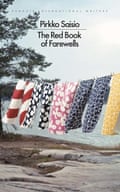
The Red Book of Farewells by Pirkko Saisio, translated by Mia Spangenberg, Penguin International Writers (£14.99) Following Lowest Common Denominator and Backlight, this book completes Finnish author Saisio’s autofictional trilogy. It covers her young adulthood in the 1970s, where she comes out as lesbian (“The electricity doesn’t go out. The Richter scale remains still”) and falls in love. One of her lovers, Havva, is a communist who’s engaged to a man; she relies on his rich parents for funding, but pees in their private pool as a protest. Later, Saisio is voted vice-president of a political drama company, as “she has the skills to bring about the revolution, specifically via theatre” – despite half-baked productions such as the “napalm opera” Vietnam-a-Go-Go. As that suggests, this is a story with a sense of both the ridiculous and the serious. Told in clear prose, it playfully shifts between third and first person as Saisio recounts her memories then analyses them. This enchanting series deserves to become a modern classic.
A Room Above a Shop opens in south Wales in the late 1980s, where a young man, B, is feeling excited, about to make a big decision. It will take him away from the sense of provisionality that’s embodied by his council house with its “doors with weightless cardboard interiors and hollow aluminium handles”. He’s going to meet an older man, M, to view the sun from a hill on New Year’s Eve.
Sex, death and parrots: Julian Barnes’s best fiction – ranked!
As the Booker prize-winning author prepares to publish his final novel at 80, we assess his finest work
John Self
Monday 19 January 2026
10 Duffy (1980)
Duffy is the first in a series of crime novels about a bisexual private eye that Barnes published under the pseudonym Dan Kavanagh. It came out the same year as Barnes’s debut novel proper, Metroland, but where that took seven years to write, this took 10 days. Not that it shows: this “refreshingly nasty” (as Barnes’s friend Martin Amis put it) crime caper is beguilingly well written, with passages that display all of Barnes’s perception and wit. The plot of reverse blackmail and the shocking climax only add to the fun. Sample line “Two in the morning is when sounds travel for ever, when a sticky window makes a soft squeak and three Panda cars hear it from miles away.”
The return of Nobel laureate Han Kang; film-making under the Nazis; stuck in a time loop; Scandinavian thrills; and essential stories from postwar Iraq
John Self
1 December 2025
We Do Not Part Han Kang, translated by e yaewon and Paige Aniyah Morris (Hamish Hamilton) The Korean 2024 Nobel laureate combines the strangeness of The Vegetarian and the political history in Human Acts to extraordinary effect in her latest novel. Kyungha, a writer experiencing a health crisis (“I can sense a migraine coming on like ice cracking in the distance”), agrees to look after a hospitalised friend’s pet bird. The friend, Inseon, makes films that expose historical massacres in Korea. At the centre of the book is a mesmerising sequence “between dream and reality” where Kyungha stumbles toward Inseon’s rural home, blinded by snow, then finds herself in ghostly company. As the pace slows, and physical and psychic pain meet, the story only becomes more involving. This might be Han’s best novel yet.
An indigenous epic, macabre short stories from Spain, Aztec adventures and more
John Self
6 December 2024
Aednan Linnea Axelsson, translated by Saskia Vogel, Pushkin This award-winning novel set in northern Sweden (the title means both “the land” and “my mother”) is subtitled “An Epic”, but its form – spare, haiku-like verse – means the pages breathe freely. The impressionistic style is matched by the structure, which shifts back and forward, covering a century from 1913 to 2015 in the lives of two indigenous Sámi families. They face the arrival of Swedish settlers and the destruction of their culture, including the building of a dam on Sámi land. One woman regrets her own failure to resist – “The Swedish / language grew / along my thoughts // The Sámi since long / asleep in the body / of shame // obedience overlaid” – and wonders of her children, “How am I to / explain to them // that the ruin / is in my voice.” The result is indeed epic, but also intimate and powerful.
Javier Marías’s final book, a love affair in 1980s East Berlin, reincarnation in France, a story of obsession and a South Korean romp
John Self Friday 8 December 2023
Tomás Levinson Javier Marías,translated by Margaret Jull Costa (Hamish Hamilton) “I was brought up in the old-fashioned way, and could never have dreamed that one day I would be ordered to kill a woman.” Ah, how we will miss the late Javier Marías and his unique genre of slow-motion page-turners, blending thrillery plots with long, equivocating sentences. His final work, a “companion novel” to its predecessor, Berta Isla, tells the story of a washed-up spy chasing down a terrorist, and is full of the complexities, comedy and most of all contradictions that define his work. Fittingly, its closing words are “Possibly. You never know.”
Haruki Murakami: ‘My books have been criticised so much over the years, I don’t pay much attention’
As his new novel is published, the acclaimed author discusses complexity, writing female characters and meeting his fans
John Self
Saturday 23 November 2024
The City and Its Uncertain Walls is based on a novella you wrote in 1980. Why was it important to give it a new audience now? That work is the only one I’ve ever written that I never allowed to be reprinted in book form. To put it another way, I just wasn’t satisfied with the story. I thought its theme was very important but unfortunately I lacked the writing skills at the time to convey it in the way I’d hoped to. I decided to bide my time, until I’d acquired the necessary skill set as a writer, and only then do a complete rewrite of the story.
In the interim, though, I had lots of other work I wanted to undertake and just couldn’t get started on this project. The next thing I knew, 40 years had passed (in a flash, it seemed), and I reached my 70s. I thought I’d better get going if I wanted to really do this, since I might not have all that much time left. I also felt a strong need to fulfil my responsibilities as a novelist.
You wrote the book during lockdown, and rarely left your home when doing so. Did this way of writing affect the tone or content of the story? Certainly, when I was writing this novel I needed a certain amount of peace and quiet, and the time to contemplate things. The situation of the town surrounded by walls was also a metaphor of the worldwide lockdown. How is it possible for both extreme isolation and warm feelings of empathy to coexist? That was one of the major themes of this novel, and in that sense it’s a significant leap forward compared with the original novella.
Some Japanese readers were confused by the book. Others find the strangeness and surreal elements some of the greatest pleasures of your novels. Do you like to leave readers with unanswered questions? I think an outstanding novel will always aim to present some compelling questions – but not give a clear-cut, straightforward conclusion. I’d like to leave my readers, after they’ve finished my books, with something to think about. Like, what endings would be possible here? I drop some hints inside each story in order to leave them thinking. What I’d like is for readers to pick up on these and each arrive at their own, unique ending.
Countless readers have written telling me: “I’ve enjoyed reading the same book of yours so many times.” As the author, nothing could please me more.
When you write about a character like the narrator in The City …, or Toru in The Wind-Up Bird Chronicle, or Kafka in Kafka on the Shore, to what extent are you writing about yourself? The first-person protagonists of my novels are not, strictly speaking, the real me, but the me who might have been. It’s fascinating to pursue those possibilities, since there aren’t many opportunities to become someone other than yourself.
Among the many English-language writers you have translated into Japanese, including Salinger, Fitzgerald, Chandler, Carver and Capote, which of them mean most to you? I’ve been influenced by each writer. I’m very much drawn to Fitzgerald’s and Capote’s brilliant, luminous writing style, though it’s totally different from my own. Personally, I’m really fond of Chandler’s style.
How has the Japanese literary scene changed since you started writing and publishing more than 40 years ago, and do you feel part of that scene or outside it? I think younger writers nowadays have set aside any pretentious ideas about “this is what constitutes literature” and write fiction with a more free, flexible approach. Which I really applaud. In my case, though, I just keep on working in my own way, and I can’t say what relationship I might have with those changes in the literary scene.
What changes have you seen in your readership, both within Japan and internationally, and does it get easier, or harder, to write as you go on? Both in Japan and abroad it seems the number of my readers around the world continues to go up, and I often find the numbers startling. In Laos I’ve had a Thai reader stop me to say hello, in Dresden it was a reader from Albania, and in Tokyo it was an Indonesian reader. I often feel like I’m not my real self, that instead I’ve turned into some kind of fictitious person …
None of that, though, has made writing novels either easier, or more difficult. I’m simply grateful that so many people, a number I never anticipated, read my books. Not everyone is as blessed as I am.
Japanese fiction now represents a quarter of all translated fiction sold in Britain. Why do you think it has such a wide appeal? I didn’t know that Japanese novels are that popular in Britain. What’s the reason? I have no idea. Maybe you could tell me – I’d like to know.
The Japanese economy is not doing well these days, and I think it’s a good thing that cultural exports can make a contribution of sorts, though literary exports don’t make that much of one, do they?
Did Mieko Kawakami’s criticism of the women in your books, made in 2017, have any effect on how you write female characters? My books have been criticised so much over the years that I can’t remember in what context the criticisms were made. And I don’t pay much attention to it, either.
Mieko is a close friend and a very intelligent woman, so I’m sure whatever criticism she made was spot on. But honestly, I don’t recall what exactly she criticised. Speaking of women and my works, though, incidentally my readers are pretty much equally divided between men and women, a fact that makes me very happy.