
 |
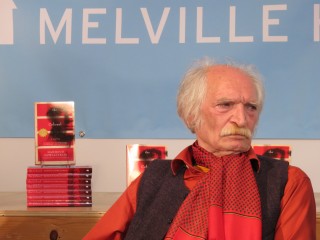
| Mahmoud Dowlatabadi |
Thirst, thirst… I’m thirsty.
Title: Thirst
Author: Mahmoud Dowlatabadi
Translator: Martin E. Weir
Publisher: Melville House, New York (2014)

Thirst, like The Colonel, is set during the Iran-Iraq War. An Iraqi author is being pressured by an army Major to write a propaganda piece. (What that entails isn’t entirely clear, but seems to involve a report about a fabricated murder committed by POW’s meant to somehow demoralize the Iranians and inspire the Iraqi army). When the author fails to produce the Major threatens his family. The author begins telling the Major a fable set in the desert. Writing it has distracted him from the Major’s commission.
Any number of shells have rained down. But the water tank still remains standing in one of the valleys between the hills up ahead. In all likelihood, it has shuddered several times from near misses, causing the water inside to spill over and run down the outside of the tank, but it’s still standing in the same gulley, seemingly immune to all gunfire. The tank should be safe for the time being, as it’s not in the enemy’s direct line of sight; unless, that is, their troops crawl out of their trenches, charge down the hill and happen upon it. But it seems that they have not yet been given the order to do so; if they d id advance down the hill, they might find themselves trapped in the same gulley as the water tank, in plain sight and within range. Which would mean that anyone who opened fire could kill as many of them as he had bullets. So the hope is that, at least until this intense bombardment is over, the water tank will remain unscathed, while those soldiers who have fallen on the path leading from the tank to the trenches will also stay where they are, dead or alive. In the distance, between the bow of the hill and the water tank, some enemy soldiers have fallen dead or dropped to the ground: some of them before reaching the tank and some on their way back with full water bottles, some of which may still be intact, dangling from their necks and shoulders. But we can also assume that many of those flasks will be mangled and riddled with bullet holes. Now anyone who tries to fetch water will first have the difficult task of finding and quickly gathering up any empty, intact flasks before dashing down to the tank to get water.
But what it all the flasks are full of holes?
‘Al-atash, atash … atashaan.‘*
Water, water everywhere, but not a drop to drink. As the soldiers lay hallucinating in the hot sun, cut off from their supplies, desperate for a drink – one by one they volunteer to crawl to the tank to fill the flasks with water. The volunteers are shot by soldiers in the opposing army and left (by necessity – those attempting to reach them will in turn be shot) to die in the scorching sun. An impasse – condemning the men in both armies to a slow, horrible death by dehydration.
There is a cinematic quality to Dowlatabadi’s books – influenced, perhaps, by his experiences as an actor. The book opens with a wide shot (see the passage above) that takes in the entire battlefield, and then slowly zooms into a master shot of three men. A Lieutenant attempting to inspire and save the single, remaining soldier under his command and their wounded prisoner. Cut to the author of this tableau who, in a post-modern cameo, “lights up his cigarette and writes: ‘Under no circumstances should prisoners be killed! They are your captives, and are completely in your charge.'” We (the readers) hear a knock at the door. Enter the Major, demanding his report. The writer doesn’t have it. He begins to talk about the fable he’s been writing instead. Cut back to the Lieutenant in the desert.
Thirst is written entirely in present tense, much like a screenplay and regardless of which character’s perspective we’re being given, making for what should be jarring transitions between the fable set in the desert and the writer’s confrontations with the Major. Instead, one scene shifts seamlessly into another in a way that can be momentarily confusing, but also very compelling. Without warning we’re pulled into the Lieutenant’s hallucinations. And then, suddenly, we’re back in the room with the Iraqi author as he attempts to distract the Major with his fable. Parallel narratives are created: one in which the author tells the fable and one in which the Lieutenant (within the fable) is experiencing those events. Realities merge, tear apart, and slowly merge again. Thirst is a sophisticated piece of literature that is a joy to read.
The things that make Thirst such an incredible book are the same reasons why it might not be for everyone. In addition to the complicated structure, readers contend with unfamiliar cultural references. The book’s original Persian title is Besmal, which is “the supplication required in Islam before the sacrifice of any animal”. The term would be familiar to Iranian readers, identifying the novel as an anti -war treatise. Besmal is a motif/theme that’s frequently repeated and referred to in the story. The translator includes a footnote (which is what is in the quotations), but how much can such a short explanation actually impart?
There are multiple references to a lioness suckling her cubs, or a man transforming into a dove, – the symbolism behind both is probably as obvious to Persian readers as references to the tortoise and the hare are to us. Antithetically, perhaps the lioness and dove have no culturally specific meanings at all. Lacking a frame of reference makes knowing the difference difficult. (For example: last year I spoke briefly with Sara Khalili, the translator of Censoring An Iranian Love Story. I asked her about the dwarf who appears and reappears throughout that novel. Is it a reference to Arabian Nights or some other Persian folk story? She laughed. No, it’s just Mandanipour playing a joke). Sometimes translated literature becomes a puzzle to solve. And not everyone wants that kind of complexity.
Thirst also abandons the more traditional plotting of Missing Soluch (Dowlatabadi’s first novel translated into English) and the breathtakingly evocative prose of Tom Patterdale’s translation of The Colonel. Martin Weir’s translation of Thirst is vibrant and fluid, but very different from Patterdale. A good thing in my opinion. The story itself is so strange, almost allegoric – there seems to be a progression towards more the experimental in the author’s writing – that here less is more when it comes to individual sentences. Weir’s plain, straightforward prose holds the book in balance.
I wouldn’t recommend Thirst to someone just discovering Dowlatabadi. Despite how much I enjoyed it, new readers would be better off starting with one of his other two novels. But for those of us who already know and love his work, and who recognize Mahmoud Dowlatabadi as one of Iran’s most important contemporary authors, Thirst is a challenging and exciting addition to the canon.




 Ten years in the writing, this fearless novel—so powerful it’s banned in Iran—tells the stirring story of a tortured people forced to live under successive oppressive regimes.