Showing posts with label Elie Wiesel. Show all posts

Monday, December 30, 2024

When intellectuals cheer on fascism

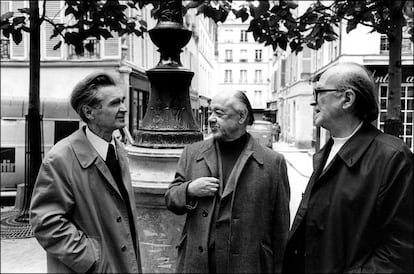
E.Ionesco, E.M.Cioran, M.Eliade

Emil Cioran, Eugène Ionesco and Mircea Eliade (from left to right), in Place Furstenberg, Paris, in 1977.LOUIS MONIER (GAMMA-

When intellectuals cheer on fascism

Many thinkers supported fascist regimes in the 1930s, a precedent that is very disturbing today


Guillermo Altares

27 December 2024

A famous photograph taken by Louis Monier in 1977 in one of the most beautiful squares in the Latin Quarter in Paris shows three great intellectuals of the 20th century whose influence continues to this day: the philosopher Emil Cioran, the historian of religions and novelist Mircea Eliade, and the playwright Eugène Ionesco. The first two had a very dark secret to hide: their sympathy for Romanian fascism in the 1930s and 1940s, their antisemitism, and their intellectual support for a regime responsible for the murder of tens of thousands of Jews. The third, the inventor of the theater of the absurd, of Jewish origin, survived the war and spent the rest of his life in France. They were very good friends in their youth, but their relationship was forever affected by Cioran and Eliade’s past.

Saturday, June 29, 2019

Elie Wiesel / The Night / Preface

  • 16 Apr 1945, Buchenwald Concentration Camp, Buchenwald, Germany --- Survivors at Buchenwald Concentration Camp remain in their barracks after liberation by Allies on April 16, 1945. Elie Wiesel is on the second bunk from the bottom, seventh from the left. --- Image by © CORBIS

ELIE WIESEL: THE NIGHT

PREFACE

Preface to the New Translation
by Elie Wiesel
If in my lifetime I was to write only one book, this would be the one. Just as the past lingers in the present, all my writings after Night, including those that deal with biblical, Talmudic, or Hasidic themes, profoundly bear its stamp, and cannot be understood if one has not read this very first of my works.

Elie Wiesel / Memories of Jerusalem

  • Elie Wiesel

    ELIE WIESEL: MEMORIES OF JERUSALEM

    by Elie Wiesel
    When did I see Jerusalem for the first time? I don’t even know. When I visited the city for the first time, it seemed to me that it was not for the first time. At the same time, each visit since then I have had the feeling it is my first visit.
    Is there a Jew, a Jewish child, who possessesa different relationship toward the most Jewish city in the world? Rabbi Yehuda Halevi’s nostalgic poem celebrates us all: though we find ourselves here and there in the Western world, the Jewish heart is always in the East.

    Alain Elkann interviews Eli Wiesel

    ft-img

    Elie Wiesel

    by Alain Elkann

    The Elie Wiesel Foundation for Humanity fights for human rights and peace and is anti-racism. It organizes lectures, conferences and annual meetings with other Nobel Prize awardees like Wiesel.
    Wiesel arrives in his office followed by a bodyguard. There are several young people working in his Foundation, which he runs with his wife Marion. He is wearing his Grand Croix de la Légion d’Honneur decoration on the lapel of his navy blue corduroy jacket. Very few people around the world have reached this notably high distinction.

    Saturday, July 9, 2016

    My hero / Elie Wiesel by David Miliband

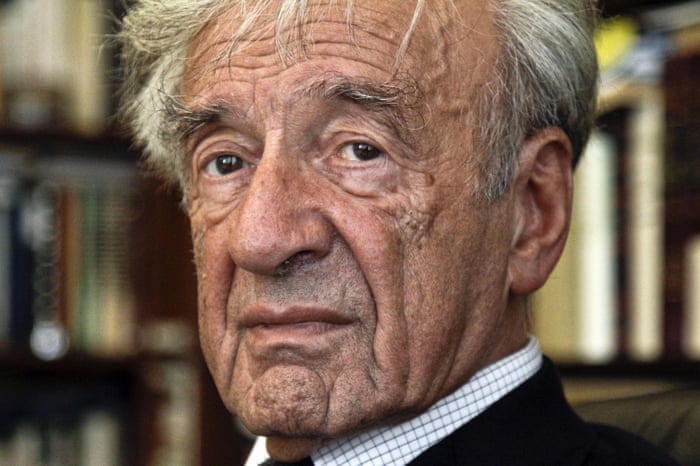
    ‘The word refugee is not popular, but everyone likes the idea of refuge’ … Elie Wiesel.
    Photograph: Bebeto Matthews/

    My hero:

    Elie Wiesel by David Miliband

    The writer and Holocaust survivor fought for justice, defending persecuted people of all races and religions. He taught us that the word ‘refugee’ need not be unpopular

    Saturday 9 July 2016 14.00 BST

    I
    met Elie Wiesel only once, in his New York office two years ago. He had joined the board of directors of the International Rescue Committee in 1985, and continued on our board of overseers. As the new president and CEO, I wanted his advice.

    Wiesel remained doughty, passionate, inspiring. “I am a refugee but the word refugee is not popular,” he told me. “But everyone likes the idea of refuge. Fight for refuge. We all need refuge.”
    I remember in that moment understanding the often-cited description that Wiesel believed in taking sides – someone who knew what he was for as well as what he was against. He understood, as well as anyone, the power of knowledge and truth in the battle against ignorance. His descriptions of his first visits to Germany, and his meetings with German youth who used education to overcome their own country’s past, are not just moving, they are testimony to an openness of mind even in the midst of the worst memories.
    Wiesel’s enduring legacy will not only be his story of survival through the darkest hours of humanity amid the unspeakable horrors of Auschwitz and Buchenwald. But also the inspiration of his lived life: his fight for truth and justice wherever he saw human dignity threatened. His visits around the world with the IRC led him to defend persecuted people of all races and religions.
    This fight has never been more needed. Where globalisation should be bringing down barriers, the trend is towards putting them up. Dangerous populism and toxic xenophobia are again on the rise in Europe and the US – but also afflict minorities across the rest of the world. War and insecurity displaced a record 65 million people last year; and the system of international order that upholds peace and security is under threat.
    But as much as Wiesel’s life reminds us of what we need to guard against, it also embodies what we must strive to emulate. He was not just a survivor, his story reminds us that when states open their doors to those fleeing persecution, they open their doors to knowledge, creativity and untold potential.
    Wiesel’s memories have documented history, and his works have informed a generation. He taught us that, in the face of atrocity and tragedy, morality can prevail; that knowledge and truth are vital in the battle against ignorance and intolerance; and that the word refugee need not be unpopular. That is the lesson of Elie Wiesel.

     David Miliband is president and CEO of the International Rescue Committee.

    THE GUARDIAN


    2009
    001 My hero / Oscar Wilde by Michael Holroyd
    002 My hero / Harley Granville-Barker by Richard Eyre
    003 My hero / Edward Goldsmith by Zac Goldsmith
    004 My hero / Fridtjof Nansen by Sara Wheeler 
    005 My hero / Mother Mercedes Lawler IBVM by Antonia Fraser

    007 My hero / Ernest Shepard by Richard Holmes
    008 My hero / JG Ballard by Will Self
    009 My hero / Alan Ross by William Boyd
    010 My hero / Ben the labrador by John Banville

    011 My hero / Vicent van Gogh by Margaret Drabble
    012 My hero / Franz Marek by Eric Hobsbawm

    2010

    017 My hero / Jack Yeats by Colm Tóibín
    018 My hero / Francisco Goya by Diana Athill
    019 My hero / Max Stafford-Clark by Sebastian Barry
    020 My hero / Arthur Holmes by Richard Fortey

    036 My hero / Robert Lowell by Jonathan Raban
    037 My hero / Beryl Bainbridge by Michael Holroyd
    038 My hero / Charles Schulz by Jenny Colgan
    039 My hero / Oliver Knussen by Adam Foulds
    040 My hero / Annie Proulx by Alan Warner

    041 My hero / David Lynch by Paul Murray
    042 My hero / Edwin Morgan by Robert Crawford
    043 My hero / Anne Lister by Emma Donoghue
    044 My hero / Jane Helen Harrinson by Mary Beard
    045 My hero / Edmund Burke by David Marquand
    046 My hero / Shelagh Deleaney by Jeanette Winterson
    047 My hero / Christopher Marlowe by Val McDermid
    048 My hero / Gwen John by Anne Enright
    049 My hero / Michael Mayne by Susan Hill
    050 My hero / Stanley Spencer by Howard Jacobson

    051 My hero / William Beveridge by Will Hutton
    052 My hero / Jean McConville by Amanda Foreman
    053 My hero / Alexander Pushkin by Elaine Feinstein
    058 My hero / Cy Twombly by Edmund de Waal

    2011
    079 My hero / Gene Wolfe by Neil Gaiman
    087 My hero / Alberto Moravia by John Burnside
    096 My hero / Isaac Babel by AD Miller
    097 Lucian Freud by Esi Edugyan
    100 Thomas Tranströmer by Robin Robertson
    102 My hero / David Hockney by Susan Hill

    2012

    190 My hero / Iris Murdoch by Charlotte Mendelson
    194 My hero / René Descartes by James Kelman
    199 My hero / Albert Camus by Geoff Dyer

    2015
    2016