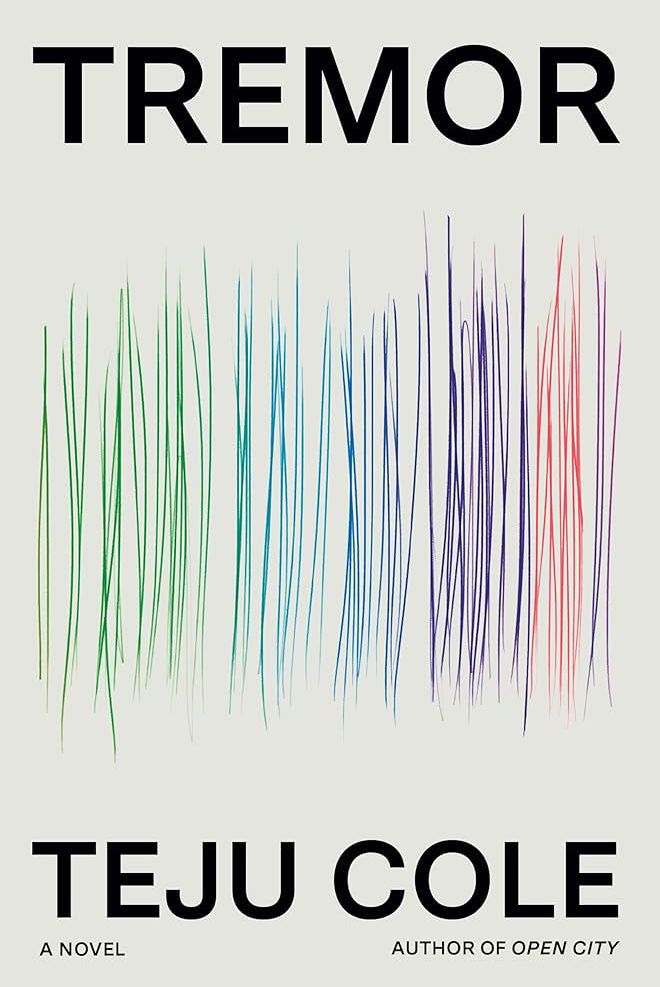
A middle-aged writer returns to his college townto record the final interview with his 90-year-old intellectual mentor. But he’s broken his phone, and doesn’t seem able to confess that it’s not recording … this anxiety dream of a beginning leads us into a series of sharp insights into family, memory, inheritance and storytelling – all that it means to be human, and how smartphones are changing our sense of the world at every level.
Throughout the year, Vulture maintained a “Best Books of the Year (So Far)” list. Many of those selections appear above in our top-ten. Below, the rest of the books that stood out to them this year, presented in order of release date.
Tremor, by Teju Cole
Teju Cole’s visual medium is photography, and lately, his written medium is the essay. With Tremor, he returns to the novel after 12 years, threading his tendency toward analysis and explication with scenes from the life of the protagonist, Tunde, who, like Cole, is a Harvard professor. At the start of the book, he is separated — hopefully, not for good — from his wife, Sadako. He is also considering the ethics of the roles he inhabits: lecturer, workshop leader, photographer, traveler, and viewer. How can one make or even behold art without assuming a dominant position? Cole considers this question alongside close readings of pastel drawings made by “the most prolific serial killer in American history”; the painting of a lesser-known Flemish master, Landscape With Burning City; Ingmar Bergman’s film Winter Light; the garden Sadako carefully maintains; and Tunde’s own photographs capturing someone else’s “private property.” Fans of other essayistic novels, including J.M. Coetzee’s Elizabeth Costello and Rachel Cusk’s Outline trilogy, will appreciate Cole’s vision. —Maddie Crum
All of Berger’s work is a beautiful and bracing argument that political commitment requires maintaining a position of wonder.
Postscript: John Berger 1926-2017
By Ben Lerner
January 6, 2017
Last Monday, I learned of John Berger’s death, at the age of ninety, while walking with my daughter along a beach in Florida watching the sunset redden the water, and maybe that’s why the first work of his that flared up in my mind was his tiny essay on the painter J. M. W. Turner. I had not read it in twenty years. The essay was written in 1972, the same year Berger wrote his most famous book, “Ways of Seeing,” hosted a TV series of the same name, and won the Booker Prize for his novel “G.” “Turner and the Barber’s Shop” suggests a possible relation between Turner’s childhood experiences as the son of a barber, what he must have so often seen in the shop, and his innovations as a painter. Berger writes:
Consider some of his later paintings and imagine, in the backstreet shop, water, froth, steam, gleaming metal, clouded mirrors, white bowls or basins in which soapy liquid is agitated by the barber’s brush and detritus deposited. Consider the equivalence between his father’s razor and the palette knife which, despite criticisms and current usage, Turner insisted upon using so extensively. More profoundly—at the level of childish phantasmagoria—picture the always possible combination, suggested by a barber’s shop, of blood and water, water and blood.
The Topeka School by Ben Lerner review – in a class of its own
Psychoanalysis, rap battles, poetry, school debates: this bravura US autofiction explores language as tool and weapon Jon Day Friday 8 November 2019
N
ear the beginning of Ben Lerner’s third novel, a teenager named Adam Gordon creeps into what he thinks is his girlfriend’s house. He goes into the bathroom and notices the toiletries there aren’t hers. “Along with the sheer terror of finding himself in the wrong house,” writes Lerner, “with his recognition of its difference, was a sense, because of the houses’ sameness, that he was in all the houses around the lake at once; the sublime of identical layouts”. It’s a typical Lerner moment: an anecdotal event is mined for latent content, the literal uncanniness of Adam’s experience suggesting something of the uniformity – both comforting and terrifying – of suburban America.
Lerner’s first two works of fiction were intelligent novels of ideas about characters who were more or less like him: disaffected, overeducated young men. What saved them from self-indulgence was their sentence-by-sentence virtuosity, their imaginative density, and the fact that the cleverness of his prose always felt appropriate to the stories he told.
Much of this is recognisable in The Topeka School (Adam is a pretentious high school student and gifted rhetorician: exactly the kind of person who would think of the “sublime of identical layouts” when he has wandered into a stranger’s house). But it is also a more earnest and sentimental novel than his previous books, which often sought to reconcile authenticity with postmodernist posturing by invoking a kind of ironic indeterminacy. The Topeka School – as dazzling as anything Lerner has written – is also his most successful effort at navigating between communal experience (the shared tropes, ideologies and cliches of a culture) and individual feeling (the specificities and textures of poetic expression) without denaturing either.
Ben Lerner
His first novel, Leaving the Atocha Station (2011), was about a US poet, also named Adam Gordon, living in Madrid on a poetry fellowship. He strolled around museums, spent time online “looking at videos of terrible things”, smoked hash and lamented his inability to have a “profound experience of art”. His second, 2014’s 10:04, was about a writer who, like Lerner, taught at a New York university and had published his first book to great acclaim. In blurring the boundary between biography and novel these books had affinities with the autofictional projects of Karl Ove Knausgaard and Rachel Cusk; what distinguished them was their tendency to insist on the conditions of their own interpretation. Both Gordon and the narrator of 10:04 were trained to deconstruct the framing devices Lerner erected around them, so that the books – peppered with essays on art and literature and anxious digressions on the impossibility of authenticity in the age of the internet – sometimes read as manifestos as much as novels.
The Topeka School is a sort of prequel to these two novels. It is set in the late 1990s, at the end of history (which turned out to be more of a pause) in Topeka, Kansas, where Lerner himself grew up. It is told in three intertwined narratives, alternating between the perspectives of Adam and his parents, Jonathan and Jane. When crossed, Adam uses his debating skills to launch on his parents “an overwhelming barrage of ridiculous but somehow irrefutable arguments”. Jonathan and Jane are New York psychiatrists who moved to Topeka to work at “the Foundation”, a psychiatric institution that is a liberal enclave in the otherwise conservative town. Jane has found national fame and local notoriety after writing a book about relationships and toxic masculinity. Jonathan is a therapist who as a research student discovered “speech shadowing”: a phenomenon sometimes observed when subjects who are asked to repeat words played to them at increasing speed descend into nonsense.
Interleaved with these is the story of Darren, a social misfit adopted by Adam and the alphas of their social group. Part mascot, part clown, Darren is treated with both ironic cruelty and confused affection. At a house party he joins the huddle of white middle-class schoolboys as they freestyle rap: his classmates “all shouted their encouragement and amazement and bobbed their heads to the nonexistent beat as though Darren were disclosing new territories of thought and feeling, new worlds, as though he were their Caedmon”. But they also take him to a party by a lake and leave him to walk home on his own. The compulsive drive of the novel (which Lerner’s previous books sometimes lacked) is provided by the foreknowledge that this treatment is going to make Darren do something awful.
Unlike Darren, Adam is able to use his articulacy to access the cultural capital of freestyle rapping and competitive debating. But he dreams of becoming a poet, “because poems were spells, were shaped sound unmaking and remaking sense that inflicted and repelled violence and made you renowned”. It is this same verbal magic that sustains the novel. The prose is thickened with precise descriptions but also with micro-essays about everything from visual phenomena (as Adam and his girlfriend kiss he sees patterns of light against his closed eyes: “Phosphenes, tiny fading Rorschachs formed by the inherent electrical charges the retina produces while at rest, an experience of light in the absence of light”) to the intricacies of competitive debating.
Language’s potential as both a tool and a weapon is one of the novel’s central concerns. Competitive debating depends on a strategy called “the spread”, in which many arguments are presented rapid fire, in a way that makes them difficult to respond to. Since the “rule among serious debaters” is that a “dropped argument”, no matter its quality or its content, is conceded, the more arguments you can advance, the more are likely to be dropped by your competitors. This means that a contest designed to test the ability of participants to use language, to persuade and to share a point of view, often descends into what looks from the outside like meaningless verbiage. “To an anthropologist or ghost wandering the halls of Russell High School,” Lerner writes, “interscholastic debate would appear less competitive speech than glossolalic ritual.”
A key inspiration for The Topeka School is Hermann Hesse’s “A Man Named Zeigler”, about a man who takes a pill that makes it possible for him to speak with animals. The new intimacy he gains is also a fall: no longer is he able to maintain a difference between human and animal. Adam has grown up in a culture where language is a source of power. It can do things in the world, either through antagonism (debate; rap battles) or seduction (poetry; psychoanalysis), but it is only available to those who can wield it. Unlike Darren, who in his inarticulacy is compelled to employ actual violence, Adam is free to perform roles and move between registers as easily as he moves between social hierarchies.
The fear in such a world is not muteness, which has its own significance, but meaninglessness: the linguistic breakdowns that constantly threaten Lerner’s characters. Baby talk, nonsense poetry, the impenetrable traditions of the rap cipher, the babbling of regressive “speech shadowing”: the novel positions language’s destruction as something literature alone can address. But it also shows this to be a dangerous desire. “The stupid mistake psychologists make,” thinks Jonathan at one point, “a very Foundation mistake; we thought that if we had a language for our feelings we might transcend them.”
The poet John Ashbery, one of Lerner’s literary heroes, thought of cliches not as threats to original expression but as comforting manifestations of human continuity. In an interview near the end of his life he said: “I’m attracted to well-worn language that has been used for ages, when people are trying to express something that is really important to them, and thus it ends up sounding banal, which for me is somehow holy because this speech has served so many times for so many people at important moments in their lives.”
It’s this same belief that underpins Lerner’s understanding of the solaces of writing in The Topeka School. When Adam and his girlfriend kiss they become literary tropes: “He tasted the sugary gloss and tobacco, the hints of mint and metal that made him when he kissed her think of blood. It was good to be inflicting optional damage on your bright pink lungs; it was good to be two young people tasting of Lancôme and Philip Morris, synthetic pheromones and carcinogens, to be at the point of their most intimate contact, their most interchangeable, corporate persons; cliches, types.” It’s self-knowledge that liberates them, but also the fact that, despite their interchangeability, they remain specific people having a specific experience, in a specific place, at a specific time.
• The Topeka School is published by Granta (£16.99).
In the first chapter of this assured debut novel, two young girls vanish, sending shock waves through a town perched on the edge of the remote, brooding Kamchatka Peninsula. What follows is a novel of overlapping short stories about the various women who have been affected by their disappearance. Each richly textured tale pushes the narrative forward another month and exposes the ways in which the women of Kamchatka have been shattered — personally, culturally and emotionally — by the crime.
Lerner’s exhilarating third novel, after “Leaving the Atocha Station” and “10:04,”rocks an emphatically American amplitude, ranging freely from parenthood to childhood, from toxic masculinity to the niceties of cunnilingus, from Freud’s Oedipus complex to Tupac’s “All Eyez on Me.” Adam Gordon returns as the protagonist, but this time as a high school debate star, and mostly in the third person. Equal portions of the book are given over to the voices of his psychologist parents, and to a former classmate whose cognitive deficits are the inverse of Adam’s gifts. The earlier novels’ questions about art and authenticity persist; but Adam’s faithlessness is now stretched into a symptom of a national crisis of belief. Lerner’s own arsenal has always included a composer’s feel for orchestration, a ventriloquist’s vocal range and a fine ethnographic attunement. Never before, though, has the latter been so joyously indulged, or the bubblicious texture of late Clintonism been so lovingly evoked.
Many of the nine deeply beautiful stories in this collection explore the material consequences of time travel. Reading them feels like sitting at dinner with a friend who explains scientific theory to you without an ounce of condescension. Each thoughtful, elegantly crafted story poses a philosophical question; Chiang curates all nine into a conversation that comes full circle, after having traversed remarkable terrain.
The Mexican author’s third novel — her first to be written in English — unfolds against a backdrop of crisis: of children crossing borders, facing death, being detained, being deported unaccompanied by their guardians. The novel centers on a couple and their two children (all unnamed), who are taking a road trip from New York City to the Mexican border; the couple’s marriage is on the brink of collapse as they pursue independent ethnographic research projects and the woman tries to help a Mexican immigrant find her daughters, who’ve gone missing in their attempt to cross the border behind her. The brilliance of Luiselli’s writing stirs rage and pity, but what might one do after reading such a novel? Acutely sensitive to these misgivings, Luiselli has delivered a madly allusive, self-reflexive, experimental book, one that is as much about storytellers and storytelling as it is about lost children.
A desolate ferry terminal on the Spanish coast isn’t a place where you’d expect to encounter sharp-edged lyricism or rueful philosophy, but thanks to the two Irish gangster antiheroes of Barry’s novel, there’s plenty of both on display, along with scabrously amusing tale-telling and much summoning of painful memories. Their lives have become so intertwined that the young woman whose arrival they await can qualify as family for either man. Will she show? How much do they care? Their banter is a shield against the dark, a witty new take on “Waiting for Godot.”
Masked intruders dragged Jean McConville, a 38-year-old widow and mother of 10, from her Belfast home in 1972. In this meticulously reported book — as finely paced as a novel — Keefe uses McConville’s murder as a prism to tell the history of the Troubles in Northern Ireland. Interviewing people on both sides of the conflict, he transforms the tragic damage and waste of the era into a searing, utterly gripping saga.
The English painter Joshua Reynolds just wanted to cheer up his friend Samuel Johnson, who was feeling blue. Who knew that the Friday night gab sessions he proposed they convene at London’s Turk’s Head Tavern would end up attracting virtually all the leading lights of late-18th-century Britain? Damrosch brings the Club’s redoubtable personalities — the brilliant minds, the jousting wits, the tender camaraderie — to vivid life, delivering indelible portraits of Johnson and Reynolds, Edmund Burke, Adam Smith, the actor David Garrick, the historian Edward Gibbon and, of course, Johnson’s loyal biographer James Boswell: “a constellation of talent that has rarely if ever been equaled.”
In her extraordinary, engrossing debut, Broom pushes past the baseline expectations of memoir to create an entertaining and inventive amalgamation of literary forms. Part oral history, part urban history, part celebration of a bygone way of life, “The Yellow House” is a full indictment of the greed, discrimination, indifference and poor city planning that led her family’s home to be wiped off the map. Tracing the history of a single home in New Orleans East (an area “50 times the size of the French Quarter,” yet nowhere to be found on most tourist maps, comprising scraps of real estate whites have passed over), from the ’60s to Hurricane Katrina, this is an instantly essential text, examining the past, present and possible future of the city of New Orleans, and of America writ large.
Snyder’s thoroughly reported book covers what the World Health Organization has called “a global health problem of epidemic proportions.” In America alone, more than half of all murdered women are killed by a current or former partner; domestic violence cuts across lines of class, religion and race. Snyder debunks pervasive myths (restraining orders are the answer, abusers never change) and writes movingly about the lives (and deaths) of people on both sides of the equation. She doesn’t give easy answers but presents a wealth of information that is its own form of hope.
Higginbotham’s superb account of the April 1986 explosion at the Chernobyl nuclear power plant is one of those rare books about science and technology that read like a tension-filled thriller. Replete with vivid detail and sharply etched personalities, this narrative of astounding incompetence moves from mistake to mistake, miscalculation to miscalculation, as it builds to the inevitable, history-changing disaster.