Showing posts with label Leïla Slimani. Show all posts

Friday, May 29, 2026

‘Writing is exactly like love – you need to do it in the dark’: novelist Leila Slimani on starting a new chapter in her life


Interview

‘Writing is exactly like love – you need to do it in the dark’: novelist Leila Slimani on starting a new chapter in her life

Now in residence at the Madrid Prado, the author talks about its dark, inspirational Goyas, the clandestine nature of her writing – and why she finally wrote about her jailed then posthumously exonerated father

Nadia Khomami
27 May 2026

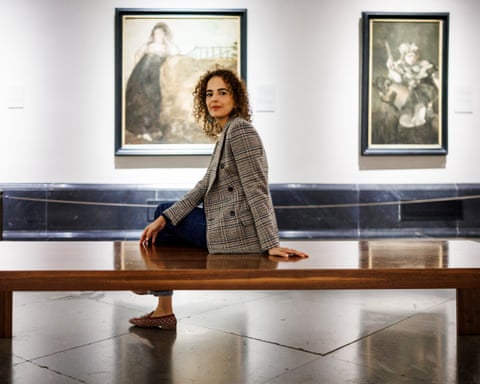
It is a bright, chilly spring morning in Madrid, and the Museo del Prado doesn’t open to the public for another hour. Without the crowds, the museum is amorphous and eerily silent. A pale light pools in the corners and casts long shadows around the paintings, as if the figures inside them have slipped quietly into the room. It is here that I meet the French-Moroccan writer Leïla Slimani, who has spent the past two weeks using the space as inspiration for her work.

Friday, May 10, 2024

Leïla Slimani / ‘Salman Rushdie’s books made me feel I could become a writer’

Leïla Slimani

The 

Books

 0f my 

life


Leïla Slimani: ‘Salman Rushdie’s books made me feel I could become a writer’

This article is more than 2 years old

The Lullaby author on identifying with Jo in Little Women, being terrified of Dr Jekyll and Mr Hyde, and why we’re still in debt to Steinbeck


Leïla Slimani
Friday 10 May 2024 10.00 BST


My earliest reading memory
Nils Holgersson’s Wonderful Journey Through Sweden by Selma Lagerlöf. My grandmother, who grew up in Germany, read it to me when I was a child and then, when I was eight, she gave me a copy that I still have. I, too, dreamed of travelling and escaping, just like that little boy.

My favourite book growing up
Little Women by Louisa May Alcott. Because we were three girls, our mother was a doctor and my sisters and I liked to identify with the characters in the book. Of course, I was Jo!

The book that changed me as a teenager
The Unbearable Lightness of Being by Milan Kundera. It was an erotic and spiritual shock. I didn’t understand everything when I read it – I must have been 16 – but it really moved me physically, as if the words were entering me.

The writer who changed my mind
Simone de Beauvoir, whose The Second Sex I borrowed from the library when I was 16. Suddenly, I realised that there was no point in responding to injustice with anger or violence. The best way to fight, for a woman, was knowledge.

The book that made me want to be a writer
All the books by Marguerite Duras, and Écrire in particular, because her passion for literature, for freedom, for the absolute, matched everything I was looking for in life.

The book or author I came back to
John Steinbeck. I had read him at school and didn’t understand him at all. I reread The Grapes of Wrath a few years ago and it was a shock. It’s a real masterpiece, with a staggeringly modern take on capitalism, social violence and migration.

The book I reread
The Unbearable Lightness of Being. I read it every year and I always find something different. It’s an unclassifiable book: part novel, part treatise on philosophy and music, part essay. I don’t think a lifetime will be enough to unravel its mystery.

The book I could never read again
The Strange Case of Dr Jekyll and Mr Hyde by Robert Louis Stevenson. I don’t know why, but this book terrified me and I’ve never been able to open it again.

The book I discovered later in life
Le Cahier Interdit (The Forbidden Notebook) by Alba de Céspedes. I read it recently and it moved me enormously. It’s the story of an Italian housewife who buys herself a notebook in which she writes down her thoughts and is terrified at the thought of it being found. From the moment she starts writing, she yearns more and more for freedom.

The book I am currently reading
Knife by Salman Rushdie. I’ve admired him ever since I was a child, and his books have carried me along, giving me the feeling that maybe one day I too could become a writer.

 Watch Us Dance by Leïla Slimani is published in paperback by Faber.


https://www.theguardian.com/books/article/2024/may/10/leila-slimani-salman-rushdies-books-made-me-feel-i-could-become-a-writer

THE GUARDIAN


Tuesday, August 3, 2021

The Country of Others by Leïla Slimani review / A compelling exploration of the past


BOOK OF THE WEEK

The Country of Others by Leïla Slimani review – a compelling exploration of the past

The bestselling author of Lullaby works her dangerous magic on her own family history in the first of a planned trilogy

Tessa Hadley

Wed 28 July 2021

The French-Moroccan author Leïla Slimani’s second novel, published in France in 2016 and translated into English as Lullabyis about a nanny who works for a bourgeois professional Parisian couple, and murders the two children in her care. It caused a huge stir globally, won the Prix Goncourt (she was the first Moroccan woman to win the prize), and caught the attention of President Macron, who appointed Slimani his representative for the “promotion of French language and culture”. The novel is uncannily good at searching out the uncomfortable pressure points where class hurts and privilege excludes and crucifies. Interestingly, Slimani deliberately confounds the usual intersections of race with class – most of the nannies in the book are Maghrebi or African, but the murdering one is white, and her employer, the children’s mother, is a French-Moroccan lawyer. Lullaby is a shocking and affecting book, but in the end I think a confusing one. Sentences succeed one another in a suspenseful tension which depends too much on our helpless fascination with the facts of the crime; the novel’s penetration of the privileged couple’s unease and the nanny’s loneliness can’t finally deliver what it seems to promise, which is any explanation of what’s happened. That could only be a matter for psychopathology. The children’s deaths are pitiable and terrible, but have no political meaning.

Leïla Slimani’s Sex and Lies / A brave and honest look at the lives of Moroccan women


Leïla Slimani


Leïla Slimani’s Sex and Lies: a brave and honest look at the lives of Moroccan women


The French-Moroccan novelist Leïla Slimani’s first work of non-fiction is composed of a series of interviews with Moroccan women from different backgrounds and age groups 


Elif Shafak

26 February 2020

Elif Shafak


Throughout the Middle East, nowhere is the need for change more urgent – and the silences more deafening – than in the areas of gender and sexuality. Patriarchal norms are so deeply rooted across the political spectrum that even the most seemingly liberal segments of societies can be homophobic, transphobic and misogynist underneath the veneer of “modernity”.

Monday, August 2, 2021

Leïla Slimani / ‘This book is a mirror to make the elite look reality in the face’


‘After I started writing novels, I understood the power of words’: Leïla Slimani 


Leïla Slimani: ‘This book is a mirror to make the elite look reality in the face’


As her book Sex and Lies appears in English, the bestselling author of Lullaby and face of Macron’s France is emerging as a champion of women’s rights in her native Morocco


Kim Willsher
Sunday 16 February 2020

Leïla Slimani is running late. She texts to say she’s waiting for her children’s nanny to arrive. Can this be true? Does the writer whose bestselling novel Lullaby features a killer childminder and begins: “The baby is dead”, really have a nanny with whom she is perfectly happy to leave her two young children?

Scheherazade’s Heirs / “Sex and Lies” by Leïla Slimani


Scheherazade’s Heirs: “Sex and Lies” by Leïla Slimani


Daniel James Sharp

12 March 2020

Most countries contain contradictions. Scotland, for example, was central to the Enlightenment, but it also has plenty of gangs and high rates of drug use and obesity (facts well known but kept out of the tourist pamphlets). But few countries are as contradictory as Morocco: a country with a split personality.

‘Virginity is an obsession in Morocco’ / An extract from Leïla Slimani’s Sex and Lies


‘Virginity is an obsession in Morocco’: an extract from Leïla Slimani’s Sex and Lies

The author reflects on the challenges faced by young women in the country of her birth, where extramarital sex is a criminal offence


Leïla Slimani
Sunday 16 February 2020

Ileft Morocco more than 15 years ago. With the years and the distance, I have surely forgotten quite how difficult it is to live without the freedoms that have become so natural to me. In France it can be a struggle to imagine the disorientation that comes with a young girl’s discovery of her sexual self in a country where Islam is the state religion and the laws are extremely conservative on everything that relates to sex.

Saturday, February 16, 2019

Adèle by Leïla Slimani review / Sex-addiction thriller


Adèle by Leïla Slimani review – sex-addiction thriller


The follow-up to Lullaby centres on a modern-day Emma Bovary whose frustrated desires threaten to destroy her family


Leïla Slimani on her shocking bestseller, Lullaby: 'Who can really say they know their nanny?'
Lara Feigel
Thu 14 Feb 2019


A
re there secret desires that both endanger family life and make it survivable? Do we long to escape our children? To have sex with strangers at will? The Franco-Moroccan novelist Leïla Slimani’s Lullaby won the Prix Goncourt in 2016 and swiftly became a bestseller here last year. That tale of a murderous nanny, exposing the fetid emotional growths fouling the bourgeois home, was Slimani’s second novelistic investigation of forbidden desires. Now Adèle, the novel she wrote before that breakthrough success, has been translated into English by Sam Taylor.

When we first meet Adèle, she’s leaving the house before her husband and son wake up, looking for sex on the way to work. “Adèle has been good,” the opening proclaims, but now “she wants to be devoured, sucked, swallowed whole.” For several years, she’s combined a sexless marriage to Richard with a closet life as a sex addict, seducing almost all the men she meets. The situation becomes unsustainable when her husband is injured in a road accident, depriving Adèle of freedom because she has to look after him.


Slimani’s novels are hard to categorise. They combine the pace of the thriller with the flatness of tone that we might associate with Michel Houellebecq, or indeed with Camus and Robbe-Grillet. Like those writers, Slimani is drawn to revealing the hellishness of the ordinary and the ordinariness of hell. But this isn’t social satire or commentary. Class and race matter – in Lullaby the employer was of north African descent and the nanny white; here Richard is upper class, Adèle working class – but these aren’t novels hustling for social change or even pushing us to be more honest about the falsity of bourgeois life. They are too story-driven for that. Adèle is rarely likable, but the narrative is on her side, breathless in its fears that sex won’t be available (“She hates the idea that her beauty will be wasted, that her good mood will be for nothing”) or that exposure will follow.

In many ways, Adèle is a modern-day Madame Bovary, but the book itself has less in common with Flaubert than with the sensation novels that Emma Bovary reads addictively. Slimani is trying to shock, arouse and titillate us with extreme mental states. Addiction makes a good subject for her because Adèle’s desire to live a fantasised version of her own life seems to mirror Slimani’s desire to write sleek, fantastical prose, not quite committing to building a three-dimensional world. Like Flaubert, though, she empathises with her character, even at her silliest (Adèle falls asleep with her face in an ashtray), and occasionally we feel something like Flaubert’s interest in the nuances of Adèle’s mind. She likes to read Kundera, and there’s a quote from him in the epigraph: his definition of vertigo not as the fear of falling but as “the desire to fall … the intoxication of the weak”. Slimani seems interested in delineating this intoxication.
In Lullaby, the question driving the book is not only whether the mother Myriam will find a way to survive bourgeois life without feeding off the weakness of another woman, but whether the nanny will give in to her own weakness, abdicating responsibility for keeping her charges alive. Here there’s the question of whether Adèle will allow her addiction to take over her life, destroying her love for her son. Both books are very good at showing that there can be a kind of gleeful pleasure in overcoming your fears by living them out, losing the things you are most desperate to hold on to. “Wanting to is the same as giving in,” Adèle thinks, “the dam has been breached. What good would it do to hold back now?” In both cases, the rapid descents feel just about credible enough to tell us something about the form of vertigo Kundera defined.


Adèle was published in France in 2014; five years later, it appears in Britain in the midst of #MeToo. Some of what it says about sex and power may seem more outdated and therefore taboo-laden now than it did then. Slimani began writing the novel when the Dominique Strauss-Kahn trial was in the news, and there’s some attempt to reverse the usual power structures by making the sex addict a woman. But though Adèle seeks power through sex, she’s attracted to powerful men and she relies on them to overpower her. If Adèle were asked about #MeToo, she would throw back her head with her usual loud laugh and say that the men are only acting as the women want them to. Her constant fantasy is of “the real men, the good ones, somewhere else, the ones who would finally know how to control her body”, and she does not have the intellectual curiosity or the emotional courage to seek new structures for desire. I found myself wondering what kind of novel it could be if her husband were better in bed, or if Adèle were less submissive and had moved further beyond Emma Bovary in her desires. What if it was reasonable rather than self-destructive or self-pitying for a woman to feel constricted by family life and ask for more?
 Lara Feigel is the author of Free Woman: Life, Liberation and Doris Lessing (Bloomsbury). Adèle by Leïla Slimani, translated by Sam Taylor, is published by Faber (£12.99). 


Friday, February 1, 2019

The books the made me / Leïla Sliman / ‘I’ve always been fascinated by Marilyn Monroe'

Leïla Slimani. Photograph: Richard Saker/The Observer


Books

that 

made me


Leïla Slimani: ‘I’ve always been fascinated by Marilyn Monroe'

The author of Lullaby and Adele celebrates Julian Barnes’s British humour and reading Anna Karenina for the first time


Leïla Slimani on her shocking bestseller, Lullaby: 'Who can really say they know their nanny?'
Leïla Slimani
Friday 1 February 2019

The book I am currently reading


The Piranhas by journalist Roberto Saviano. It is his first novel and it’s very impressive. I admire Roberto a lot. I’ve been following his career for years.

The book that changed my life


I can still remember when I read Leo Tolstoy’s Anna Karenina in my room in Rabat, where I grew up. I was completely overwhelmed.

The book I wish I’d written


I couldn’t stop reading Blonde by Joyce Carol Oates, based on the life of Marilyn Monroe. I’ve always been fascinated by Monroe, her melancholia, her extreme beauty and how fragile she was. Blonde is a terrific novel.

The book that influenced my writing


Albert Camus’s L’Étranger. The style is simple, direct and so luminous.

The book that is most overrated


So many books are overrated these days. Readers seem to place a greater emphasis on sociological issues, on provocative topics rather than on style. Reputation is a lot about marketing.


The book that changed my mind


I thought that every human being wanted to be free until I read The Politics of Obedience (1576) by Étienne de La Boétie. He showed me that people can prefer to live in servitude, will sacrifice their freedom for security or money. When you really want to be free, you must be able to sacrifice everything; a lot of people can’t.

The last book that made me cry


Lyudmila Ulitskaya’s Sonechka. It is a very delicate and poetic novel about a woman who is crazy about books. Ulitskaya loves this character and makes a heroine of a very ordinary woman.

The last book that made me laugh


The Only Storyby Julian Barnes. It is actually a very sad novel but even when he tells a sad story Barnes has the power to make me laugh or smile. I love his British humour, his sensibility.

The book I couldn’t finish


Robert Musil’s The Man Without Qualities. I found it so boring! But I will probably try again because everyone tells me that I have to persevere.

The book I’m ashamed not to have read


None. There is no shame in literature.

The book I give as a gift


Any of the books of Israeli author Zeruya Shalev, one of the most talented writers of our times.

The book I’d most like to be remembered for


I haven’t written it yet.

My earliest reading memory


Les Malheurs de Sophie (1858) by the Comtesse de Ségur. I was crazy about this book and about this little girl, who lies, steals and feels so lonely and misunderstood. It is profound and not very politically correct.

My comfort read


Magazines and newspapers. I love reading the press.


 Leïla Slimani’s Adèle is published by Faber (£12.99).


THE BOOKS THAT MADE ME
2017
13 October 2017
Eimear McBride / ‘I can never finish Dickens – it’s sacrilege’
20 October 2017
Shami Chakrabarti / ‘Harry Potter offers a great metaphor for the war on terror’