Showing posts with label Playboy. Show all posts

Thursday, April 9, 2026

Karol G in Playboy


Karol G Is Playboy’s Spring 2026 Cover Star 

Before making history at Coachella, the Colombian superstar opens up about ICE, being newly single, and why she said yes to Playboy 

ENTERTAINMENT & CULTURE  APRIL 7, 2026

Karol G is about to make history—again. The Colombian pop superstar lands on the cover of Playboy‘s Spring 2026 issue just as she becomes the first Latina to headline Coachella. After years of careful cultivation—topping charts, breaking records, and racking up awards—she tells Playboy she’s no longer interested in playing it safe. We are entering a whole new era of her artistry and her womanhood. 

Shot by Gray Sorrenti in Los Angeles, our cover story captures Karol G at a turning point: past a devastating and very public breakup, and unapologetically embracing her full self. “Last year…life threw me to the floor, kicked me, pushed me, stood on me, spun me around,” she says. So she flew to Hawaii, chopped her hair off, and did some thinking. Now, she’s on the verge of what could be one of the biggest years of her life.


Posing for Playboy, she tells writer Paola Ramos, was entirely her call: 

“Why do I want to do this? Because I want to. Because I grew up inspired by how beautiful the women in the magazine looked and now I have the opportunity to be that beautiful, sexy, mamasota.” 

In the interview, Karol opens up about everything from her responsibility to the Latino community to the freedom she’s found being single, and the “wild woman” ethos that’s been fueling her this year.


On this weekend’s history-making Coachella performance: 

“I thought that this was going to be like my consecration, but I actually feel like it’s the beginning. This is the first time in my life that I feel I’m going to see myself as the artist in the same caliber as the stage that I’m stepping on.”

“When I received the call, I felt like a huge weight fell on me…. I feel very blessed to be part of a generation that is trying to change the narrative and raise our voice for the community… I feel like it’s a show for my community, for the world, but it’s a show that’s very much for me.”

On standing up for her community:

“I don’t want to just say “ICE Out” and have nothing come from it… I’m probably going to go a little harder than that. I just want to represent my community. But what I’m telling you is that, as a human being, I want that to mean more. I’m not saying that I’m not going to do it; what I’m saying is that I would do it and will do it with my soul. But I want to sit down and understand, in my head: Here’s what that meant.

On being single:

“I’m letting go of everything. I’m single and, to be honest, I’ve always thought that my most evolutionary moments come when I’m alone. As a good Latina from a traditional family, they teach you to give yourself fully to relationships, to a point where you can even lose yourself… I think you have to work a lot on yourself so the relationship can work. You also have to do the work so that you can walk away when you recognize it’s not going to work. When I finished my last relationship, I initially felt like, Wow, I’m here again. But then I saw it as, Wow, how beautiful that I had the courage to say that I no longer wanted to be there.

On being happy where she is:

“According to my culture, I should have kids by now. But you know what? This year has literally been like, Fuck it. I don’t feel like I’m behind. I actually feel that it’s beautiful that I’m living my process, that I’m evolving, that I’m learning, that I’m not tired of experimenting, that I’m curious.”

On her Playboy cover:

“The only person I asked if I should do it or not was Sofía Vergara. I called her and told her, ‘If you tell me not to do it, I won’t.’ [She said] ‘Mijita, with that body? When you get to this age, you tell yourself, “Fuck, why didn’t I pose that one time? I should have posed more with a thong!” Just one thing: Don’t show your pussy!’ She also said, ‘This moment will have a reason. What is going to be your reason?’”



Saturday, July 22, 2023

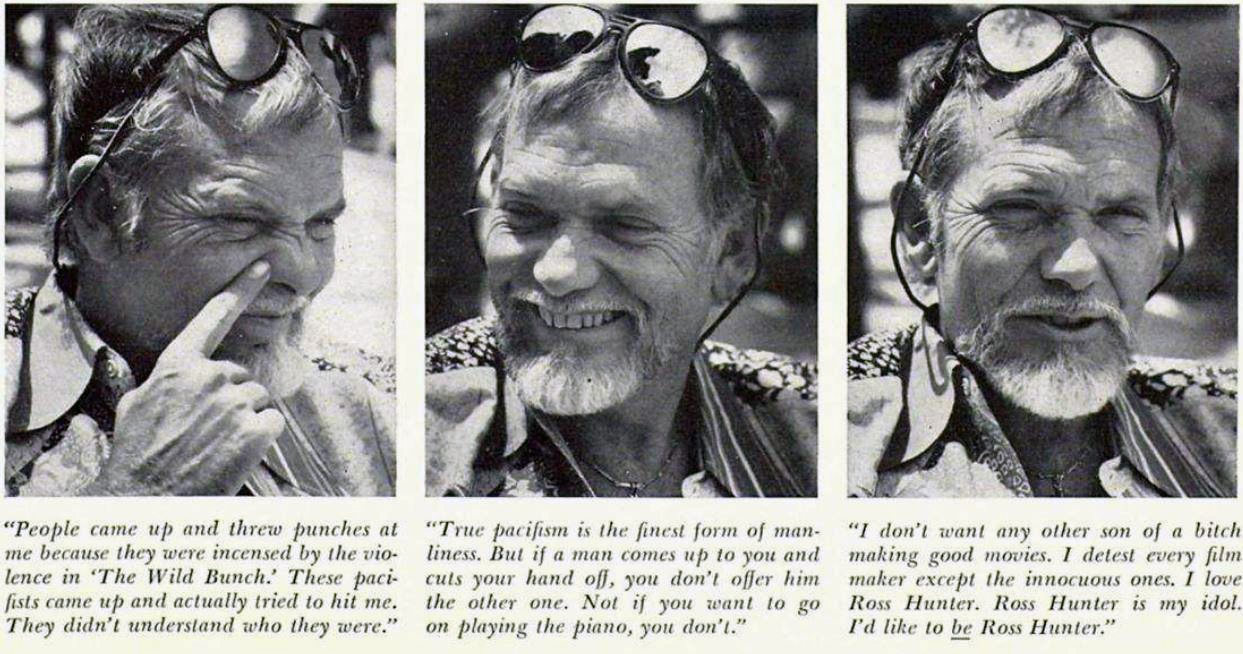
Sam Peckinpah / Playboy interview

  • Sam Peckinpah - Playboy Interview

    SAM PECKINPAH: PLAYBOY INTERVIEW 

    (1972)

    A candid conversation with the screen’s “Picasso of violence,” controversial creator of “the wild bunch” and “straw dogs”
    by William Murray
    In a scene from Sam Peckinpah’s movie The Wild Bunch, the bunch — a ruthless gang of misfits — is gathered around a campfire after a busy day. They’ve robbed a bank and killed most of a town while escaping, only to discover that the blood bath had been committed not for the gold they thought they’d stolen but for a worthless bag of washers. Passing a bottle around, they talk about what’s to become of them. William Holden, the leader, says to Ernest Borgnine, “This was going to be my last. I was going to pull back after this one.” Borgnine replies, “Pull back to what?” This is the theme of Peckinpah’s classic film: desperate men with a worn out way of living locked in a doomed and brutal struggle against a new order.

    Thursday, July 13, 2023

    Richard Dawkins / Playboy Interview

    Richard Dawkins


    RICHARD DAWKINS: PLAYBOY INTERVIEW (2012) – by Chip Rowe

    A candid conversation with the controversial atheist about the simple beauty of evolution, the improbability of God and why the pope should be arrested

    All Time 100 Nonfiction Books / No 79 / The Selfish Gene by Richard Dawkins

    by Chip Rowe
    Playboy, August 20, 2012

    Richard Dawkins, the patron saint of nonbelievers, caused a stir earlier this year during a debate with the Archbishop of Canterbury, who noted that his opponent is often described as the world’s most famous atheist. “Not by me, ” Dawkins replied before providing his standard explanation—a supreme being is possible but highly improbable—which led a London newspaper to proclaim that the world’s most notorious skeptic was hedging his bets. Far from it. Dawkins, at 71, remains an unbending and sharp-tongued critic of religious dogmatism. Like any scientist who challenges the Bible and its lyrical version of creation, he spends a great deal of time defending Charles Darwin’s theory that all life, including humans, evolved over eons through natural selection, rather than being molded 10,000 years ago by an intelligent but unseen hand.Dawkins, who retired from Oxford University in 2008 after 13 years as a professor of public understanding of science (meaning he lectured and wrote books), stepped into the limelight in 1976, at the age of 35, with the publication of The Selfish Gene. The book, which has sold more than a million copies, argues persuasively that evolution takes place at the genetic level; individuals die, but the fittest genes survive. Dawkins has since written 10 more best-sellers, including most recently The Magic of Reality: How We Know What’s Really True. Since 9/11 he has become more outspoken about his skepticism, culminating in The God Delusion, which provides the foundation for his continuing debates with believers. Published in 2006, the book has become Dawkins’s most popular, available in 31 languages with 2 million copies sold. That same year he founded the Richard Dawkins Foundation for Reason and Science “to support scientific education, critical thinking and evidence-based understanding of the natural world in the quest to overcome religious fundamentalism, superstition, intolerance and suffering. ” His books have made Dawkins a popular speaker and champion of critical thinking. In March he spoke to 20,000 people at the Reason Rally on the National Mall in Washington, D.C.; a week later he was at Fort Bragg in North Carolina, offering encouragement to the first gathering of atheistic and agnostic soldiers ever allowed on a U.S. military base.Dawkins lives in Oxford with his third wife, Lalla Ward, best known for her role as Romana onDoctor Who. But he is rarely home for long, and Contributing Editor Chip Rowe had to travel to three cities to complete their conversation. He reports: “Dawkins is a careful speaker with little patience for foolishness (which is everywhere, especially among the faithful and the occasional journalist), but he straightens and his eyes dance when he is asked to explain an evolutionary principle. We met for the first time in Las Vegas at a convention for skeptics. We talked again when he visited New York to lecture at Cooper Union and in Washington, where he spoke at Howard University, checked in with the director of his foundation, thanked its volunteers and visited the impressive human origins exhibit at the Smithsonian’s National Museum of Natural History. During a tour with the exhibit’s curator, Dawkins looked pained anytime he was compelled to chat, glancing furtively at the fossilized eye candy in every direction, including a wall of progressively modern skulls. At one point two young women approached. ‘This is Richard Dawkins!’ one told the other, wide-eyed. I suppose it’s like bumping into Bono at the Rock and Roll Hall of Fame. ”

    Friday, July 2, 2021

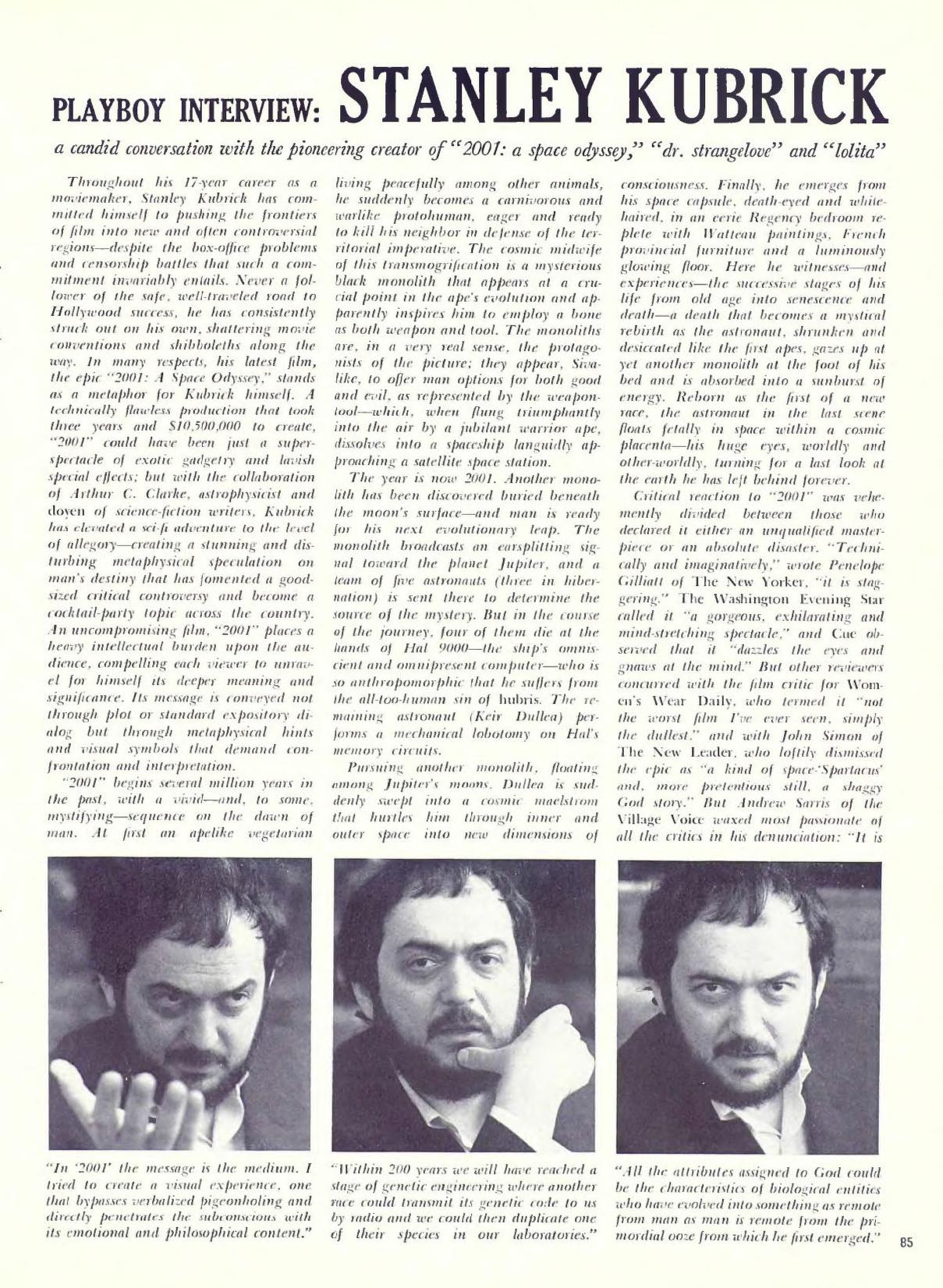
    Stanley Kubrick / Playboy Interview

    • Playboy interview - Stanley Kubrick

      STANLEY KUBRICK: PLAYBOY INTERVIEW 

      (1968) 

      by Eric Norden


      A candid conversation with the pioneering creator of 2001: A Space Odyssey, Dr. Strangelove and Lolita
      Throughout his 17-year career as a moviemaker, Stanley Kubrick has committed himself to pushing the frontiers of film into new and often controversial regions—despite the box-office problems and censorship battles that such a commitment invariably entails. Never a follower of the safe, well-traveled road to Hollywood success, he has consistently struck out on his own, shattering movie conventions and shibboleths along the way. In many respects, his latest film, the epic 2001: A Space Odyssey, stands as a metaphor for Kubrick himself. A technically flawless production that took three years and $10,500,000 to create, 2001 could have been just a super-spectacle of exotic gadgetry and lavish special effects; but with the collaboration of Arthur C. Clarke, astrophysicist and doyen of science-fiction writers, Kubrick has elevated a sci-fi adventure to the level of allegory—creating a stunning and disturbing metaphysical speculation on man’s destiny that has fomented a good-sized critical controversy and become a cocktail-party topic across the country. An uncompromising film, 2001 places a heavy intellectual burden upon the audience, compelling each viewer to unravel for himself its deeper meaning and significance. Its message is conveyed not through plot or standard expository dialog but through metaphysical hints and visual symbols that demand confrontation and interpretation.

      Wednesday, June 30, 2021

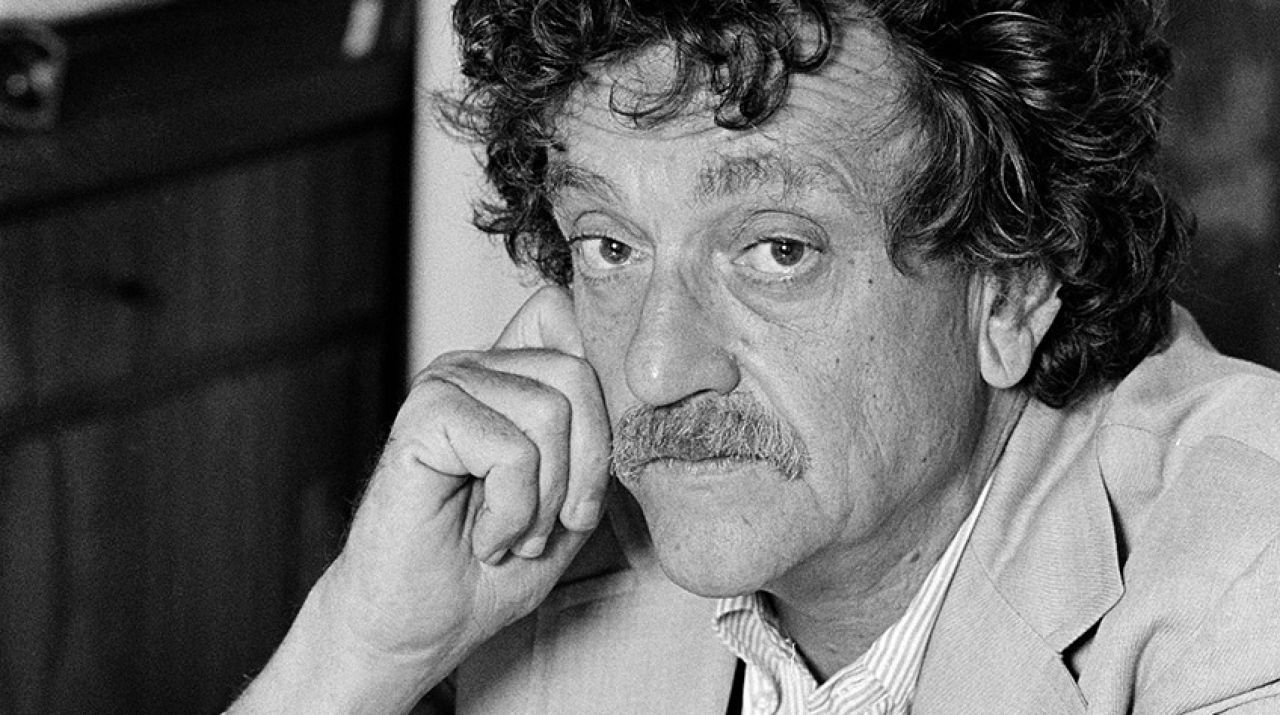
      Kurt Vonnegut / Playboy Interview

      • Kurt Vonnegut

        KURT VONNEGUT: PLAYBOY INTERVIEW (1973)

        by David Standish
        By 1962, Kurt Vonnegut, Jr., had been writing novels for ten years; three had been published—Player PianoThe Sirens of Titan and Mother Night—and nobody had ever heard of him. He didn’t count. Player Piano had been haphazardly reviewed when it was published in 1952, because it was a first novel; and had been as haphazardly dismissed when the reviewers found out that it looked a lot like science fiction—which is to say, trash. In 1959, “The Sirens of Titan” came out as a paperback original, with a screaming space-opera cover—and didn’t get a single review. Ditto Mother Night, in 1962, which carried a cover blurb implying that it was part of the Kiss My Whip school of writing.
        In the 11 years since, he’s written four more novels—Cat’s CradleGod Bless You, Mr. RosewaterSlaughterhouse-Five and Breakfast of Champions, just published. His books are now reviewed in the lead slot of the Sunday Times book section; Slaughterhouse-Five rode the best-seller lists for more than three months and was nominated for a National Book Award; Breakfast of Champions was grabbed by three book clubs long before it came out; those early novels that the critics wouldn’t touch with a stick are now being taught in colleges all over the place; a book of original essays about him called “The Vonnegut Statement” just appeared; the number of Ph.D. dissertations considering his work is up to six so far, and you can practically hear the typewriters clacking in graduate schools everywhere: “The Ambivalent Relationship of Zen and Bokononism in ‘Cat’s Cradle’: An Approach.” And so on.

        Friday, February 12, 2021

        Truman Capote / Playboy interview

        Truman Capote


        TRUMAN CAPOTE – PLAYBOY INTERVIEW

        (1968)

        “Wealthy Farmer, Three of Family Slain: H.W. Clutter, Wife and Two Children Are Found Shot in Kansas Home.” The UPI dispatch below this headline, buried in the back pages of the November 15, 1959, New York Times, was newsworthy outside Kansas only because H.W. Clutter was a former Eisenhower appointee to the Federal Farm Credit Board. But in New York City, the item had an electrifying effect on novelist Truman Capote. Within three days, he was in the small western Kansas farm town of Holcomb, interviewing friends and neighbors of the Clutter family and badgering local police for information about the crime, determined to probe deeply into the lives of both the Clutter family and their murderers.

        Saturday, January 16, 2021

        Stephen King / Playboy Interview

        Stephen King: los 15 mejores libros, las 18 mejores películas ...
        Stephen King


        STEPHEN KING: PLAYBOY INTERVIEW 

        (1983) 

        by Eric Norden


        In the early winter of 1972, a Maine housewife dusting her husband’s makeshift study fished a discarded manuscript out of the wastebasket and sat down to read it. When Stephen King returned from teaching high school English that evening, his wife, Tabitha, persuaded him to resume work on the abandoned novel, despite his conviction “that I had written the world’s all-time loser.” Several months later, he submitted the revised version to Doubleday & Company in New York. Carrie, a twisted fairy tale about an ugly-duckling adolescent transformed into a merciless engine of psychic destruction, was purchased by Doubleday in March 1973 for a $2500 advance and subsequently sold a modest 13,000 copies in hardcover. Reviews were both sparse and mixed; some dismissed the novel as a potboiler, but New York Times critic Newgate Callendar hailed it as “brilliant . . . A first novel guaranteed to give you a chill.” Screen rights were purchased by United Artists, and Brian De Palma’s 1976 film version, starring Sissy Spacek and John Travolta, was a critical and commercial success, while New American Library paid $400,000 for paperback rights and subsequently sold more than 2,500,000 copies. King, dubbed “the modern master of horror” by The New York Times, had exploded onto the publishing scene and had begun his meteoric rise on the best-seller lists.

        Tuesday, September 8, 2020

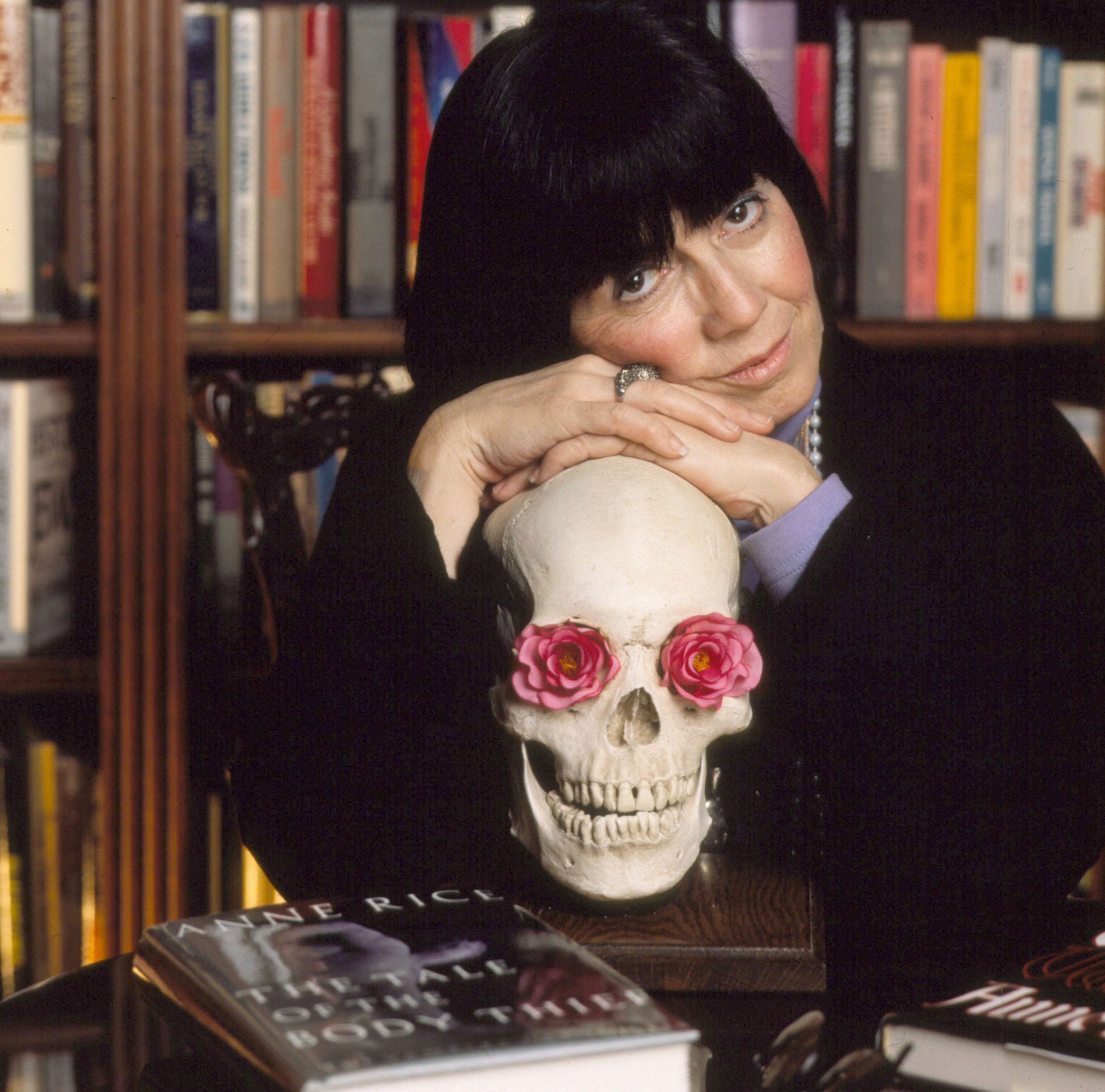
        Anne Rice / Playboy Interview

        A Comprehensive Guide to Anne Rice, the Queen of Sexy Vampire Fiction
        Anne Rice

        Anne Rice: Playboy Interview (1993)

        A candid conversation with the author of The Vampire Chronicles about sex and violence, gays and bloodsuckers, and her helpful fans from the S&M scene
        In 1976 Anne Rice came upon the literary scene with an extraordinarily innovative novel called “Interview with the Vampire.” Critics were not sure what to make of her richly imagined, deadly serious portrait of Lestat de Lioncourt—an 18th century vampire who poured out his tale of centuries on the run, of the eternal struggle between good and evil and of the meanings of death and immortality. But readers had no trouble seeing this vampire as an ultimate outsider—a symbolic figure for teens, gays and lonely urban apartment dwellers. It became an instant cult classic and the basis for a series of novels, “The Vampire Chronicles”—including “The Vampire Lestat,” “The Queen of the Damned” and, most recently, “The Tale of the Body Thief”—which have sold nearly 5 million copies.
        The handful of critics who condemned “Interview with the Vampire” as a clever literary stunt could not have guessed how profoundly Rice identified with her fictional character’s emotions. For two years, she had watched helplessly as her only daughter, Michele, battled leukemia, dying before her sixth birthday. In her grief and frustration, she turned to alcohol and to marathon binges at the typewriter. The novel—which features a six-year-old vampire—emerged as a sort of catharsis. Prior to this crossroad in her life, Rice had been a “perpetual student” and aspiring writer who lived in the heart of San Francisco’s Haight-Ashbury district during the rock-and-roll revolution of the Sixties.

        Saturday, August 15, 2020

        Nabokov / Playboy interview


        VLADIMIR NABOKOV Painting by LAUTIR ----- | Saatchi Art
        Vladimir Nabokov
        VLADIMIR NABOKOV: PLAYBOY INTERVIEW (1964)
        BIOGRAPHY OF VLADIMIR NABOKOV

        Few authors of this generation have sparked more controversy with a single book than a former Cornell University professor with the resoundingly Russian name of Vladimir Vladimirovich Nabokov. Lolita, his brilliant tragicomic novel about the nonplatonic love of a middle-aged man for a 12-year-old nymphet, has sold 2,500,000 copies in the United States alone.
        It has also been made into a top-grossing movie, denounced in the House of Commons, and banned in Austria, England, Burma, Belgium, Australia and even France. Fulminating critics have found it to be “the filthiest book I’ve ever read,” “exquisitely distilled sewage,” “corrupt,” “repulsive,” “dirty,” “decadent” and “disgusting.” Champions of the book, in turn, have proclaimed it “brilliantly written” and “one of the great comic novels of all time”; while Nabokov himself has been compared favorably with every writer from Dostoievsky to Krafft-Ebing, and hailed by some as the supreme stylist in the English language today. Pedants have theorized that the book is actually an allegory about the seduction of the Old World by the New—or perhaps the New World by the Old. And Jack Kerouac, brushing aside such lascivious symbolism, has announced that it is nothing more than a “classic old love story.”
        Whatever it is, Nabokov would seem to be incongruously miscast as its author. A reticent Russian-born scholar whose most violent passion is an avid interest in butterfly collecting, he was born in 1899 to the family of a wealthy statesman in St. Petersburg. Fleeing the country when the Bolsheviks seized power, he made his way to England, where he enrolled as an undergraduate at Trinity College in Cambridge. In the Twenties and Thirties he drifted between Paris and Berlin earning a spotty living as a tennis instructor and tutor in English and French; achieving a modest degree of fame as an author of provocative and luminously original short stories, plays, poems and book reviews for the émigré press; and stirring praise and puzzlement with a trio of masterful novels in Russian—Invitation to a BeheadingThe Gift and Laughter in the Dark. Finding himself again a refugee when France fell to the Nazis in 1940, Nabokov emigrated with his wife to the United States, where he began his academic career as a research fellow at Harvard’s Museum of Comparative Zoology. Now writing in English—in a style rich with inventive metaphors and teeming with the philosophical paradoxes, abstruse ironies, sly non sequiturs, multilingual puns, anagrams, rhymes and riddles which both illuminate and obscure his work—he produced three more novels during his subsequent years as a professor in Russian and English literature at Wellesley, and then at Cornell. First came “Bend Sinister,” an unsettling evocation of life under a dictatorship; then “Pnin,” the poignant, haunting portrait of an aging émigré college instructor; and finally the erotic tour de force which was to catapult him almost overnight to worldwide eminence—Lolita.

        Saturday, March 14, 2020

        Ingmar Bergman / Playboy interview

        • Ingmar Bergman

          INGMAR BERGMAN: PLAYBOY INTERVIEW 

          (1964)

          In the months since Ingmar Bergman’s The Silence world-premiered in Stockholm, moviegoers in a dozen countries have been lining up around the block: some to see the final third of the Swedish film maker’s celebrated trilogy (following Through a Glass Darkly and Winter Light) on the quest for love as a salvation from emotional death; others to verify the judgment of some critics that this anatomy of lust is the masterwork of Bergman’s 20-year career. But most, quite unabashedly, have come to ogle the most explicitly erotic movie scenes on view this side of a stag smoker—even after the snipping of more than a minute’s film for the toned-down U.S. version. The film has precipitated a rain of abuse on its 45-year-old creator—as a pornographer (by members of the Swedish parliament), purveyor of obscenity (from Lutheran pulpits all over Sweden) and corrupter of youth and decency (via anonymous calls and letters). Outraged at the outcry, Bergman was most offended by the accusation that he filmed the sex scenes merely to shock and titillate his audiences. “I’m an artist,” he told a reporter. “Once I had the idea for The Silence in my mind, I had to make it—that’s all.” The son of an Evangelical Lutheran parson who became the chaplain to Sweden’s royal family, Bergman remembers his years at home “with bitterness,” as a period of emotional sterility and rigid moral rectitude from which he withdrew into the private world of fantasy. It was on his ninth birthday that he traded a set of tin soldiers for a toy that was to become the catalyst of his creativity: a battered magic lantern. A year later he was building scenery, fashioning marionettes, working all the strings and speaking all the parts in his own puppet theater productions of Strindberg—foreshadowing his directorship of a youth-club theater during his years at Stockholm University, where he produced in 1940 an anti-Nazi version of “Macbeth” which became a minor cause célèbre—and scandalized his family.

          Monday, October 21, 2019

          Federico Fellini / Playboy interview

          • Federico Fellini

            FEDERICO FELLINI: PLAYBOY INTERVIEW 

            (1966)


            A few months ago, during the closed-set filming of Juliet of the Spirits, Federico Fellini’s long-awaited latest film, Roman TV officials congratulated themselves on what promised to be a major video coup when il grande maestro unexpectedly rescinded his own ban on press coverage of the production in progress and acquiesced to their repeated requests for a sample snippet from the film. They were understandably baffled and bedazzled by the footage he supplied—an extraordinary comic-opera scene starring the elephantine, wild-haired whore from  outrageously decked out as D’Artagnan in feathers, velvets, boots and blond mustaches, surrounded by a motley chorus of nuns, clowns and gypsies, all cavorting about to the tune of a blaring Neapolitan aria. The viewing public was equally perplexed when the scene was subsequently sneak-previewed on television, but the critics greeted it with learned interpretations of its allegorical significance—or lack of it. Not until the finished film premiered did they discover that they’d been had: Never intended as part of the picture, it was conspicuous by its absence; Fellini had dreamed up the whole thing as a put-on for symbol searchers.

            Tuesday, June 25, 2019

            Robin Williams / Playboy Interview


              ROBIN WILLIAMS: PLAYBOY INTERVIEW 

              (1992)

              by Larry Grobel
              In many ways, Robin Williams is just a big kid. Watch him play with eight-year-old son Zachary. Williams is positioned in front of the laptop computer, joystick in hand, as planes fly at him on the screen. He pops them off with childlike enthusiasm. “This is great!” he says, racking up kills. “Spielberg loves these, too, you know.” Williams is just back from his day on the set of Hook, in which he plays, appropriately, Peter Pan, the boy who wouldn’t grow up. And what about Zachary, Williams’ son and playmate? He stands by quietly as dad downs more planes, patiently waiting his turn. In other ways, Williams has grown up quite nicely. The stand-up comedian with the quicksilver mind who became an overnight sensation in Mork & Mindy has matured into something of a rarity-a true genius in the world of stand-up comedy, as well as one of the country’s most respected dramatic actors. Many comics have had success in the movies, but few have enjoyed the esteem that Williams does (or the two Oscar nominations). Nor have many overcome the personal demons Williams faced early in stardom when drugs and alcohol threatened to destroy his career, if not his life. Now 40, married for a second time and the father of three children, Williams is at his peak. He appears in movies of substance, not mindless comedies, and he has created a family life in Northern California far from the temptations of the Hollywood fast lane. When Playboy first interviewed Williams in 1982, his career was at a crossroads. Mork & Mindy had nose-dived in the ratings and was canceled after a four-year run. His first movie, Popeye, had been a bomb, and his second, The World According to Garp, earned few rave reviews. But his stand-up comedy routines were legendary, racing from a sometimes simple premise-with mimicry, one-liners, characters and anything else he could think of-to cover an encyclopedia of subjects, leaving his audience breathless. The New York Times described them as having a “perfervid pace and wild, associative leaps,” and worried that his “improvisational method seemed tinged with madness.” Much has happened to Williams in the ten years since that first interview. After the death of acquaintance John Belushi, he stopped using drugs. His first marriage fell apart in a very public manner, and he’s still angry about the way the press covered his divorce and marriage to the woman who had been his son’s nanny; his father, a Detroit automobile industry executive, died. Despite the personal upheaval, his professional life started to jell. His stand-up routines became, in the words of The New York Times, “sharper and less frenetic.” His successful concerts, albums, video tapes and cable specials put him in the top rank of comedians. In 1986, he joined Whoopi Goldberg and Billy Crystal to found Comic Relief, a yearly benefit for the homeless that appears on HBO. So far, it has raised more than $18,000,000. He also makes appearances in support of literacy and is an advocate of women’s rights. But it was his development as an actor that surprised many. Not all of his film roles were memorable, especially at first, but as his list of credits began to build, so did his reputation. He followed Popeye and Garp with The Survivors (which also starred Walter Matthau), Moscow on the HudsonClub Paradise and Cadillac Man. His performance in Good Morning, Vietnam earned his first chance at an Academy Award; his second came with Dead Poets Society. He followed that by co-starring in Awakenings with Robert De Niro, and with a tasty, morbid cameo as a “defrocked” psychiatrist in Dead Again. His performance in The Fisher King has received excellent reviews. And, of course, he’s headlining one of the most anticipated Christmas films-Hook, in which he co-stars with Dustin Hoffman (who plays Hook), Julia Roberts (Tinkerbell), Maggie Smith (Wendy) and Bob Hoskins (the pirate Smee). Director Terry Gilliam has worked with Williams twice, most recently in The Fisher King and earlier in The Adventures of Baron Munchausen, in which Williams appeared as a giant-headed man in the moon. “The thing with Robin is, he has the ability to go from manic to mad to tender and vulnerable,” says Gilliam, who was a founding member of Monty Python. “He’s the most unique mind on the planet. There’s nobody like him out there.” To catch up with one of our national treasures, we sent Contributing Editor Lawrence Grobel (whose previous interviews include Marlon Brando and Robert De Niro) to spend three weekends with the Pan Man. Grobel’s report: “Since Robin was smack in the middle of making Hook, I was aware he was giving up precious family time to do the interview. Yet, once we started talking, I knew it couldn’t be rushed. Williams is a stream-of-consciousness talker, and ideas bounce off him like atoms in a blender. Give him a topic-any topic-and he can do five minutes. “When he was on a roll, he would often lean toward the tape recorder to make sure nothing was garbled or lost. But he can also be quiet and serious, concerned about social issues and politics. And sometimes, when his pregnant wife, Marsha, would enter the room, he would simply become very loving, almost apologizing for spending this time away from her. “Throughout our time together, Williams was open and friendly, often more concerned about my welfare than he was about his own. When my car failed to start after one of our sessions, I called my wife to come get me and Robin volunteered himself, his publicist and his gardener to push the car out of the way until a tow truck arrived. The thought of these three men struggling with a car up a steep hill-and the ensuing chiropractic bills-worried me enough that I tried to start it one more time. This time it worked. ‘It’s OK. I yelled. I’m outa here.’ “‘Wait!’ Robin yelled. ‘You better call your wife.’ “How can you not like a guy who’s willing to risk his back pushing your car and then reminds you to call your wife.”
              Robin Williams
              * * *
              PLAYBOY: This is our second time with you. How did the first interview affect you?
              WILLIAMS: To tell you the truth. I can’t remember it.

              Friday, September 29, 2017

              Pamela Anderson / "Good Bye Hugh "


              Pamela Anderson
              "Good Bye Hugh "

              Playboy Playmate Pamela Anderson pays emotional tribute to Hugh Hefner

              Former Playboy Playmate, actress, and animal rights activist Pamela Anderson paid emotional tribute to Hugh Hefner, the Playboy founder who died Wednesday at age 91 and helped launch Anderson to international stardom.
              In a video posted to her Instagram page, Anderson is seen crying and wiping away tears as she lies in bed. “Goodbye Hef,” she says at the end of the short video.

              To caption the clip, Anderson wrote a poem in memory of Hefner, whom she called “the most important person in my life” outside of her family.

              Hugh Hefner, founder of Playboy magazine, dies at 91


              Hugh Hefner
              Poster by T.A.

              Hugh Hefner, founder of Playboy magazine, dies at 91


              ‘American icon’ died at his Playboy Mansion home from natural causes, the publication announces


              Stephanie Convery and agencies
              Thursday 28 September 2017 07.08 BST


              Hugh Hefner, the founder of Playboy magazine, has died aged 91.
              Hefner, who founded the sexually explicit men’s lifestyle magazine in 1953, died at his home, the Playboy Mansion in Holmby Hills, Los Angeles, the publication announced.

              Cooper Hefner, Hefner’s son and the chief creative officer of Playboy Enterprises, said in a statement: “My father lived an exceptional and impactful life as a media and cultural pioneer and a leading voice behind some of the most significant social and cultural movements of our time in advocating free speech, civil rights and sexual freedom. He defined a lifestyle and ethos that lie at the heart of the Playboy brand, one of the most recognizable and enduring in history.”

              Wednesday, March 1, 2017

              Scarlett Johansson / Playboy Interview

              Scarlett johansson

              Interview


              Playboy Interview: Scarlett Johansson Talks Monogamy, Women’s March & ‘Ghost in the Shell’

              Photography by Jake Chessum

              PLAYBOY INTERVIEW
              The opening sequence of Lost in Translation, Sofia Coppola’s 2003 film about two spiritually adrift, jet-lagged Americans finding each other in Tokyo, features a sustained shot of Scarlett Johansson’s behind, swaddled in a pair of nearly translucent pink underwear, as she lies on a bed, gazing at a window with the curtains drawn. Johansson plays Charlotte, a recent college graduate lamenting the trajectory of her life from inside an opulent Japanese hotel; the actress was just 17 when she landed the role. Although she had already been working for almost a decade, her quiet, deliberate performance turned her into one of Hollywood’s most sought-after actresses, and in the 14 years since Lost in Translation was released, she has served as a muse to auteurs including Woody Allen and the Coen brothers and propped up massive commercial franchises such as Captain America and The Avengers. Her creative choices have been vast and varied, a mix of blockbusters and art-house experiments: a computer operating system in Spike Jonze’s Her (a character she gave life to using only that dusky, twilight voice), a 17th century servant to the painter Johannes Vermeer in Girl With a Pearl Earring, the girlfriend of a porn addict in Don Jon.

              Friday, February 12, 2016

              Sharon Rogers / Her fascinating life


              Sharon Rogers

              Her fascinating life


              MARCH 10, 2013
              An interview with Sharon Rogers

              Sharon Rogers is best known for her appearances in Playboy.  She was on the cover in November 1963 and Playmate of the month in January 1964 (The Tenth Anniversary Issue). Sharon has appeared in over 20 Playboy publications to date. She moved into the ChicagoPlayboyMansion in 1962 where she lived until January 1964.  She worked and trained bunnies at the Playboy Club in Chicago before moving to Hollywood where she helped hire and train bunnies for the opening of the L.A. Playboy Club.  She spent a year doing pre-publicity interviews on TV and in newspapers to promote the new Club.  She also worked in the New York Playboy Club before leaving the organization in 1969. She also appeared in a few TV Series and a couple of movies. Sharon went on to retire in 2009 after working for the Washington State Department of Transportation for 22 years. It was an honor to sit down with her to learn more of her fascinating life.