Sex, death and parrots: Julian Barnes’s best fiction – ranked!
As the Booker prize-winning author prepares to publish his final novel at 80, we assess his finest work
John Self
Monday 19 January 2026
10 Duffy (1980)
Duffy is the first in a series of crime novels about a bisexual private eye that Barnes published under the pseudonym Dan Kavanagh. It came out the same year as Barnes’s debut novel proper, Metroland, but where that took seven years to write, this took 10 days. Not that it shows: this “refreshingly nasty” (as Barnes’s friend Martin Amis put it) crime caper is beguilingly well written, with passages that display all of Barnes’s perception and wit. The plot of reverse blackmail and the shocking climax only add to the fun. Sample line “Two in the morning is when sounds travel for ever, when a sticky window makes a soft squeak and three Panda cars hear it from miles away.”
As Georges Simenon's centenary approaches, Mark Lawson unravels clues to the life of the Belgian thriller-writer and discovers a mysterious character who could write a book in 11 days and claimed to have had 10,000 lovers
The life of Georges Simenon began with a lie. He was born, during a rainstorm in Liège, 10 minutes into Friday February 13, 1903, but his superstitious mother insisted the birth was registered for the more auspicious Thursday. So, for 86 years until his death in Switzerland, he lit candles annually to a fiction and, in three months' time, his centenary will be celebrated one day early.
When Primo Levi died in 1987 at age 67, after falling down the stairwell of his apartment building in Turin, Italy, his fellow writer and survivor Elie Wiesel delivered an epigrammatic coroner’s report: “Primo Levi died at Auschwitz forty years later.” The long-delayed suicide of the Holocaust survivor is a story whose outlines we know too well. Jean Amery, who survived Gestapo torture and Auschwitz, took an overdose of sleeping pills in 1978; Paul Celan, who spent the war in a slave labor camp in Romania and saw his parents murdered, drowned himself in the Seine in 1970; Jerzy Kosiński, who survived in hiding during the Nazi occupation of Poland, asphyxiated himself in a bathtub in 1991. By jumping from a third-story landing, Levi seemed to be delivering the same message: he had borne the burden of an intolerable experience as long as he could, until his strength gave out and he had to let it drop.
She May Have Died in 1999, but Iris Murdoch Is the Perfect Novelist for Our Time
Her absolute refusal to judge her characters is an antidote to contemporary literary certainty.
BY ISAAC BUTLER
For much of 2021, while putting the finishing touches on my own book, I served as a reader for a literary prize. I was excited—honored, even—to do it, and looked forward to deeply immersing myself in the fiction of this moment. And did I ever: I read at least the first chapters of more than 200 novels, turning my reading year into a kind of supersize survey course of contemporary literature. At first it felt great, as if I were tuned in to the frequency of our age. By the fall, though, I felt as though I was overdosing on the contemporary. It’s not that the literature of today wasn’t good—I read several wonderful books!—so much as that contemporary literature cannot help but be, well, contemporary.
Isaac Babel was born in the Moldavanka, a poor, raffish district of Odessa, in 1894, and died, it has been established only within the last ten years, in Moscow's Lubyanka prison, early in the morning on January 27, 1940. He was shot by a firing squad after a twenty-minute trial held the day before in the private chambers of Lavrenti Beria, the notorious head of the K.G.B.'s predecessor, the N.K.V.D. Babel was convicted of "active participation in an anti-Soviet Trotskyite organization" and of "being a member of a terrorist conspiracy, as well as spying for the French and Austrian governments." He had confessed, during the previous eight months of imprisonment and interrogation, to charges of espionage, but his last recorded statement protested, "I am innocent. I have never been a spy. I never allowed any action against the Soviet Union. . . . I am asking for only one thing—let me finish my work."
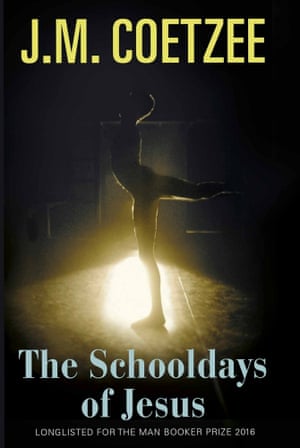
‘Is it possible that I am the Messiah?’ David asks. ‘No, you’re just a very naughty boy’ John Crace Sunday 4 September 2016
“I was expecting Estrella to be bigger,” says he, Simon. “It looked much bigger on the map.”
“Where are we?” says Ines.
“I don’t know because we have forgotten everything except the bits we remember. All I know is that we are everywhere and nowhere,” says he, Simon.
“Why does your direct speech always end with ‘says he, Simon’ but mine always ends ‘says Ines’?” says Ines.
“Only Booker judges can truly know why this kind of nonsense ends up on their longlist,” says he, Simon.
They look at their six-year-old boy who is not their boy, the boy who is called David yet is not called David.
“Is it possible that I am the Messiah?” David asks.
“No, you’re just a very naughty boy.”
Simon and Ines find some work which they do to the best of their ability. Sometimes they fall asleep. It is hard to stay awake when every sentence has been crafted to be as dull as this. David sees some boys torturing a duck. Simon kills the duck because it has been fatally wounded.
“Are there burial rites for ducks?” David asks.
“That’s a fascinating question,” says he, Simon.
The owner of the place where Simon and Ines are working offers to pay to send David to one of Estrella’s two Academies.
“David seems to be a very intelligent little boy,” says the woman.
“That’s news to us,” say the readers, who remember him all too well from the first book, The Childhood of Jesus.
“There are two Academies in Estrella,” says the woman who has forgotten she has already mentioned this. “The Academy of Dancing and the Academy of Singing. There are also regular schools but I think David should go to the Academy of Dancing.”
“Very well,” says he, Simon.
The next day Simon takes David to meet the beautiful Ana Magdalena. “Ordinary sums like 9 x 7 are for the lesser mechanical mortals. Here I teach children how to get in touch with numbers through interpretative dance.” She shimmies across the room. “That was the true meaning of the number two. Only children can understand this because they are still in touch with their former cosmic lives.”
Simon wants to say this is the biggest load of bollocks he has ever heard and that JM Coetzee must be taking the piss out of his readers but he has forgotten what Ana Magdalena has said so he just nods.
“I want to dance the number eight,” says David.
Outside the Academy David meets an ugly, dishevelled man called Dmitri. “I work in the museum but as I don’t have any work to do I spend all my time hanging around the Academy,” says Dmitri.
“That’s fascinating,” says he, Simon.
At some point Simon and Ines separate but neither suffer any great distress as neither has any recollection of being together. Simon goes to watch Ana Magdalena swimming naked with the boys in the Academy and finds some pornography that Dmitri has been showing to the boys.
“Can I ask a load of second-rate philosophical questions that are usually found in the novels of Paulo Coelho?” asks David.
“That would be great,” says he, Simon. “I can’t wait.”
“Do you think I’m Jesus?”
“Well, you’re not David.”
Just then Simon hears a commotion. Ana Magdalena has been found strangled in the basement.
“I did it, I did it,” yells Dmitri. “Send me to the salt mines for ever. I deserve to be punished.”
“No,” says everyone. “You must go to a hospital for you are not well.”
The next 100 pages pass slowly for time is sometimes like that. The Academy of Dance closes, David is refused a place at the Academy of Singing and continues to be annoying.
“Psst, it’s me,” says Dmitri. “I’ve escaped from the hospital. Help me get to the salt mines. I was having a passionate affair with Ana Magdalena and I don’t know why I killed her. I need to atone for my sins.”
“OK,” says he, Simon. Simon doesn’t question this ludicrous turn of events as none dare challenge the plotting of a Nobel prize-winning novelist who has twice won the Booker.
David dances a perfect two. “That’s very good,” says he, Simon. “Now hide under the mattress so you don’t get counted in the census.”
“Is that because I am the Son of God? I can dance a perfect three if you like.”
“Save that for one of the next 20 books,” says he, Simon. “You’re still only seven and something tells me you are going to live to 33.”