The Head of Franz Kafka, at Prague’s Quadrio shopping mall.
Franz Kafka’s Prague: a centenary tour of the writer’s home city
A hundred years after his death, the author’s presence is as strong as ever in the Czech capital – from his childhood homes and the literary cafes he frequented to the remarkable buildings immortalised in his work
Paul Sullivan
Monday 3 June 2024
It’s a boiling summer’s day in Prague and I’m staring into the austere face of Franz Kafka. Not the real Kafka, of course – he died exactly a century ago, which is why I’m here – but a cast-iron plaque on the wall of his birthplace. The house, a replica as it turns out, sits pretty much on Old Town Square, which as usual is thronged with tourists snapping pics of its fairytale architecture, sipping drinks on terraces and gawking at its 15th-century astronomical clock. It’s impossible to imagine Kafka – 6ft tall and skinny, with dark, intense eyes – in this vibrant, carefree milieu. But then the Prague that Kafka was born into, in 1883 – the capital of the Kingdom of Bohemia, part of the Austro-Hungarian empire – was a very different city. And Kafka himself, alienated both as a Jew and a minority German speaker, had a sensitive imagination that interpreted the city’s narrow, winding streets as claustrophobic and its looming spires as threatening.
A sculpture by David Cerny at the Franz Kafka Museum in Prague.DOMONABIKECZECH / ALAMY / CORDON PRESS
Kafka’s Prague: a captivating city brimming with literary tradition
The capital of the Czech Republic is a metropolis very much focused on culture and attracting tourists
TONI MONTESINOS
OCT 24, 2023 - 14:13 COT
Franz Kafka is known for his precise and enthralling writing style. His literary worksgo beyond published works into letters and diaries that provide insight into his enigmatic persona. Testimonials, studies and new discoveries — Kafka’s essence continues to fascinate readers and leave a lasting impact a century after his death.
Because of his frequent appearances in news articles, Franz Kafka is often considered the most iconic writer of the 20th century. Visiting Prague offers a unique opportunity to delve into Kafka’s world and vision. The Franz Kafka Museum is a marvel for admirers of the author, offering insights into his life, socio-historical context and the city he lived in. Explore first editions of his works, along with a wealth of documents, photographs and audiovisual materials, presented in a meticulously designed exhibition.
About a 10-minute walk from the museum, you’ll find the impressive Prague Castle in the Hradcany neighborhood on the left bank of the Vltava River. Inside the castle grounds, you’ll discover palaces, churches and the cathedral… as well as a charming little street called Zlatá ulička, also known as Golden Lane. One of the houses on this street — number 22 — is where Kafka lived in 1916 and 1917. Although the house was renovated in 1955, it still retains the humble character and low ceilings of the author’s abode a few years before his death.
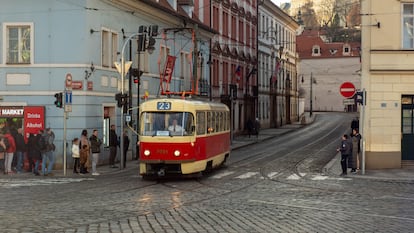
Tram 22 is the ideal way to explore this area of the Czech capital. To save money and time, purchase a transportation card from the Prague tourist office, as well a visitor pass that gives you direct entry to over 60 places of interest, guided tours and boat trips around the city.
Tram 22 was given its number in honor of Franz Kafka's home at 22 Zlatá ulička in Prague.DALIBOR KOTEK (ALAMY / CORDON PRESS)
The neighborhood adjacent to Prague Castle is the place about which Jan Neruda wrote his most famous book of short stories. In 1895, the city named a street there after him — Nerudova — undoubtedly one of the most beautiful in Prague. It had been four years since he passed away, and the city decided to honor his childhood home on this street. Prior to 1770, houses in Prague were distinguished by their signs, and Neruda’s home was known as the Two Suns. The author drew inspiration from the innumerable anecdotes and snatches of gossip he heard in his father’s grocery store to write Tales of the Lesser Quarter, a collection of short stories published in 1877.
Hispanic-Czech fusion
In this same charming Prague neighborhood, you’ll find a cozy restaurant called El Centro (Maltézské 293/9, Malá Strana, 118 00). Opened in 1999, it was the first restaurant with Spanish and Central American cuisine in the city. It’s run by Radek Neruda and his wife Norma, a Czech and Guatemalan duo with an interesting personal story. Their restaurant offers a delightful selection of tapas, paellas, Latin American delicacies and a carefully curated selection of Spanish wines. It’s the perfect spot to rest, recharge and enjoy delicious food.
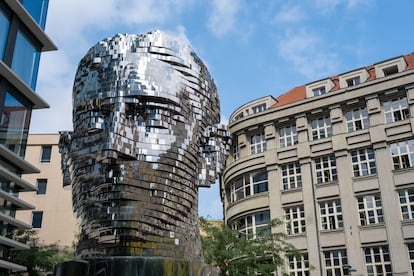
The Kafka Statue by David Cerny is modern sculpture of Franz Kafka's head in Prague.MARC BRUXELLE (ALAMY / CORDON PRESS)
This Hispanic-Czech fusion restaurant is notable because it’s also surrounded by weighty literary tradition. Nearby is the Czech Literary Center (České literární centrum), where Kateřina Chromková promotes Czech writers in other countries. The Prague Cervantes Institute occupies a beautiful and imposing building where its director, novelist Gonzalo Manglano, connects local literature with works in the Spanish language.
The city is a thriving literary hub, hosting various events and offering scholarships for writing and translation through the Czech Literary Center. Initiatives like “Encounters with Literature” promote Hispanic literature and its authors to the Czech public and publishing industry. This focus on the literary world is not surprising in a country that loves radio dramas, reflecting the Czech Republic’s enthusiasm for literature.
On the corner of Dusní and Vezenská streets, in the heart of the ancient Jewish Quarter, stands a monument honoring Kafka created by sculptor Jaroslav Róna and unveiled in 2003. Another famous writer, Jaroslav Hašek, best known for his four-part humorous novel, The Fateful Adventures of the Good Soldier Svejk During the World War (1920-1923), is also honored in various places around Prague. Known for his bohemian lifestyle and anarchist leanings, Hašek fought with the Austrians in World War I and later as a mercenary in the Russian Army. Josef Landa’s iIllustrations of the fictional character of Švejk can be found in several Prague cafés.
Some of Landa’s illustrations adorn the U Brejsku café, a place both Hašek and Kafka frequented. A colossal sculpture of Kafka’s head sits on the outskirts of Quadrio shopping center. Designed by David Černý and installed in 2014, the 24-ton, stainless-steel sculpture has 42 movable sections that rotate independently, creating a mesmerizing facial effect.
Bothšek and Kafka also frequented literary cafés like the Louvre, a charming establishment that has maintained its beauty since it opened in 1902. Inside, you can find images and information commemorating visits by Kafka and other writers, including Karel Čapek, who coined the term “robot” in one of his science fiction plays. Albert Einstein even paid a visit once. The restaurant is highly recommended for its Czech cuisine, particularly the delicious roast pork with pasta, a dish that truly represents local flavors.
Equally impressive is the elegant Slavia café, open since 1884. Its walls are adorned with photographs of renowned writers, especially former president and playwright, Vaclav Havel. During the post-Soviet collapse of the 1990s, Havel played a crucial role in saving the establishment after the fall of the Berlin Wall. Another notable spot is U zlatého tygra (The Golden Tiger), where Bohumil Hrabal would often spend entire days. Finding a seat can be challenging in this popular tavern housed in a 14th-century building that features a Gothic portal and painting dedicated to the 20th-century Czech writer.
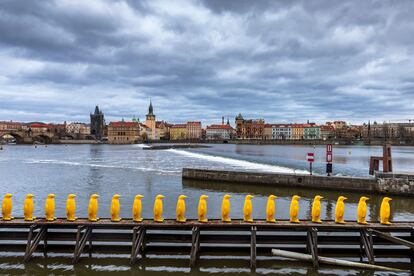
Cracking Art's yellow penguins line the Vltava River at the Kampa Museum in Prague.JIM MONK (ALAMY / CORDON PRESS)
Attached to the Old Town Hall in Prague is the renowned 15th-century astronomical clock, a ubiquitous sight (in miniature) in every souvenir shop. Every hour, figures of the 12 Biblical apostles spring into motion, drawing huge crowds of fascinated tourists. Surrounding the clock, four allegorical figures symbolize Vanity, Greed, Death and Lust, encapsulating large parts of our shared human experience.
Brazilian writer Jorge Amado and his son (fourth from left ro right) and Czech journalist and playwright Jan Drda (first from left to right), at Dobříš, a Czech castle that served as a residency for Czech and international writers, in 1950. Photo from the Paloma Amado archive, used with permission.
During the Cold War, Latin American intellectuals found solace in communist Prague
Gabriel García Márquez, Jorge Amado, and Pablo Neruda were among the illustrious visitors
Before COVID-19, Prague was visited every year by millions of tourists looking for cheap beer and spectacular architecture. In the 1950s, on the other hand, the capital of then-Czechoslovakia attracted a very different crowd of travelers: Leftist intellectuals from around the world looking to see what life was like under socialism.
Prague Nights by Benjamin Black review – murder in the city of masks
This stylish historical fantasy from John Banville’s crime-writing alter ego sees the two aspects of the author coming together
Clare Clarke WED 7 JUNE 2017
Perhaps it is to warn those hoping for another in his Dublin-set Quirke series that Benjamin Black’s latest novel is firmly entitled Prague Nights (in the US the book will have the more evocative title Wolf on a String). Over the last 10 years the seven Quirke books have established Black as a master of high-class crime fiction, literary noir in the tradition of Georges Simenon and Raymond Chandler.
The new novel, however, forsakes 1950s Dublin and Black’s misanthropic pathologist in favour of 16th-century Prague and the court of the rapacious, paranoid and all-powerful Holy Roman Emperor, Rudolf II. An unexpected shift, except that Benjamin Black is, of course, the pen name of the Man Booker prize-winning John Banville, who set much of his 1981 novel Kepler, a re-imagining of the life of Rudolf’s imperial mathematician and astronomer, in the same time and place. Banville has also written about the city in Prague Pictures, a chronicle of his own experiences of the Czech capital interwoven with fragments of history, literature and folklore. Prague, perhaps almost as much as Dublin, is in Black and Banville’s DNA.
As crime fiction tradition demands, Prague Nights opens with a dead body. It is the winter of 1599 and Christian Stern, the ambitious bastard son of the prince regent of Regensburg, is newly arrived in the city, intent on currying favour with the imperial high-ups and securing a place “among the scores of learned men who laboured at His Majesty’s pleasure, and under his direction, in the fabulous hothouse that was Hradčany Castle”. Instead, drunk and disoriented, he stumbles upon the corpse of a beautiful young woman in the snow, her throat savagely slit. After staggering to a castle guard for help, Stern discovers that she is Magdalena Kroll, daughter of Rudolf’s physician and the emperor’s latest “little plaything”. Stern is promptly apprehended as a suspect and imprisoned.
This is, despite all appearances, an astonishing piece of good luck. The paranoid, occult-obsessed emperor has dreamed that a star will come from the west, sent by Christ himself, “a great good omen to the throne and … a token of victory over the Turk”; thanks to his auspicious name, Stern seems to be this star. Sprung from jail and abruptly elevated to the imperial inner circle, he is given the responsibility of investigating Magdalena’s murder.
The problem is that Stern proves a lousy detective. His predicament only worsens when another body is found. He knows no one in Prague and the emperor’s advisers are determined to exploit him for their own ends. Despite his claims to prodigious intelligence, Stern is both careless and naive. Dazzled by his new status and helpless in the face of his own impulses, he ricochets through Prague in a state of almost permanent intoxication, drunk not only on the plentiful liquor but on sex, novelty and, most of all, fear. He may have no idea who killed Kroll but he knows only too well the fate of those who displease the emperor.
A conventional whodunit would be fatally undone by so feckless a protagonist, but Prague Nights is not a conventional whodunit. Early in the novel, Stern meets with Rudolf’s chamberlain in a room dominated by a tapestry of Actaeon, the hunter who in Greek mythology was turned into a stag by a wrathful Artemis and killed by his own hunting dogs. Stern fails to take the warning, but the stage is set. As the sophisticated and ruthless masters of court diplomacy move him like a chess piece from square to square to achieve their own ends, it is not the mystery of the two murders but the creeping sense of the net tightening around Stern himself that drives the narrative, slowly revealing a power struggle that threatens to undermine the emperor.
The plot is rather slapdash, but the marvellously evoked “city of masks and make-believe” is the great pleasure of Prague Nights. In an author’s note, Black describes the book as a historical fantasy and, in characteristically gorgeous prose, he conjures a wintry world of opportunists and occultists, dwarves and hunchbacks, wolves and shadowy black-winged beasts. With its “windows like eye sockets”, even the house where Stern stays resembles “a hollowed-out death’s head”.
This novel seems to narrow the gap between Banville and Black, a sense underscored by the appearance of Jeppe Schenkel, the fictional dwarf from Banville’s Kepler. The many fans of Black’s hard-boiled noir will be hoping that this is a playful nod from the writer Banville calls his “dark brother” and not an indication that one of the most successful literary bifurcations of recent years is coming to a close.
•Clare Clark’s We That Are Left is published by Vintage. Prague Nights is published by Viking.