Capturing Venice: Lucy Truman’s Inspired Travel Journal Series
Posted on
IllustratorLucy Trumanrecently shared Part Two of her travel journal series, this time taking us along the historic canals of Venice, Italy. Working on-location to capture the city’s soft architectural tones and shifting light, Lucy uses these spontaneous sketches as a vital foundation for her finished editorial and narrative illustrations.
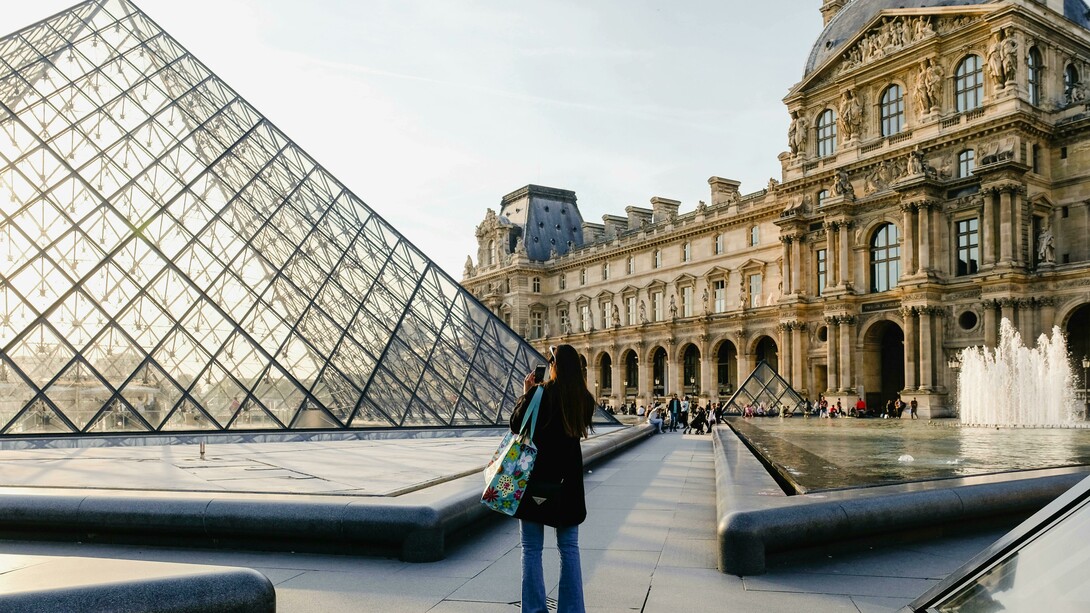
A woman photographs a building in Paris, Île-de-France, France
Paris through a visitor’s eyes
How the city of light reveals its culture, artistry, and everyday elegance beyond the iconic landmarks
Orsolya Antoni
12 June 2026
In 2017, I had the extraordinary opportunity to explore one of the world’s most enchanting cities: Paris. Often celebrated as a symbol of romance and elegance, the city reveals a much deeper identity when experienced through the eyes of a visitor. Beyond its iconic landmarks lies an intricate cultural landscape shaped by history, art, philosophy, and the everyday rituals of its people. Paris is not merely a destination; it is a living masterpiece where the past and present coexist, creating a unique atmosphere that captivates and inspires.
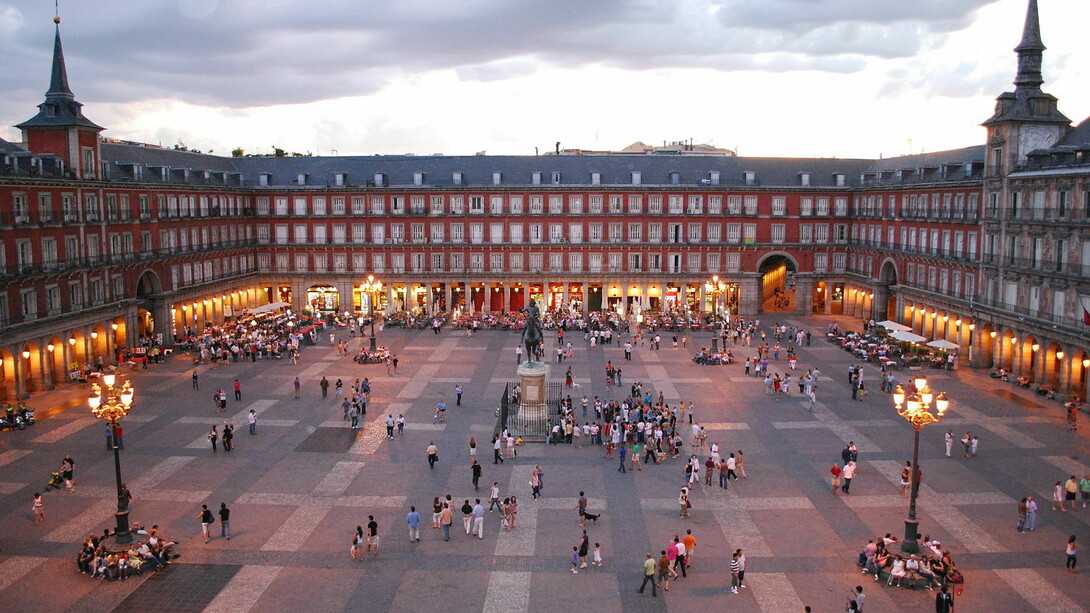
At dusk, walking up to the palace I could see a statue of a horse and its rider silhouetted against the palace. The rider’s sword was raised high, standing out against the darkening sky. Groups sat on the steps of the fountain enjoying the view and each other’s company. In the evening, the area took on a fairytale atmosphere with a multi-coloured, twirling carousel and twinkling fairy lights. We were serenaded by a Spanish guy who said his mother was from the same city Viva is from (what a coincidence – it’s just too bad he knew absolutely nothing about the city or where it was) and then asked us for 10 euro. An Instagram Husband/Boyfriend provided much entertainment as he followed his partner around taking multiple pictures - maybe he was happy to do this because she only smiled at him when he was taking a picture. The palace and the vast gardens are very romantic and it was good to see that Madrid is accepting of LGBT+ couples with multiple couples freely walking around the park hand-in-hand.
What to do As you enter the site you will step onto what remains of an old road; large blocks of stone inlaid in the ground provide a different (if somewhat harsh on the knees) walking experience. It is considerably easier walking along the ground on either side of the road but I would recommend walking on the stones at least for a while to truly enjoy the experience of walking down a vast avenue with ancient ruins on either side. This main road is called Decumanus Maximus and as you walk along you will encounter remains of arches along the right side as well as marble pillars.
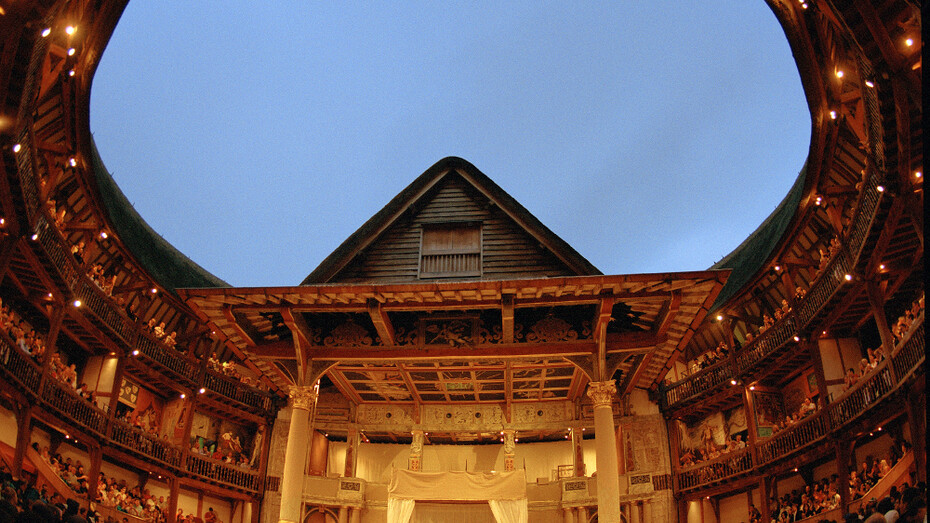
This is part of a continuing series on places to visit and things to do in London from a local’s perspective. From watching Shakespearean plays to visiting museums, seeing London from several hundred feet above the ground to having a drink in a pub going back to medieval times, there is never a shortage of things to do.
Visitors may not think of London Bridge as being a tourist hot spot in the same way they think of the West End but recent developments have resulted in a variety of restaurants, bars, cafes and open spaces which have created a fantastic atmosphere. The area is all the more special because it successfully balances the modern and the historic; you can walk along cobbled streets while gazing up at the Shard.
Copenhagen may just be the most perfectly designed city I have seen. The roads are broad. The pavements are broad. All roads have a cycle track (this is necessary because 52% of the population cycle). Buses are frequent and cover most locations, supplemented by a metro. Recycling bins are divided into various categories instead of the catch all ‘recycle’ bins seen in other cities.
Axolotls in crisis: the fight to save the 'water monster' of Mexico City
This article is more than 7 years old
The city’s floating gardens are a prime party spot – but pollution has driven the axolotl population to the verge of extinction. Can a radical plan save them?
Alan Grabinsky in Mexico City
Tue 4 Dec 2018
Like many residents of Mexico City, my experience of the floating gardens of Xochimilco has mostly been tinged with alcohol. After all, every weekend, this Unesco world heritage site turns into a bacchanal, with groups aboard the canals’ iconic boats celebrating everything from high school graduations to engagements and weddings.
The City of London wakes up and they are already in place. Located at ten entrances to the enclave, the dragons flank more than just its limits, they indicate the direction of the geographical influence of the decisions made there, a particular compass rose. Each dragon, always standing, always alert, ironically holds in its claws the shield with the city's banner: the red cross on a white background of Saint George or the official flag of England, with the red sword of Saint Paul on the back, up to the left corner, always pointing to the sky.
Writing about this place and the experience it gave me feels almost wrong. Though, again, I feel the paradoxical urge, as many writers do, to share my experience.
The Roman Empire was a vast, polytheistic, fascinating civilization. Throughout the eternal city, we recognized and worshiped multiple gods and goddesses. Although the monotheistic religion of Judaism thrived throughout the empire—a religion that eventually gave rise to Christianity and Islam—the original Romans honored multiple deities. We truly believed that these gods and goddesses served a role in founding our civilization. Most importantly, we also believed that these gods and goddesses helped shape our daily lives.
Artemis with a hind, better known as "Diana of Versailles" as it was long exhibited in the Versailles Castle. Marble, Roman artwork, Imperial Era (1st-2nd centuries CE). Found in Italy
The gods of Greece and Rome
A way for kids to experience the allure and drama of ancient Rome
Once upon a time, a very long time ago, the people of Greece believed that the world was ruled by a family of powerful gods and goddesses. The ancient Greeks shared myths—compelling origin stories—by telling oral stories that were then immortalized by painting such tales on walls, vases, pots, jars, and cups.
View of the Grand Canal and Basilica Santa Maria della Salute from the Ponte dell'Accademia in Venice.
Jeff Bezos and Lauren Sánchez arrive in Venice for divisive wedding
Nuptials of Amazon founder and former TV journalist to kick off on Thursday as activists continue to protest against event
Angela Giuffrida in Venice
Wed 25 Jun 2025 17.01
The billionaire Amazon founder, Jeff Bezos, and the former TV journalist Lauren Sánchez have arrived in Venice as they prepare to tie the knot in a lavish three-day celebration that has divided the lagoon city.
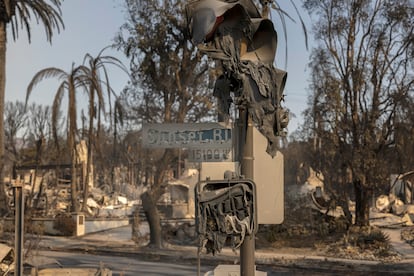
A section of Sunset Boulevard affected by the fire that has devastated the south of Los Angeles, on January 10, 2025.CARLOS ROSILLO LOS ANGELES
A journey to the devastation of Sunset Boulevard, L.A.’s iconic artery
The last six miles of the 23.6-mile long iconic boulevard have been consumed by one of the worst fires in the city’s history. We traveled down that stretch to survey the damage and talk to residents
MARÍA PORCEL & LUIS PABLO BEAUREGARD
Los Angeles - JAN 13, 2025 - 08:06
Sunset is the beating heart of Los Angeles, the street that is photographed by tourists and desired by businesses. It extends along 23.6 miles (38 kilometers) and has 17,383 door numbers. There are palm trees everywhere, grandiose mansions and decadent apartments, pricey restaurants and simple hamburger joints, luxury stores and street markets; also to be found there is part of Beverly Hills and the University of California.
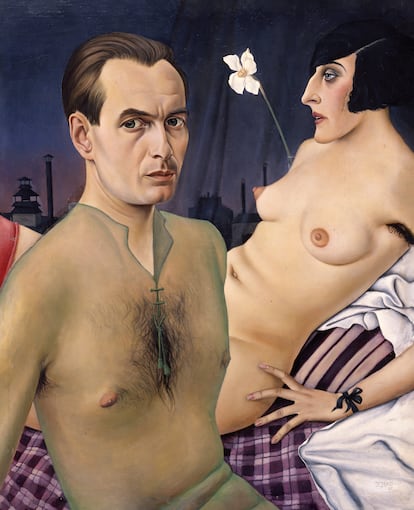
'Self-Portrait with Model' by Christian Schad, from 1927, one of the works blocked by Meta.CHRISTIAN-SCHAD-STIFTUNG ASCHAFFENBURG/BILDRECHT
Meta’s digital censorship targets art from the Leopold Museum in Vienna
According to the prestigious institution, the works of established artists such as Egon Schiele and Christian Schad have been blocked by Instagram and Facebook
David Granda Vienna, 15 July 2024
In 2021, museums in Vienna launched a witty campaign to protest the censorship of art on social media: they opened an account on OnlyFans, a platform that monetizes pornographic content. That year, a short video featuring the 1914 painting Liebespaar by Koloman Moser — made to commemorate the 20th anniversary of the founding of the Leopold Museum — was rejected by Facebook and Instagram as “potentially pornographic.” Three years later, the Leopold Museum in Vienna has launched a new campaign against Meta, the parent company of Instagram and Facebook. This time it goes straight to the point: “Do you think this work of art should be censored?” it asks in a social media postfeaturing works by Egon Schiele and Christian Schad. “Meta does!”
A sculpture by David Cerny at the Franz Kafka Museum in Prague.DOMONABIKECZECH / ALAMY / CORDON PRESS
Kafka’s Prague: a captivating city brimming with literary tradition
The capital of the Czech Republic is a metropolis very much focused on culture and attracting tourists
TONI MONTESINOS
OCT 24, 2023 - 14:13 COT
Franz Kafka is known for his precise and enthralling writing style. His literary worksgo beyond published works into letters and diaries that provide insight into his enigmatic persona. Testimonials, studies and new discoveries — Kafka’s essence continues to fascinate readers and leave a lasting impact a century after his death.
Because of his frequent appearances in news articles, Franz Kafka is often considered the most iconic writer of the 20th century. Visiting Prague offers a unique opportunity to delve into Kafka’s world and vision. The Franz Kafka Museum is a marvel for admirers of the author, offering insights into his life, socio-historical context and the city he lived in. Explore first editions of his works, along with a wealth of documents, photographs and audiovisual materials, presented in a meticulously designed exhibition.
About a 10-minute walk from the museum, you’ll find the impressive Prague Castle in the Hradcany neighborhood on the left bank of the Vltava River. Inside the castle grounds, you’ll discover palaces, churches and the cathedral… as well as a charming little street called Zlatá ulička, also known as Golden Lane. One of the houses on this street — number 22 — is where Kafka lived in 1916 and 1917. Although the house was renovated in 1955, it still retains the humble character and low ceilings of the author’s abode a few years before his death.
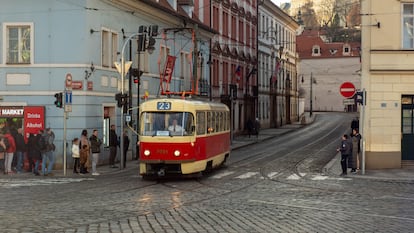
Tram 22 is the ideal way to explore this area of the Czech capital. To save money and time, purchase a transportation card from the Prague tourist office, as well a visitor pass that gives you direct entry to over 60 places of interest, guided tours and boat trips around the city.
Tram 22 was given its number in honor of Franz Kafka's home at 22 Zlatá ulička in Prague.DALIBOR KOTEK (ALAMY / CORDON PRESS)
The neighborhood adjacent to Prague Castle is the place about which Jan Neruda wrote his most famous book of short stories. In 1895, the city named a street there after him — Nerudova — undoubtedly one of the most beautiful in Prague. It had been four years since he passed away, and the city decided to honor his childhood home on this street. Prior to 1770, houses in Prague were distinguished by their signs, and Neruda’s home was known as the Two Suns. The author drew inspiration from the innumerable anecdotes and snatches of gossip he heard in his father’s grocery store to write Tales of the Lesser Quarter, a collection of short stories published in 1877.
Hispanic-Czech fusion
In this same charming Prague neighborhood, you’ll find a cozy restaurant called El Centro (Maltézské 293/9, Malá Strana, 118 00). Opened in 1999, it was the first restaurant with Spanish and Central American cuisine in the city. It’s run by Radek Neruda and his wife Norma, a Czech and Guatemalan duo with an interesting personal story. Their restaurant offers a delightful selection of tapas, paellas, Latin American delicacies and a carefully curated selection of Spanish wines. It’s the perfect spot to rest, recharge and enjoy delicious food.
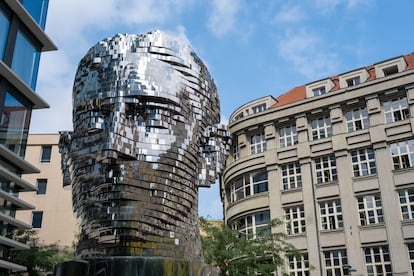
The Kafka Statue by David Cerny is modern sculpture of Franz Kafka's head in Prague.MARC BRUXELLE (ALAMY / CORDON PRESS)
This Hispanic-Czech fusion restaurant is notable because it’s also surrounded by weighty literary tradition. Nearby is the Czech Literary Center (České literární centrum), where Kateřina Chromková promotes Czech writers in other countries. The Prague Cervantes Institute occupies a beautiful and imposing building where its director, novelist Gonzalo Manglano, connects local literature with works in the Spanish language.
The city is a thriving literary hub, hosting various events and offering scholarships for writing and translation through the Czech Literary Center. Initiatives like “Encounters with Literature” promote Hispanic literature and its authors to the Czech public and publishing industry. This focus on the literary world is not surprising in a country that loves radio dramas, reflecting the Czech Republic’s enthusiasm for literature.
On the corner of Dusní and Vezenská streets, in the heart of the ancient Jewish Quarter, stands a monument honoring Kafka created by sculptor Jaroslav Róna and unveiled in 2003. Another famous writer, Jaroslav Hašek, best known for his four-part humorous novel, The Fateful Adventures of the Good Soldier Svejk During the World War (1920-1923), is also honored in various places around Prague. Known for his bohemian lifestyle and anarchist leanings, Hašek fought with the Austrians in World War I and later as a mercenary in the Russian Army. Josef Landa’s iIllustrations of the fictional character of Švejk can be found in several Prague cafés.
Some of Landa’s illustrations adorn the U Brejsku café, a place both Hašek and Kafka frequented. A colossal sculpture of Kafka’s head sits on the outskirts of Quadrio shopping center. Designed by David Černý and installed in 2014, the 24-ton, stainless-steel sculpture has 42 movable sections that rotate independently, creating a mesmerizing facial effect.
Bothšek and Kafka also frequented literary cafés like the Louvre, a charming establishment that has maintained its beauty since it opened in 1902. Inside, you can find images and information commemorating visits by Kafka and other writers, including Karel Čapek, who coined the term “robot” in one of his science fiction plays. Albert Einstein even paid a visit once. The restaurant is highly recommended for its Czech cuisine, particularly the delicious roast pork with pasta, a dish that truly represents local flavors.
Equally impressive is the elegant Slavia café, open since 1884. Its walls are adorned with photographs of renowned writers, especially former president and playwright, Vaclav Havel. During the post-Soviet collapse of the 1990s, Havel played a crucial role in saving the establishment after the fall of the Berlin Wall. Another notable spot is U zlatého tygra (The Golden Tiger), where Bohumil Hrabal would often spend entire days. Finding a seat can be challenging in this popular tavern housed in a 14th-century building that features a Gothic portal and painting dedicated to the 20th-century Czech writer.
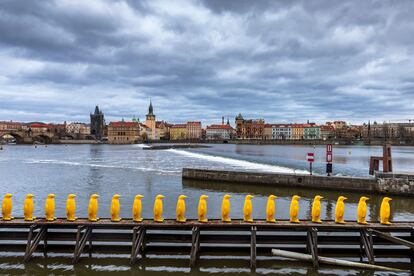
Cracking Art's yellow penguins line the Vltava River at the Kampa Museum in Prague.JIM MONK (ALAMY / CORDON PRESS)
Attached to the Old Town Hall in Prague is the renowned 15th-century astronomical clock, a ubiquitous sight (in miniature) in every souvenir shop. Every hour, figures of the 12 Biblical apostles spring into motion, drawing huge crowds of fascinated tourists. Surrounding the clock, four allegorical figures symbolize Vanity, Greed, Death and Lust, encapsulating large parts of our shared human experience.