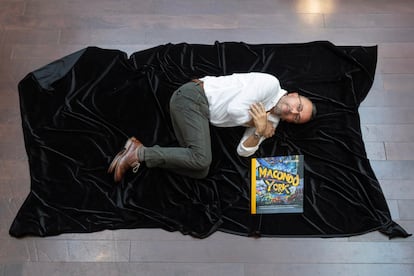
‘Macondo York’: The gaze of a García Márquez overwhelmed by the Big Apple
Designer Iván Onatra rescues in a graphic book the turbulent six months the Colombian writer spent in the US city

Designer Iván Onatra rescues in a graphic book the turbulent six months the Colombian writer spent in the US city
 |
| Gabriel García Márquez París, 1990 Photo by Ulf Andersen |
Author of One Hundred Years of Solitude tops list of those most translated into 10 languages this century ahead of Don Quixote creator

Translator Edith Grossman believes Love in the Time of Cholera is one of the great novels of the 20th century
Susanna Rustin
Saturday 26 April 2026
 |
| Gabriel García Márquez and Mercedes Barcha |
Most of my father’s drafts of work-in-progress were salvaged by my mother behind his back, because he was strictly against showing or preserving unfinished work. Many times during our childhood, my brother and I were summoned to sit on the floor of his study and help him rip up entire previous versions and throw them out—an unhappy image, I am sure, for collectors and students of his process. His papers and his reference library went to the Harry Ransom Center in Austin, Texas, and my mom took great pleasure in the opening ceremonies of that collection. Both my brother’s family and mine were there, and she enjoyed and took shelter in the company of her grandchildren.
 |
| William Faulkner |
For some time now I have been planning to give a course on William Faulkner's influence on the on the so-called Boom in Latin American writing that began in the 1960s. The course would begin with Nobel laureate Mario Vargas Llosa, who said that this American writer was the first novelist he read with pencil and paper at hand, trying to "rationally" reconstruct the architecture of his novels, see the workings of the complex play of chronology and point of view.
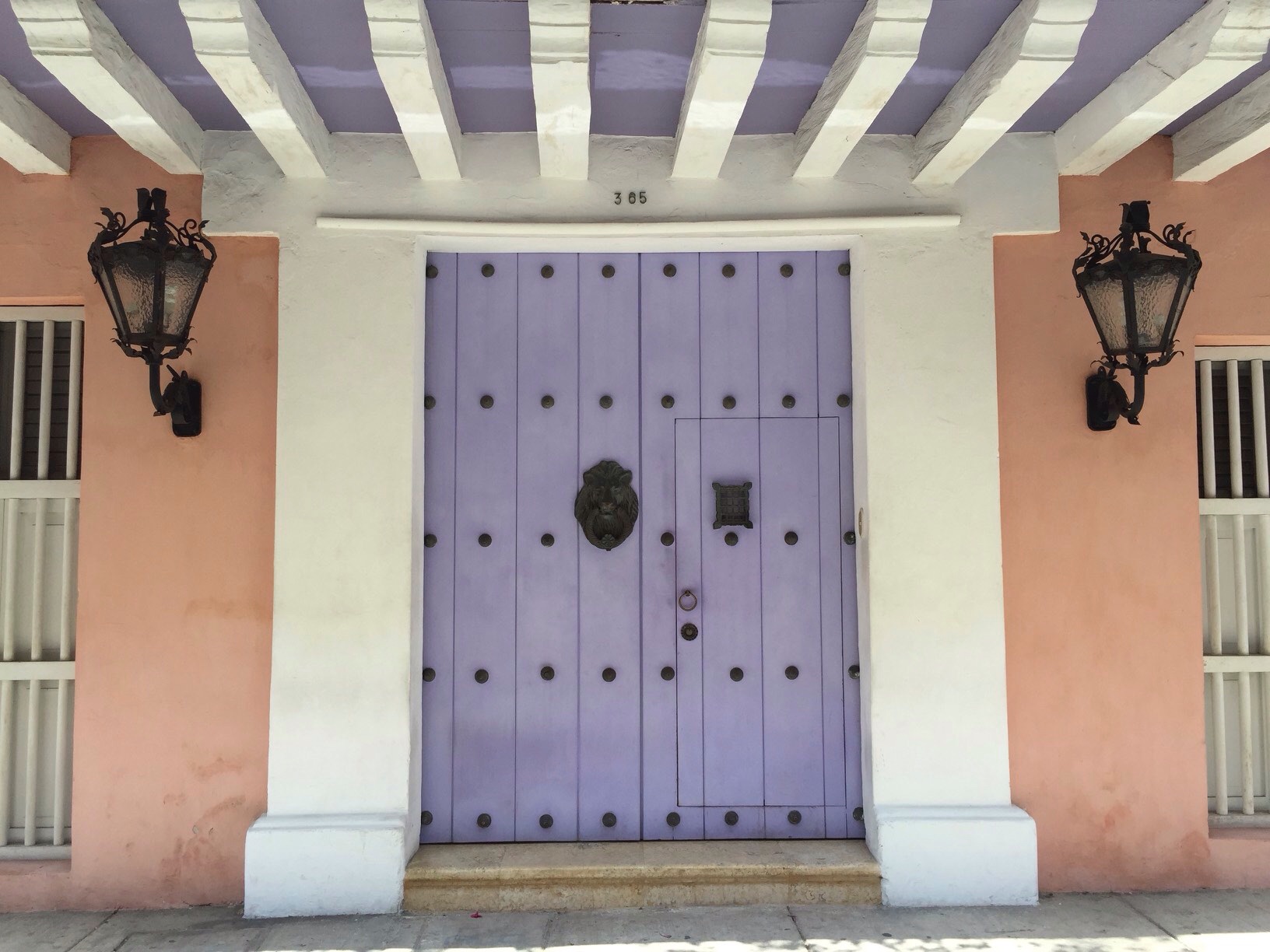
A lavender door in Cartagena, a UNESCO World Heritage City.
“The very life of the colonial city was an illusion of memory.” Gabriel García Márquez Love in the Time of Cholera.
My first impression of Cartagena de Indias was of its doors. Some were closed, others open, but they were all beautiful, redolent of a deceased Spanish power that was ultimately unable to control the collision of races and cultures populating its New World and that still search for ways to share life together. In Cartagena, Beethoven’s Fate slams on doors with weighty brass knockers, ancient Janus opens both ways, while Márquez’s dogmatic Bishop in Love and Other Demons conducts his exorcisms with the eternal pounding of sinister fear.
 |
| Gabriel García Márquez |
The journalist Gustavo Tatis confirmed the information that was revealed about the Colombian writer Gabriel Garcia Marquez, who had a daughter, Indira Cato, daughter also of the writer Susana Cato, the young woman studied Dramatic Literature and Theater at the National Autonomous University of Mexico (UNAM).
 |
| Gabriel García Márquez |
For decades renowned Colombian author Gabriel García Márquez kept the public from knowing about an intimate aspect of his life: He had a daughter with a Mexican writer, with whom he had an extramarital affair in the early 1990s.


A warm homage filled with both fond and painful memories.
An account of the days of a remarkable couple.
In a slender, affectionate memoir, film director and screenwriter Garcia pays tribute to his father, Nobel Prize–winning author Gabriel García Márquez (1927-2014), and his mother, Mercedes Barcha, who died in 2020. His father’s life, Garcia reflects, seemed to him “one of the most fortunate and privileged” ever enjoyed by a Latin American. Yet Garcia was impelled to make “a deliberate, if unconscious choice” to distance himself from his father’s fame by living and working in Los Angeles. He traveled frequently to Mexico during his father’s final years, when García Márquez descended into dementia, able to recall only those whom he saw daily—a secretary, driver, cook, and, of course, his beloved wife. When Garcia and his brother visited, he looked at them “with uninhibited curiosity” but no recognition. The man they were speaking to, though welcoming, was “hardly there at all.” However, his death, while expected, still felt like a shock. “Beyond the sadness,” Garcia writes, “is the disbelief that such an exuberant, expansive man, forever intoxicated with life and with the travails of the living, has been extinguished.” When his mother died six years later, the sense of loss was compounded. “The death of the second parent is like looking through a telescope one night and no longer finding a planet that has always been there,” he writes. “It has vanished, with its religion, its customs, its own peculiar habits and rituals, big and small. The echo remains.” Although his parents were determined to keep their personal lives private from inquiring journalists and literary fans, Garcia recounts in sensitive detail his father’s last days. “My father,” he writes, “complained that one of the things he hated most about death was that it was the only aspect of his life he would not be able to write about.” His son sensitively completes the story, and he includes family photos.
A warm homage filled with both fond and painful memories.


A Farewell to Gabo and Mercedes
By Rodrigo García
Rodrigo García’s new memoir, A Farewell to Gabo and Mercedes, recounts the ailing health and eventual passing of his father, the writer Gabriel García Márquez, in close detail. Amid family discussions and trips to the doctor, García explores the challenge of writing about grief while living within it. In the below excerpt, García documents the aftermath of his father’s dementia diagnosis and considers the emotional weight of the memory loss upon the renowned writer.
Writing about the death of loved ones must be about as old as writing itself, and yet the inclination to do it instantly ties me up in knots. I am appalled that I am thinking of taking notes, ashamed as I take notes, disappointed in myself as I revise notes. What makes matters emotionally turbulent is the fact that my father is a famous person. Beneath the need to write may lurk the temptation to advance one’s own fame in the age of vulgarity. Perhaps it might be better to resist the call and to stay humble. Humility is, after all, my favorite form of vanity. But as with most writing, the subject matter chooses you, and so resistance could be futile.
A few months earlier a friend asked how my dad was doing with his loss of memory. I told her he lives strictly in the present, unburdened by the past, free of expectations for the future. Forecasting based on previous experience, which is believed to be of evolutionary significance as well as one of the origins of storytelling, no longer plays a part in his life.
“So he doesn’t know he’s mortal,” she concluded. “Lucky him.”
Of course, the picture I painted for her is simplified. It is dramatized. The past still plays a part in his conscious life. He relies on the distant echo of his considerable interpersonal skills to ask anyone he meets a series of safe questions: “How is everything?” “Where are you living these days?” “How are your people?” Occasionally he’ll venture an attempt at a more ambitious exchange and become disoriented in the middle of it, losing the thread of the idea or running out of words. The puzzled expression on his face, as well as the embarrassment that crosses it momentarily, like a puff of smoke in a breeze, betrays a past when conversation was as natural to him as breathing. Creative, funny, evocative, provocative conversation. Being a great conversador was almost as highly regarded among his oldest group of friends as being a good writer.
The future is also not completely behind him. Often at dusk he asks, “Where are we going tonight? Let’s go out to a fun place. Let’s go dancing. Why? Why not?” If you change the subject enough times, he moves on.
He recognizes my mother and addresses her as Meche, Mercedes, La Madre, or La Madre Santa. There were a few very difficult months not long ago when he remembered his lifelong wife but considered the woman in front of him claiming to be her to be an impostor.
“Why is she here giving orders and running the house if she is nothing to me?”
My mother reacted to this with anger.
“What is wrong with him?” she asked in disbelief.
“It’s not him, Mom. It’s dementia.” She looked at me like I was trying to pull a fast one. Surprisingly, that period passed, and she regained her proper place in his mind as his principal companion. She is the last tether. His secretary, his driver, his cook, who have all worked in the house for years, he recognizes as familiar and friendly people who make him feel safe, but he no longer knows their names. When my brother and I visit, he looks at us long and hard, with uninhibited curiosity. Our faces ring a distant bell, but he cannot make us out.
“Who are those people in the next room?” he asks a housekeeper.
“Your sons.”
“Really? Those men? Carajo. That’s incredible.”
There was an uglier period a couple of years earlier. My father was fully aware of his mind slipping away. He asked for help insistently, repeating time and time again that he was losing his memory. The toll of seeing a person in that state of anxiety and having to tolerate their endless repetitions over and over and over again is enormous. He would say, “I work with my memory. Memory is my tool and my raw material. I cannot work without it. Help me,” and then he would repeat it in one form or another multiple times an hour for half an afternoon. It was grueling. That eventually passed. He regained some tranquility and would sometimes say, “I’m losing my memory, but fortunately I forget that I’m losing it,” or “Everyone treats me like I’m a child. It’s good that I like it.”
His secretary tells me that one afternoon she found him standing alone in the middle of the garden, looking off into the distance, lost in thought.
“What are you doing out here, Don Gabriel?”
“Crying.”
“Crying? You’re not crying.”
“Yes, I am. But without tears. Don’t you realize that my head is now shit?”
On another occasion, he said to her: “This isn’t my home. I want to go home. Home to my dad. I have a bed next to my dad’s.”
We suspect he was referring not to his father but to his grandfather, the colonel (and the inspiration for Colonel Aureliano Buendía), with whom he lived until he was eight. The colonel was the most influential man in his life. My father slept on a small mattress on the floor next to his bed. They never saw each other after 1935.
“That’s the thing about your father,” his secretary says to me. “Even ugly things he can talk about beautifully.”
Rodrigo García was born in Colombia, grew up in Mexico City, and studied history at Harvard University. His features as writer and director include Nine Lives, Albert Nobbs, and Last Days in the Desert. Garcia has directed for television series such as Six Feet Under, The Sopranos, and Big Love, for which he received an Emmy nomination. He also directed several episodes of HBO’s In Treatment, where, in addition to directing, he served as writer, executive producer, and series showrunner. Garcia currently resides in Los Angeles with his family.
Excerpted from A Farewell to Gabo and Mercedes: A Son’s Memoir of Gabriel García Márquez and Mercedes Barcha, by Rodrigo García.

 |
| Merces Barcha, Fidel Castro and Gabriel García Márquez |

 |
| Mercedes Barcha, Gabriel García Márquez, Gonzalo and Rodrigo. |
Not a day goes by that I don’t come across a reference to your novel “Love in the Time of Cholera.” It’s impossible not to speculate about what you would have made of all this.

Gabo,
April 17 was the sixth anniversary of your death, and the world has gone on largely as it always has, with human beings behaving with stunning and creative cruelty, sublime generosity and sacrifice, and everything in between.

Alife-long passion for the Hispanic world first led me to Colombia, together with a fascination with the early explorers of the New World, from the conquistadors to the German scientist Alexander von Humboldt. The latter conveyed for me a sense of wonder and awe I would later find in the writings of Gabriel García Márquez, whose novels encouraged my belief in travel literature as a poetic transformation of reality.
 |
| Carla Bruni |
As she returns with a new album, the French chanteuse recalls the genius of the Clash and Henry James, plus encounters with Balearic naturists
As a teenager in Paris all I wanted was travel, freedom and independence. I started working [in modelling] right after my high school exam and didn’t go to university because I wanted to be an adult. I was a bit of a rebel. For me, growing up was about discovering where the boundaries were and breaking them. Like the “terrible twos”, but in adolescence.
 |
| Jorge Luis Borges Illustration by Leib Chigrin |


