‘Literature can be a form of resistance’: Lea Ypi talks to Elif Shafak about writing in the age of demagogues
The Albanian author of Free and the Turkish novelist discuss the rise of populism, censorship – and how today’s conflicts all come from the unresolved trauma of the past
'One doesn't read him to feel better – one reads him to feel'
Elif Shafak
Friday 27 April 2012
Iwas a student in college when I first starting reading Walter Benjamin. Literary critic, philosopher, essayist, he was a man of words. As a German Jew he had been born in turbulent times, at the end of the 19th century, and in the most dangerous of places, Berlin.
Elif Shafak: ‘I was already a reader before I started school and long before I managed to learn how to write.’ Photograph: Adrian Sherratt
The
Books
0f my
life
Elif Shafak: ‘Reading Orlando was like plunging into a cold but beautifully blue sea’
Elif Shafak
5 November 2021
The novelist on her love of Virginia Woolf, being inspired by HG Wells and how Jack Kerouac’s ego puts her off his books
My earliest reading memory I was in my grandmother’s house in Ankara, Turkey. I must have been six years old. I learned how to read from Grandma’s cookbooks and traditional Middle Eastern love stories – Layla and Majnun, Ferhat and Shirin.
How to write a Booker contender – by Margaret Atwood, Salman Rushdie and others
Where do Booker-prize authors find their inspiration? The authors on the 2019 shortlist reveal the secrets behind their novels
Margaret Atwood
In The Handmaid’s Tale, we left Offred here: “The van waits in the driveway, its double doors stand open. The two of them, one on either side now, take me by the elbows to help me in. Whether this is my end or a new beginning I have no way of knowing: I have given myself over into the hands of strangers, because it can’t be helped. And so I step up, into the darkness within; or else the light.” When readers were asking for a sequel, So The Testaments is a sequel, but not the kind that was once expected – even by me. That was the narrative thread they wanted me to pick up. But it would have been impossible for me to recreate that voice, so I kept saying no. Then I saw that another approach to the world of Gilead might be possible: a later time, different voices.
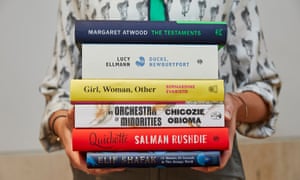
Presenting the competition … the six novels shortlisted for the Booker Prize 2019. Photograph: The Booker Prize/PA
The Booker prize shortlist resists easy reading
From the detonation of the domestic in Ducks, Newburyport to Don Quixote’s reincarnation in Quichotte, this year’s finalists revealed today challenge our assumptions Alex ClarkTuesday 3 September 2019
I
n an accelerated age, the best response is to take your time. There is no choice with Ducks, Newburyport, Lucy Ellmann’s 1,000-page plus novel, shortlisted on Tuesday for the 2019 Booker prize. A bewildering feat of simultaneous compression and expansion, it takes us into the mind of an Ohio housewife as her thoughts run wild – from the state of the nation to the minutiae of daily life. Its narrative occupies a mere eight sentences. Among many other things, it is a rebuke to the consistent downgrading of the “domestic” in literature, so frequently ascribed to female writers, because it insists that our consciousness does not exist in neat compartments marked personal, social, familial, political. Our heads, instead, are a riot.
What does the inclusion of Ducks, Newburyport tell us about the judges’ tastes, judgments and priorities in assembling this year’s shortlist? Perhaps foremost, that they are unafraid of issuing a challenge to readers not to make assumptions about novels based on thumbnail sketches like the one above (Ducks is a hoot, as it were, not a slog.) That they are concerned with writers concerned with foregrounding women’s voices: joining Ellmann on the list are Margaret Atwood’s The Testaments, her reprise of the world of The Handmaid’s Tale; Bernardine Evaristo’s Girl, Woman, Other, the story of 12 black British women, told in Evaristo’s trademark multi-vocal, poetic style; and Elif Shafak’s 10 Minutes 38 Seconds in This Strange World, whose title refers to the final moments of brain activity experienced by an Istanbul sex worker after a fatal assault.
Completing the half dozen are Chigozie Obioma, whose second novel, An Orchestra of Minorities, brings him his second Booker shortlisting; and Salman Rushdie’s Quichotte, which transplants the kernel of Cervantes’s Don Quixote into the world of a travelling salesman on a US road trip. In common with other novels on the shortlist (and indeed longlist: Lost Children Archive by Valeria Luiselli and John Lanchester’s The Wall spring to mind), Obioma and Rushdie’s books invoke older traditions and instances of storytelling and recast them in a contemporary world, bringing to the fore the experiences and pressures of movement and migration.
Which of these six will triumph on 14 October? (And will the ceremony have to compete with a general election?) Given the thematic unity of this year’s prize – from long- to shortlist, there has been an emphasis on experimentation and engagement with the present day – it’s not immediately obvious where divergence of opinions will begin; as ever, it’s a pin in a donkey’s tail. Perhaps out of sheer fun, my money’s on those Ducks.
Surrealist artists, dogged detectives, modern lovers and spies behaving badly ... leading authors pick their best books to enjoy these holidays
Saturday 7 July 2018
Taiye Selasi
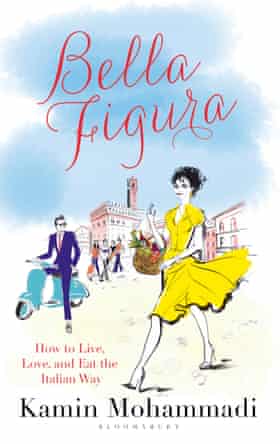
Uprooting her life, London-based Kamin Mohammadi relocated to bucolic Florence. Her glorious memoir Bella Figura is witty, intelligent and heartfelt in equal measure and will delight anyone dreaming of a summer holiday – or a brand new life – in Italy.
Recently optioned to become a film, Katja Meier’s timely memoir Across the Big Blue Sea: Good Intentions and Hard Lessons in an Italian Refugee Home avoids easy sentiment in favour of honesty and humour. The African women we meet at this Tuscan refugee home are fierce, scared, brave, vulnerable — triumphant yes, but human too. A beautifully complex account.
And finally, I cannot heap enough praise upon Freshwater, a daring, sexy debut. Raw and lyrical, Akwaeke Emezi’s semi-autobiographical narrative takes on sexuality, spirituality, family and more — all with a clarity that belies her 30 years.
Will Self
I basked in the interwar twilight of Cressida Connolly’s After the Party(Viking). The novel a beautifully written evocation of the era, and the woolly self-absorption of its party-going protagonist. However, it’s also a pitiless exercise in ideological revelation, as it becomes clear that the party in question doesn’t feature dancing until dawn and a sumptuous breakfast buffet, but men and women wearing black shirts, who greet each other with fascist salutes. In a year that’s seen bigotry of all kinds on the rise, and the storm clouds of nationalist intolerance gathering on the near horizons of Europe, Connolly’s novel achieves the rare feat of at once summoning that foreign country, the past, then returning us, uncomfortably, to a contemporary Britain with a burgeoning fatherland complex.
Elif Shafak Photograph: Adrian Sherratt
Elif Shafak
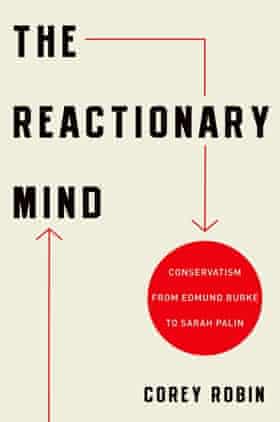
I have just finished reading The Reactionary Mind (Oxford) by Corey Robin. So many writers and thinkers today, East and West, are questioning the rise of conservatism, populism and tribalism. What makes Robin’s book extraordinary is the long-term pesrpective he introduces in this book. Robin shows that Trump is not a break from the conservative tradition, in fact, he is the fulfilment of a tradition that goes all the way back to Edmund Burke and his reaction to the French Revolution. It is a deeply thought-provoking book with utmost clarity and astonishing depth.
What struck me about Neel Mukherjee’s novel A State of Freedom(Vintage) was the mesmerising complexity and the sharpness mixed with compassion and empathy. All the stories are beautifully written, and while they remain semi-independent, they are also subtly interconnected. Long after I finished it I realized the characters were still with me, vivid, compelling, haunting.
Janesville: An American Story (Simon & Schuster) by Amy Goldstein is incredibly well-researched, empathetic and moving. Political experts and pundits talk about “the American working class” all the time, making massive generalisations without paying much attention to individual stories, but this book is extraordinary in the way it sheds light on an industrial town in America’s heartland by masterfully combining analysis and storytelling.
Kamila Shamsie
I’ve already read Tishani Doshi’s poetry collection Girls Are Coming Out of the Woods (Bloodaxe) but I know I’ll return to it many times. One of the poems talks about poets ‘holding the throat of life/ till all the sunsets and lies are choked out/ till only the bones of truth remain’ - that’s precisely what Doshi does in this intelligent, elegant, unflinching collection. It’s very much a collection for this moment in history, but one that will endure long past it.
The publishing house And Other Stories has committed to making 2018 a Year of Publishing Women – I’m planning to work my way through their entire list for the year over the summer. First up: Fleur Jaeggy’s Sweet Days of Discipline, translated by Tim Parks. It is set in a boarding school in postwar Switzerland, the opening pages are spare and beautiful, with an intriguing darkness.
Ali Smith
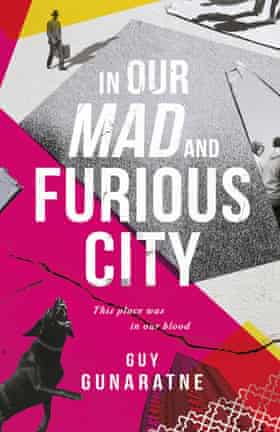
This summer the book I’m telling anyone who asks me about is Guy Gunaratne’s In Our Mad and Furious City(Tinder), a novel that’s a piece of communal vitality, choral in its urgency, one that squares up to the history of division, makes contemporary disjuncture come alive on the page, doesn’t flinch, and demands change right now. The book I’ll take with me on holiday is Michael Ondaatje’s Warlight. I love his writing, I wait for his books.
Colm Tóibín
Now that America has come to seem so unsettled and so strange, two books help us to become more alarmed. One is Michèle Mendelssohn’s Making Oscar Wilde(Oxford). It charts the early rise of Wilde, with special attention to how, during the 1880s, his lecture tours in America, a country beguiled by novelty and in need of excitement, made his name. As long as it was new, it seemed, America wanted it. Rachel Kushner’s The Mars Room is set in the American prison system, but manages to be a novel with its own worldview and its own textures, as much as a chronicle of a system that holds more prisoners per head of population than any other country in the world. On a more uplifting note, there is a wonderful doorstopper called Gillian Ayres (Art/Books), with a text by Martin Gayford and David Cleaton-Roberts and examples of Ayres’s work that will lift your heart.
Matthew Walker
Do you want to understand yourself? To understand why you say and do what you do? To know why you, and the rest of our human race, are capable of paradoxical extremes, from compassion to cruelty (even within minutes of each other)? With humour, sublime insight and supportive data, Robert Sapolsky serves up all the answers in Behave, his gem of an explanatory masterpiece.
Many of us feel that an occasional lie is fine, perhaps when trying to protect someone’s feelings, or when pressured to maintain political correctness. Lying by Sam Harris is a timely, well-reasoned treatise exposing how wrongheaded such beliefs are. It proves out the lack of utility in lying, in any scenario. Yet, that is not the reason I prescribe this book. Rather, it is the palpable sense of liberation and relief that you will feel when you practice what Harris preaches. Such is the truth about lying.
Sarah Waters
My most beguiling read lately has been Rupert Thomson’s Never Anyone But You (Corsair), a beautifully written fictionalised account of the decades-long lesbian love affair between surrealist artists and anti-Nazi activists Claude Cahun and Marcel Moore. I’m currently very much enjoying Diana Evans’s novel Ordinary People(Chatto), which takes a forensic look at the pleasures and perils of marriage and parenting and modern London living. And, as a Londoner myself, and one who likes to make as many journeys as possible by foot, the book I plan to turn to next is Lauren Elkin’s Flâneuse(Vintage), which promises to be an inspiring a piece of feminist psychogeography based on the experiences of several notable female city-strollers including Jean Rhys, Virginia Woolf and Martha Gellhorn.