|
| Matthew Weiner |
Matthew Weiner
The Art of Screenwriting No. 4
Interviewed by Semi Chellas
The Paris Review No. 208
Spring 2014
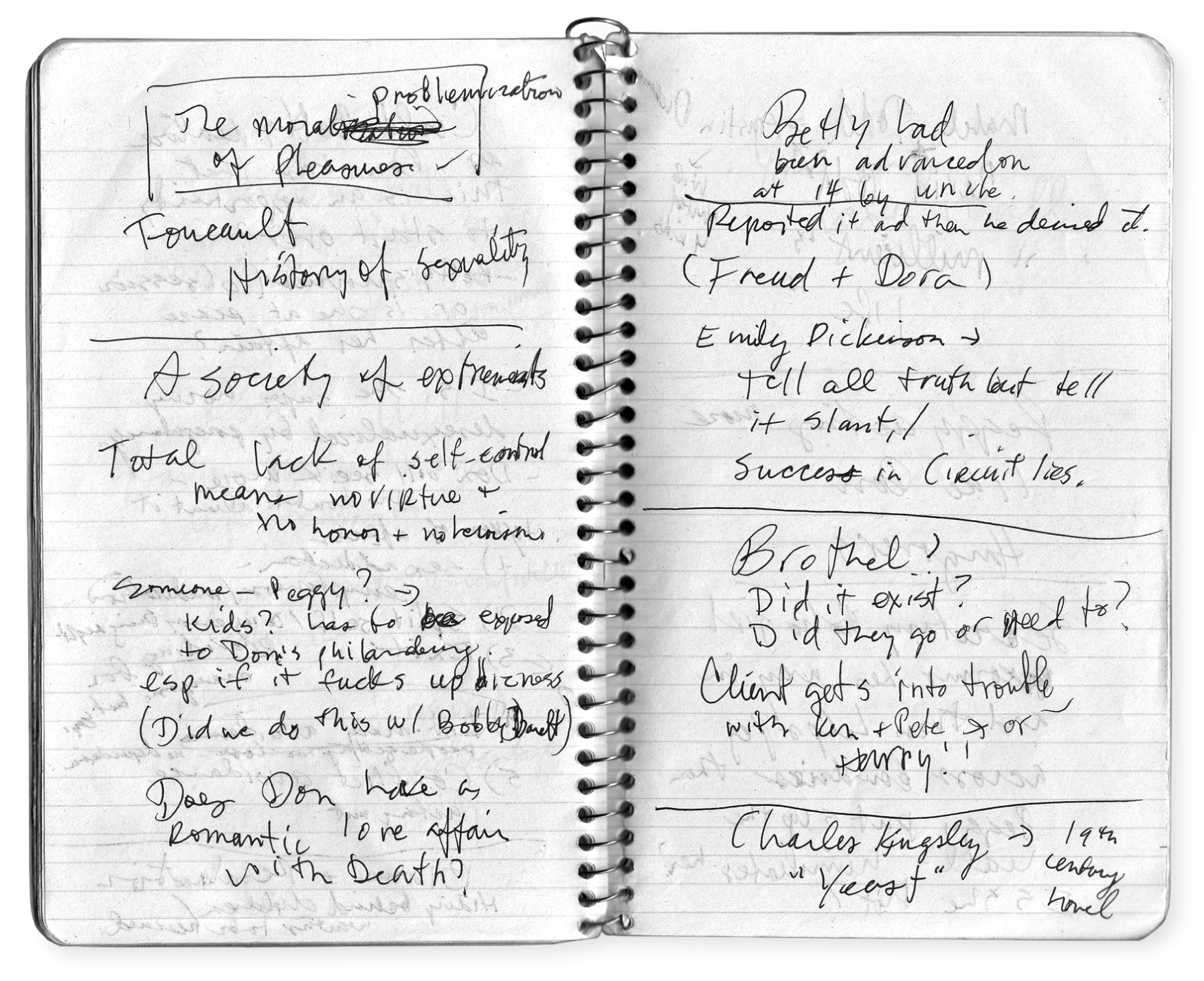 |
| Manuscript of Mathew Weiner |
Born in 1965, Matthew Weiner is barely old enough to remember the period with which his television series Mad Men has now become almost synonymous. His office is exactly what one might hope for the creator of Don Draper: a stylish mixture of midcentury modern furniture, with a cabinet full of top-shelf liquor. But it turns out that the furniture came with the building, which was designed in 1955, and the liquor, mostly gifts, is wasted on Weiner, who hardly drinks at all.
Weiner’s sensibility reveals itself on closer inspection. A framed still from the set is shot from behind the actors’ heads, showing the crew. There’s a black-and-white photograph of Groucho Marx, Alice Cooper, and Marvin Hamlisch in conversation. There’s a homemade Father’s Day card by one of Weiner’s four sons, reading “Dad Men” in red and black crayon. There’s a picture of Stedman (Oprah’s boyfriend), because when
Vanity Fair photographed Weiner’s desk soon after Oprah’s, he asked what she’d had on hers. His bookshelf overflows with fiction, essays, and poetry—from
Diaries of Old Manhattan to Billy Collins to
Moby-Dick.

A former
Jeopardy! champion who once, rather than give notes, jumped up and danced to “Zou Bisou Bisou” for Jessica PareÌ (Megan Draper on the show), Weiner seems never to sleep. Our interview took place in four sessions that spanned almost eighteen months—real months, that is. More time than that passed on the show during the same period, but to say exactly how much would be, in Weiner’s universe, a spoiler. We spoke late into the night after he had spent full days in preproduction meetings, in editing, in sound-mixing sessions, on set, and in the writers’ room—and we could only sit down to talk on the rare nights when he didn’t have to write. Even with this schedule, he comes in every morning inspired by a movie he’s seen, an article he’s read, or a poem he’s remembered. (I’m lucky to be a writer on the show.) Weiner begins every season by rereading John Cheever’s preface to his
Collected Stories: “A writer can be seen clumsily learning to walk, to tie his necktie, to make love, and to eat his peas off a fork. He appears much alone and determined to instruct himself.” The life of a showrunner leaves him almost no time to be alone, but Weiner seems always to be instructing himself.
Semi Chellas
WEINER
You know, I got a subscription to The Paris Review when I was fourteen or fifteen years old. I read those interviews all the time. They were really helpful.
INTERVIEWER
How did they help you?
WEINER
There were people talking about writing like it was a job, first of all. And then saying “I don’t know” a lot. It’s helpful, when you’re a kid, to hear someone saying “I don’t know.” Also, they were asking questions that I would’ve asked, only I’d have been embarrassed to ask them. Like, What time of day do you write?