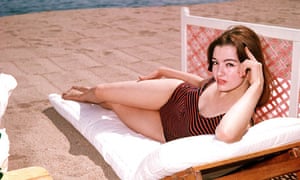
John Profumo, secretary of state for war, and his wife, the former actress Valerie Hobson, at Sandown Park, 22 March 1963. Photograph: Fox Photos/Getty Images
Mr Profumo clears the air - archive, 1963
23 March 1963: Rumours about friendship with Miss Christine Keeler refuted by John Profumo, secretary of state for war
Edward Greenfield
Friday 23 March 2018
In the face of what had been said in the House on Thursday, Mr John Profumo, the secretary of state for war, yesterday took the earliest opportunity of refuting rumours about his friendship with “the missing model,” Miss Christine Keeler.
Profumo affair model Christine Keeler: a life in pictures
Former model at centre of Profumo affair that shook politics in the 60s has died aged 75
TUE 5 DEC 2017
July 22, 1963 Christine Keeler, a principal witnesses in the vice charges case against osteopath Dr. Stephen Ward.
Photograph: stf/AP
The model, right, with Ward
Photograph: Express/Getty Images
Then a teenage model, she had affairs with the Tory cabinet minister John Profumo and a Russian diplomat at the height of the cold war
Photograph: Sharok Hatami/
The East End gangster Ronnie Kray sits on Keeler’s righthand side at a nightclub
Photograph: Express Newspapers
Keeler and Mandy Rice-Davies leave the Old Bailey after the first day of Stephen Ward’s trial in 1963. It was through Ward, an osteopath, that Keeler was introduced to Profumo
Photograph: Hulton-Deutsch
Keeler arrives at court in October 1963. A BBC series revisiting the scandal is due to start filming next year
Photograph: Evening Standard
Keeler leaves court with her solicitor. The Profumo scandal rocked the Harold Macmillan government
Photograph: John Twine/Daily Mail / Rex
Christine Keeler in 1964
Photograph: Sharokh Hatami
Keeler, left, with the photographer David Bailey, the model Penelope Tree and the singer Marianne Faithfull, right, in 1969
Photograph: Express Newspapers
21 Year Old Christine Keeler Pictured With Robin Drury On The Day Aloysius ‘lucky’ Gordon Was Sentenced To Three Years Imprisonment For Assaulting Her.
Photograph: ANL/REX/Shutterstock
Keeler suffered from the lung disease COPD and had been ill for several months before her death
Photograph: Popperfoto/Getty Images
Christine Keeler, key figure in the 1963 Profumo Scandal which rocked the government, wearing a swimsuit as she walks along a beach, 1963 (Photo by Popperfoto/Getty Images) Photograph: Popperfoto/Getty Images
'I am part of English history': Christine Keeler interview - archive, 1983
The Observer, 13 March 1983 Simon Hoggart talks to Christine Keeler about her second autobiography
Simon Hoggart
Wed 6 Dec 2017
C
hristine Keeler is now 41, and has just published her second autobiography. She and a girlfriend wrote the first in 1968 and, she says, it cheered her up enormously to have put down her own version of events. But it wasn’t truthful. “I thought it was quite right for me not to be honest. I said that I’d never been to bed with a man for money; it was a pack of lies, in other words. It was a whitewash on myself.”
She says that the new book, Nothing But... (New English Library, £1.50) is entirely truthful. She took an advance copy to her parents. “They’ve taken it all very well indeed, they’ve been marvellous. I told them I was going on TV a few weeks ago, and my mother said: ‘People should know that you weren’t a prostitute,’ and I said: ‘I wasn’t exactly innocent.’ I said to Dad: ‘You’re going to read a few things about me. I was a bit of a goer.’ Dad said: ‘We always suspected something.’”
She is still a remarkably good-looking woman, better than her photographs suggest. Twenty years ago she was sensational. A lot of men thought she was the most beautiful woman they had ever seen. “I’m certainly not a beauty now. I might be all right for 41, but I don’t think heads turn when I walk down the street, and that did happen.”
These days she is recognised only rarely. She lives in a council flat in World’s End, Chelsea, and seldom leaves the area. People there know who she is and, she says, accept her. She still has her astonishing hourglass figure.
She is also charming, well-spoken and fairly collected, though she smokes a lot, nervously. She says that she has been happy for the past ten years, ever since she left her second husband, Anthony Platt. They had a son called Seymour, who is now 11 and lives with his mother. Her older son, Jimmy, who is 16, lives with her parents.
Christine Keeler, (right), and Mandy Rice-Davies leaving the Old Bailey after the first day of the trial of Dr Stephen Ward. 22 July 1963. “I’ve never been in love, ever. I had a tremendous ego, so my affairs were just ego and lust, rather than love, which is a matter of give and take. Even my husbands were ego trips. I married my first husband just to prove to myself that I was a normal person. I did live with a man from 1974 to 1977, which is the longest I’ve ever lived with a chap. I don’t think men are attracted by the fact that I’m famous. I think it puts them off. I also couldn’t get any lower than I am now, living on social security in a council flat.”She firmly believes that she brought about the downfall of the Conservative Government in 1964, though I doubt if this is actually true; only a year after all the scandals, the Tories almost won the election. From talking to her and reading the book, I suspect it is quite important for her to believe that she did destroy the Macmillan administration. “I thought it was my duty to say the whole truth, every line. After all, I am English and I am part of English history. I think it should be told.
My first book was published all over the world, including places like Japan. They think that English people go around whipping each other all the time, but there was only ever one MP. That was Ernie Marples. I know there was only one because Stephen was so thrilled. He couldn’t stop talking about it.”
Stephen Ward is one of the two men who dominate the book. The other, oddly enough, is not John Profumo but Lucky Gordon, the violent West Indian who fell dementedly in love with her and then terrorised her. Her fear of Gordon and her desire to escape from him were far stronger than any particular feeling about Profumo, who only ever had a walk-on part in her life, and for whom she now just feels a mild resentment.
In the book (ghosted by Sandy Fawkes) she says of Profumo that he “should have known better.” She has not met him since the scandal, in 1963. What would she say if he walked in and said hello? “I’d say hello hack. I expect he’d make a joke about it, he was a very humorous man. But I wouldn’t say hello to him first.”
I asked about her regrets and she had to think for a while. “I don’t think it’s any good sitting around regretting things. I suppose that I do regret the time when I first went to Notting Hill Gate with Stephen and met Lucky Gordon. I had him on my back for so long. I was really paranoid all that time. I don’t know what Lucky Gordon is doing now. Recently I spoke to someone who knows him. They said: ‘He’s thriving.’ I said ‘Oh dear.’ He was a terrible man, he really was a terrible man. I had made up my mind to kill him, you know. I thought they would only give me three years. It would have been better to go to prison than have him grab me and take me away some-where.”
She is now fairly cheerful, and hopes that the book will lead to a film or at least a drama-documentary on television. I suspect that she is quite proud of being Christine Keeler. “Funnily enough, I was in the Ladies just now and a woman said, ‘you know, you remind me of someone. I know: Christine Keeler.’ Yes, I told her, I was.” I asked if she thought that the ghost-written book accurately reflected what she thought and how she felt. “It’s got me right, it has got me emotionally right. There’s one word I don’t like: ‘Ruining my life may not seem very important to some, considering what I was, just a pretty scrubber...’ I wanted them to change it to ‘tart.’ ‘Scrubber’ implies someone who can’t talk properly and wears horrible clothes, but I always spoke well and had good clothes. I’ve always had a bit of class to me. I’m sure Jack Profumo wouldn’t have gone out with a scrubber. Perhaps they should have written ‘just a pretty nobody.’”
Notes on a scandal … Lewis Morley's 1963 photograph of Christine Keeler. Photograph: Lewis Morley/National Portrait Gallery
Christine Keeler's nude photograph: still sexy and subversive, 50 years on
The notorious post-Profumo shot, now on show at the National Portrait Gallery, has long inspired artists to take a pop at sexism
JONATHAN JONES
Wed 1 May 2012
An iconic nude has just gone on view at the National Portrait Gallery. Lewis Morley's photograph of Christine Keeler is included in a display to mark the 50th anniversary of the Profumo affair, the Tory sex scandal that rocked – or perhaps it is fairer to say delighted – 1963 Britain.
The display reveals that Morley photographed Keeler as publicity and screen-testing for a film about the events that led to the resignation of John Profumo, secretary of state for war in Harold Macmillan's government. She was obliged to be photographed naked by her contract with the film company, so Morley devised the famous shot in which she straddles a modernist chair and gazes smokily at the onlooker. It is a brilliant tease and still very sexy.
Pauline Boty with her missing painting, Scandal '63. Photograph: Michael Ward
Joe Orton struck the pose for his own portrait, at once mocking its seduction and using it to allude to his own rebellious identity as a gay writer. A less famous quotation is in a lost painting by Pauline Boty, which is revisited at the NPG through photographs of Boty with her work. Boty, the most celebrated woman in the pop art movement of early 60s Britain, created several paintings about the Profumo affair, including one in which she copies the classic photograph of Keeler. It is now mysteriously missing.
Looking at pictures of Boty, who died from cancer in 1966, alongside the incandescent image of Keeler raises questions about women, art, beauty and the 1960s. Boty was herself regarded as a beauty, and it is no coincidence that visual documentation of her art often seems to portray her with it. Meanwhile, Keeler was in a tradition of unrespectable women in the public eye that goes back to Restoration royal mistresses such as Nell Gwyn. Compare her with Charles II's lover for yourself at the National Portrait Gallery.
So then: was the art of the pop era good or bad for women? Becoming an icon gave Keeler a career that still continues. Meanwhile, Boty was treated in the media of the time as a swinging London star who just happened to paint. She herself portrayed Keeler, so she must have found her notorious image subversive and fascinating. All this added to the heady mix of liberation and oppression that by 1970 would lead to the publication of The Female Eunuch– and the rise of a new feminist movement.
A fully-clad Christine Keeler in 1990, back in the chair made famous in 1963. Photograph: Terry O'Neill/
Christine Keeler, former model at heart of Profumo affair, dies at 75
Showgirl’s affairs with Russian diplomat and British MP John Profumo caused one of UK’s biggest scandals of 20th century Caroline Davies Tue 5 Dec 2017
Christine Keeler, the former model at the centre of the Profumo affair that shook British politics in the 1960s, has died aged 75, her family and a close friend have said.
Keeler, then a teenage model and showgirl, became famous for her role in the 1963 scandal that rocked the establishment when she had an affair with the Tory cabinet minister John Profumo and a Russian diplomat at the same time at the height of the cold war. Profumo was eventually forced to resign after lying to parliament about the affair.
Keeler’s son, Seymour Platt, 46, told the Guardian she died on Monday at the Princess Royal university hospital in Farnborough: “My mother passed away last night at about 11.30pm,” he said on Tuesday.
Christine Keeler, a key figure in the 1963 Profumo Scandal which rocked the government, was the subject of intimate sketches by the sculptor Alberto Giacometti. Photograph: Popperfoto/Popperfoto/Getty Images
How Christine Keeler provided inspiration for Giacometti
As the Profumo scandal raged, the artist Alberto Giacometti was fascinated by a French news report and dashed off some previously unknown sketches
Dalya Alberge
Sunday 14 November 2010
Dozens of previously unknown sketches by the artist and sculptor Alberto Giacometti have come to light, including impromptu drawings of Christine Keeler, the showgirl whose 1960s affair with Conservative minister John Profumo shook the British establishment.
Nine months ago, one of Giacometti's sculptures sold for £65m. Now the Swiss artist's family has allowed his biographer, the distinguished art historian Michael Peppiatt, access to the collection for a major new book and a loan exhibition. The unseen images reveal Giacometti at his most intimate and unselfconscious.
Giacometti seems to have taken his inspiration for the Keeler sketch from a 1963 French newspaper report. A series of nude female figures sketched across a page from France-Soir is thought to represent her. The collection also contains sculptures, paintings and drawings not seen since they left his dilapidated studio in Paris. Another find is an art book owned by Giacometti which he used to produce a striking drawing of Van Gogh's self-portrait.
CHRISTINE KEELER
Another previously unknown sketch appears across a torn-out page of L'Express, a 1964 edition with a report on Lee Harvey Oswald, President John Kennedy's assassin. Giacometti scribbled over Oswald's photograph, giving him a beard and scrawling across the page the repeated word continuare ("to go on") and the phrase "the busts were made quickly, and a painting this evening, the drawings soon". The words seem to convey Giacometti's constant urge to push himself into yet more work. The artist, who died in 1966, obsessively scrutinised his work for hints of failure, always destroying works that did not match his vision. Peppiatt said that the newspaper sketches showed that drawing was fundamental for Giacometti. "Drawing was a form of instinctive thinking for him. He was never without a pencil in his hand or a fag in his mouth," he explained.
Peppiatt, an art critic for the Observer during the 1960s, recalled his excitement at being given access to the images, taken from a collection owned by the widow of Giacometti's nephew, Silvio Berthoud: "There is something very intimate about these works. I was allowed to choose from 300 drawings. I was deeply moved. I felt that Giacometti was almost there with me … as if his drawings were dropping from his hands. He had scribbled over the inside covers of books, doodled on bits of paper in cafes." Some of the unknown images are in Peppiatt's forthcoming book, In Giacometti's Studio, and a loan exhibition he has curated at the Eykyn Maclean gallery in New York.
Through newly published letters, Peppiatt offers new insight into Giacometti, the man and his art. He has delved into the artist's relationships, notably his doomed affair with Isabel Rawsthorne, a raucous, bohemian painter and model.
Peppiatt said: "Isabel was a terrifying animal, a man-eater. She was having affairs with both sexes and drinking everybody under the table. He was ambivalent towards women. What he liked were prostitutes. Giacometti was both attracted and repelled by Isabel." Feelings of despair emerge from their letters, Peppiatt said. In one, Giacometti wrote: "I didn't think your stay was a washout, Isabel, otherwise I wouldn't have felt so upset when you left. My throat was tight. I was sobbing inside."
Peppiatt also casts light on the artist's friendship with Samuel Beckett. Describing Giacometti's skeletal figures as a visual embodiment of the Irish writer's pared down prose, he said: "They had the same nocturnal habits. They'd bump into one another in Montparnasse around midnight, go to the same brothels together and walk home together." He tried to imagine their conversations as they strolled the deserted streets. "I researched and researched, following every line of inquiry, until I came to the truth," he recalled. These 20th-century geniuses would walk in "deep, utter, total silence", he said.

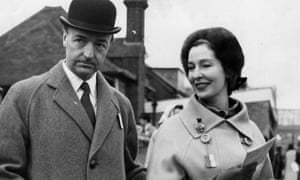





 Notes on a scandal … Lewis Morley's 1963 photograph of Christine Keeler. Photograph: Lewis Morley/National Portrait Gallery