Showing posts with label Adaptation of the week. Show all posts

Saturday, July 16, 2005

Manuel Puig / Kiss of the Spider Woman


Jailbirds

Kiss of the Spider Woman (1985)


Andrew Pulver
Saturday 16 July 2005

Author: Manuel Puig (1932-1990) grew up in a small town in the remote Argentinian pampas, obsessed with films and dabbling in transvestitism. At 23, he won a scholaship to study film-making in Rome, but soon dropped out. After a decade of writing film scripts, Puig returned to Buenos Aires in 1967 and turned a script into his first novel, a semi-autobiographical fable about a movie-world fantasist, Betrayed by Rita Hayworth (1968). However, the flamboyant Puig found it difficult to live in Peronist Argentina, and moved to Brazil in 1973 and New York three years later. Kiss of the Spider Woman was published in 1976. Puig remained in New York - as a high-profile gay writer he was regularly attacked in the Argentinian media - and lectured on creative writing at Columbia university. He finally settled in 1989 in Cuernavaca, Mexico, and died a year later from complications after a gall-bladder operation.
Story: Echoing his film script work, Kiss of the Spider Woman is written almost entirely as dialogue. Two men - a political radical, Arregui, and a gay paedophile, Molina, are imprisoned in the same cell in a Buenos Aires penitentiary. To pass the time, Molina recites the plots of his favourite films, beginning with Jacques Tourneur's 1942 horror movieCat People. Molina's camp fetishism initially irritates Arregui - especially when he realises another of Molina's favourites is a Nazi propaganda piece. Puig inserts a "transcript" of a meeting between Molina and the prison warden, revealing that the authorities have demanded Molina inform on Arregui. But as their relationship deepens (culminating in a sexual episode), Molina agrees to deliver a message for Arregui after he is released. A final "report" reveals that Molina is shot dead in the street as he tries to carry out his mission.


The film-maker: Hector Babenco (b1946) grew up in Argentina but settled in Brazil in 1969. He began directing features in 1975, but made a major international impact with Pixote (1981), an account of the appalling life of São Paulo street children. Babenco spent four years bringing Kiss of the Spider Woman to the screen, casting William Hurt in the pivotal role. (Puig hated Hurt's performance, despite his winning an Oscar.) Shortly after completing the film, Babenco was diagnosed with lymphatic cancer; his doctor, Dráuzio Varella, went on to write the prison stories that would become Babenco's most successful film, Carandiru (2003).
How book and film compare: Though the film's narrative generally sticks close to the novel it excises Puig's lengthy footnotes about clinical assessments of homosexuality, and replaces Molina's fetishisation of real movies with a single, fictitious Nazi-style piece, which is recreated at intervals throughout the story. Much of the detail of Molina's lifestyle is lost in the adaptation, and the "spider woman" is presented as another of Molina's films - whereas she appears in Puig's original as the final image of Arregui's own fantasy as he is tortured.
Inspirations and influences: As an evocation of high camp, Kiss of the Spider Woman brought gay cabaret style into mainstream movies, paving the way for American treatments of similar themes, such as Torch Song Trilogy (1988). It also marked a turning point for Latin American cinema, in the doldrums after the politically inspired cinema novo of the 1960s and 1970s.


Saturday, November 13, 2004

Jerzy Kosinski / Being There


ADAPTATION OF THE WEEK

Inspired by Chance

Jerzy Kosinski's Being There (1979)


Andrew Pulver
Saturday 13 November 2004
Author: Jerzy Kosinski (1933-91) survived the Nazi invasion of Poland (during which he apparently lost the power of speech) and became an academic in the communist regime. He emigrated to the US in 1957 and his first novel, The Painted Bird (1965), became a key addition to "Holocaust literature".

Having fortuitously avoided the Manson murders in 1969 - he was due to be Sharon Tate's dinner guest, but missing luggage meant he cancelled his visit - Kosinski completed Being There in 1970. His literary celebrity was assured - he even took a sizeable role in Reds (1981), playing a Bolshevik. However, in 1982, an article in the Village Voice accused him of plagiarism, as Being There was apparently taken from a Polish bestseller, The Career of Nikodem Dyzmy by Tadeusz Dolega-Mostowicz. Depressed by the reception of his subsequent work as he tried to prove his credentials, Kosinski committed suicide in 1991 after taking an overdose and taping a plastic bag over his head.


Story: A modern equivalent of the "feral child" tales popular in central Europe in the 18th and 19th centuries, Being There focuses on the figure of Chance the gardener, raised in complete isolation, except for TV.
Forced to leave the house where he lives and works by the death of his employer, Chance is taken in by an influential financier, Benjamin Rand, and his young wife, Eve, after a car accident. Known as Chauncey Gardiner after his name is misheard, Chance becomes a celebrity after his simple pronouncements about gardening are taken as meaningful political metaphors.
Eve falls in love with him, and plans to marry a bewildered Chance after Rand's death.
Film-makers: Hal Ashby (1929-88) was Norman Jewison's editor in the 1960s, working on The Cincinatti Kid (1965) and The Thomas Crown Affair (1968).
As a director, he became a key figure in the Hollywood new wave of the 1970s with Harold and Maude and The Last Detail, before finding popular success with Shampoo and one of the first post-Vietnam films, Coming Home. Playing Chance had been a long-term ambition for Peter Sellers. He sent Kosinski a telegram soon after the book's publication. But it was only towards the end of his life, when he was already ill with heart trouble, that he could get the project off the ground.
How book and film compare: Kosinski worked on the screenplay, and the film follows the path of the novel scrupulously. Kosinski inserts considerable embroidery and adds extra scenes, such as Chance's confrontation with the teen gang on his first day in the street.
The film's iconic sequence of Chance walking across the surface of a cemetery lake, however, was a last-minute inspiration of Ashby's. Ashby also personally edited in his preferred end-sequence - of Sellers repeatedly messing up a line - in all the cinemas showing the film on its first release after the producers refused it.
Inspirations and influences: The kind of symbiotic relationship with TV that Chance enjoyed became a popular theme in ensuing decades, from Martin Scorsese's The King of Comedy (1983), which elaborated on the idea of a viewer confusing TV and reality, to Ben Stiller's The Cable Guy (1996), in which a TV obsessive has no identity other than the one that he culls from the airwaves.


Saturday, September 11, 2004

Sweet like chocolate / Willy Wonka and the Chocolate Factory


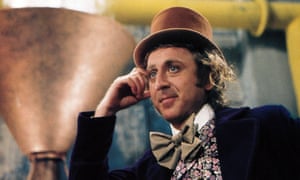
Gene Wilder as Willy Wonka in the 1971 film.
 Gene Wilder as Willy Wonka in the 1971 film. Photograph: Allstar/Warner Bros.


Adaptation of the week

Sweet like chocolate: Willy Wonka and the Chocolate Factory

Andrew Pulver
Saturday 11 September 2004
Author: Roald Dahl (1916-1990) began his prolific writing career after being invalided out of the RAF during the second world war, and being posted to the US. His first book, The Gremlins (1943), became a Disney film. In 1960 he moved back to England, and started writing in earnest, with James and the Giant Peach (1961) becoming his first significant success. Charlie and the Chocolate Factory - inspired, so he said, by being used as a test consumer by the nearby Cadbury’s factory while at school in Repton – was published first in the US in 1964. A string of successful children’s books followed, including Fantastic Mr Fox (1970), Danny: The Champion of the World (1975), The BFG (1982), The Witches (1983) and Matilda (1988). He died of leukemia in 1990.
Story: Dahl’s children’s fantasy tale is set in an un-named town that’s recognisably English (and still suffering the after-effects of war and rationing). Poverty-stricken child Charlie Bucket is one of five winners of a competition to visit the chocolate factory run by the mysterious Wonka. The factory tour introduces them to a string of bizarre confectioneries (Everlasting Gobstoppers etc) as well as the Oompa-Loompas – the pygmy-sized workforce. But the fairy tale becomes a cautionary one as Charlie’s fellow competition winners are consigned to humiliation for indulging in Dahl’s pet hates - eating too much, chewing gum, being grasping, and watching TV. Charlie is then handed ownership of the factory by Wonka as the “winner”.
The film-makers: Mel Stuart (b 1928) was originally a TV documentarist, and was told about the book by his 11-year-old daughter. The $1.8m budget was raised from Quaker Oats, who were planning to market a chocolate bar around its release. Dahl wanted Spike Milligan to play Wonka, but he was considered too much of a risk for the US market. Gene Wilder, hitherto best known for his role in Mel Brooks’s The Producers (1968), was cast instead, opposite a group of unknown child actors. Anthony Newley and Leslie Bricusse wrote the songs.


How book and film compare: The film is first and foremost a children’s musical, with catchy tunes such as The Candy Man Can and Oompa Loompa. Though the setting remains physically similar, the film is considerably more transatlantic than the book, with most of the principal cast being American. (Augustus Gloop, the glutton, is German; Veruca Salt, the spoilt kid, is English.) The film added two significant plot elements: the sinister figure of Slugworth, who tries to persuade each child to tell him the secret of Everlasting Gobstoppers; and Wonka’s threat to expel Charlie along with the other children after he samples the Fizzy Lifting Drinks. The film transforms Dahl’s story into a classic of pop-art kitsch, with costumes, design and lettering all contributing to an extravagantly imagined work. But the author was vocal about his unhappiness with Stuart’s changes.
Inspirations and influences: The success of previous children’s musicals like Oliver! (1968) and Chitty Chitty Bang Bang (1968) - on which Dahl had worked - meant that a market for this movie appeared assured. But it failed at the box office, and it wasn’t until the advent of video in the early 1980s that its bizarre stylings were rediscovered. Director Tim Burton was particularly affected: he is currently directing a remake of this film, having produced an animated adaptation of another Dahl book, James and the Giant Peach, in 1996.