
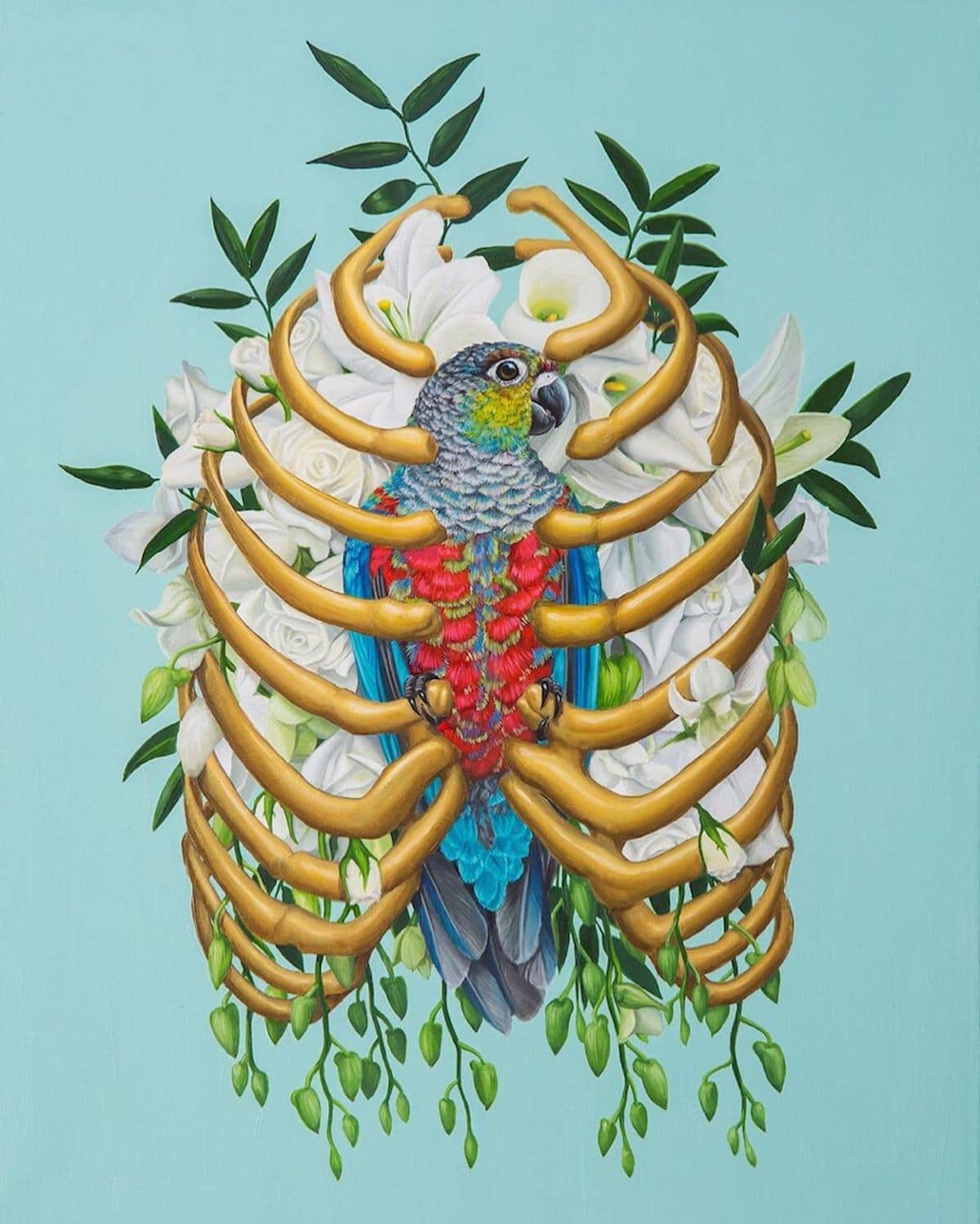
A Strange Bird’s Cry
by Karl Ove Knausgård
The Norwegian author Tarjei Vesaas was born in 1897, the same year as William Faulkner, and two years before Jorge Luis Borges, Vladimir Nabokov and Ernest Hemingway. Vesaas is not usually mentioned in the same breath as the others in this generation, obviously because his books are hardly read outside Scandinavia and, I suppose, because it is easy to think that his books are hardly read outside Scandinavia for a reason, and that reason can only be that they are not as good. But they are.
Fuglane (The Birds), Vesaas’s masterpiece from 1957, is in my opinion one of the best novels ever written in Norwegian, if not the best. Vesaas himself was a taciturn and modest man who probably would not have minded that his books remained largely a Norwegian secret, indeed, he would probably have been more than satisfied, and perhaps even surprised, that his books were still being read here, more than fifty years after his death. Most books remain in the world in which they were written, representing that world and not much else, and they are left behind when that world changes. Not so with The Birds. I read it for the first time as a teenager and have read it three times since. Seventy years after Vesaas sat down and wrote it, it still feels important. The same applies to his other late masterpiece, Is-slottet (The Ice Palace). Both of these novels have protagonists who are completely outside the mainstream and utterly powerless: the protagonist in The Birds is called Mattis, a dysfunctional man in his late thirties, a child at heart, helpless in the world, cared for by his sister, with whom he lives. The main character in The Ice Palace is called Siss, an eleven-year-old girl who, as she is discovering her own burgeoning sexuality, is confronted with death. The lust for life and the paralysis of it in an icy, snow-filled landscape – that is The Ice Palace.
For a long time these were the only two books by Vesaas that I had read. And that is a bit weird, because he was a fiercely productive writer, his oeuvre spanning some fifty years. He made his debut in 1923 with the novel Menneskebonn (Children of Man), and published forty books in all, ending with the posthumous collection of poems Liv ved straumen (Life by the Stream), which came out in 1970. I never picked up any of them. The reason being I had the notion that Vesaas wrote two definitive masterpieces, and that the rest of his work was competent but uneven and not very exciting – that all his other books in some way led to those two.
Why did I think that?
A prejudice is an assumption borrowed from others, an opinion that lacks grounding in experience. I must have come across this judgement of Vesaas’s work in more places than one, not necessarily in so many words, but perhaps casually intimated, a disparaging sentence here, a perfunctory remark there, which, without my consciously assessing them, nonetheless slipped into my mind to clandestinely build a case there against Vesaas’s early work – for in the mind a prejudice is never a prejudice but a truth.
At any rate, I just couldn’t get interested in any of his other work.
Even when I was asked last year to give the annual Vesaas lecture in his home town, Vinje, it didn’t occur to me that I could delve deeper into his writing – I thought I would talk about The Birds and The Ice Palace; the other thirty-eight books I kind of ‘knew’ anyway.
But then, a couple of months before the lecture was to be held, I happened to be in the book town of Fjærland, browsing the shelf-metres of titles old and new, Norwegian and foreign, which included a good selection of Vesaas’s books, when it struck me that I could perhaps buy some of his older novels and at least have a look at them, if only for appearances’ sake, yes, out of courtesy almost. After all, I was going to give a lecture on his writing in his home town.
So a big stack of these novels ended up in my study, a stack I had to go past every day to get to my desk, but which I then forgot about as soon as I switched on the computer. Until one evening in early autumn. I needed something to read and was standing in the doorway looking in at the man-high towers of books on the floor. My eyes fell upon Vesaas. Maybe. Yes, why not? A quick skim wouldn’t hurt, surely?
The first book on the pile was the novel Bleikeplassen(The Bleaching Yard), and I picked it up and took it with me over to the bed where I stretched out to read.
I was devastated. How could such a stunningly good novel, such a consummate, vital, absorbing work have so completely passed me by?
My senses sharpened as I read, the book seized my full attention, and all the time I kept thinking: this is important, this is important, I must remember this.
In the haze of my prejudicial notions about Vesaas, The Bleaching Yard was about someone who dried sheets for people on a 1920s farm, and wasn’t there a sullen youngster too who didn’t want to take the place on after his father? Don’t ask me where I got this from. Because now I’m going to write something about what to my mind makes The Bleaching Yard such a brilliant novel.
The story takes place over a single day and night, and in a single place. This narrow frame creates the sense of being in a kind of room from which nothing can escape. The narrative is present tense, what goes on is in the here and now, in front of our eyes. These elements, the novel’s form, impart almost single-handedly an urgent, intense feel to the events. And this is crucial, since what the novel tries to encircle, as I see it, is the relationship between emotions and actions, between inner life and outer world, though not seen in isolation, not in the way they play out in the individual; on the contrary, the novel’s concern is the collective, the interplay between people, which is to say human relations. The way something inside a person can manifest outwardly and how its ripples spread and affect everyone. Vesaas wrote The Bleaching Yard during the Nazi occupation and buried his manuscript in the forest, where it remained until the war was over and the book could be published in 1946. It would not seem unreasonable, therefore, to think that in this novel Vesaas was seeking to explore the relationship between emotion and action, between hatred and violence, not on the grand scale, but in terms of its minutest components, its germ, such as we all recognise those things in ourselves. How do emotions arise, and what forces lie within them? The novel makes no mention of the war, nor is it in any way necessary to one’s reading of it: The Bleaching Yardconstitutes its own reality, complete in itself, like any other significant novel.
The events are set in a laundry in a small town. The laundry is run by Johan Tander and his wife Elise. They have three people working for them: an older woman by the name of Marte, and two young women, Vera and Anna. The laundry is in the basement of a large house owned by an old man, Olsen, who also owns large areas of forest land. Besides the Tander couple, three young men, forest workers, live in the house too: Jan Vang, Amund and Stein.
The lives of these various people are intertwined. But much of the tissue that connects them is hidden, existing only within the individuals themselves, without any external form. Johan Tander, for instance, while married to Elise, has a soft spot for Vera. It’s no more than that. He perks up when he sees her, he enjoys talking to her. Nothing happens, he doesn’t do anything, he simply feels good whenever she’s around. When the novel begins, Jan Vang, one of the men who works in the forest, is in a relationship with Vera. Anna had a relationship with him earlier, and she’s jealous. Johan Tander is jealous too. Not that he thinks he has a chance with her, something in him just wants her to stay pure. Elise, his wife, sees this. She realises the kind of feelings Johan has for Vera, and how it makes him feel towards Jan Vang. This is the situation as the novel opens. Nothing bad has happened, nothing bad has been done. Elise sees how tortured her husband is, it fills her with despair and she decides to do something to make him snap out of it, something radical that will make him realise how good he has it. She goes over the street and with big letters on the front of the house opposite writes: no one has ever cared for johan tander. This utterance becomes the catalyst for everything that happens next. Again, it’s only a small thing, a few words scrawled on a wall with chalk – is that anything to get worked up about? But for Johan Tander the words are humiliating and demeaning, and if you take that sentence in it’s hardly surprising. Because what it says is that Johan Tander is no use to anyone. And if you’re no use to anyone, what are you then but no one?
The novel itself contains no such overarching thoughts or drawn-out lines of reasoning. It’s completely down to earth, follows its characters closely, and they sense only their own thoughts and feelings, not those of the others, and for that reason none of them has any kind of overview of what is happening or why. The dialogue is everyday, though laden with meaning, and Vesaas seems to follow the exchanges as they are absorbed, describing their effects on the characters’ inner lives. This was perhaps his greatest gift as a writer, to articulate what is wordless between people as it is shaped inside people. The picture that emerges is that dependence on others is total, but also hidden and therefore often unrecognised. Johan Tander too is dependent on others, and when conversely it is made plain to him that no one is dependent on him, and that accordingly he is no one, he turns his feelings outwards in the form of hatred, for hatred leaves its mark, it is he who has made it, and in that, he becomes someone to the others.
Alongside this story, in which hatred spirals and ends in death, albeit unintentionally, runs another story, that of Krister, an old man who shuffles about in the area and who on this particular day wakes up with ‘rubble’ in his heart. He knows he’s going to die and gets it into his head that he must have a clean shirt on when it happens. He thinks: ‘I need to see a sign that I’ve been among people, that I haven’t lived for nothing. And that is the sign: I must have that shirt right away.’
Novels that employ a heavy symbol are often problematic in that they can easily steer our understanding with too firm a hand, it being crucial to a novel’s quality that the reader remain free, but when it’s done well, the gains can be enormous. Think of the white whale in Melville’s Moby-Dick or the castle in Kafka’s The Castle. The Bleaching Yard is not at that level – only a handful of novels in the history of literature are – but there’s something deeply satisfying about the symbol in this novel, since it’s so fully integrated into the realistic flow of events: the action surrounds a laundry, where people bring their dirty clothes, they’re washed and then hung to dry, spotless and white – and at the same time it functions as a distilled image of what takes place in the story.
The Bleaching Yard is a novel about people and the relationships between them, nature has no part in what is told, with the exception of a short passage in which the narrative follows the three young men out into the forest. And there this sentence stands shining, all on its own:
‘The tree is a thousand things that go unreckoned, denied a voice.’
That sentence could be a motto for Tarjei Vesaas’s collected works – and it points forwards to The Birds. But we are not quite there yet, because after I’d put The Bleaching Yard down I took the next book from the top of my Vesaas stack. It was Tårnet (The Tower). And The Tower too was written during the occupation, and its manuscript buried in the ground together with that of The Bleaching Yard.
I was expecting a Kafka-like novel dense with symbolism, and was pretty certain it couldn’t possibly match the same high level as The Bleaching Yard. My prejudice about Vesaas’s early novels had turned out to be wrong, granted, but it still had to have come from somewhere, been prompted by someone’s reasoning, it couldn’t have just arisen out of thin air.
Again I was wrong. Shamefully wrong, in fact.
In spite of all its qualities, The Bleaching Yard didn’t quite clutch at my heart. The Tower did. It reduced me to tears at one point, and my emotions rose and fell throughout, and when suddenly a deep sigh escaped me, my wife asked me what the matter was. I suppose she thought something had happened in real life, so I told her about what happened in Vesaas’s The Tower. She wanted to read it herself, but she’s English and the book has never been published in English. (One major upside to being Norwegian is that we can read Vesaas in his own language . . .)
But yes, Tårnet.
It takes place on a farm called Sund where two families live. One house is occupied by the Sund family themselves, who run the farm – Olav and Sigrid and their three adolescent children – in the other live Randolv and Jorunn and their two children; the main character Nils, who is fifteen, and Vesla, who is twelve. Randolv runs a garage. All around are rolling fields and forest, there is a strait with a bridge crossing over it, and there is a road that passes by with a lot of traffic. We’re talking everyday Norwegian life in the 1930s.
At the beginning of the novel Jorunn is expecting a child. This has driven a wedge between Nils and Vesla and their parents. The child is born, and Vesaas, who never recoiled from depicting even the most unfamiliar lives from within, describes the infant’s world:
The newborn is now, and only now! He is not something that was.
He lies up on the veranda that Randolv’s father built in order to see the strait. And the last-born lies there and sees the strait and clouds all day.
The bassinet has been put down there and all he has to do is see.
He faces out, and his hazy eyes strain into the vastness that has become his, but they make no headway. The glitter from the strait comes to him as something unfamiliar which he reaches out to grasp. It is all he knows of gleaming straits and such.
Land, land! He has been put down here so as to take it in and be filled by it – and his hazy eyes strain and seek to comprehend. In vain. But nonetheless it shall lie spread out in front of him in its lush abundance. It will enter him long before he knows it.
Free, wide straits will engender something in him. Clouds, sun and straits – and kind, rounded faces. Together and in turn.
It is for him. He has arrived.
He is lifted up, and the one who lifts him is good, and turned towards him. She faces him towards the water and the fields and the bridge, and the dark hills beyond. He will become attached to this place such that the place will be his, regardless of where he later may roam. For here I have carried and given birth to you.
High up on the veranda. The strait glitters.
Words are said to him. Sounds he thinks are a thing that may be grasped by a hand when they bubble in his ears. He reaches out for it. All he has learned is that everything is his.
Pure serenity. The two other children are won over, Randolv even takes several weeks off work to spend time with the little one. And then events take an abrupt turn, a tragedy occurs, and the rest of the novel is about a family coming undone. The mother withdraws completely into herself, shuts herself off from everyone, while the father becomes obsessed with his work, and this unhealthy state of affairs, which gathers in strength on both sides, also consumes the two children, who are loyal and try to cope as best they can, yet are likewise dragged down into the same cruel, cold and bewildering place. All the while hoping it will change for the better. As is his habit, Vesaas describes his characters from within, and his portrayal of the mother, for instance as she wanders restlessly about the fields having lost her grip on what is real and what is not, is not only shockingly well turned, but yields the paradox of the novel’s perspective becoming more elevated the deeper it reaches within. She has let go, and we understand why, for she is destroyed by grief. The novel tells us: this can happen. It’s no one’s fault. It’s a catastrophe, a catastrophe within the collective. It is a tearing of the bonds that hold people together. And the novel encompasses this in two movements: one that turns away, and one that turns towards. The mother turns away from Nils and does not see him. Nils, pulled ever deeper into this slow collapse, leaves the house one day, he goes over to the neighbouring farm – the people there have seen what is happening and have been helpless to intervene – and there the young Astrid looks after him. She turns towards him and sees him. And it saves him.
This goodness in people, always present in Vesaas’s novels, isn’t it a tad sentimental? Something drawn from half-forgotten pockets of Romantic literature rather than from life?
One might think so. But take away goodness from Vesaas’s books and we take away their essence – we take away the kernel, and only the husk remains. Vesaas was the poet of goodness. That’s how I look at him. And it’s why his books steer towards what is painful, difficult, unmanageable, dark – death is central to The Bleaching Yard, to The Tower, to The Birds, and to The Ice Palace. Why? Simply because it exists. Why does it exist, and how does its presence work on us? These are the questions his books raise. And if there is hope, where is that hope? Hope, goodness and evil are, in Vesaas’s novels, concepts that are in no way firm, the universal does not exist, what he shows us is something occurring among people, something in motion, something living, and which belongs to the moment and the situation. Astrid is neither good nor evil, but what she does is good, more than she herself understands.
With these thoughts printed out and packed in my luggage, I took the plane to Oslo and drove from there down into the country, to Vinje in Telemark, the sparsely populated mountain village where Vesaas was born and where he lived his entire life. In the hall where the lecture was to be held, Vesaas’s two children, Olav and Guri, aged eighty-nine and eighty-six respectively, were present. Both are well-known names in Norway, Olav as a journalist and author, Guri as an editor and translator. They invited me to their childhood home the next day, the Midtbø farm, which Vesaas bought in 1930 and which was not only the place where he had written almost all his books, but also a place of pilgrimage: in the 1960s, many young writers travelled here from Oslo to meet Vesaas. The new generation of writers in Norway at the end of the 1960s, led by Dag Solstad and Jan Erik Vold, represented something radically new and were relatively uninterested in the generations before them, with two notable exceptions: Tarjei Vesaas and Olav H. Hauge.
The next morning, I stood there myself. A small, ochre-yellow, well-maintained farmhouse on a slope, surrounded by dark, unpainted farm buildings, with a view down to a lake, wooded hills and, in the distance, high mountains. The zinc boxes containing the manuscripts of Bleikeplassen and Tårnet were buried in the woods behind the house, Olav told me, under a tree marked by Vesaas. I knew he had had a cabin nearby, where he sometimes sat and wrote, and when I asked where it was Olav pointed further along the lake. It was impossible to see that lake and the surrounding landscape without thinking of the landscape and lake in The Birds.
We went inside. The living room was small and painted in bright colours: light green ceiling, dark green wooden walls, red wooden doors and chairs. Tarjei had painted everything himself, Olav said, and it had remained unchanged since the 1930s. An old, antique farm bed stood in the corner, contrasting with the modernist paintings, one of which I immediately recognised as being by Kai Fjell. Olav told me that Tarjei had received it from the artist after he had spent a summer there. The home-made, green-painted bookshelves contained mostly Scandinavian poetry collections from the 1920s through to the 1960s. Olav came over while I was looking at the titles and told me that they had held secret poetry readings here during the war, friends and neighbours gathering in the living room in the evening while Tarjei read Nordahl Grieg, the poet who was shot down over Germany in 1943. The bedroom upstairs was painted yellow with orange window frames and an orange bed, and contained Vesaas’s study, small as a closet, with books from floor to ceiling. Guri talked about how soothing the sound of the clattering typewriter had been when they were growing up – their bedroom was on the other side of the wall – when they heard it, everything was fine.
Vesaas himself grew up on a farm a few kilometres away. It was called Vesås and had been in the family for ten generations. Tarjei was the eldest of three brothers and was supposed to take over the farm, but he gave up his share because he wanted to write. The costs must have been considerable, as must have the inner conflict. You are born into a family that has run the same farm since the 1600s, and as the eldest son it is not only expected that you will take over from your father, it is a given. How strong must the urge to write be to overcome that? Writing is, after all, something weak, incorporeal, a few thin pencil strokes on a small sheet of paper; it can’t really be called work, because you sit almost completely still while it’s happening, and most of this so-called ‘work’ consists of staring at the blank sheet of paper, and, if you’ve come to a complete standstill, perhaps taking a stroll outside. And what is written, the context formed by the words, is just as weak and incorporeal, some vague impulses you have inside you that almost never lead to any kind of action. They have to be put down on paper, and when they are, the ‘work’ is done. How can the urge to do this, so infinitely trivial, overcome the demand and the obvious expectation to run the farm, whose work is hard and physical and measurable, and which must be done, because that is where the food comes from, that is where the clothes come from, and in doing that work you may be incorporated into a line of men, of fathers and sons, going back as far as anyone can remember, a few hundred years, until they disappear somewhere in the depths of history?
But that was exactly what Vesaas did. He stepped out of the line, out of the family, out of the context and into, well, where? A hut where he could sit alone and fiddle with his pencil? Probably.
But what does it mean to have the urge to write?
What does it mean to write?
Let’s say that one morning in late September you stop on the hillside and look over at the mountains on the other side of the water. It has snowed during the night. The fog has begun to lift, the water is black, the air greyish. The colours along the lower part of the mountainside, dark green, red, orange, yellow, shine brightly and intensely against the thin, white veil, and farther up, where no trees grow, it is as if the mountain, suddenly defined by the fresh snow, has moved closer. It is a magnificent sight, and it fills you with awe. You don’t know why, but it has to do with the feeling of being. Of being alive. Perhaps your father comes by and stops, perhaps your mother. They see the same thing you do. But the feelings it fills you with cannot be shared. You can say that it is nice, perhaps even beautiful, even though that is not a word that is used much where you live, but that is all. You cannot know what your mother or father thinks about it, what they feel, whether it is anything like what you feel, or something completely different. You are alone with this, of course. And so it is with almost everything else too. When you eat dinner a couple of hours later, it is about so much more than just eating. Your mother radiates something, your father radiates something, both who they are and what they are feeling right now, even though nothing is said. You notice their wills, and what happens when they meet, because it’s not as if their wills, personalities and feelings live in isolation, one by one. No, they meet all the time, gently and nicely or harshly and brutally, and everything in between, so that new moods arise continuously, and you take part in these moods, they colour you, your thoughts and feelings, sometimes in violent bursts. They come not only from people, but also from animals, such as the cries of fear from a pig when it realises it is about to be slaughtered, or the joyful somersaults of swallows as they swoop through the quiet summer sky, and every place has its own mood, something unique that you encounter when you are there. But what is it? And where does it take place? In you, of course, but that is only where it manifests itself, not where it originates; it happens outside of you. But it is invisible and indefinable – it is not like a mountain, which emerges and becomes clear when snow falls on it. It is as if two realities exist side by side. One physical, concrete, tangible. It is the one in which work takes place, cooking and eating, it is the one in which bodies move. Handles made for hands, rakes made for the grassy slope, spades made for the earth. Fences to keep the animals in, barns to store the hay, cowsheds for the cows in winter. Beds for the people, tables and chairs. Greasy chops on the plates. Faces dimly lit by the light from the window, faces in the sunshine outside on the porch, faces in the darkness on their way in. Happy eyes, angry eyes, tired eyes. Lips pressed together, lips opening. Voices whispering, voices mumbling, voices talking, voices shouting. Someone crying somewhere. Laughter spreading and dying away. A black bucket of water glinting in the sunlight on the tram. Out of all this, out of all the faces and bodies and what they move between, another reality rises up. It is invisible, almost ghostly, sometimes vague to the point of imperceptibility, sometimes so powerful that it makes the inside tremble, adults cry. But of these two realities, only one really counts, only one has language and can be talked about. What do you do then if the other one is the one that matters, that fills you, and that is the one you actually live in? When you are alone with all these feelings – it is not that the others don’t have them, just that you have them one by one, and perhaps assess them differently, perhaps feel them to varying degrees, so that for others they are completely manageable, the feelings can somehow be incorporated into practical life and actually make it more robust, but that is not as it is for you, for you it stands in the way of practical life – when you are alone with all this, because it not only stands in the way, but also cannot be shared, it is as if you are isolated, and what then tears and wears you down is loneliness and its companion, meaninglessness.
But what does the urge to write have to do with all this?
The urge to write does not arise from nothing; it arises from the urge to read. And what is reading?
Yes, what is literature?
Literature is the place where the other reality, the one that takes place between people, animals, things and places, and which cannot be seen but is invisible, literature is the place where all this takes shape. It is the place where it comes to light. It is also the place where the inner self of one person, no matter how closed off on the outside, can emerge. Literature is simply the other, and the otherness.
To write is to give form to that which has no form – what else could it be? – and in that way make it present. There are as many ways of doing this as there are writers. Vesaas himself highlighted two who had meant a great deal to him as a young man. They were Knut Hamsun and Selma Lagerlöf. It is not difficult to see from his writing why they were important to him. Hamsun’s novels are characterised by heightened presence, which is what still makes his books so readable, while Lagerlöf’s novels are characterised by a great concern for people on the margins of society. Presence is basically a question of literary technique – i.e. aesthetics – care and a heartfelt concern for ethics, but as we know, there is no such thing as a neutral literary technique or aesthetic; it always involves morality, whether the author is aware of it or not.
Presence and care: is this perhaps as good a description of what goes on in The Birds as any other?
Formulated in this way, ‘presence and care’, the concepts are abstract and rather empty, meaning that you, the reader, can fill them with whatever you want. Neither presence nor care exist in themselves, but only in relation to something else – what you come close to, what you care about. In The Birds, it is a mind. To get so close, Vesaas must have sat virtually motionless and listened, allowing the inner self space to unfold. This absolutely necessary passivity must have occurred simultaneously with the writing, which implies the opposite; it is an active action and it takes up space. Language itself has a form, it is a tool, something other than what it describes, and if the words are too heavy, too crude, too harsh, they can close themselves off from the reality they want to open up and make present. Then we see language, plot, characterisation, style, convention, literature. In order to get close to something else, literature must go against the nature of words, from being something that takes up space to becoming something that makes space, by fine-tuning them, making them light, lasting, so that what they describe can seep in between them and be found there, that is, in the spaces between the words, in much the same way as it is found in the spaces between people. In The Birds, Vesaas is close to language, language is close to Mattis, Mattis is close to existence – he is not someone who does, he cannot, he just is. And his being is filled to the brim with the being around him – his sister’s, but also that of the birds, the trees, the sky, the water. Instead of close, one could also say open – Vesaas is open to language, language is open to Mattis, Mattis is open to existence. It flows through him, that is, through language, and via language through us. And the same applies to the reader as to Vesaas: in the same way that he worked to make room for something in language, the reader must make room for language within themselves. That is why it is so difficult to say anything about The Birds, because it is precisely about what cannot be said, only sensed, and a statement, almost any statement, destroys the sensation through its sheer weight.
None of the four times I read The Birds did I think about this. I just read, and I came close. But how? I wonder now as I write about it. What did Vesaas do with language that allowed Mattis’s reality to seep into mine? It must necessarily have happened imperceptibly, because if I had noticed it, that is, become aware of the means the author used, a distance would have arisen and I would no longer have been close to the text, close to Mattis, close to his experience of reality.
Allow me to take a look at the very first sentence of the novel.
Mattis looked to see if the sky was clear and cloudless tonight, and the sky was.
The sentence is simple and uncomplicated – a man named Mattis looks to see if the evening sky is cloudless. But the sentence is also slightly unusual. The expected or normal way to write it would perhaps be to use ‘it’ instead of repeating ‘the sky’. Like this: ‘Mattis looked to see if the sky was clear and cloudless this evening, and it was.’
What does the repetition do?
By its mere presence, it suggests that we are close to something that is not quite normal, something that in a still undefined way breaks with expectations, but more importantly, it affects the tone: by repeating ‘sky’, it introduces something childlike, but also something solemn, with the faint echo of the repetitions in biblical language. This creates a mood that surrounds Mattis from the very beginning, without a word being said about it, and which the reader can relate to: Mattis is surrounded by something childlike and something solemn, and he looks up at the sky.
That was the first sentence. In the next three, we are taken further into Mattis’s world:
Then he said to his sister Hege, to cheer her up:
‘You’re like lightning, you’ he said to her.
He shuddered a little at the words he had uttered, but in a safe way, since the sky was nice.
In addition to the information provided – Mattis has a sister named Hege and she needs cheering up, so she must be weighed down by something – there is a new repetition. This time it is more prosaic, without any obvious resonance from anything else and without containing any new information, thus seemingly unnecessary: why write ‘he said to his sister Hege’ and then add ‘he said to her’ after the line? It is not rational, the same information is given twice, and what is repeated is not important either, there is no major event being emphasised in this way. The language is otherwise sparse, there is no waste of words here. So why the repetition of ‘he said’? For an author who has learned a lot from Vesaas, namely Jon Fosse, repetitions are central; they do not relate so much to the individual characters or the plot, but are part of the style in which they are written, a slow avalanche of words, which thus takes on the leading role. In Fosse’s novels, all characters, all descriptions, all thoughts are part of this avalanche, a bit like how the various instruments, regardless of their distinctive characteristics, submit to the logic of the symphony they are playing in. In Fosse’s work, the language thickens, becomes visible as language, and it is through this, the slow avalanche of words, that the moods and emotions arise, not through the characters, who are barely distinguishable from one another. In Vesaas, on the other hand, the language is close to the characters and works quietly, with shifts so subtle they are almost invisible:
Then he said to his sister Hege, to cheer her up:
‘You’re like lightning, you’ he said to her.
An eager child may repeat words unnecessarily, and there is an element of that here, but in what is repeated there may also lie security, a bit like wrapping the rope around the rack with the skis on the car roof one extra time, even though you know that, strictly speaking, it is not necessary. In other words, Vesaas, close to Mattis, secures his space with repetition. In the next sentence, a connection between words/language and security/insecurity is made explicit: ‘He shuddered a little at the word he had uttered, but in a safe way, since the sky was nice.’
This opening, these first four sentences, draw the reader straight into the universe of the novel, but not by telling them about it (‘His name was Mattis and he was called Tusten. He lived with his sister, Hege, who took care of him after their parents died. Mattis was not like others, did not think like others, thought more like a child, but there was also something solemn about his thoughts, filled with awe for nature as he was. One evening, the two sat on the porch outside the house, and he looked up at the sky’) or by showing it through scenes (‘The sun was setting in the west. The air was warm and still, the sky was completely clear, blue with a touch of red where the sun’s rays made it flare up. Mattis, a thin man of thirty-seven with an open, almost childlike face, sat on the porch next to his sister, Hege, who was four years older, and looked up at the sky. There was silence between them. Mattis turned to Hege. His eyes were sparkling. She seemed older than her years, weighed down by something. Then Mattis took a deep breath and said: “You’re like lightning.” ’) In Vesaas’s work, it is within the language that the essential things happen, through tones, sounds, rhythms – not in the words themselves, but what the words convey, what rises from them and the spaces between them:
Mattis looked to see if the sky was clear and cloudless tonight, and the sky was.
Then he said to his sister Hege, to cheer her up:
‘You’re like lightning, you’ he said to her.
He shuddered a little at the words he had uttered but in a safe way, since the sky was nice.
The third repetition of ‘the sky’ both closes the scene and opens it up, of course towards the sky through which the birds fly and which arches over the siblings sitting there, but also towards a web of calm and unrest, safety and danger, openness and closedness that Mattis finds himself within.
When I read this opening, I still do not know who Mattis is, I still have no idea about his personality, but it is nevertheless as if I am getting close to him, that I feel him, have him. A bit like when you meet someone for the first time, their unique presence, that which escapes your thoughts, is nevertheless noticeable. The fact that the text manages to convey this has to do with the tone, and that should be impossible, because it is just a few words that Vesaas has put together, but the way he has done it, the sensitivity he has shown, means that something Mattis-like flows towards me and into me when I read these four sentences. It is as if Vesaas’s language does not construct Mattis, but listens its way to him. Through this, Mattis’s own relationship with language takes on weight, becoming like a heavy stone in a net, since it represents the exact opposite – for Mattis, words and actions are so closely connected that saying ‘lightning’ is dangerous because it can invoke lightning. In other words, the relationship between language and reality is magical. For Mattis, words are as real as reality, or are directly connected to it.
In these first four sentences, we are not only introduced to the main character and his world, we are also introduced to what is perhaps the most important but also the most elusive theme in The Birds, which is – at least as I experience the novel – what meaning is. And thus, as a necessary consequence, what language is. The key scene in this regard is when Mattis, sitting at the steps outside in the dusk, sees a woodcock passing over the rooftop, and realises it is a roding, the bird’s mating route:
But then there was a tiny sound! A strange noise all of a sudden. And at the same time he got a glimpse of some quick, flailing wingbeats in the air above him. Then some faint calls again, in a helpless bird language.
It went straight across the house.
But it went straight through Mattis as well. Muted and agitated inside, he sat wide awake and confused.
Was it something unnatural?
No, anything but, and yet . . .
Mattis has no doubt that this is a significant event, and that it has great meaning. Something has been revealed. He does not know what, he does not know why, only that it has happened. Something has been revealed.
If one were to lift the event up and place it in a language other than Mattis’s, one could perhaps say that it possesses many of the characteristics of the sacred. According to Rudolf Otto, the experience of the sacred is characterised by a thrilling sense of a presence, nameless and divine, which he called ‘the wholly other’. According to Émile Durkheim, the sacred was something for which a society at any given time created a separate category, outside of everyday life. To Mattis, the flight of the woodcock is sacred in both senses of the word; something vast, yet obscure, has drawn near, and he creates a separate category for it. The roding is a revelation: it changes the house, which becomes like a different house, and it changes Mattis (‘He was clearly different inside’). And it will change Hege when she finds out about it – as he goes in to wake her up and tell her about the revelation, he thinks Now Hege would be different too.
Crucial to the novel is that this momentous event for Mattis takes place outside the realm of grand words, outside concepts of the sacred and revelation, but entirely within Mattis’s consciousness, filled as it is with sensations and premonitions, as if on the threshold of language, and based on his understanding, where the magnitude and significance of the event are self-evident. He knows. And knowing something is important to Mattis; it is what sets him apart from everyone else, that they know and he does not. Now I know something, he thinks as he sits on the tram after seeing the bird for the third time, just before it strikes him that it will also change Hege. Bursting with the urge to tell her what he knows, with a feeling that he is now perhaps even more important than she is, he goes inside. In a scene as luminous as the previous one, he tries to explain what has happened. Hege, angry and grumpy at being woken up, but also patient with her unreasonable brother, listens to what he has to say and understands, saying kindly:
The roding? Oh yes. Go back to sleep, Mattis.
Mattis doesn’t give up, keeps banging on about the roding, until Hege snaps, shouts at him and finally starts crying in despair. Mattis doesn’t understand why; he interprets it as her not believing him when he said the roding had come. He goes outside again:
That’s it for tonight. Because now the bird has found his girlfriend.
When he looked up, there were streaks of light where the woodcock had flown. Right above his house.
Here, two completely different meanings meet – the solemn, almost religious feeling that the sudden presence of the woodcock fills Mattis with, when the traces of the roding glow like a halo in the air, and then the biological or zoological function that the roding has, in that it is part of a mating ritual, something the male does to attract females. That same night, Mattis dreams about girls, in a context where he himself does everything right, he is strong and powerful, perfectly normal and someone the girls look up to and want, a dream he associates with the mating call – something new has begun. All of Mattis’s longing is directed towards the social, the only thing he really wants is to be like everyone else, and there is a painful irony in the fact that he believes the roding is his ticket, his pass, the thing that will make him like everyone else, both through his identification with the bird – it flies over his house and attracts females, so soon he will also attract females – and through the fact that by having seen this, he has also become someone who knows. For the opposite happens, of course: the revelation and everything it represents increases his distance to others, drives him further and further out, until on the last page he lies in the dark water and desperately calls his own name, which on the desolate water ‘sounded like a strange bird’s cry’.
The Birds can easily be read as a psychological portrait of an immature mind, a kind of restoration of human dignity for all who are like Mattis, or as an investigation of the mechanisms of exclusion and the conditions of loneliness. But it also seems essential to me that this mind is so open, and that what it is open to and filled with comes to light in a fierce ambivalence: humanity on the one hand, nature on the other. Action on the one hand, inaction on the other. Mattis, the scene of these contradictions, in the middle. He cannot communicate the significance that the flight of the woodcock has for him. He tries, mentioning it to everyone he meets. The reference is the same, a roding, but the meaning is too different for communication to be possible. The roding is a sign in a language that Mattis believes is universal, but which only makes sense to him.
When he can’t communicate the meaning of the bird’s behaviour to anyone, he goes the other way and starts communicating with the bird itself. He finds traces of the bird in a ditch, it looks like writing, and he writes something to it in the same language with a stick. He is so attuned to his surroundings that he is afraid to take up space, thinking that just being there could scare the bird and cause something to break. Something important. What could that be? The bond he has with the bird, perhaps, which is so fragile that it would take very little to break. The very sense of belonging. When a lumberjack enters his life towards the end of the book, as his sister Hege’s boyfriend, and takes him into the forest, everything is different. There is no sensitivity, no responsiveness, no finely tuned language. The lumberjack wants to make him into a man, and the forest is about work, about cutting down trees, chopping them up and clearing them away. It fills the space completely. Everything is rough and efficient, nothing goes in, everything goes out, and in Mattis, thoughts grow, tangle themselves up and make action impossible. When he finally acts, it is not according to social logic, which has to do with work and rationality, but according to the other logic, which until then has had to do with signs, which he has interpreted based on the belief that what happens in nature predicts what happens to humans. He places his life in the hands of fate, something passive in itself, but which Mattis now fills with action: he rows out onto the water, kicks a hole in the boat, lets it sink, grabs the oars and floats on them. Fate will decide what happens next, whether he goes under and drowns or manages to save himself and live on. The ambivalence in the action, the ambivalence in Mattis, the ambivalence in the novel finds its final expression when, in deep despair, he shouts his own name out there in the darkness on the water. The name has been given to him by the others, it comes from their language, so he calls himself in a strange way from outside, and the cry is distorted over the deserted water and becomes the cry of a bird. Mattis cannot hear it, only the novel can, and the reader of it.


No comments:
Post a Comment