
Moon-shaped rice cake
by Hang Kang
Last spring, someone asked me whether I’d had ‘a particular experience, when you were young, which brought you close to sadness?’ during a radio interview.
Faced with that question, it was this death which came to me. I had grown up inside this story. The most helpless of all young animals. Pretty little baby, white as a moon-shaped rice cake. How I’d been born and grown up in the place of that death.
‘White as a moon-shaped rice cake’ never made much sense until, at six, I was old enough to help out with making the rice cakes for Chuseok, forming the dough into small crescent moons. Before being steamed, those bright white shapes of rice dough are a thing so lovely they do not seem of this world. Only afterwards, dished up on a plate with a pine-needle garnish, did they become disappointingly matter-of-fact. Glistening with roasted sesame oil, their colour and texture transformed by heat and steam, they were tasty, of course, but utterly unlike that former loveliness.
So when my mother said ‘white as rice cake’, I realised, she meant a rice cake before it is steamed. A face as startlingly pristine as that. These thoughts made my chest grow tight, as though compressed with an iron weight.
Last spring, in the recording studio, I didn’t mention any of this. Instead, I spoke of my pet dog, who died when I was five years old. He was an unusually intelligent dog, I said, a mongrel, but descended in part from the famous Jindo breed. I still have a black-and-white photo of the two of us, a candid shot of an intimate moment, but, strangely enough, I cannot remember him alive. My one vivid memory is of the morning when he died. White fur, black eyes, still-damp nose. From then on I developed an aversion to dogs, which has persisted to this day. Rather than reaching out to tousle soft fur, my arm stays clamped to my side.
This is an excerpt from Han Kang’s The White Book.
Han Kang
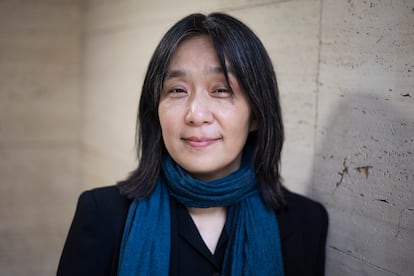
Han Kang was awarded the 2024 Nobel Prize in Literature. Born in Gwangju, South Korea, she moved to Seoul at the age of ten. She studied Korean literature at Yonsei University. Her writing has won the Yi Sang Literary Prize, the Today's Young Artist Award, and the Korean Literature Novel Award. The Vegetarian, her first novel to be translated into English, was published by Portobello Books in 2015 and won the 2016 Man Booker International Prize. She is also the author of Human Acts (Portobello, 2016) and The White Book (Portobello, 2017). She is based in Seoul.


No comments:
Post a Comment