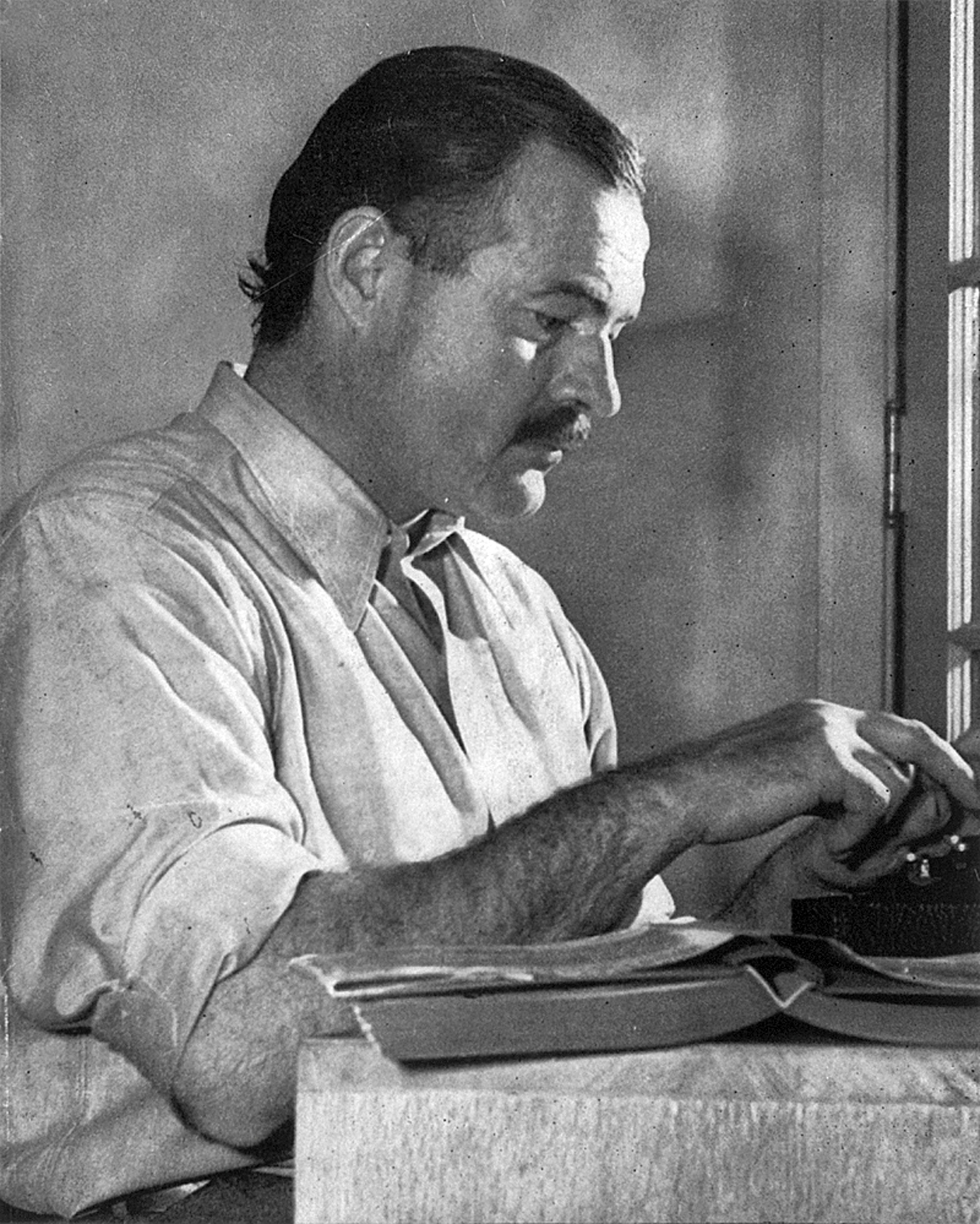
There was a time when for me — and for many others, those who are more or less my contemporaries — Hemingway was a god. And they were good times, which I am happy to remember, without even a hint of that ironic indulgence with which we look back on youthful fashions and obsessions. They were serious times and we lived through them seriously and boldly and with purity of heart, and in Hemingway we could also have found pessimism, an individualistic detachment, a superficial involvement with extremely violent experiences: that was all there too in Hemingway, but either we could not see it in him or we had other things in our head, but the fact remains that the lesson we learnt from him was one of a capacity for openness and generosity, a practical commitment — as well as a technical and moral one – to the things that had to be done, a straightforward look, a rejection of self-contemplation or self-pity, a readiness to snatch a lesson for life, the worth of a person summed up in a brusque exchange, or a gesture. But soon we began to see his limitations, his flaws: his poetics, his style, to which I had been largely indebted in my first literary works, came to be seen as narrow, too prone to descending into mannerism. That life of his — and philosophy of life — of violent tourism began to fill me with distrust and even aversion and disgust. Today, however, ten years on, assessing the balance of my apprenticeship with Hemingway, I can close the account in the black. ‘You didn’t put one over on me, old man,’ I can say to him, indulging for the last time in his own style, ‘you did not make it, you never became amauvais maitre.’ The aim of this discussion of Hemingway, in fact – now that he has won the Nobel Prize for Literature, a fact that means absolutely nothing, but which is as good an occasion as any other for putting down onpaper ideas that have been in my head for some time – is to try to define both what Hemingway meant for me, and what he is now, what moved me away from him and what I continue to find in his not others’ works.
At that time what pushed me towards Hemingway was an appeal that was both poetic and political, a confused rge towards an active antifascism, as opposed to purely intellectual antifascism. Actually, to be truthful, it was the twin constellation of Hemingway and Malraux that attracted me, the symbol of international antifascism, the international front in the Spanish Civil War. Fortunately we Italians had had D’Annunzio to inoculate us against certain ‘heroic’ inclinations, and the rather aestheticising base to Malraux’ works soon became apparent. (For some people in France, such as Roger Vailland, who is also a very nice guy, a bit superficial but genuine enough, the Hemingway-Malraux double-bill was a formative factor.) Hemingway too has had the label of D’Annunzian attached to him, and in some cases not inappropriately. But Hemingway’s style is always dry, he hardly ever gets sloppy or pompous, his feet are on the ground (or almost always: I mean, I cannot take ‘lyricism’ in Hemingway: The Snows of Kilimanjaro is for me his worst work), he sticks to dealing with things: all features that are at the opposite extreme from D’Annunzio. And in any case, we should be careful with these definitions: if all you need to be called a D’Annunzian is to like the active life and beautiful women, long live D’Annunzio. But the problem cannot be framed in these terms: the myth of Hemingway the activist comes from another side of contemporary history, much more relevant to today and still problematic.
Hemingway’s hero likes to identify with the actions that he carries out, to be himself in the totality of his actions, in his commitment to manual or at any rate practical dexterity. He tries not to have any other problems, any other concerns except that of knowing how to do something well: being good at fishing, hunting, blowing up bridges, watching bullfights the way they should be watched, as well as being good at making love. But around him there is always something he is trying to escape, a sense of the vanity of everything, of desperation, of defeat, of death. He concentrates on the strict observance of his code, of those sporting rules that he always feels he should impose on himself everywhere and that carry the weight of moral rules, whether he finds himself fighting with a shark, or in a position besieged by Falangists. He clings to all that, because outside it is the void and death. (Even though he never mentions it: for his first rule is understatement.) One of the best and most typical of his tales in the 45 short stories in The Big Two-Hearted River is nothing more than an account of every single action done by a man who goes fishing on his own: he goes up the river, looks for a good place to pitch his tent, makes himself some food, goes into the river, prepares his rod, catches some small trout, throws them back into the river, catches a bigger one, and so on. Nothing but a bare list of actions, fleeting but clear-cut images in between, and the odd generic, unconvincing comment on his state of mind, like ‘It was a good feeling’. It is a very depressing tale, with a sense of oppression too, of vague anguish besetting him on all sides, no matter how serene nature is and how caught up he is in his fishing. Now the story in which ‘nothing happens’ is not new. But let’s take a recent example from nearer home: Il taglio del bosco (The Cutting of the Woods) by Cassola (all he has in common with Hemingway is his love of Tolstoy) which describes the actions of a woodcutter, against the background of his endless grief for the death of his wife. In Cassola the two poles of the story are the work on one side and a very precise feeling on the other: the death of a loved one, a situation which can apply to everyone, at any time. The format is similar in Hemingway, but the content is completely different: on one side a commitment to a sport, which has no other sense beyond the formal execution of the task, and on the other something unknown, nothingness. We are in an extreme situation, in the context of a very precise society, in a very precise moment of the crisis of bourgeois thought.
Hemingway, famously, did not care for philosophy. But his poetics has anything but accidental connections with American philosophy, linked as the latter is so directly to a ‘structure’, to a milieu of activity and practical concepts. The Hemingway hero’s fidelity to a sporting and ethical code, the only certain reality in an unknowable universe, corresponds to neopositivism which proposes rules of thought inside a closed system, which has no other validity outside itself. Behaviourism, which identifies man’s reality with the paradigms of his behaviour, finds its equivalent in Hemingway’s style, which in its bare list of actions, its lines of brief dialogue, eliminates the unreachable reality of emotions and thoughts. (On Hemingway’s code of behaviour, and on characters’ ‘inarticulate’ conversation, see the intelligent observations in Marcus Cunliffe, The Literature of the US (Penguin Books, 1954), pp. 271 ff.)
All around is the horror vacui of existentialist nothingness. Nada y pues nada y nada y pues nada,thinks the waiter in ‘A Clean, Well-Lighted Place’, while ‘The Gambler, the Nun and the Radio’ ends with the conclusionthat everything is ‘the opium of the people’, in other words an illusory shelter from a general malaise. These two stories (both from 1933) can be regarded as the texts of Hemingway’s loose ‘existentialism’. But it is not on these more explicitly ‘philosophical’ statements that we can rely, so much as on his general way of representing the negative, the senseless, the despairing elements of contemporary life, right from the time of Fiesta(1926) with its eternal tourists, sex-maniacs and drunkards. The emptiness of the dialogues with their pauses and digressions, whose most obvious predecessor must be the ‘talking of other things’ by Chekhov’s characters when they are on the verge of desperation, reflects the problematics of twentieth-century irrationalism. Chekhov’s petty bourgeois characters, defeated in everything except their consciousness of human dignity, stand their ground as the storm approaches and retain their hope for a better world. Hemingway’s roodess Americans are inside the storm, body and soul, and the only defence they have against it is trying to ski well, to shoot lions well, establish the right relationship between a man and a woman, and between a man and another man, techniques and virtues which certainly will be useful in that better world except that they do not believe in it. Between Chekhov and Hemingway comes the First World War: reality is now seen as a huge massacre. Hemingway refuses to join the side of the massacre, his antifascism is one of those clear, indisputable ‘rules of the game’ on which his conception of life is based, but he accepts massacres as the natural scenario of contemporary man. The apprenticeship of Nick Adams — the autobiographical character in his earliest and most poetic stories — is a training course to help him tolerate the brutality of the world. It begins in Indian Camp where his father, the doctor, operates on a pregnant Indian woman with a fishing pen-knife, while her husband, unable to stand the sight of suffering, silendy slits his own throat. When the Hemingway hero wants a symbolic ritual to represent this conception of the world the best he can come up with is the bullfight, thus starting down the road towards the primitive and the barbaric, which leads to D. H. Lawrence and a certain kind of ethnology.
It is this jagged cultural panorama that is Hemingway’s context, and here we might bring in for comparison another writer who is often named in this context, Stendhal. This is not an arbitrary choice, but is suggested by Hemingway’s admission of admiration for him, and justified by a certain analogy in their chosen sobriety of style — even though this is much more skilful, Flaubertian, in the more modern writer — and by certain parallels inkey events and places in their lives (that ‘Milanese’ Italy they both loved). Stendhal’s heroes are on the border between eighteenth-century rationalist lucidity and Romantic Sturm und Drang, between an Enlightenment education of the sentiments and the Romantic exaltation of amoral individualism. Hemingway’s heroes find themselves at the same crossroads a hundred yean later, when bourgeois thought has been impoverished, past its best — which instead has been inherited by the new working class — and yet is still developing as best it can, between blind alleys and partial and contradictory solutions: from the old Enlightenment trunk American technicist philosophies branch off, while the Romantic trunk brings forth its final fruits in existential nihilism. Stendhal’s hero, though a product of the Revolution, still accepted the world of the Holy Alliance and submitted to the rules of his own hypocritical game, in order to fight his own individual batde. Hemingway’s hero, who has also seen open up the great alternative of the October Revolution, accepts the world of imperialism and moves amongst imperialism’s massacres, also fighting a batde with lucidity and detachment, but one which he knows is lost from the outset because he is on his own.
Hemingway’s fundamental intuition was to have realised that war was the most accurate image, theeveryday reality of the bourgeois world in the imperialist age. At the age of eighteen, even before America joined the war, he managed to reach the Italian front, just to see what war was like, first as an ambulance driver, then in charge of a canteen shutding on bike between the trenches on the river Piave (as we learn from a recent book by Charles A. Fenton, The Apprenticeship of Ernest Hemingway(Farrar and Strauss, 1954)). (A long essay could be written on how much he understood about Italy, and how already in 1917 he was able to recognise the country’s ‘fascist’ face and on the opposite side the people’s face, as he portrayed them in his best novel,A Farewell to Arms (1929); and also on how much he still understood of 1949 Italy and portrayed in his less successful, but still in many respects interesting, novel, Across the River and Into the Trees; but also on how much he never understood, never managing to escape from his tourist shell.) His first book (published in 1924 then expanded in 1925), whose tone was set by his memories of the Great War and those of the massacres in Greece which he witnessed as a journalist, is entitled In Our Time, a tide which by itself does not tell us much, but which takes on a cutting ironic tone if it is true that he wanted to echo a line from The Book of Common Prayer: ‘Give us peace in our time, O Lord.’ The flavour of war conveyed in the brief chapters of In Our Time was decisive for Hemingway’s development, just as the impressions described in the Tales of Sebastopol were crucial for Tolstoy. And I don’t know whether it was Hemingway’s admiration for Tolstoy that led him to seek out the experience of war, or vice versa. Of course, the manner of being at war described by Hemingway is not the same as in Tolstoy, nor as in another admired author, who wrote a minor classic, the American Stephen Crane. This is war in distant lands, viewed with the detachment of a foreigner: Hemingway thus prefigures the spirit of the American soldier in Europe.
If the poet who celebrated British imperialism, Kipling, still had a precise link with his adopted country, so that his India also became a fatherland for him, in Hemingway (who unlike Kipling did not want to ‘celebrate’ anything but only to report facts and things) we find the spirit of America roaming the world without any clear motive, following the lead of its expanding economy.
But Hemingway interests us more not for his testimony of the reality of war or for his condemnation of massacres. Just as no poet identifies totally with the ideas which he represents, so Hemingway is not to be identified solely with the cultural crisis which is his context. Leaving aside the limits of behaviourism, that identification of man with his actions, his being able to cope or not with the duties that have been imposed on him, is still a valid and correct way of conceiving of existence, a way which can be adopted by a more industrious humanity than Hemingway’s heroes, whose actions are almost never a job — except in ‘exceptional’ jobs, such as shark-fishing, or having a precise duty in a struggle. We do not really know what to do with his bullfights, for all the technique they require; but the clear, precise seriousness with which his characters know how to light a fire in the outdoors, cast a rod, position a machine gun, that is of interest and use to us. We can do without all of the more flashy and famous sides of Hemingway, in return for those moments of perfect integration of man with the world in the things he does, for those moments when man finds himself at peace with nature though still struggling with it, in harmony with humankind even in the fire of batde. If someone one day manages to write poetically about the relationship of the worker with his machinery, with the precise operations of his labour, he will have to go back to these moments in Hemingway, detaching them from their context of touristic futility, brutality or boredom, and restoring them to the organic context of the modern productive world from which Hemingway has taken and isolated them. Hemingway has understood how to live in the world with open, dry eyes, without illusions or mysticism, how to be alone without anguish and how it is better to be in company than to be alone: and, in particular, he has developed a style which expresses fully his conception of life, and which though sometimes betraying its limitations and defects, in its more successful moments (as in the Nick Adams stories) it can be considered the driest and most immediate language, the least redundant and pompous style, the most limpid and realistic prose in modern literature. (A Soviet critic, J. Kashkin, in a fine article which came out in a 1935 issue ofInternational Literature, and which was quoted in the proceedings of the symposium edited by John K. M. McCaffery, Ernest Hemingway: the Man and his Work(The World Publishing Company, 1950) compares the style of those tales to that of Pushkin the novelist.)
In fact there is nothing more remote from Hemingway than the hazy symbolism, and religious-based exoticism with which he is associated by Carlos Baker in his Hemingway, the Writer as Artist (Princeton University Press, 1952, recently translated into Italian by G. Ambrosoli for Guanda). This volume contains extremely precious information and quotations from unpublished letters by Hemingway to Baker himself, to Fitzgerald and others, and it also has an excellent bibliography (missing from the Italian translation), as well as useful individual analyses, for instance of Hemingway’s polemical relationship with — not his adherence to — the lost generation’ in Fiesta; but the book is based on flimsy critical formulas, like the opposition between ‘Home’ and ‘Not-home’, between ‘Mountain’ and ‘Plain’, and it talks of ‘Christian symbolism’ in The Old Man and the Sea.
Less ambitious and less philologically interesting is another American book: Philip Young’s brief ErnestHemingway (Rinehart, 1952). Young too, poor soul, has to go to considerable lengths to prove that Hemingway was never a Communist, that he is not ‘un-American’, that one can be crude and pessimistic without being ‘un-American’. But the general outlines of his critical approach show us the Hemingway we know, attributing a fundamental value to the Nick Adams stories, and placing them in the tradition inaugurated by that wonderful book — wonderful for its language, the richness of life and adventure it contains, its sense of nature, its involvement with the social problems of its time and place – which is Mark Twain’s Huckleberry Finn.
[1954]